


Introduction
Choosing a ceramic material is rarely a matter of selecting the material with the highest value for one property.
A material with high thermal conductivity may not be the right choice when mechanical toughness, thermal cycling, chemical compatibility or manufacturing cost is more important. Similarly, a highly wear-resistant ceramic may not be suitable if the component is exposed to impact or requires complex machining.
The practical approach is to start with the application requirements, identify the properties that actually control component performance, and then compare suitable material candidates.
This hub provides an engineering framework for ceramic material selection, including:
- Mechanical requirements
- Thermal requirements
- Electrical requirements
- Chemical compatibility
- Wear and friction conditions
- Manufacturing and machining requirements
- Material trade-offs
- Material-to-material comparisons
The individual material pages in our material portfolio provide detailed information about each ceramic. This hub focuses on the decision process between materials.
Start With Application Requirements
Before comparing ceramic materials, define what the component actually needs to withstand. A useful starting point is to separate the requirements into six groups:
| Main Requirement | What to Evaluate | Typical Candidate Materials |
|---|---|---|
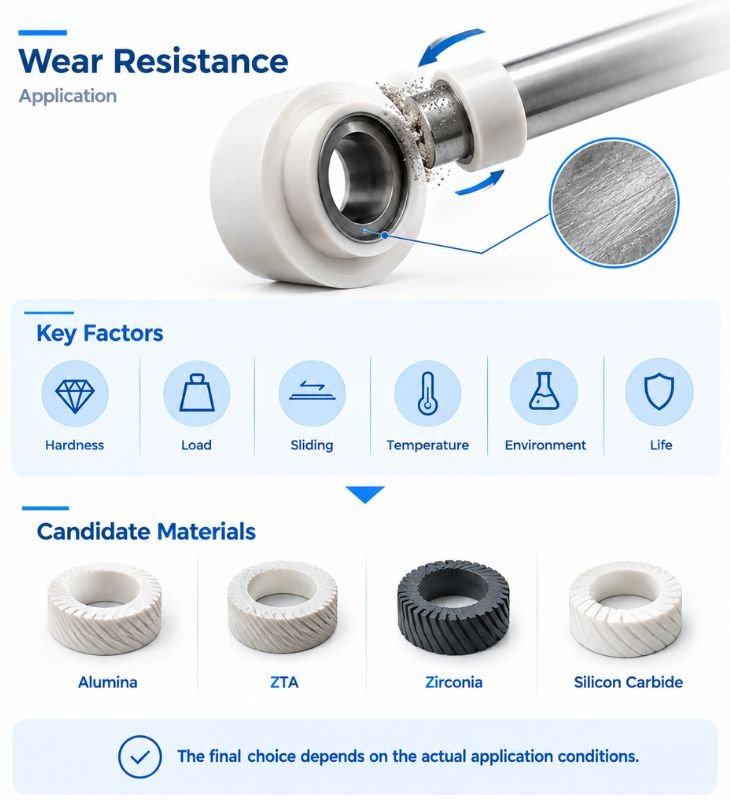
| Wear resistance | Hardness, contact load, sliding condition, temperature | Al₂O₃, ZTA, ZrO₂, SiC |
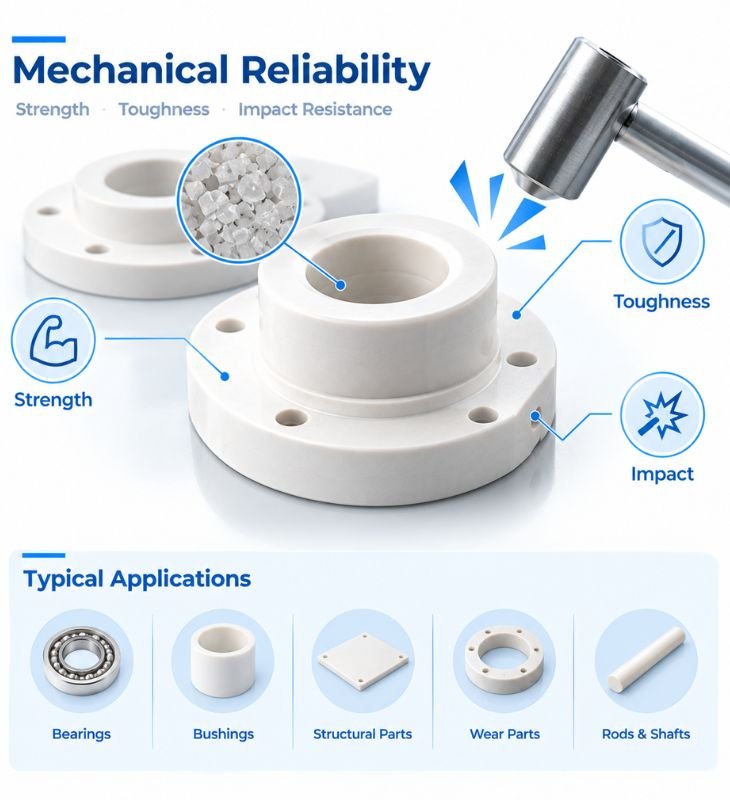
| Mechanical reliability | Strength, toughness, impact, stress concentration | ZrO₂, Si₃N₄, ZTA, Al₂O₃ |
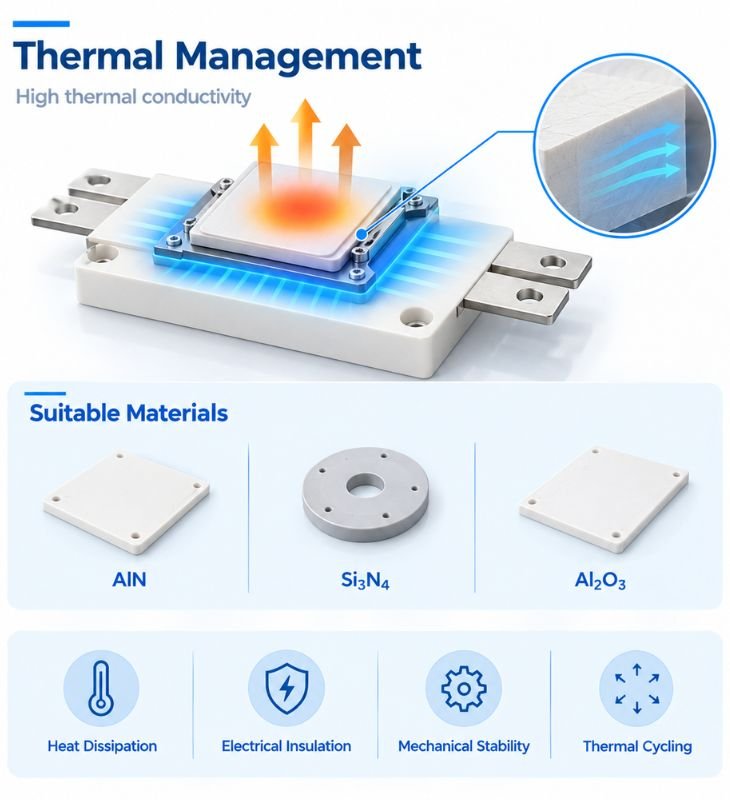
| Thermal management | Thermal conductivity, CTE, thermal cycling, insulation | AlN, Si₃N₄, Al₂O₃ |
| Electrical insulation | Dielectric requirements, temperature, environment | Al₂O₃, AlN, BN |
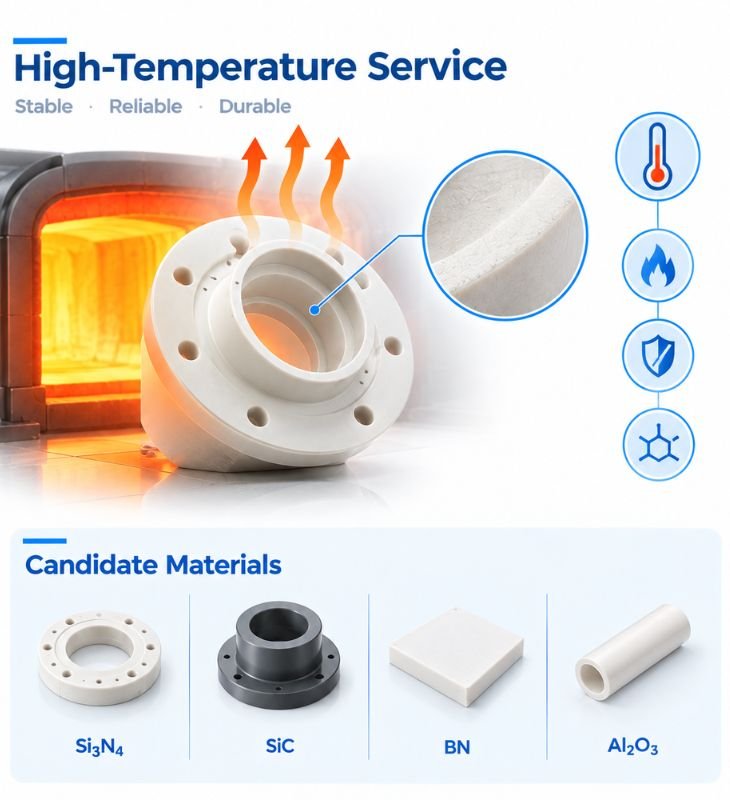
| High-temperature service | Temperature, thermal shock, atmosphere, chemical stability | Si₃N₄, SiC, BN, Al₂O₃ |
| Chemical resistance | Medium, concentration, temperature, exposure time | Al₂O₃, SiC, Si₃N₄ |
These categories are not independent. A component may need to satisfy several of them at the same time.
For example, a power-electronics component may require both thermal conductivity and electrical insulation, while a wear component may need both hardness and fracture resistance.
Ceramic Material Selection Framework
A practical ceramic material selection process can be viewed as:
Application Requirements–>Operating Conditions–>Required Material Properties–>Candidate Materials–>Property Trade-offs–>Manufacturing Feasibility–>Final Material Selection

Identify the function of the ceramic component. Is it primarily:
- An electrical insulator?
- A thermal management component?
- A wear component?
- A structural component?
- A high-temperature component?
- A vacuum or sealing component?
- A precision positioning component?

Consider:
- Temperature
- Mechanical load
- Impact
- Friction and sliding
- Chemical exposure
- Electrical environment
- Thermal cycling
- Atmosphere or vacuum
- Expected service conditions

Not every material property has the same importance. For example:
Thermal component: thermal conductivity may be critical.
Wear component: hardness and wear behavior may dominate.
Dynamic component: strength, toughness and fatigue-related behavior may become more important.
Electrical insulator: dielectric performance and insulation stability may be critical.

Only after defining the requirements should materials such as alumina, zirconia, AlN, Si₃N₄, SiC, BN or ZTA be compared.

The selected material must also be compatible with:
- Component geometry
- Forming method
- Sintering process
- Machining requirements
- Dimensional tolerance
- Surface finish
- Production volume

The final choice should balance performance, reliability, manufacturability and cost, rather than maximizing one material property.
Property Trade-Offs in Ceramic Material Selection
Ceramic materials are often selected because they provide a particular combination of properties. However, improving one property does not automatically improve the overall suitability of a component.
-
Hardness vs. Toughness
High hardness can be beneficial for wear resistance, but wear applications may also involve impact, stress concentration or mechanical shock.
Therefore, hardness should be evaluated together with fracture toughness and the actual loading condition.
-
Thermal Conductivity vs. Other Requirements
A material with higher thermal conductivity may be attractive for heat dissipation, but the final selection may also depend on:
- Electrical insulation
- Thermal expansion
- Thermal cycling
- Mechanical requirements
- Manufacturing cost
- Metallization or joining requirements
-
Strength vs. Machinability
Some high-performance ceramics can require more demanding machining processes.
For precision components, material selection should therefore consider both the required mechanical performance and the geometry, tolerance and surface finish that must be manufactured.
-
Performance vs. Cost
A higher-performance material is not automatically a better engineering solution.
If the application does not use the additional performance, the additional material and manufacturing cost may not provide a practical benefit.
Engineering Comparison Matrix
The following matrix provides a qualitative starting point for material comparison. Actual properties vary by grade, composition, density, processing and supplier specification.
| Material | Main Engineering Strength | Typical Limitation / Consideration | Common Selection Driver |
|---|---|---|---|
| Alumina (Al₂O₃) | Electrical insulation, wear resistance, broad application range | Lower toughness than some structural ceramics | General-purpose industrial ceramics |
| Zirconia (ZrO₂) | Toughness, wear resistance, mechanical reliability | Thermal properties and processing requirements must be considered | Tough wear and structural components |
| Aluminum Nitride (AlN) | Thermal conductivity with electrical insulation | Material cost and processing considerations | Thermal management |
| Silicon Nitride (Si₃N₄) | Strength, toughness and thermal shock resistance | Processing and material cost | Dynamic and thermally cycled components |
| Silicon Carbide (SiC) | Hardness, chemical resistance and high-temperature capability | Difficult precision machining | Harsh wear and chemical environments |
| Boron Nitride (BN) | Machinability, thermal stability and electrical insulation | Mechanical strength varies significantly by grade | High-temperature and machinable applications |
| ZTA | Combination of alumina hardness and improved toughness | Grade-specific performance and processing | Wear applications requiring a toughness balance |
Important: This matrix is intended for initial engineering comparison, not as a substitute for a material datasheet or grade-specific qualification.
Material Selection by Engineering Requirement-1 When Wear Resistance Is the Main Requirement
For wear components, material selection should not be based on hardness alone.
Evaluate:
- Contact load
- Sliding speed
- Friction condition
- Counterpart material
- Temperature
- Lubrication
- Particle contamination
- Required service life
Potential candidates include:
Al₂O₃ / ZTA / ZrO₂ / SiC
The final choice depends on whether the application is dominated by abrasive wear, sliding wear, impact or chemical exposure.
2 When Thermal Management Is the Main Requirement
For thermal management components, thermal conductivity is important, but it should be evaluated together with:
- Electrical insulation
- Thermal expansion
- Thermal cycling
- Mechanical strength
- Component geometry
- Metallization or joining requirements
AlN, Si₃N₄ and Al₂O₃ may be considered depending on the balance of these requirements.
3 When Mechanical Reliability Is the Main Requirement
For structural or dynamically loaded ceramic components, consider:
- Tensile and bending stresses
- Impact
- Fracture toughness
- Stress concentration
- Component geometry
- Surface defects
- Thermal cycling
- Assembly conditions
Zirconia, silicon nitride, ZTA and alumina may all be candidates depending on the application.
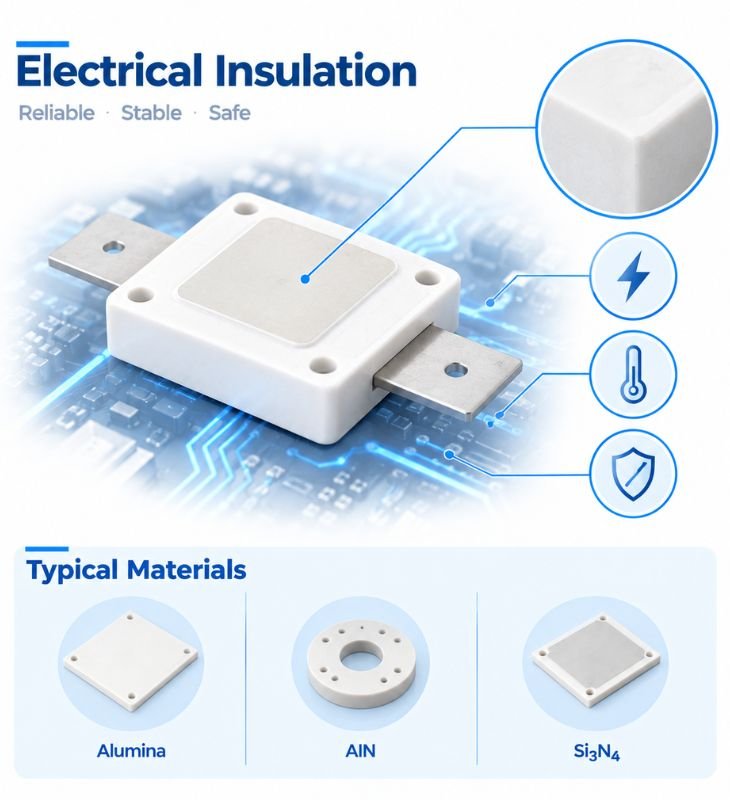
4 When Electrical Insulation Is the Main Requirement
Electrical insulation applications require more than simply selecting a ceramic with high resistivity.
Consider:
- Operating voltage
- Temperature
- Frequency
- Dielectric environment
- Surface condition
- Moisture or contamination
- Component geometry
- Creepage and clearance requirements
Alumina is widely used for electrical insulation, while AlN may become relevant when thermal management is also important.
5 When High-Temperature Performance Is the Main Requirement
High-temperature applications should be evaluated according to the complete operating environment rather than temperature alone.
Consider:
- Maximum temperature
- Temperature cycling
- Thermal shock
- Atmosphere
- Chemical exposure
- Mechanical load
- Dimensional stability
Candidate materials may include Si₃N₄, SiC, BN and selected alumina grades depending on the specific environment.
Material Comparison: Common Engineering Questions
The comparison should focus on the actual mechanical requirement.
Alumina is commonly considered for electrical insulation, wear resistance and general industrial components. Zirconia becomes more relevant when higher fracture toughness or mechanical reliability is required.
Selection question:
Is the application primarily driven by insulation and general wear performance, or by toughness and mechanical loading?
The key difference is often the thermal management requirement.
If heat dissipation is a major design requirement while electrical insulation must be maintained, AlN may be considered. If thermal conductivity is less critical, alumina may provide a more practical solution depending on the application.
Selection question:
How important is heat dissipation compared with cost, mechanical requirements and manufacturing considerations?

Both can be used in demanding environments, but the selection depends on the dominant requirement.
Silicon nitride is often considered where mechanical strength, toughness and thermal shock resistance are important. Silicon carbide becomes attractive where hardness, chemical resistance and high-temperature capability are dominant.
Selection question:
Is the component primarily a mechanically loaded part or a harsh-environment wear/chemical component?
ZTA modifies the alumina-based material system to improve toughness while retaining much of the hardness associated with alumina.
The comparison should therefore consider whether the additional toughness is valuable for the specific component.
Selection question:
Does the application experience impact, stress concentration or mechanical loading that makes improved toughness valuable?
Ceramics and metals should not be compared using a single property.
- Temperature
- Electrical insulation
- Wear
- Corrosion
- Weight
- Thermal expansion
- Mechanical loading
- Manufacturing
- Joining
The correct question is not “Which material is better?” but: Which material better satisfies the complete operating requirements of the component?
The comparison should consider:
- Operating temperature
- Chemical exposure
- Wear
- Dimensional stability
- Electrical requirements
- Mechanical loading
- Moisture
- Long-term environmental stability
Ceramics may be attractive when temperature, wear, insulation or chemical stability is important, while plastics may offer advantages in weight, impact behavior, processing or cost depending on the application.
Manufacturing Factors in Material Selection
Material selection and manufacturing cannot be separated. A ceramic material may satisfy the performance requirements but still create difficulties when the component has:
- Complex geometry
- Thin walls
- Deep holes
- Tight dimensional tolerances
- Fine surface finish requirements
- Small edge features
- Difficult-to-machine surfaces
- Large production volumes
The manufacturing route may include:
Powder Preparation → Forming → Sintering → Precision Machining → Surface Finishing → Inspection
Each stage can influence dimensional accuracy, surface condition, production yield and final cost.
Material Selection Should Consider Manufacturability
Before finalizing a material, ask:
- Can the required geometry be formed reliably?
- What machining method is required after sintering?
- Can the required tolerance and surface finish be achieved?
- Is the geometry likely to create chipping or cracking during machining?
- How does production volume affect the preferred process?
- Will the selected material require special processing or inspection?
For this reason, material selection should ideally be discussed together with component design and manufacturing engineering.
Ceramic Material Engineering Articles
Continue your material engineering research through our technical articles. Browse all ceramic material engineering articles →
- Material Selection
- Material Comparison
- Manufacturing & Reliability
- Application
Industrial Ceramic Materials Selection Guide: How to choose the right engineering ceramic for industrial applications
Browse Article →
Beyond Metal and Plastic: Advanced Ceramic Solutions
Browse Article →
Why There Is No “Best” Ceramic Material
Browse Article →
7 Common Mistakes in Ceramic Material Selection and Design
Browse Article →
Alumina Ceramics: Safe and Non-Toxic Advanced Material Solutions
Browse Article →
Seven Core Advantages of Aluminum Oxide in Abrasion-resistant Tools
Browse Article →
Aluminium Nitride Ceramics: A Revolutionary Breakthrough in High Thermal Conductivity Electronic Packaging Materials
Browse Article →
Everything You Want to Know About the Ceramic Melting Point
Browse Article →
Zirconia Ceramic: Beyond Steel – The Secret to Its Superior Toughness
Browse Article →
Three Core Ceramic Semiconductor Materials: Alumina, Aluminum Nitride, and Silicon Carbide
Browse Article →
Alumina vs. Silicon Carbide: A Wear Resistance Comparison and Selection Guide
Browse Article →
What is the difference between traditional and advanced ceramics
Browse Article →
Ceramic vs Stainless Steel in Industrial Applications: Cost, Wear & Corrosion Comparison
Browse Article →
Reaction Bonded vs Sintered Silicon Carbide
Browse Article →
Advanced Ceramic Manufacturing
Browse Article →
Hot Pressing Sintering Technology in Advanced Ceramics: A Comprehensive Guide
Browse Article →
Lessons from In-Orbit Spacecraft Repair on Advanced Ceramic Material Reliability
Browse Article →
Engineering Ceramic Failure Mechanisms: Understanding Thermal, Mechanical and Electrical Failures
Browse Article →
Bulletproof Ceramic Materials: The Technological Core of Modern Armor Protection
Browse Article →
From ICEV to EV: The Automotive Ceramics Application Transformation
Browse Article →
PTC Ceramic Heating Elements: Why Efficiency Starts with Advanced Ceramic Materials
Browse Article →
Advanced Ceramics for Electronic Packaging: Beyond Ceramic Substrates
Browse Article →
Silicon Carbide Ceramic Uses: A Practical Guide for Buyers and Small Manufacturers
Browse Article →
How to Use This Material Comparison Hub
This hub is designed as a starting point for engineering material selection. For detailed information about a specific material, refer to the corresponding material page for:
- Material characteristics
- Typical applications
- Available grades
- Manufacturing considerations
- Material-specific engineering information
When several materials appear suitable, use the comparison resources in this hub to evaluate the trade-offs between them.
For a custom ceramic component, the final material decision should consider both the component requirements and the manufacturing process.
Need Help Selecting a Ceramic Material?
If you are comparing several ceramic materials for a new component, send us the basic engineering requirements:
- Component drawing or sample
- Operating temperature
- Mechanical load
- Wear or friction conditions
- Electrical requirements
- Chemical environment
- Dimensional tolerance
- Surface finish
- Expected production volume
Our engineering team can evaluate the material options together with the component design and manufacturing requirements. Please contact Jinghui engineering team.
There is no single best ceramic material for all industrial applications. Material selection depends on the operating environment, mechanical loading, thermal requirements, electrical requirements, chemical exposure, manufacturing conditions and cost. The appropriate material is the one that provides a suitable balance for the actual component.
Engineers should first define the operating requirements and then compare the material properties that directly affect component performance. Hardness, toughness, thermal conductivity, thermal expansion, electrical insulation, chemical resistance and manufacturability may all be relevant depending on the application.
Not necessarily. High thermal conductivity is useful when heat dissipation is a major requirement, but the material must also satisfy electrical, mechanical, thermal-expansion, manufacturing and cost requirements. A higher value for one property does not automatically make a material more suitable.
Start with the mechanical and electrical requirements of the component. Alumina is widely considered for insulation, wear resistance and general industrial applications. Zirconia may become more relevant when fracture toughness and mechanical reliability are important.
AlN becomes more relevant when heat dissipation is a major design requirement while electrical insulation must also be maintained. If thermal management is less critical, alumina may remain a practical choice depending on the application.
Yes. Different ceramic materials can behave differently during forming, sintering and machining. Material characteristics, geometry, tolerance, surface finish and production volume can all affect the manufacturing process and final cost.
Yes, but the suitability of a material depends on the specific grade, component design and operating conditions. A material that performs well in one application may require additional evaluation in another environment.
Yes. For custom ceramic components, material selection can be evaluated together with component geometry, tolerance, surface requirements, manufacturing process and application conditions.