

Table of Contents
ToggleIntroduction
Silicon carbide (SiC) is one of the most important advanced ceramic materials used in semiconductor, energy, chemical processing, aerospace, and industrial wear applications. Its exceptional hardness, corrosion resistance, thermal conductivity, and high-temperature stability make it a preferred alternative to metals and conventional ceramics.
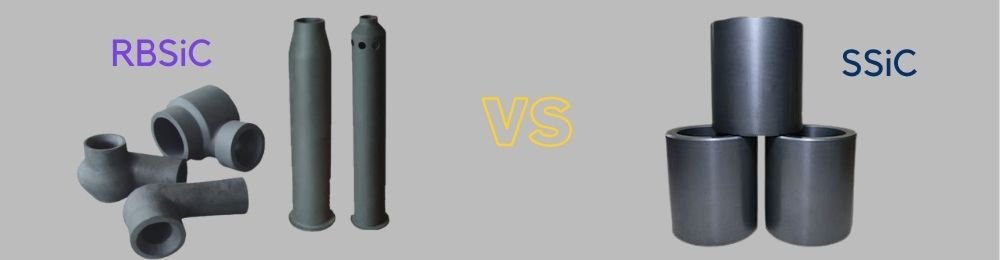
However, not all silicon carbide ceramics are the same.
Among commercial silicon carbide materials, Reaction Bonded Silicon Carbide (RBSiC or RBSC) and Direct Sintered Silicon Carbide (SSiC) are the two most widely used grades.
Although both are based on silicon carbide, their manufacturing methods, microstructures, physical properties, and application suitability differ significantly.
This guide explains the differences between RBSiC and SSiC and helps engineers select the right material for demanding applications.
What Is Reaction Bonded Silicon Carbide (RBSiC)?
Reaction Bonded Silicon Carbide is produced by infiltrating molten silicon into a porous carbon-containing SiC preform.
During infiltration:
Silicon + Carbon → Silicon Carbide
Not all molten silicon reacts completely. As a result, residual free silicon remains inside the final structure.
Typical composition:
- SiC: 85–92%
- Free Silicon: 8–15%
The presence of residual silicon significantly influences material properties.
What Is Direct Sintered Silicon Carbide (SSiC)?
Direct Sintered Silicon Carbide is produced by sintering ultra-fine SiC powders at temperatures above 2000°C using sintering additives.
Unlike RBSiC:
- No silicon infiltration
- No free silicon phase
- Nearly pure SiC microstructure
Typical SiC purity exceeds 98%.
This results in superior mechanical, thermal, and chemical performance.
Manufacturing Process Comparison
| Process | RBSiC | SSiC |
|---|---|---|
| Raw Material Cost | Lower | Higher |
| Shrinkage During Sintering | Very Low | Significant |
| Dimensional Control | Excellent | More Difficult |
| Complex Shapes | Excellent | Moderate |
| Machining Cost | Lower | Higher |
Material Properties Comparison
| Property | RBSiC | SSiC |
|---|---|---|
| Density (g/cm³) | 3.02 | 3.10–3.15 |
| Hardness (HV) | 2200–2500 | 2500–2800 |
| Flexural Strength (MPa) | 300–400 | 400–550 |
| Thermal Conductivity (W/m·K) | 120–180 | 120–200 |
| Corrosion Resistance | Good | Excellent |
| Max Operating Temperature | ~1380°C | >1600°C |
| Thermal Shock Resistance | Excellent | Excellent |
Why Does Free Silicon Matter?
Residual silicon is the biggest difference between RBSiC and SSiC.
Free silicon:
- Lowers hardness
- Reduces high-temperature capability
- Limits corrosion resistance in aggressive environments
- Can soften above 1414°C
This is why RBSiC is generally not recommended for ultra-high-temperature applications.
Advantages of Reaction Bonded Silicon Carbide
- Near-net-shape manufacturing
- Minimal sintering shrinkage
- Lower production cost
- Excellent dimensional accuracy
- Large component capability
- Good wear resistance
Advantages of Sintered Silicon Carbide
- Higher purity
- Higher strength
- Better corrosion resistance
- Better high-temperature performance
- Higher hardness
- Longer service life
Application Comparison
RBSiC Applications
- Kiln furniture
- Burner nozzles
- Cyclones
- Desulfurization equipment
- Wear liners
- Heat exchanger components
SSiC Applications
- Mechanical seals
- Semiconductor components
- Wafer handling systems
- Pump components
- Valve seats
- High-purity chemical processing equipment
Real-World Application Cases
Case 1: Semiconductor Wafer Handling Components
One of our clients manufactures semiconductor equipment and, when developing a wafer robotic arm, evaluated both RBSiC and SSiC materials, providing samples of both materials for experimentation.
Although RBSiC offered lower manufacturing costs and good dimensional accuracy, trace free silicon was considered a potential contamination source during long-term operation. After evaluation, the manufacturer selected SSiC because of its higher purity, superior chemical stability, and lower particle generation risk.
The result was improved process stability and reduced maintenance frequency in semiconductor production lines.
Why SSiC Was Selected
- Ultra-high purity requirements
- Particle contamination control
- Plasma resistance
- Long-term dimensional stability
Case 2: Desulfurization System Wear Liners
One of our overseas clients is a power plant that requires large wear-resistant liners in its flue gas desulfurization system to withstand slurry erosion and particle wear. They were previously using metal liners, which required frequent replacements, and wanted to optimize the system by changing the material.
Due to the large size and complex structure of the parts, RBSiC material was ultimately chosen. Its near-net-shape capability significantly reduced processing costs while maintaining excellent wear resistance.
Compared to the original metal liners, the service life was increased by more than three times.
Case 3: Mechanical Seal Rings
One of our clients, a chemical pump manufacturer, needed mechanical seal rings for an optimization project involving the transport of corrosive media. They initially evaluated and tested two silicon carbide (SSiC) materials.
Testing revealed that both exhibited excellent wear resistance, but SSiC demonstrated greater stability in strong acid and alkali environments. Due to the absence of a free silicon phase, it offered superior corrosion resistance and a longer seal life.
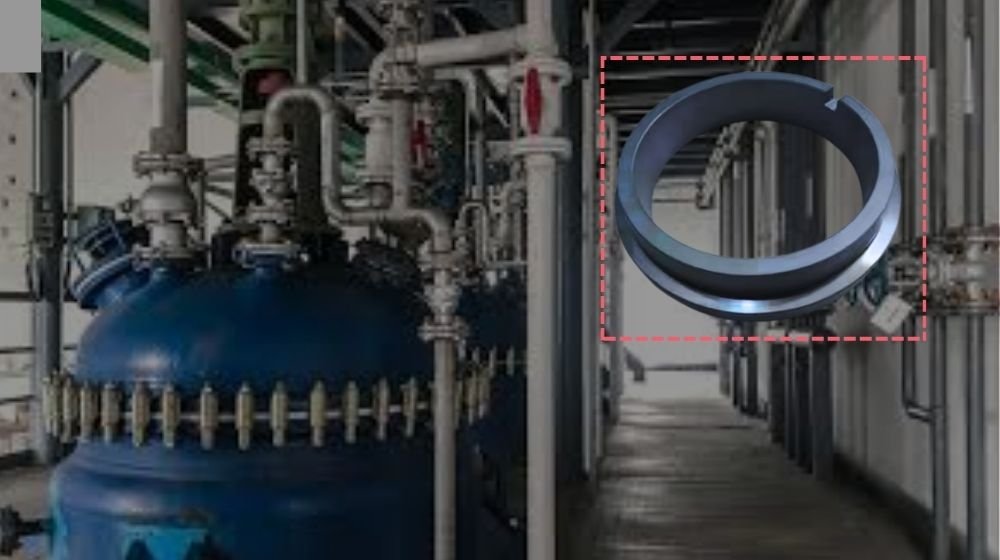
Therefore, considering the harsh chemical environment, the client ultimately chose SSiC for the project.
RBSiC vs SSiC: Which Should You Choose?
Choose RBSiC When:
- Cost is critical
- Large parts are required
- Moderate temperatures
- Moderate corrosion conditions
- Complex shapes needed
Choose SSiC When:
- Maximum performance required
- High-purity environments
- Strong acids or alkalis
- Semiconductor applications
- Temperatures exceed 1400°C
Material Selection Guide
| Application Requirement | Recommended Material |
|---|---|
| Lowest cost | RBSiC |
| Large complex parts | RBSiC |
| Kiln furniture | RBSiC |
| Burner nozzles | RBSiC |
| Mechanical seals | SSiC |
| Semiconductor equipment | SSiC |
| Strong acid environment | SSiC |
| High-temperature service >1400°C | SSiC |
| Ultra-high purity process | SSiC |
| Longest service life | SSiC |
Frequently Asked Questions
1.What is the biggest difference between Reaction Bonded Silicon Carbide and Sintered Silicon Carbide?
The most significant difference is the presence of residual free silicon in Reaction Bonded Silicon Carbide. RBSiC typically contains 8–15% free silicon, while SSiC is nearly pure silicon carbide. This difference affects hardness, corrosion resistance, operating temperature, and long-term reliability. For high-purity and high-temperature applications, SSiC generally offers superior performance.
2.Is SSiC always better than RBSiC?
Not necessarily. While SSiC provides higher strength, higher purity, and better corrosion resistance, RBSiC offers lower manufacturing costs, excellent dimensional accuracy, and the ability to produce large, complex components. For many industrial wear applications, kiln furniture, and burner systems, RBSiC delivers excellent performance at a lower total cost.
3Why is SSiC commonly used in semiconductor equipment?
Semiconductor manufacturing requires extremely low contamination levels. The free silicon phase found in RBSiC may become a potential contamination source under plasma, vacuum, or high-temperature environments. SSiC provides higher purity, lower particle generation, superior plasma resistance, and better chemical stability, making it more suitable for wafer processing and semiconductor handling systems.
4.Which silicon carbide material has better corrosion resistance?
SSiC generally provides superior corrosion resistance because it contains almost no free silicon. In aggressive environments involving strong acids, alkalis, or high-purity chemicals, the residual silicon phase in RBSiC may become the weak point. For chemical processing equipment and mechanical seals exposed to corrosive media, SSiC is usually the preferred choice.
Conclusion
Both Reaction Bonded Silicon Carbide (RBSiC) and Direct Sintered Silicon Carbide (SSiC) are outstanding engineering ceramic materials. RBSiC provides cost-effective manufacturing, excellent dimensional stability, and suitability for large wear-resistant components. SSiC offers superior purity, strength, corrosion resistance, and high-temperature performance.
The best choice depends on application requirements, operating environment, temperature, and budget. Understanding the differences between these two silicon carbide materials helps engineers optimize performance, reliability, and total lifecycle cost.