

Engineering Insight
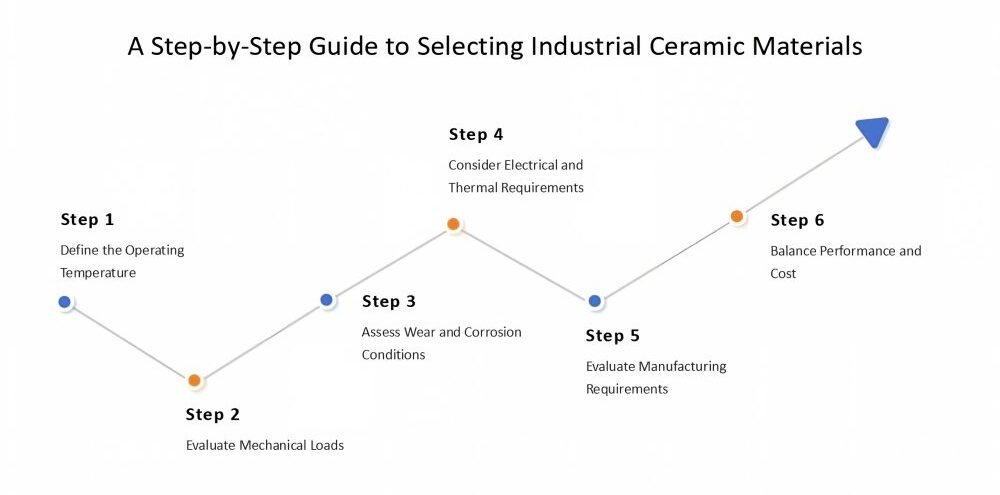
Selecting the right industrial ceramic material is not about choosing the material with the highest hardness, thermal conductivity, or temperature resistance. A successful selection requires balancing application requirements, operating conditions, material properties, manufacturing feasibility, and total cost.
By following a structured selection process, engineers can reduce development risks, avoid premature failures, and identify ceramic materials that provide the best overall performance for their specific application.
The next section compares the major engineering ceramic materials, including alumina, zirconia, aluminum nitride, silicon nitride, silicon carbide, boron nitride, machinable glass ceramic, and ZTA, to help you understand their strengths and typical application areas.
Comparing Industrial Ceramic Materials
After defining the application requirements and understanding the material selection process, the next step is evaluating how different engineering ceramics compare.
No single ceramic material provides the best performance in every application. Engineers must balance different properties, including wear resistance, toughness, thermal conductivity, electrical insulation, and chemical stability, based on the actual operating environment.
Engineering Material Selection Matrix
The comparison below provides a general overview of the most widely used industrial ceramic materials.
| Material | Wear Resistance | Toughness | Thermal Conductivity | Electrical Insulation | Chemical Resistance |
|---|---|---|---|---|---|
| Alumina | ★★★★★ | ★★★ | ★★★ | ★★★★★ | ★★★★★ |
| Zirconia | ★★★★ | ★★★★★ | ★★ | ★★★★★ | ★★★★★ |
| AlN | ★★★ | ★★★ | ★★★★★ | ★★★★★ | ★★★★ |
| Si₃N₄ | ★★★★ | ★★★★★ | ★★★★ | ★★★★★ | ★★★★ |
| SiC | ★★★★★ | ★★★ | ★★★★★ | Varies by Grade | ★★★★★ |
| BN | ★★★ | ★★ | ★★★★ | ★★★★★ | ★★★★★ |
| Machinable Glass Ceramic | ★★ | ★★★ | ★★ | ★★★★★ | ★★★ |
| ZTA | ★★★★★ | ★★★★ | ★★★ | ★★★★★ | ★★★★★ |
Every engineering ceramic has its own strengths and limitations. Understanding these characteristics helps narrow down the most suitable material before considering detailed design or manufacturing factors.
Material Profiles
Alumina (Al₂O₃)
Typical alumina grades provide excellent hardness, electrical insulation, and chemical stability while maintaining one of the best cost-performance balances among engineering ceramics.
Best suited for
- Electrical insulators
- Ceramic substrates
- Wear-resistant components
- Textile ceramics
- Metallized ceramics
Key advantages
- Cost-effective
- Excellent electrical insulation
- Mature manufacturing processes
- Wide range of available purity grades
Potential limitations
- Lower fracture toughness than zirconia
- Moderate thermal conductivity
Zirconia (ZrO₂)
Among common engineering ceramics, zirconia offers one of the highest fracture toughness values. Its transformation toughening mechanism helps resist crack propagation, making it particularly suitable for components exposed to impact, vibration, or cyclic loading.
Best suited for
- Valve components
- Ceramic blades
- Precision wear parts
- Medical devices
- Bearings
Key advantages
- Outstanding toughness
- High strength
- Excellent dimensional stability
Potential limitations
- Higher density than most ceramics
- Lower thermal conductivity
Aluminum Nitride (AlN)
Aluminum nitride combines excellent electrical insulation with very high thermal conductivity, making it one of the preferred materials for thermal management in electronic packaging.
Best suited for
- Power electronics
- IGBT substrates
- LED packages
- Semiconductor equipment
- RF devices
Key advantages
- Excellent heat dissipation
- Good electrical insulation
- CTE close to silicon
Potential limitations
- Sensitive to moisture during processing
- Higher material cost
Silicon Nitride (Si₃N₄)
Silicon nitride combines high strength with excellent fracture toughness and thermal shock resistance. It is often selected for applications involving repeated mechanical loading or rapid temperature changes.
Best suited for
- Ceramic bearings
- Automotive components
- Structural parts
- Welding fixtures
- Turbocharger rotors
Key advantages
- Excellent thermal shock resistance
- High mechanical reliability
- Low density
Potential limitations
- More expensive than alumina
- More difficult to machine
Silicon Carbide (SiC)
Silicon carbide combines outstanding hardness, corrosion resistance, thermal conductivity, and high-temperature stability, making it suitable for demanding mechanical and semiconductor applications.
Best suited for
- Mechanical seals
- Pump components
- Semiconductor equipment
- Chemical processing equipment
- Heat exchangers
Key advantages
- Extremely high hardness
- Excellent corrosion resistance
- High thermal conductivity
Potential limitations
- Relatively brittle
- Higher manufacturing cost
Boron Nitride (BN)
Unlike most engineering ceramics, boron nitride can be easily machined while maintaining excellent electrical insulation and high-temperature stability. It is widely used where low contamination and easy machining are required.
Best suited for
- Vacuum systems
- Molten metal handling
- Crystal growth
- High-temperature insulation
- Semiconductor equipment
Key advantages
- Easily machinable
- Excellent thermal stability
- Good chemical resistance
Potential limitations
- Lower mechanical strength
- Limited wear resistance
Machinable Glass Ceramic
Machinable glass ceramic offers excellent machinability, electrical insulation, and dimensional stability. It is commonly used for complex components, prototypes, and precision insulating parts.
Best suited for
- Electrical insulators
- Vacuum fixtures
- Semiconductor equipment
- Precision prototypes
- High-temperature insulating components
Key advantages
- Easily machined with conventional tools
- Ideal for complex geometries
- Excellent electrical insulation
- Good dimensional stability
Potential limitations
- Lower mechanical strength than structural ceramics
- Limited wear resistance
- Not suitable for heavy-load applications
Zirconia Toughened Alumina (ZTA)
ZTA combines the hardness and wear resistance of alumina with the improved toughness provided by zirconia. It is commonly selected when both wear resistance and mechanical reliability are important.
Best suited for
- Valve seats
- Seal rings
- Pump components
- Wear liners
- Precision mechanical parts
Key advantages
- Improved fracture toughness
- Excellent wear resistance
- Longer service life than alumina in many applications
Potential limitations
- More expensive than standard alumina
- Fewer standardized grades
Engineering Insight
Material comparison tables provide a useful starting point, but they should not be used as the sole basis for material selection. In practice, the best engineering solution is determined by the complete operating environment, component design, manufacturing feasibility, and cost targets rather than by any single material property. For a more detailed property-by-property comparison between ceramic materials, see our ceramic material comparison guide.
Common Material Selection Mistakes
Selecting the right engineering ceramic involves more than comparing material properties. In practice, many material selection problems arise not because the ceramic itself is unsuitable, but because important design, manufacturing, or application factors were overlooked.
Understanding these common mistakes can help reduce development risks and improve long-term component reliability.
Choosing Materials Based on a Single Property
A common mistake is selecting a ceramic solely because it offers the highest hardness, thermal conductivity, or fracture toughness.
In reality, no single material excels in every aspect. A component designed for wear resistance may also require adequate toughness, while a thermally conductive material may need to meet electrical insulation requirements at the same time.
Successful material selection always considers the complete operating environment rather than one outstanding property.
Ignoring the Operating Environment
The same ceramic material can perform very differently under different service conditions.
Factors such as operating temperature, chemical exposure, mechanical loading, thermal cycling, and humidity should all be evaluated before selecting a material. Ignoring these conditions may result in premature failure even when the material itself has excellent published properties.
Overlooking Manufacturing Constraints
Material performance is only part of a successful ceramic design.
Complex geometries, extremely tight tolerances, small holes, or large thin-walled components may require specialized manufacturing processes. Choosing a material without considering manufacturing feasibility can increase production costs, extend lead times, or limit achievable quality.
Design and manufacturing should always be evaluated together.
Focusing Only on Initial Material Cost
Selecting the lowest-cost ceramic does not always produce the lowest overall cost.
Components with longer service life often reduce maintenance, replacement frequency, and equipment downtime. Evaluating the total cost of ownership rather than material price alone usually leads to better long-term value. This also requires balancing manufacturing complexity, production volume, and component design throughout the development process.
The best ceramic material is not necessarily the one with the highest specification. It is the material that delivers the most appropriate balance of performance, manufacturability, reliability, and cost for the intended application.
Manufacturing Considerations for Industrial Ceramic Components
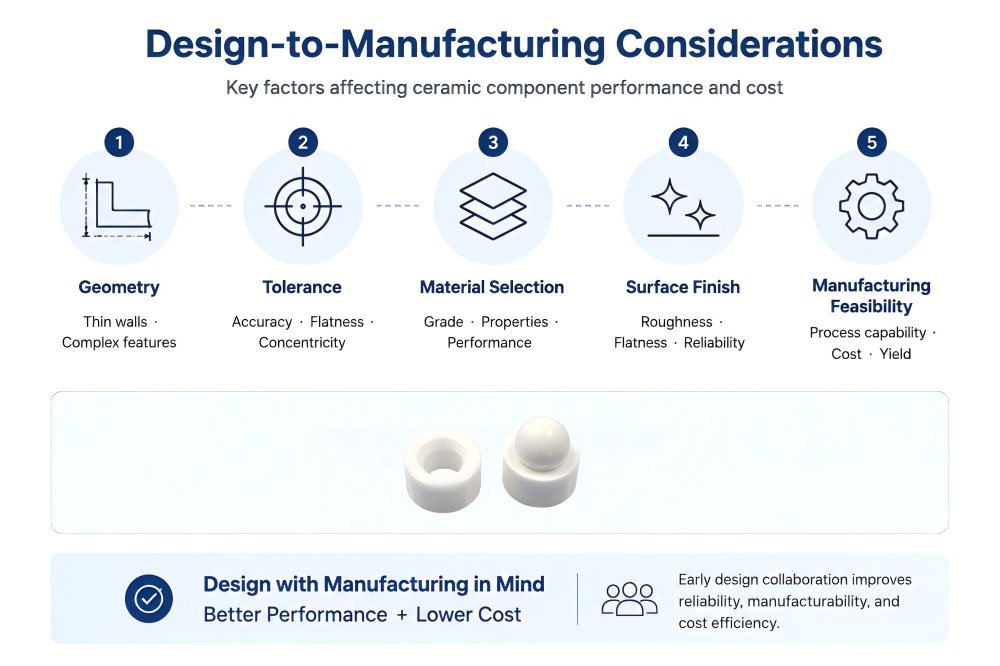
Selecting the right ceramic material is only part of a successful engineering solution. Even the most suitable material may fail to meet performance expectations if the manufacturing process cannot consistently achieve the required geometry, tolerances, surface finish, or joining quality.
For industrial ceramic components, manufacturing capability directly influences product reliability, dimensional consistency, and long-term service life. Therefore, material selection and manufacturing planning should be considered together from the early design stage.
Why Manufacturing Matters
Unlike metals, engineering ceramics cannot usually be reshaped after sintering. Most dimensional accuracy is determined during powder processing, forming, sintering, and precision machining. Once a component has been sintered, design changes become costly or even impossible. Understanding the complete advanced ceramics manufacturing process helps engineers optimize both design and production at an early stage.
As a result, experienced ceramic manufacturers often review component geometry and manufacturing feasibility before production begins to help reduce cost and improve yield.
Key manufacturing considerations include:
- Component size and geometry
- Required dimensional tolerances
- Surface finish requirements
- Hole size and feature complexity
- Material grade and forming method
- Production volume
- Secondary processing requirements
Manufacturing Processes and Their Typical Applications
Different manufacturing processes are suited to different component designs and production volumes.
| Manufacturing Process | Typical Application |
|---|---|
| Dry Pressing | High-volume simple components |
| Isostatic Pressing | High-density structural parts |
| Ceramic Injection Molding (CIM) | Complex small components |
| Extrusion | Tubes, rods and continuous profiles |
| Tape Casting | Thin ceramic substrates |
| Precision Grinding | Tight tolerances and fine surface finish |
| Laser Cutting & Drilling | Ceramic substrates and micro features |
| Metallization | Ceramic-to-metal assemblies |
| Brazing | Hermetic packages and vacuum components |
The manufacturing route should always be selected according to component geometry, required precision, functional requirements, and production quantity rather than based on process availability alone.
Design Features That Influence Manufacturing Cost
Many engineers focus primarily on material selection while overlooking the impact of component design on manufacturing efficiency.
Certain design features may significantly increase machining time, reduce production yield, or require additional processing steps.
Examples include:
- Extremely thin walls
- Deep or narrow holes
- Sharp internal corners
- Tight dimensional tolerances
- Mirror-polished surfaces
- Complex three-dimensional geometries
Optimizing these features during the design stage often reduces manufacturing cost without compromising functional performance.
Manufacturing Quality Directly Affects Component Performance
For many industrial ceramic components, long-term reliability depends not only on the ceramic material itself but also on manufacturing consistency.
Examples include:
- Poor flatness may reduce sealing performance.
- Dimensional variation can affect assembly accuracy.
- Surface defects may initiate crack propagation.
- Improper metallization may weaken ceramic-to-metal joints.
- Inconsistent density may reduce mechanical strength.
Stable manufacturing processes and comprehensive quality inspection help minimize these risks and improve product consistency.
In ceramic engineering, selecting the right material is only the beginning. Successful projects require balancing material properties, component design, manufacturing capability, quality control, and production cost. Early collaboration between design engineers and ceramic manufacturers often results in more reliable components, shorter development cycles, and lower overall project costs.
How to Select the Right Industrial Ceramic Supplier
A successful ceramic project depends not only on selecting the appropriate material but also on working with a manufacturer that has the technical capability to produce reliable components consistently.
When evaluating potential suppliers, consider the following factors.
- Material Expertise: An experienced supplier should understand the strengths and limitations of different ceramic materials and recommend solutions based on application requirements rather than promoting a single material.
- Manufacturing Capability: Look for suppliers that offer integrated manufacturing processes, including forming, precision machining, laser processing, metallization, brazing, and quality inspection. A complete manufacturing capability helps improve consistency and shortens development cycles.
- Engineering Support: Many ceramic projects require design optimization before production. Suppliers that provide engineering support during material selection, prototype development, and design review can help identify potential manufacturing challenges early and reduce project risk.
- Quality Assurance: Consistent quality control is essential for industrial ceramic components. Consider whether the supplier has established inspection procedures, material traceability, dimensional verification, and appropriate testing capabilities to ensure product reliability.
- Production Capacity: A reliable supplier should be able to support both prototype development and volume production while maintaining consistent quality, delivery performance, and technical support throughout the product lifecycle.
The most valuable ceramic supplier is not simply the one offering the lowest quotation, but the one capable of helping optimize material selection, component design, manufacturing, and long-term product reliability.
Frequently Asked Questions
Q1: What is the best industrial ceramic material?
A1: There is no single “best” industrial ceramic material. The right choice depends on your application’s operating conditions, including temperature, mechanical load, wear, corrosion, electrical requirements, and cost.
For example, alumina is often the best choice for general-purpose insulation and wear resistance, while aluminum nitride is preferred for high thermal conductivity, silicon carbide for severe wear and corrosion, and silicon nitride for high mechanical reliability under dynamic loads.
Q2: How do I choose between alumina, zirconia, silicon carbide, and silicon nitride?
A2: Each material is optimized for different performance priorities:
- Alumina – Best overall balance of cost, electrical insulation, and wear resistance.
- Zirconia – Highest fracture toughness for impact- and wear-resistant components.
- Silicon Carbide – Excellent hardness, corrosion resistance, and high-temperature performance.
- Silicon Nitride – Ideal for applications involving thermal shock, cyclic loading, and high mechanical reliability.
Material selection should always be based on the complete operating environment rather than a single property.
Q3: Can industrial ceramics replace metal components?
A3: Yes—but only when ceramics provide clear performance advantages.
Industrial ceramics are commonly used to replace metals in applications involving excessive wear, corrosion, electrical insulation, high temperatures, or dimensional stability. However, metals may still be the better choice for applications requiring high ductility, easy machining, or low manufacturing cost.
Successful replacement requires evaluating both material properties and component design.
Q4: What information should I prepare before requesting a ceramic quotation?
A4: Providing detailed application information helps engineers recommend the most suitable ceramic material and manufacturing process.
Useful information includes: Operating temperature, mechanical loads, wear or corrosion conditions, electrical or thermal requirements, component drawings or dimensions, required tolerances and surface finish, and annual production quantity.
The more complete the technical information, the more accurate the material recommendation and quotation will be.
Q5: Why is manufacturing capability important when selecting a ceramic supplier?
A5: Material selection alone does not guarantee component performance. Manufacturing capability directly affects dimensional accuracy, surface quality, mechanical reliability, and production consistency.
A qualified ceramic manufacturer should provide support throughout material selection, process planning, precision machining, quality inspection, and prototype development to help reduce technical risks and overall project costs.
Conclusion
Industrial ceramic materials continue to play an increasingly important role in modern engineering by solving challenges that conventional metals and plastics cannot easily overcome.
Successful material selection begins with understanding the application rather than the material itself. By evaluating operating conditions, comparing material properties, considering manufacturing constraints, and working with an experienced ceramic supplier, engineers can identify solutions that improve reliability, extend service life, and reduce total ownership cost.
Whether your project involves semiconductor equipment, power electronics, wear-resistant machinery, or other demanding industrial applications, selecting the right engineering ceramic is a process of balancing performance, manufacturability, and cost—not simply choosing the material with the highest specification.
If you are evaluating ceramic materials for a new project, discussing your application requirements with an experienced engineering ceramic manufacturer early in the design stage often leads to a more reliable and cost-effective solution.