

Introduction
Advanced technical ceramics have become essential materials in demanding applications such as semiconductor manufacturing, aerospace systems, high-voltage equipment, and precision machinery due to their excellent properties, including high-temperature resistance, electrical insulation, wear resistance, and dimensional stability.
However, unlike metals, ceramic materials do not generally fail through gradual plastic deformation. When internal stress exceeds the material’s tolerance, cracks may initiate and rapidly propagate, resulting in sudden fracture or loss of function.
Understanding ceramic reliability requires more than simply identifying where a component failed. Engineers need to understand how failure develops, what physical mechanisms drive it, and how material properties influence the final failure behavior.
In practical applications, ceramic failures can generally be classified into three major mechanisms:
- Thermal failure caused by temperature variation and thermal stress
- Mechanical failure caused by external loading and stress concentration
- Electrical failure caused by excessive electric field and insulation breakdown
This article explains the fundamental mechanisms behind these failure modes and provides engineering insights into how ceramic components behave under extreme operating conditions.
Why Engineering Ceramics Show Unique Failure Behavior
Ceramic Brittleness and Limited Plastic Deformation
One of the most important differences between ceramics and metals is their mechanical response under stress.
Metal components can often absorb additional energy through plastic deformation before fracture. This deformation process helps redistribute local stresses and delays crack growth.
Engineering ceramics, however, typically have very limited plastic deformation capability at room temperature. When local stress exceeds the material’s strength, cracks can initiate and propagate rapidly, leading to sudden failure.
This characteristic does not mean ceramics are unreliable. In fact, many advanced ceramics provide exceptional performance under extreme conditions. However, their reliability depends strongly on controlling stress distribution, component design, surface condition, and operating environment.
How Microstructural Defects Influence Ceramic Reliability
In practical ceramic components, microscopic imperfections may exist due to material processing and manufacturing conditions.
Potential crack initiation sites may include internal pores formed during processing, microstructural variations, surface damage introduced during machining, and local residual stresses.
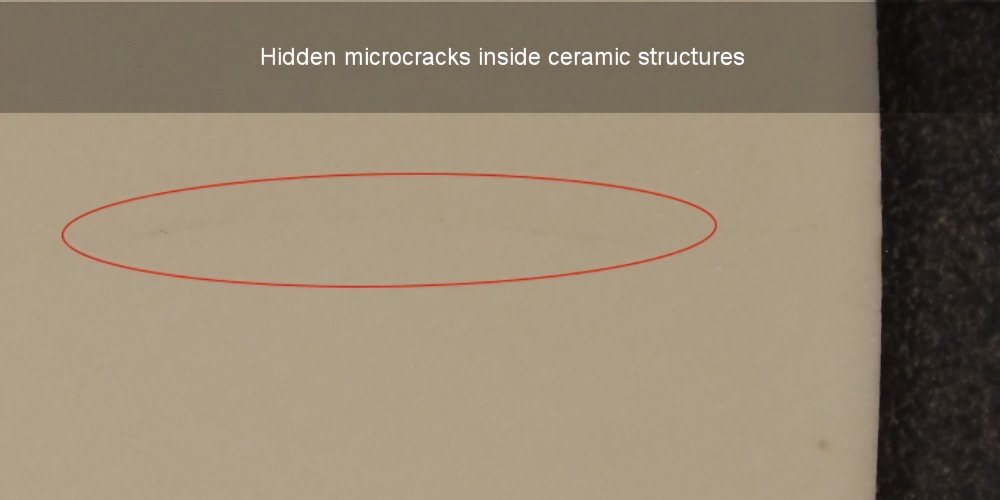
Understanding these hidden defects is also an important part of ceramic failure analysis, where engineers investigate the root causes behind unexpected component failures.
When external loading, thermal stress, or electrical stress is applied, these microscopic defects can become starting points for crack growth.
Therefore, the actual performance of a ceramic component depends not only on the material itself but also on how well the material structure, manufacturing process, and application conditions are matched.
Thermal Failure Mechanisms
Thermal failure commonly occurs when ceramic components experience rapid temperature changes or long-term exposure to elevated temperatures.
Among various thermal failure modes, thermal shock failure is one of the most frequently encountered mechanisms.
How Thermal Stress Develops Inside Ceramic Components
When a ceramic component is heated or cooled, different regions of the material may experience different temperature changes.
For example:
- Complex geometries and uneven thickness can further increase thermal gradients inside ceramic components.
- Different sections of a complex geometry may expand at different rates.
- Local temperature gradients may create uneven deformation.
Because ceramic materials have limited ability to release stress through plastic deformation, these expansion differences generate internal thermal stress.
If the thermal stress exceeds the material’s tolerance, microscopic cracks may begin to form.
Thermal Shock Failure
Thermal shock failure occurs when a ceramic component experiences a sudden temperature change that creates excessive internal stress.
Typical situations include rapid heating during equipment startup, sudden cooling during process interruption, and thermal cycling in semiconductor or high-temperature equipment.
During repeated thermal cycling, cracks may not immediately appear as visible fractures. Instead, microscopic damage can gradually develop within grain boundaries or regions with higher residual stress.
Under severe thermal cycling conditions, accumulated damage may develop from microcracks to crack propagation and eventually structural failure. This explains why some ceramic components may appear normal during initial inspection but fail after repeated thermal exposure.
Typical Engineering Scenario: Thermal Cycling of Ceramic Components
In semiconductor processing equipment, ceramic structural components may experience repeated heating and cooling cycles.
If heat distribution is uneven, different regions of the component expand and contract at different rates. The resulting thermal stress may gradually accumulate, especially in areas with complex geometry or temperature gradients.
For such applications, engineers need to consider not only thermal conductivity, but also thermal expansion behavior, component geometry, and long-term thermal stability.
High-Temperature Creep and Dimensional Stability
In addition to thermal shock, prolonged exposure to high temperatures may cause gradual structural changes known as high-temperature creep.
During long-term high-temperature operation, grain boundaries may slowly shift, microstructure may evolve, and dimensional accuracy may gradually decrease.
Although many ceramics exhibit excellent high-temperature stability compared with metals, material selection remains critical for applications requiring long-term precision.
Mechanical Failure Mechanisms
Mechanical failure is one of the most common failure mechanisms observed in engineering ceramic components.
Unlike metals, ceramics have limited ability to absorb mechanical energy through deformation. Therefore, when external loads exceed the material’s tolerance or create excessive local stress, cracks can initiate and propagate rapidly.
Mechanical failure is usually related to three key factors:
- External loading conditions
- Stress distribution within the component
- Long-term mechanical interaction between contacting surfaces
How External Loads Trigger Ceramic Fracture
Ceramic components may experience different types of mechanical loading during operation, including tensile stress, bending stress, impact loading, and repeated contact stress.
Among these loads, tensile stress is particularly critical because cracks in ceramic materials tend to propagate under tension.
For example, when a ceramic component is subjected to bending force, the tensile stress generated on one side of the component can become the driving force for crack growth.
Once a critical crack develops, the stored elastic energy may cause rapid fracture without significant visible deformation.
This is why ceramic components may appear stable during normal operation but fail suddenly when exposed to unexpected mechanical conditions.
Stress Concentration and Localized Failure
Even when the overall applied load is within the design range, local stress concentration can cause ceramic failure.
Common locations where stress concentration may occur include sharp corners, holes and openings, sudden changes in component thickness, and contact areas with uneven loading.
At these locations, the actual local stress can be significantly higher than the average applied stress.
For ceramic components, controlling stress distribution through proper structural design is essential because localized stress cannot easily be relieved through plastic deformation.
Contact Fatigue and Surface Damage Under Repeated Loading
In applications involving repeated contact, ceramic components may experience gradual surface degradation rather than immediate fracture.
Typical applications include ceramic valve components, wear-resistant parts, precision sealing components, and bearing components.
During repeated mechanical contact:
1. Contact stress accumulates at localized areas.
2. Small surface defects gradually develop.
3. Surface damage, including micro-chipping or material removal, may gradually reduce sealing or wear performance.
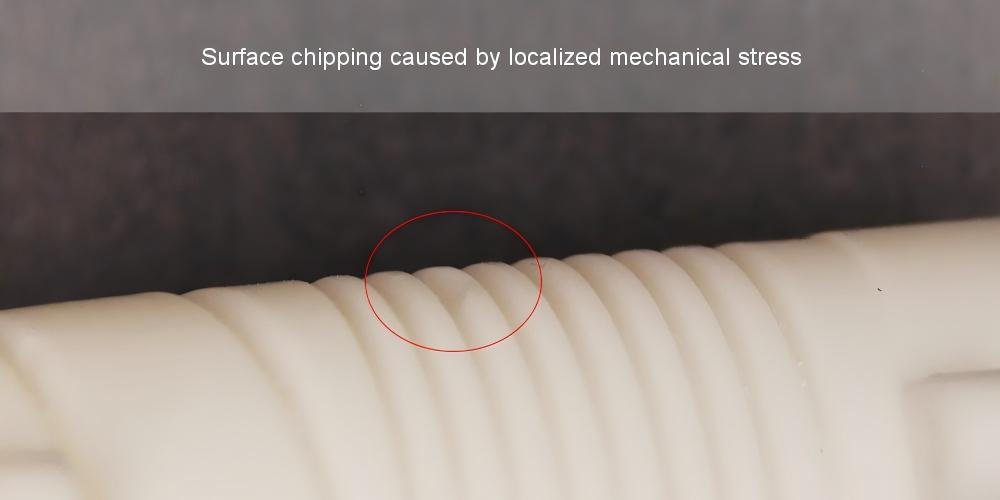
4. Surface performance and sealing reliability may decrease.
Therefore, long-term mechanical reliability depends not only on the bulk strength of the ceramic material, but also on surface quality, contact conditions, and application environment.
Selecting the appropriate ceramic material for different mechanical conditions is equally important. Our industrial ceramic materials selection guide provides further guidance on matching ceramic materials with specific application requirements.
Typical Engineering Scenario: Contact Stress in Ceramic Valve Components
In high-pressure fluid control systems, ceramic valve components may experience thousands or even millions of opening and closing cycles.
During operation, the contact surfaces are repeatedly exposed to mechanical loading. If contact conditions, surface finish, or material properties are not properly matched, localized surface damage may gradually develop.
This type of failure is not caused by a single overload event, but by the accumulation of repeated mechanical stress over time.
For such applications, engineers need to carefully evaluate contact pressure distribution, surface roughness, wear resistance, and dimensional stability.
Electrical Failure Mechanisms
Electrical failure is one of the most critical failure modes for ceramic components used in high-voltage, vacuum, and electronic applications.
Ceramics are widely used as electrical insulating materials because of their excellent dielectric properties. However, under extreme electrical conditions, insulation performance can deteriorate and eventually fail.
The two most common electrical failure mechanisms are dielectric breakdown and surface flashover.
Dielectric Breakdown
Dielectric breakdown occurs when the applied electric field exceeds the insulating capability of the ceramic material.
Under normal conditions, ceramic materials prevent electrical current flow. However, when the electric field becomes excessively strong:
- Localized conductive paths may form inside the ceramic when the applied electric field exceeds the material’s dielectric strength.
- Local conductive paths may form.
- The insulating structure may be permanently damaged.
The result can include loss of insulation performance, local heating, carbonization or material damage, and complete electrical failure.
The dielectric strength of ceramics depends on multiple factors, including material composition, porosity, microstructure, thickness, and operating environment.
Surface Flashover in High-Voltage Applications
Surface flashover is a common electrical failure mechanism in ceramic components used in vacuum systems and high-voltage equipment.
Unlike dielectric breakdown, which occurs through the ceramic body, surface flashover occurs along the ceramic surface.
Several factors can increase the risk:
- Electric field concentration near electrode edges
- Surface contamination
- Moisture adsorption
- Charge accumulation on the ceramic surface
In high-voltage applications, even a small surface defect or contamination layer may influence the local electric field distribution and reduce insulation reliability.
Electrical Reliability of Metallized Ceramic Components
For metallized ceramic components, electrical reliability depends not only on the ceramic material itself but also on the ceramic-metal interface.
Applications such as ceramic feedthroughs, ceramic-to-metal hermetic seals, and high-voltage insulating components require stable bonding between ceramic and metal layers.
Potential risks include poor interface bonding, uneven metallization layers, or thermal stress caused by CTE mismatch between ceramic and metal.
Therefore, controlling metallization quality and interface reliability is essential for long-term electrical performance.
Typical Engineering Scenario: Metallized Ceramic Components in High-Voltage Systems
In high-voltage vacuum equipment, metallized ceramic components provide both electrical insulation and hermetic sealing.
During operation, electric fields may become concentrated around metalized regions, especially near edges or transitions between ceramic and metal.
If the component design, surface condition, or metallization process is not properly controlled, local electrical stress may gradually reduce insulation reliability.
This is why high-reliability applications require careful consideration of dielectric strength, surface condition, metallization quality, and thermal expansion compatibility.
Material Properties Behind Ceramic Failure
Although ceramic failures may appear in different forms, such as cracking, wear, or insulation breakdown, each failure mechanism is closely related to specific material properties.
Understanding these relationships helps engineers evaluate material suitability for different operating conditions.
Key Material Properties Affecting Ceramic Reliability
| Failure Mechanism | Primary Driving Factors | Key Material Properties |
| Thermal failure | Temperature gradients, thermal stress, thermal cycling | Thermal conductivity, CTE, thermal shock resistance |
| Mechanical failure | External loading, stress concentration, repeated contact | Flexural strength, hardness, surface quality |
| Electrical failure | Excessive electric field, insulation degradation, surface discharge | Dielectric strength, volume resistivity, microstructure |
The matrix above provides a general overview of how different material properties influence ceramic failure behavior. However, each failure mechanism is governed by different physical factors.
The following sections will further explain how thermal, mechanical, and electrical properties affect ceramic reliability in practical applications.
Thermal Properties and Thermal Failure Resistance
Thermal-related failures are mainly influenced by the ability of a ceramic material to manage temperature changes and thermal stress.
Important properties include:
| Material Property | Influence on Failure Behavior |
| Thermal conductivity | Determines how quickly heat is transferred and affects temperature distribution |
| Coefficient of thermal expansion (CTE) | Influences thermal stress generated during temperature changes |
| Thermal shock resistance | Determines the ability to withstand rapid heating and cooling |
| High-temperature stability | Affects long-term performance under elevated temperatures |
For example:
- Aluminum nitride (AlN) provides excellent thermal conductivity for applications requiring efficient heat dissipation.
- Silicon nitride (Si₃N₄) offers excellent thermal shock resistance due to its combination of strength and thermal properties.
- Silicon carbide (SiC) maintains high-temperature stability in demanding environments.
The optimal material choice depends on the actual thermal conditions rather than a single performance parameter.
For electronic applications, understanding the balance between thermal conductivity, thermal expansion, and thermal reliability is essential. A comparison of Al₂O₃, AlN, and Si₃N₄ ceramic substrates provides further insight into how different ceramic materials perform in thermal management applications.
Mechanical Properties and Structural Reliability
Mechanical reliability of ceramic components is determined by how the material responds to external loading and surface conditions.
Key properties include:
| Mechanical reliability | Influence on Failure Behavior |
| Flexural strength | Indicates resistance against bending loads |
| Hardness | Influences wear resistance and surface durability |
| Fracture toughness | Affects resistance to crack propagation |
| Surface quality | Influences crack initiation and contact performance |
However, selecting a ceramic material based only on strength values may not guarantee long-term reliability.
A component exposed to impact, repeated loading, or complex stress conditions requires a combination of appropriate material properties, optimized geometry, and suitable surface condition.
Electrical Properties and Insulation Reliability
For electrical applications, ceramic reliability depends on the ability of the material to maintain insulation performance under operating conditions.
Important properties include:
| Material Property | Influence on Failure Behavior |
| Dielectric strength | Determines resistance to electrical breakdown |
| Volume resistivity | Indicates electrical insulation capability |
| Porosity level | Affects insulation reliability |
| Surface condition | Influences surface flashover behavior |
For high-voltage and vacuum applications, electrical performance must be considered together with ceramic processing quality and metallization design.
Selecting Ceramic Materials Based on Failure Mechanisms
There is no single “best” ceramic material for all applications.
The appropriate material depends on which failure mechanism needs to be controlled.
When Thermal Stress Is the Main Concern
Applications involving rapid temperature changes, thermal cycling, and high operating temperatures often require materials with excellent thermal stability.
Typical choices:
| Application Requirement | Suitable Materials |
| High thermal shock resistance | Silicon nitride (Si₃N₄), Silicon carbide (SiC), depending on material grade and application conditions |
| High heat dissipation | Aluminum nitride (AlN) |
| High-temperature insulation | Alumina (Al₂O₃), Silicon carbide (SiC) |
When Mechanical Wear or Loading Is the Main Concern
Applications involving repeated contact, wear, and nechanical loading require consideration of hardness, surface durability, and structural reliability.
Typical choices:
| Application Requirement | Suitable Materials |
| Electrical insulation with good mechanical strength | Alumina (Al₂O₃) |
| Wear-resistant components | Zirconia (ZrO₂), Silicon carbide (SiC) |
| Precision mechanical applications | Silicon nitride (Si₃N₄), Zirconia (ZrO₂) |
When Electrical Reliability Is the Main Concern
For high-voltage insulation, hermetic sealing, and electronic packaging, key considerations include dielectric strength, metallization compatibility, and thermal expansion matching.
Typical choices:
| Application Requirement | Suitable Materials |
| General electrical insulation | Alumina (Al₂O₃) |
| High thermal conductivity insulation | Aluminum nitride (AlN) |
| Ceramic-metal hermetic sealing | Metallized alumina ceramics |
Conclusion
Engineering ceramic failure is rarely caused by a single factor. Instead, it results from the interaction between material properties, component design, manufacturing conditions, and operating environments.
Thermal stress may create internal damage, mechanical loading may accelerate crack growth or surface degradation, and excessive electrical stress may compromise insulation performance.
By understanding the mechanisms behind ceramic failure, engineers can make better decisions in material selection, component design, and application evaluation.
The goal is not to find a ceramic material that never fails, but to select and engineer ceramic components that remain reliable under their intended working conditions.
With extensive experience in advanced ceramic manufacturing, Jinghui Ceramics supports customers in developing customized advanced ceramic components by considering material characteristics, processing requirements, and application environments.
Frequently Asked Questions
Q1: Why do ceramic components fail suddenly instead of deforming like metals?
A1: Ceramic materials generally have limited plastic deformation capability. When stress exceeds the material’s tolerance, cracks may propagate rapidly, resulting in sudden fracture rather than gradual deformation.
Q2: Does a ceramic material with higher strength always provide better reliability?
A2: Not necessarily. Component reliability depends on multiple factors, including loading conditions, component geometry, surface condition, and operating environment.
A material with higher strength may not always be the best choice if it does not match the actual application requirements.
Q3: Is high thermal conductivity enough to prevent thermal failure?
A3: No. Thermal failure depends on multiple factors, including thermal conductivity, thermal expansion behavior, temperature gradient, and component geometry.
For example, a material with high thermal conductivity may still experience thermal stress if the component design creates uneven temperature distribution.
Q4: Why are metallized ceramics used in high-voltage applications?
A4: Metallized ceramics combine the electrical insulation properties of ceramics with the joining capability of metal interfaces.
They are widely used in applications requiring hermetic sealing, electrical insulation, and high-voltage reliability.
The long-term performance depends on ceramic properties, metallization quality, and thermal expansion compatibility.