



Product Overview
| Product | Ceramic Eyelet / Ceramic Yarn Guide |
| Main Material | Alumina Ceramic |
| Alternative Materials | Zirconia and other ceramics available |
| Surface Finish | Ground or polished |
| Shape | Round, flanged or customized |
| Application | Yarn, thread and filament guiding |
| Production | Prototype, small batch and mass production |
Note: Dimensions, tolerances, materials and surface finish can be customized according to the customer’s drawing and application requirements.
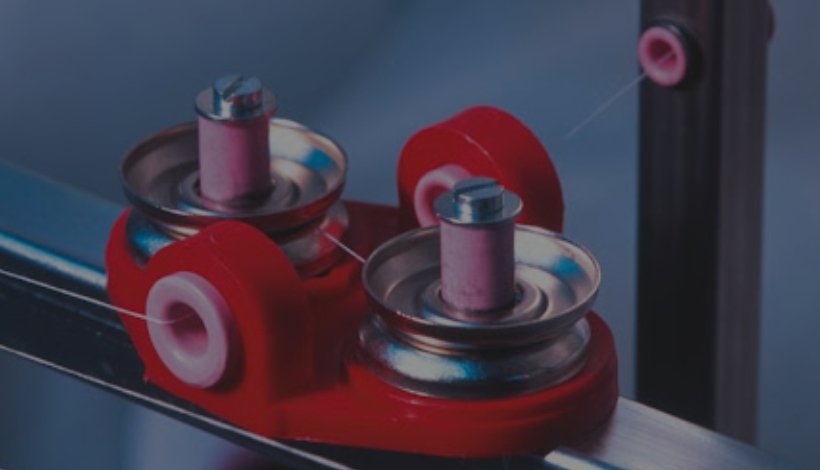
What Is a Ceramic Eyelet
A ceramic eyelet is a small ceramic guiding component with an opening through which yarn, thread, filament or other continuous materials pass during processing. It is commonly used in textile machinery where the moving material must be guided, aligned or redirected.
Unlike a simple structural ceramic part, a ceramic eyelet has a working surface that remains in continuous contact with the moving material. The condition of the inner hole therefore becomes an important design consideration.
Material hardness, surface finish, inner-hole geometry and edge condition can all influence friction, wear and the service life of the guide.
Ceramic Eyelet vs. Ceramic Yarn Guide
“Ceramic yarn guide” is a broader term for ceramic components used to guide yarn or filament, while a ceramic eyelet is one specific type of yarn guide with a closed opening.
Ceramic yarn guides can include eyelets, thread guides, pigtail guides, slotted guides and other specialized geometries. Therefore, customers searching for ceramic yarn guides may also use terms such as ceramic eyelet, ceramic thread guide or textile ceramic guide.
By Features
Ceramic eyelets are the one of the main product type of texitile ceramics, and main materials of ceramic eyelets are 95% alumina, 99% alumina, alternative materials are zirconia and titania ceramic.
Standard and customized ceramic eyelets are available according to drawings, samples, dimensions and application requirements.
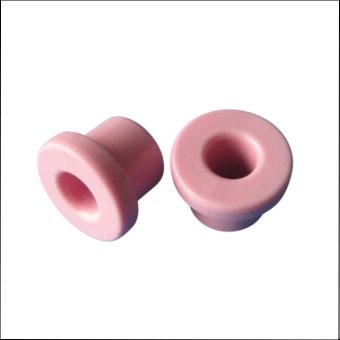
Colors can be customized according to customer requirements.
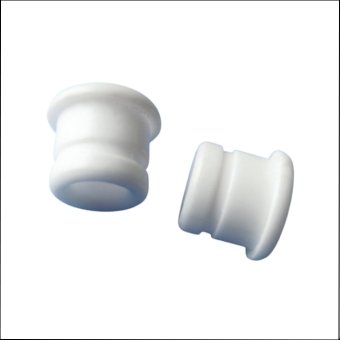
The number of grooves may be one or several to add additional sealing.
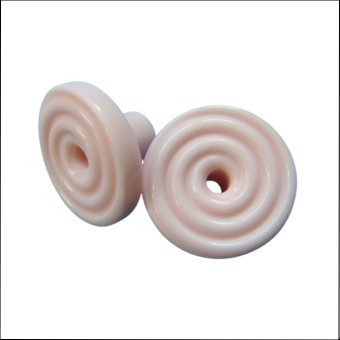
The threads on the surface serve a functional purpose.
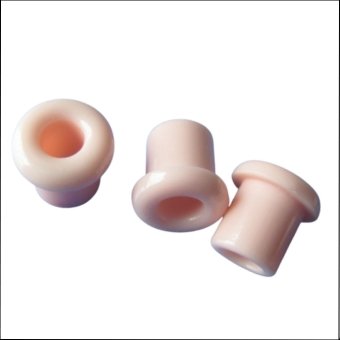
Zirconia are used more frequently in applications with higher wire density.
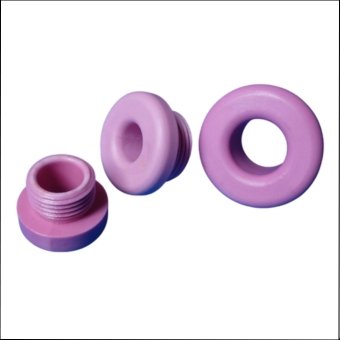
The threaded design on the outer column is commonly used for easy assembly.
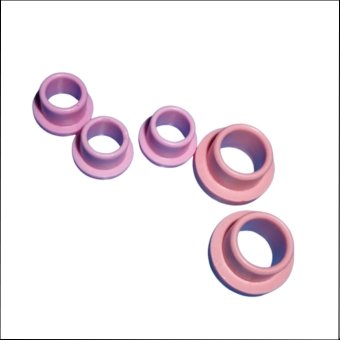
The larger inner diameter is designed for guiding thicker wires.
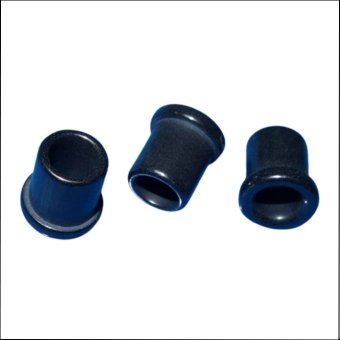
wear-resistant and lower friction ,be suitable for use in fine weaving and knitting machines.
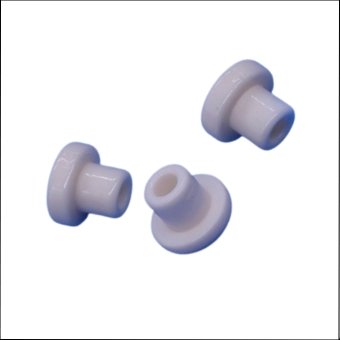
The glazed ceramic surface is smoother, which greatly reduces friction.
Why Use Ceramic Eyelets for Yarn Guiding
The general ceramic eyelets performance characteristics are as follow. If you have different requirements, do not hesitate to let us know.

Alumina ceramic has high hardness and good resistance to mechanical wear. This makes it suitable for continuous yarn-guiding applications where the guide surface is repeatedly contacted by moving yarn or filament.

The inner hole is the primary working surface of a ceramic eyelet. Grinding and polishing can be used to improve the surface condition and reduce irregularities that could increase friction or affect sensitive yarns.

Alumina ceramic has good chemical resistance and can be used in environments where textile components may be exposed to lubricants, processing chemicals, dyes or other substances. Material selection should still be based on the actual chemical environment.

A ceramic eyelet must maintain a stable guiding geometry during operation. Proper material selection and precision machining help maintain the inner-hole dimensions and overall geometry throughout the service life of the component.
Key Design Parameters for Ceramic Eyelets
Our ceramic eyelets are designed for applications where yarn, filament or thread passes continuously through a guide opening. Inner-hole geometry, surface finish and edge quality are carefully controlled to help reduce unnecessary friction and abrasion during operation.

The inner-hole diameter should be selected according to yarn size, filament configuration, tension and machine conditions. An excessively small opening may increase contact, while an unnecessarily large opening may reduce guiding accuracy.

Surface finish is particularly important on the inner hole because it directly contacts the moving yarn. Depending on the application, the inner surface can be ground, polished or further finished to meet the required surface condition.

The entrance and exit edges of the eyelet can affect yarn contact. Sharp edges or poorly finished transitions may create unnecessary contact stress. Controlled chamfers or radiused edges can therefore be incorporated into the design.

Alumina is commonly selected for its balance of hardness, wear resistance, chemical stability and cost. Zirconia may be considered when higher fracture toughness or mechanical strength is required.
More About Our Ceramic Eyelets
- Materials
- Surface Finishing
- Applications
Alumina Ceramic Eyelets
Alumina ceramic is the primary material for many textile ceramic eyelets. Different alumina grades can be selected according to the required mechanical properties, surface finish, dimensional requirements and cost target.
Zirconia Ceramic Eyelets
Zirconia provides higher fracture toughness than conventional alumina ceramics and can be considered for applications where impact resistance or mechanical robustness is important. Material selection should be evaluated together with geometry and surface requirements.
For yarn-guiding applications, the inner-hole surface deserves particular attention.
Standard Grinding
Suitable for general guiding applications where a controlled ceramic surface is required.
Precision Polishing
Used when a smoother inner surface is required to reduce surface irregularities and improve yarn-contact conditions.
Customized Surface Finish
Surface requirements can be specified according to yarn type, machine speed, contact conditions and customer testing requirements.
Textile Machinery
Ceramic eyelets can be used as yarn or filament guiding components in:
- Spinning machinery
- Weaving machinery
- Knitting machinery
- Winding machines
- Yarn processing equipment
- Filament processing equipment
Typical Guiding Functions
- Yarn guiding
- Thread positioning
- Filament alignment
- Direction changing
- Tension-path guidance
Custom Ceramic Eyelets
Different textile machines require different guide dimensions and mounting structures. Jinghui supports custom ceramic eyelets based on engineering drawings, samples or defined technical requirements.
Customizable features may include:
- Outer diameter
- Inner-hole diameter
- Height
- Flange geometry
- Groove or slot
- Chamfer
- Edge radius
- Mounting structure
- Material grade
- Surface finish
Quality Control
For ceramic eyelets, inspection focuses on both dimensional accuracy and the condition of the working surface.
Key Inspection Items
- Outer diameter
- Inner-hole diameter
- Height
- Concentricity
- Chamfer / radius
- Surface roughness
- Visual defects
- Cracks and chips
- Material properties
Inspection requirements can be defined according to the customer’s drawing and application.
Looking for ceramic eyelets or ceramic yarn guides for textile machinery?
Send us your drawing, sample or basic dimensions. Our engineering team can review the material, geometry, inner-hole requirements and finishing process, then provide a suitable manufacturing solution and quotation.
Ceramic Manufacturing Experience
We focus on industrial ceramic components and provide ceramic forming, sintering, precision grinding and finishing capabilities.
OEM & Custom Production
We can manufacture ceramic eyelets according to drawings, samples or customer specifications.
Precision Post-Machining
Grinding and polishing processes are available for applications requiring controlled dimensions and smooth working surfaces.。
Prototype to Mass Production
We support prototype development, small-batch orders and production quantities according to project requirements.
To evaluate a ceramic eyelet project efficiently, please provide as much of the following information as available:
- Drawing or sample
- Outer diameter
- Inner-hole diameter
- Overall height
- Ceramic material
- Surface finish requirement
- Yarn or filament type
- Approximate operating conditions
- Annual or monthly quantity
- Special inspection requirements
If you do not have a complete drawing, a sample or basic dimensions are also sufficient for an initial evaluation.
A ceramic eyelet is mainly used to guide yarn, thread or filament through a defined path during textile processing. It helps maintain the position and direction of the moving material while providing a hard, wear-resistant contact surface. Alumina ceramic is commonly selected because it combines high hardness, good wear resistance and chemical stability. The inner-hole size, surface finish and edge geometry should be selected according to the yarn characteristics and operating conditions.
Alumina ceramic eyelets provide a useful combination of hardness, wear resistance, chemical stability and dimensional stability. During continuous yarn guiding, the inner surface of the eyelet is repeatedly contacted by the moving yarn or filament. A properly manufactured alumina eyelet can maintain its guiding geometry and working surface better than many softer materials. Different alumina grades and surface finishes can be selected according to the application and required performance.
The recommended surface finish depends on the yarn material, yarn size, machine speed, contact condition and required service life. Because the inner hole is the main contact surface, grinding and polishing quality are particularly important. A smoother and properly controlled surface can reduce irregular contact points, but the final specification should be determined according to the actual application rather than using one universal roughness value for every ceramic eyelet.