

Introduction
In modern power module design, thermal management and thermo-mechanical reliability are two critical considerations. As the insulating and heat-transfer layer between semiconductor devices and the cooling system, ceramic substrates play an important role in thermal performance, electrical insulation, and long-term reliability.
Al₂O₃, AlN, and Si₃N₄ are among the main ceramic substrate materials used in power electronics. Each material offers a different balance of thermal conductivity, mechanical reliability, thermal expansion behavior, and cost.
This article compares their key properties and explains how these differences affect power module design. Rather than asking which material is universally “best,” the goal is to determine which material is most suitable when cost, heat dissipation, or thermo-mechanical reliability is the primary design consideration.
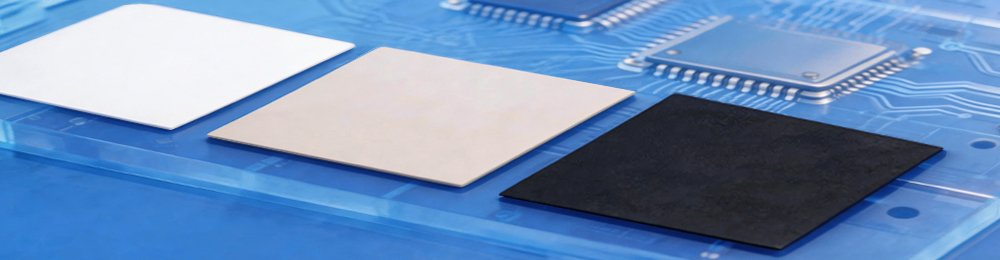
What Is a Power Module and Why Does the Substrate Matter?
Simply put, a power module is a highly integrated unit that packages multiple power semiconductor chips—such as IGBTs, MOSFETs, and third-generation semiconductor devices such as SiC MOSFETs—into a specific circuit configuration.
Power modules are widely used in EV inverters, industrial motor drives, renewable energy converters, and other high-power electronic systems.
When selecting a ceramic substrate, three key factors should be considered:
Electrical Insulation
Power semiconductors typically operate in high-voltage circuits, such as 650 V to 1200 V and above. The ceramic substrate must provide a stable, long-term insulation barrier with sufficient dielectric strength between the high-voltage semiconductor devices and the underlying metal heat sink.
Thermal Performance
Power chips generate significant heat during high-frequency switching. As a critical heat-transfer path, the ceramic substrate transfers this heat to the downstream cooling system as efficiently as possible, helping prevent chip failure caused by overheating.
Thermo-Mechanical Reliability
The thermal expansion behavior of the ceramic substrate affects thermo-mechanical stresses within the module. Appropriate CTE matching can help reduce stresses caused by temperature changes, but actual reliability also depends on factors such as substrate thickness, copper structure, bonding method, and thermal cycling conditions.
Material Properties Comparison: Al₂O₃ vs AlN vs Si₃N₄
In power module design, the choice of ceramic substrate material can significantly affect thermal performance, mechanical reliability, and overall BOM cost.
The table below compares the key properties that most directly influence thermal performance, mechanical reliability, and material selection in power modules.
| Property | Unit | Al₂O₃ | AlN | Si₃N₄ |
| Thermal Conductivity | W/m·K | 20–30 | 170–230 | 70–90 |
| Coefficient of Thermal Expansion (CTE) | ×10⁻⁶/°C | 6.5–7.0 | 4.4–4.7 | 3.0–3.2 |
| Flexural Strength | MPa | ≥310 | ≥310 | 600–800 |
| Fracture Toughness | MPa·m¹/² | 3–4 | 3–4 | 6.0–7.0 |
| Dielectric Strength | kV/mm | >15 | >15 | >15 |
Note: The values shown are typical ranges for comparison. Actual properties may vary depending on material grade, formulation, manufacturing process, and test method.
These values illustrate the fundamental differences between the three materials. However, material selection cannot be based on a single property alone. The following sections explain how these differences affect thermal performance and thermo-mechanical reliability at the module level.
How Material Properties Affect Power Module Performance
After comparing the basic properties of Al₂O₃, AlN, and Si₃N₄, the more important question is what these properties actually mean in real high-power applications.
The following sections examine three key design challenges: thermal management, mechanical reliability, and CTE-related thermo-mechanical stress.
Thermal Management and Heat Dissipation
Power semiconductor chips generate significant amounts of heat during operation. For the same heat load, lower system thermal resistance generally results in a lower temperature rise and lower chip junction temperature. This can improve the thermal management of the module and may also have a positive effect on long-term reliability.
- AlN: With a high thermal conductivity of 170–230 W/m·K, aluminum nitride substrates offer a clear advantage in applications with extremely demanding thermal requirements, particularly where minimizing the thermal resistance of the ceramic layer is a primary design objective.
- Si₃N₄: Although Si₃N₄ has a lower intrinsic thermal conductivity of 70–90 W/m·K than AlN, its higher mechanical strength can allow the ceramic layer to be made thinner. Depending on substrate thickness, copper thickness, and module design, the resulting system-level thermal resistance may be more competitive than would be predicted by comparing intrinsic thermal conductivity alone.
Mechanical Reliability Under Thermal Cycling
The fracture toughness of a ceramic material is one of the important factors affecting the thermo-mechanical reliability of a power module. During frequent temperature fluctuations, the substrate is repeatedly subjected to thermo-mechanical stress. Higher fracture toughness generally means greater resistance to crack initiation and propagation.
- Al₂O₃ and AlN: With relatively low fracture toughness of only 3–4 MPa·m¹/², both are typical brittle ceramic materials. Their lower fracture toughness generally provides less tolerance to cracking under severe thermo-mechanical stress and repeated thermal cycling.
- Si₃N₄: With a fracture toughness of 6.0–7.0 MPa·m¹/², Si₃N₄ is significantly tougher than Al₂O₃ and AlN. This higher fracture toughness gives it greater resistance to crack initiation and propagation under thermo-mechanical stress, making it particularly suitable for applications with demanding thermal cycling requirements.
CTE Matching and Thermo-Mechanical Stress
Differences in the coefficient of thermal expansion (CTE) are one of the important factors affecting thermo-mechanical stress in the soldering or sintering layer beneath the semiconductor chip.
- SiC chip (CTE ~4.0): Closer to AlN at 4.4–4.7.
- Si chip (CTE ~2.6): Closer to Si₃N₄ at 3.0–3.2.
However, CTE matching is only one part of substrate selection. The actual thermo-mechanical reliability of a module also depends on the mechanical properties of the substrate, substrate thickness, copper structure, bonding method, and thermal cycling conditions.
Why Is Si₃N₄ Often Preferred for Demanding EV and SiC Power Modules?
A closer CTE match does not necessarily result in the highest level of component reliability. In SiC power modules, the substrate must also withstand repeated thermo-mechanical stresses caused by temperature cycling and the interaction between the ceramic and copper layers.
Si₃N₄ offers significant advantages in this regard. Its higher fracture toughness provides greater resistance to cracking under demanding thermo-mechanical loads.
Therefore, for applications where thermal cycling reliability is a primary design consideration, Si₃N₄ is often one of the more advantageous candidate materials, despite its lower thermal conductivity than AlN.
Material Selection Guide
After understanding the physical properties of these three materials, you can use the following selection approach based on the primary design priority when choosing a ceramic substrate for an actual project.
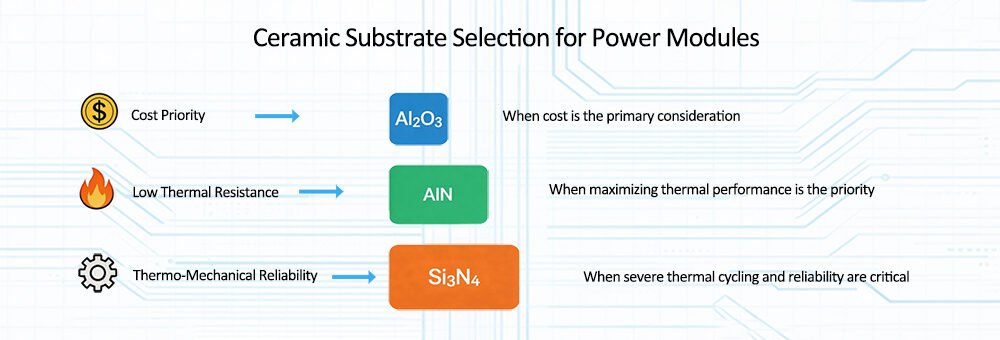
When Cost Is the Primary Priority: Choose Al₂O₃
Among the three materials, Al₂O₃ substrates are generally the most economical option. Their relatively low thermal conductivity makes them less suitable for applications with extremely high heat flux. However, when thermal and reliability requirements can be met without using higher-performance ceramics, they remain a practical choice.
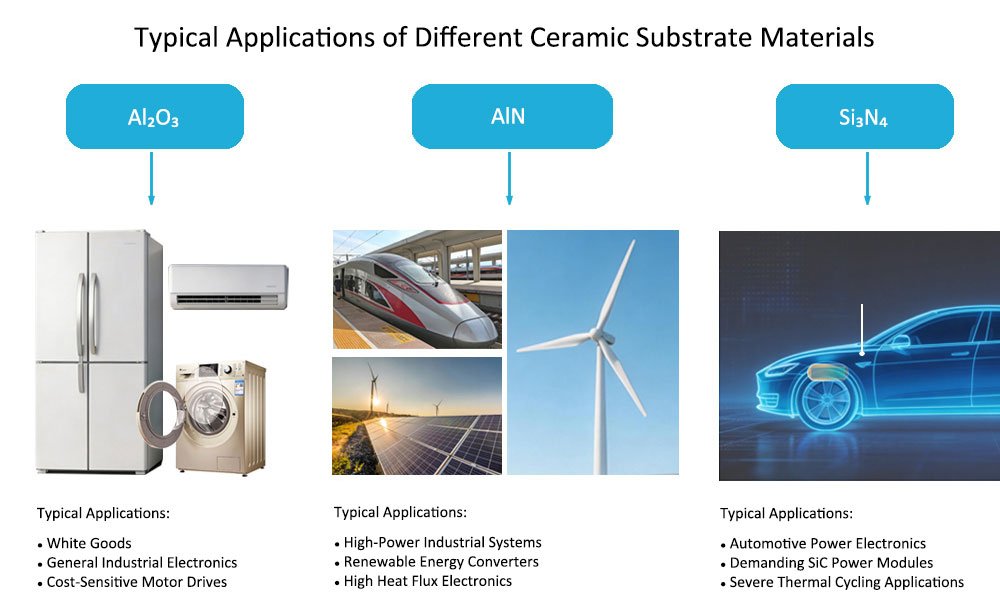
Typical applications include cost-sensitive industrial drives and certain white goods applications.
When Low Thermal Resistance Is the Primary Priority: Choose AlN
AlN is particularly attractive when reducing thermal resistance is the primary design objective.
It is worth considering for high-power industrial applications, renewable energy systems, and other applications where higher thermal conductivity can provide significant system-level benefits.
When Thermo-Mechanical Reliability Is Critical: Consider Si₃N₄ First
Si₃N₄ substrates are particularly suitable for applications involving severe thermal cycling and high thermo-mechanical stress.
Their higher thermal conductivity than Al₂O₃, together with their high flexural strength and fracture toughness, provides a good balance between thermal performance and mechanical reliability.
This makes Si₃N₄ an important option for high-reliability power modules, particularly in demanding automotive and SiC applications where thermal cycling reliability requirements are stringent.
These selection principles can be seen in a range of practical applications. While no material is exclusively tied to a specific industry, Al₂O₃, AlN, and Si₃N₄ are often considered for different types of applications based on their respective performance and cost advantages.
Cost and Supply Considerations
In real industrial projects, technical performance is not the only factor in material selection. BOM cost, supply chain stability, and production capacity can also affect whether a material solution can successfully move into mass production.
The table below compares the relative cost levels and major supply considerations for the three materials.
| Material | Relative Cost | Supply Considerations |
| Al₂O₃ | Generally Lowest | Mature supply base and broad supplier availability |
| AlN | Generally Higher | Higher material and processing requirements; supplier capabilities can vary by performance grade |
| Si₃N₄ | Generally Highest | More demanding manufacturing and a more specialized supplier base |
These are general relative trends rather than fixed pricing rules. Actual cost and availability can vary significantly depending on substrate size, thickness, material grade, copper structure, performance requirements, order volume, and supplier.
Conclusion
So, which material is best for power modules? There is no single answer.
When cost is the primary consideration, Al₂O₃ is generally a practical choice. When minimizing thermal resistance is the main objective, AlN offers clear advantages. When thermo-mechanical reliability and thermal cycling performance are critical, Si₃N₄ is often the more advantageous option.
In actual material selection, the overall module design must also be considered, including power density, thermal requirements, substrate thickness, copper structure, bonding technology, operating environment, reliability targets, and total system cost.
There is no universally “best” material—only the material that is best suited to the specific application requirements.
Frequently Asked Questions
Q1: Why is Si₃N₄ often selected for high-performance SiC power modules despite its lower thermal conductivity than AlN?
A1: Although Si₃N₄ has lower intrinsic thermal conductivity, its high mechanical strength allows it to be made thinner. A thinner ceramic substrate can help reduce the thermal resistance of the ceramic layer. When combined with an appropriate copper structure and module design, its system-level thermal performance can be more competitive than a comparison based solely on intrinsic thermal conductivity would suggest.
In addition, SiC devices are typically designed for higher junction temperatures and higher power density applications, which place greater demands on module thermal management and thermo-mechanical reliability. Si₃N₄ offers clear advantages in resistance to thermo-mechanical stress and crack formation.
Q2: How thin can a Si₃N₄ substrate be made?
A2: A thickness of 0.32 mm is one of the commonly used thin Si₃N₄ substrate options in certain high-performance applications. However, the optimum thickness depends on the required electrical insulation, mechanical strength, thermal resistance, copper structure, and manufacturing capability.
Q3: How should I choose between DBC and AMB for copper-clad ceramic substrates?
A3: Due to its strong ceramic-to-metal bonding capability, AMB is often the preferred choice for demanding applications involving thick copper, high current, and severe thermal cycling.
Q4: Why can prices vary so much between suppliers for nominally similar AlN substrates?
A4: Price differences usually depend on more than just the material name. Key factors include raw material quality and formulation control, sintering and processing capability, finished product performance requirements, and copper cladding and bonding quality.
Therefore, when comparing AlN substrate quotations, you should not compare unit prices alone. It is also important to confirm whether the material properties, dimensions, thermal conductivity grade, structural design, and reliability requirements are being compared on an equivalent basis.