

Introduction
Grinding is an essential process in many daily and industrial applications, including coffee beans, pepper, spices, grains, and other food ingredients. A grinder transforms larger particles into smaller and more uniform particles through mechanical cutting, crushing, and friction.
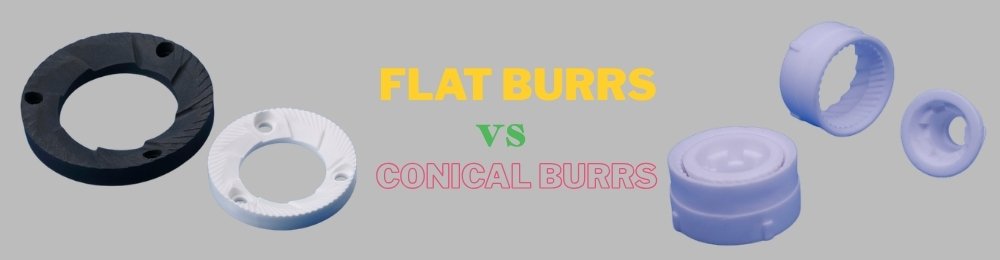
The grinding burr is the core functional component of a grinder. Its geometry, material, surface structure, and manufacturing accuracy directly influence grinding efficiency, particle consistency, wear resistance, and service life.
Depending on the design and application requirements, grinder burrs are generally classified into different types:
- Conical burr and flat burr according to geometry;
- Ceramic burr and metal burr according to material;
- Abrasive grinding burr and cutting blade according to grinding mechanism.
Among these options, ceramic conical and ceramic flat burrs are widely used in coffee grinders, manual spice grinders, and customized OEM grinding systems because ceramic materials provide excellent wear resistance, chemical stability, and long-term dimensional reliability.
This article focuses on the engineering differences between ceramic conical burrs and ceramic flat burrs, helping equipment manufacturers and users better understand their performance characteristics and application suitability.
What Are Ceramic Conical and Flat Burrs?
1. Ceramic Conical Burr
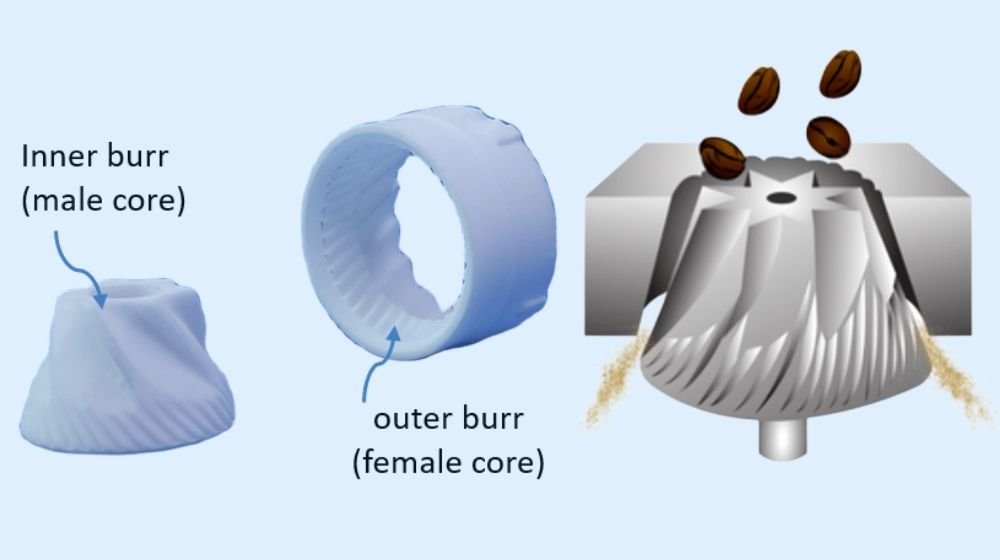
A ceramic conical burr consists of two matching components:
- Outer burr (female burr)
- Inner burr (male burr)
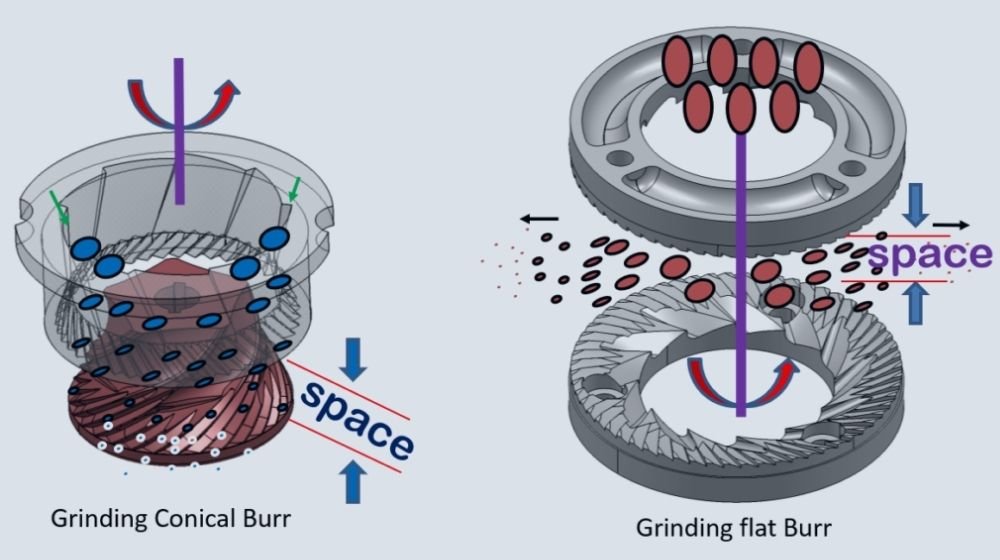
The outer burr has a cylindrical internal surface, while the inner burr has a cone-shaped external surface. These two components create an inclined grinding gap where particles gradually move from a larger opening area to a smaller precision grinding zone.
During operation, particles enter from the top of the burr and are initially crushed by larger cutting teeth. As they move downward, the gap becomes narrower and the tooth structure becomes finer, resulting in progressive particle refinement.
The final particle size is mainly determined by:
- Grinding gap adjustment;
- Tooth geometry;
- Rotation speed;
- Ceramic material properties.
Ceramic conical burrs are commonly selected for applications requiring:
- Lower operating noise;
- Lower heat generation;
- Compact grinder design;
- Easy cleaning and maintenance.
2. Ceramic Flat Burr
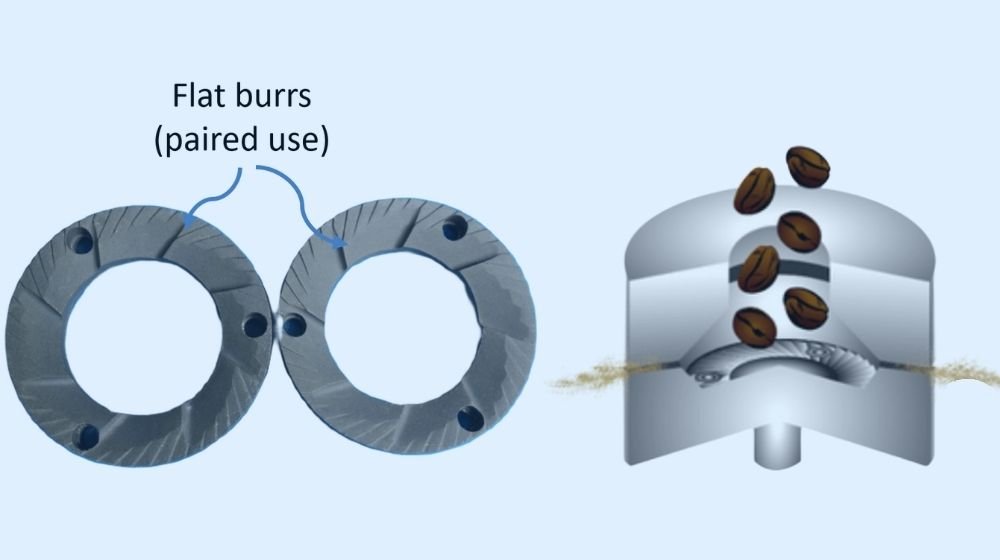
A ceramic flat burr consists of two circular grinding discs positioned parallel to each other. The working surfaces contain precisely designed cutting teeth. The particles enter from the center opening and are pushed outward through the grinding channel as the burrs rotate.
During this process, the grinding gap gradually becomes smaller, and the particles experience continuous compression and shear forces until reaching the required particle size.
Compared with conical burrs, flat burrs generally provide a larger active grinding area and more controlled particle movement. Therefore, ceramic flat burrs are often selected for applications requiring:
- Higher grinding consistency;
- More precise particle control;
- Professional coffee grinding systems.
Engineering Comparison of Ceramic Conical vs Flat Burr
The performance difference between ceramic conical and flat burrs is mainly determined by their grinding geometry, particle movement path, contact area, and heat generation characteristics.
Although both designs use ceramic materials, the final grinding performance can vary significantly because the particles experience different mechanical forces during the grinding process.
1. Grinding Consistency
Grinding consistency refers to the ability of a burr system to produce particles with a relatively narrow and controlled size distribution. It directly affects the quality of the final product, especially in applications such as coffee extraction, spice processing, and precision ingredient preparation.
Ceramic Conical Burr
In a conical burr structure, particles move through a vertical inclined grinding channel. The particles are gradually reduced from coarse crushing to fine grinding as they move downward.
Because particle movement is influenced partly by gravity, the residence time of individual particles inside the grinding zone may vary. Some particles may pass through the grinding gap quickly, while others remain slightly longer and experience additional grinding. As a result, conical burrs tend to produce a slightly wider particle size distribution.
However, this characteristic is not necessarily a disadvantage. In many applications, especially manual grinders and general-purpose spice grinders, stable performance and lower operating requirements are more important than extremely narrow particle distribution.
Ceramic Flat Burr
Flat burrs use two parallel grinding discs, forcing particles to move from the center toward the outer circumference. The particle movement path is more controlled because the grinding process mainly depends on the rotation force and tooth geometry.
The larger working surface allows particles to experience more consistent compression and shearing forces. Therefore, flat burrs generally provide better grinding consistency and more predictable particle distribution.
This is why flat burr structures are widely used in professional coffee grinders where particle control directly influences extraction quality.
Engineering Summary
| Performance | Ceramic Conical Burr | Ceramic Flat Burr |
|---|---|---|
| Particle control | Moderate | Excellent |
| Grinding consistency | Good | Higher |
| Structure complexity | Lower | Higher |
| Suitable applications | General grinding, manual grinders, spices | Professional coffee grinders, precision grinding |
2. Particle Size Distribution
Particle size distribution is closely related to burr geometry. The same ceramic material can produce different grinding results when the burr design changes.
Conical Burr Particle Characteristics
The inclined grinding gap creates a gradual reduction process. Large particles are first broken by coarse teeth and then refined by smaller teeth. This multi-stage grinding process provides good efficiency with relatively low energy consumption.
For applications where a small variation in particle size is acceptable, conical burrs provide a practical balance between performance and cost.
Flat Burr Particle Characteristics
Flat burrs create a more uniform grinding path. Because particles travel through a horizontal grinding channel, each particle experiences a more similar grinding process. This results in better control of particle distribution. For professional applications where repeatability is important, flat burrs provide advantages.
3. Heat Generation During Grinding
Heat generation is an important factor, especially when grinding heat-sensitive materials such as coffee beans. Excessive heat may influence:
- Aroma retention
- Material properties
- Final product quality
Ceramic Conical Burr
Conical burrs generally operate at lower rotational speeds. The vertical grinding path and gravity-assisted particle movement reduce the required driving force.
Therefore, heat accumulation is usually lower. This characteristic makes ceramic conical burrs suitable for compact manual grinders and applications requiring stable temperature control.
Ceramic Flat Burr
Flat burrs generally have a larger contact area and higher mechanical interaction between particles and grinding surfaces. During high-speed operation, more energy is converted into friction heat.
Therefore, thermal management becomes more important. Professional flat burr systems often require:
- Optimized airflow design;
- Heat dissipation structure;
- Appropriate motor speed control.
4. Noise Performance
Noise is influenced by:
- Burr structure;
- Rotation speed;
- Motor power;
- Material damping characteristics.
Conical Burr
Due to lower speed requirements and gravity-assisted grinding, conical burr systems usually generate lower operating noise. This makes them popular in household grinders and portable grinding devices.
Flat Burr
Flat burr systems generally require stronger driving force and higher rotational control. The increased mechanical interaction may result in higher operating noise. However, optimized tooth design, ceramic material selection, and machine structure can significantly reduce noise.
5. Grinding Retention
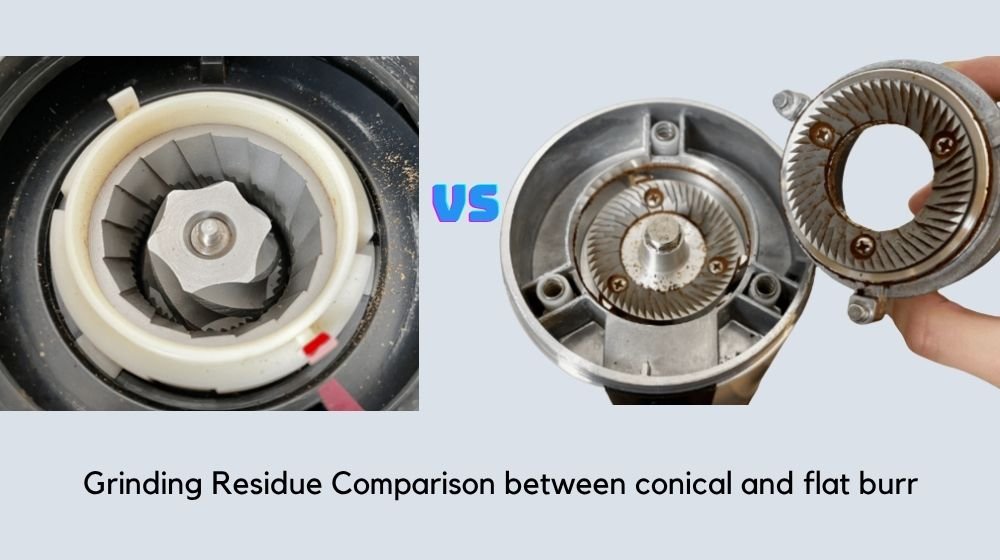
Grinding retention refers to the amount of material that remains inside the burr structure after the grinding process is completed. Although the retained amount is usually small, it becomes an important consideration in applications where freshness, hygiene, or material consistency is critical.
Examples include:
- Coffee grinding
- Pharmaceutical powder preparation
- Food ingredient processing
The retention behavior is influenced by:
- Burr geometry;
- Internal cavity design;
- Surface roughness;
- Particle flow path;
- Material surface characteristics.
Ceramic Conical Burr Retention
The vertical structure of a conical burr allows particles to move downward with the assistance of gravity. After grinding, most particles naturally leave the grinding chamber through the lower outlet.
The larger internal tooth spaces also reduce the possibility of particles becoming trapped inside the burr. Therefore, ceramic conical burrs generally provide good self-cleaning characteristics.
This characteristic is particularly valuable for manual grinders and applications where frequent cleaning is inconvenient.
Ceramic Flat Burr Retention
Flat burrs use a horizontal grinding path. Particles are moved outward by rotational force rather than gravity. Because of the larger grinding surface area and more complex internal pathways, some fine particles may remain in the grinding area.
However, modern flat burr designs often include:
- Optimized tooth geometry;
- Improved discharge channels;
- Anti-retention structures.
Therefore, retention differences depend not only on burr type but also on the detailed engineering design.
6. Wear Resistance and Service Life
For industrial and commercial grinding applications, wear resistance is one of the most important evaluation factors.
A burr is continuously exposed to:
- Mechanical impact;
- Sliding friction;
- Particle abrasion.
Over time, wear can change:
- Tooth profile;
- Grinding gap;
- Particle consistency;
- Grinding efficiency.
Why Ceramic Burrs Have Excellent Wear Resistance?
Engineering ceramics such as alumina have significantly higher hardness than many metallic materials. This allows ceramic burrs to maintain their tooth geometry and grinding performance for a longer period.
The advantages include:
1. Stable Grinding Gap
Wear resistance helps maintain the designed distance between grinding surfaces. A stable gap improves particle consistency.
2. Reduced Performance Degradation
Metal burrs may gradually lose sharpness because of surface wear. Ceramic burrs generally maintain their surface structure longer.
3. Better Chemical Stability
Ceramics are not affected by oxidation or corrosion in the same way as metals.his makes ceramic burrs suitable for applications involving moisture, salt, spices, or food ingredients.
Conical vs Flat Burr Wear Comparison
| Factor | Ceramic Conical Burr | Ceramic Flat Burr |
|---|---|---|
| Contact area | Smaller | Larger |
| Grinding force distribution | Gradual | More concentrated |
| Wear pattern | Generally uniform | Depends on alignment accuracy |
| Maintenance requirement | Lower | Requires better control |
7. Cost Comparison
Cost is an important factor, but it should not be evaluated only by the initial purchase price. For grinder manufacturers, total cost should include:
- Material cost;
- Manufacturing difficulty;
- Machining requirement;
- Tooling investment;
- Service life;
- Customer maintenance cost.
Ceramic Conical Burr Cost
Ceramic conical burrs are commonly used in:
- Manual coffee grinders;
- Pepper mills;
- Salt grinders;
- Household spice grinders.
Their relatively compact structure requires less material and simpler machining processes. Therefore, they are usually more economical for high-volume consumer applications.
Ceramic Flat Burr Cost
Ceramic flat burrs generally require:
- Larger ceramic discs;
- Higher dimensional accuracy;
- More complex tooth machining;
- Better parallelism control.
Because the grinding surfaces must maintain accurate alignment, manufacturing requirements are higher. As a result, ceramic flat burrs usually have a higher production cost.
8. Engineering Selection Guide
There is no universal answer to which ceramic burr is better. The correct selection depends on:
- Grinding target;
- Required particle consistency;
- Equipment design;
- Operating frequency;
- Cost target.
When to Choose Ceramic Conical Burr
Recommended for:
✓ Manual grinders
✓ Household spice grinders
✓ Pepper and salt mills
✓ Cost-sensitive applications
✓ Low-noise requirements
When to Choose Ceramic Flat Burr
Recommended for:
✓ Professional coffee grinders
✓ High consistency grinding
✓ Commercial equipment
✓ Precision particle control
Engineering Conclusion
Ceramic conical and flat burrs are not competing designs where one completely replaces the other. They are engineered for different performance priorities.
Conical burrs emphasize:
- Efficiency;
- Low noise;
- Simple structure;
- Easy maintenance.
Flat burrs emphasize:
- Grinding consistency;
- Particle control;
- Professional performance.
For OEM manufacturers, the best solution is to match burr geometry, ceramic material, and manufacturing capability with the final application requirements.
Ceramic Conical vs Flat Burr: Final Engineering Comparison
Both ceramic conical and flat burrs have their own advantages, and the better choice depends on the specific application requirements. A conical burr focuses more on efficiency, low noise, simple structure, and cost balance.
A flat burr focuses more on grinding consistency, particle control, and professional performance. The following table summarizes the main engineering differences.
| Comparison Item | Ceramic Conical Burr | Ceramic Flat Burr |
|---|---|---|
| Structure | Vertical cone-shaped grinding system | Two parallel circular grinding discs |
| Grinding path | Top-to-bottom inclined path | Center-to-outside horizontal path |
| Particle control | Good | Excellent |
| Grinding consistency | Good | Higher |
| Heat generation | Lower | Higher under high-speed operation |
| Noise level | Generally lower | Relatively higher |
| Grinding retention | Usually lower | Depends on design optimization |
| Mechanical complexity | Lower | Higher |
| Manufacturing difficulty | Moderate | Higher |
| Cost level | More economical | Higher |
| Typical applications | Manual grinders, spice grinders, household products | Professional coffee grinders, commercial equipment |
Ceramic Burr Manufacturing Capability
A high-performance ceramic burr is not achieved by material selection alone. The final performance depends on the combination of:
- Ceramic formulation;
- Forming process;
- Sintering technology;
- Precision machining;
- Inspection capability.
For OEM customers, a reliable ceramic burr supplier should provide consistent production quality, engineering support, and customization capability. Jinghui Ceramic specializes in the development and manufacturing of ceramic grinding components, including ceramic conical burrs, flat burrs, and customized grinding solutions.
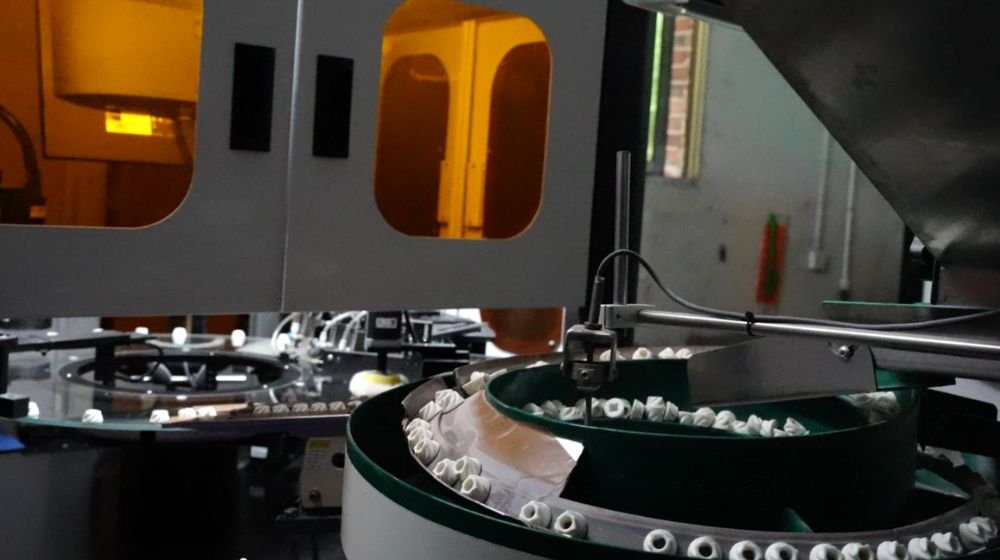
With ceramic material expertise and precision machining capability, we support customers from prototype development to mass production. Our manufacturing capability includes:
- Ceramic material preparation;
- Precision forming;
- High-temperature sintering;
- Grinding and surface finishing;
- Dimensional inspection;
- OEM customization.
For grinder manufacturers seeking reliable ceramic burr solutions, choosing the right manufacturing partner is as important as choosing the right burr design.
Frequently Asked Questions
1: What is the difference between ceramic conical and flat burr grinders?
Ceramic conical and flat burrs mainly differ in their grinding geometry and particle movement mechanism. Conical burrs use a vertical inclined grinding path where particles gradually move downward through different grinding stages. They usually provide lower noise, lower heat generation, and easier maintenance. Flat burrs use two parallel grinding discs, creating a more controlled particle movement path and generally providing better grinding consistency. The choice depends on whether the application prioritizes efficiency and cost balance or precision particle control.
2: Are ceramic burrs better than stainless steel burrs?
Ceramic burrs and stainless steel burrs have different advantages rather than one being universally better. Ceramic burrs provide excellent hardness, wear resistance, and chemical stability, making them suitable for applications requiring long service life and stable grinding performance. Stainless steel burrs offer high toughness and easier machining, which can be advantageous for certain designs. The correct choice depends on application conditions, grinding materials, required performance, and cost considerations.
3: How long do ceramic grinder burrs usually last?
The service life of ceramic burrs depends on many factors, including ceramic material grade, burr design, grinding frequency, material hardness, and operating conditions. Because ceramic materials have high hardness and excellent wear resistance, ceramic burrs can maintain their grinding geometry for a long period under normal conditions. However, actual lifetime should be evaluated based on the specific application rather than using a fixed number of operating years or cycles.
4: What should OEM customers consider when selecting a ceramic burr supplier?
OEM customers should evaluate more than the burr design itself. Important factors include ceramic material quality, production consistency, machining capability, dimensional accuracy, surface finishing technology, and engineering support. A qualified supplier should be able to provide stable mass production, customized development, and reliable quality control because small dimensional differences in ceramic burrs can directly influence grinding performance.
5: Can ceramic burrs be customized for different grinder designs?
Yes. Ceramic burrs are often customized according to grinder structure, mounting method, grinding target, and performance requirements. Customization may include burr diameter, tooth profile, grinding gap design, material selection, and surface finishing requirements. For OEM equipment manufacturers, working with an experienced ceramic supplier helps optimize the burr design before mass production and improves overall equipment performance.
Final Conclusion
Ceramic conical and flat burrs represent two different engineering approaches to grinding.
Conical burrs provide an efficient and practical solution with lower noise, lower heat generation, and cost advantages. Flat burrs provide higher control over particle distribution and are suitable for applications requiring precision grinding performance.
The best ceramic burr solution is determined by the combination of material, geometry, manufacturing quality, and application requirements.