

Introduction
For decades, stainless steel has been one of the most widely used engineering materials because it combines mechanical strength, corrosion resistance, and relatively low manufacturing cost. Pumps, valves, bearings, guide components, food-processing equipment, chemical systems, and countless industrial machines rely on stainless steel every day.
However, modern industrial equipment is operating under increasingly demanding conditions. Higher rotational speeds, abrasive media, corrosive chemicals, elevated temperatures, and tighter dimensional tolerances are exposing the limitations of traditional metallic materials.
As a result, many engineers are no longer asking “Which stainless steel grade should I choose?” Instead, they are asking “Should this component remain stainless steel, or is it time to switch to an engineering ceramic?”
Industrial ceramics—including alumina (Al₂O₃), zirconia (ZrO₂), silicon nitride (Si₃N₄), and silicon carbide (SiC)—are no longer niche materials reserved for laboratories. They are now widely used in mechanical seals, pump components, textile machinery, semiconductor equipment, food-processing systems, chemical plants, and high-precision automation.
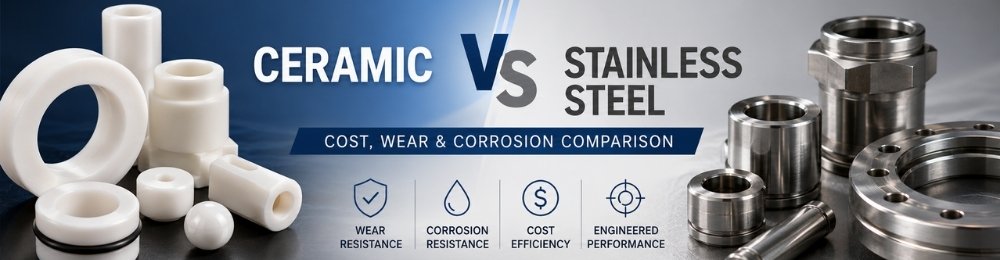
Choosing between ceramic and stainless steel is therefore not simply a comparison of hardness or price. The decision affects maintenance frequency, equipment uptime, contamination control, service life, and overall operating cost.
This guide compares both materials from an engineering perspective, focusing on practical material selection rather than theoretical material science.
What Makes Industrial Ceramics Different from Stainless Steel?
Although ceramics and stainless steel are often used in similar applications, they are fundamentally different classes of engineering materials.
Stainless steel is a metallic alloy whose properties are determined by its composition, heat treatment, and microstructure. It offers excellent toughness, ductility, and machinability, making it suitable for structural components and complex mechanical assemblies.
Industrial ceramics are inorganic, non-metallic materials produced through powder processing and high-temperature sintering. Their properties are primarily governed by crystal structure, grain size, purity, and sintering quality.
Unlike stainless steel, ceramics do not rely on plastic deformation to absorb energy. Instead, they achieve exceptional hardness, dimensional stability, chemical inertness, and wear resistance through strong atomic bonding.
This difference explains why the two materials often complement rather than replace each other.
Why Stainless Steel Is Still Widely Used
Despite the rapid growth of engineering ceramics, stainless steel remains indispensable across almost every manufacturing industry.
Its greatest advantages are not wear resistance or hardness, but manufacturing flexibility.
Engineers continue to select stainless steel because it offers:
- Excellent impact resistance
- High fracture toughness
- Easy machining
- Reliable welding performance
- Mature global supply chain
- Lower initial manufacturing cost
- Simple repair and maintenance
- Availability in numerous standardized grades
For large structural components or applications involving heavy shock loading, stainless steel often remains the preferred engineering solution.
Property Comparison
| Property | Industrial Ceramic | Stainless Steel |
|---|---|---|
| Hardness | Excellent | Moderate |
| Wear Resistance | Excellent | Good |
| Corrosion Resistance | Excellent | Good |
| Oxidation Resistance | Excellent | Good |
| Density | Lower | Higher |
| Electrical Conductivity | Insulator (most ceramics) | Conductive |
| Thermal Expansion | Low | Higher |
| High Temperature Stability | Excellent | Moderate |
| Dimensional Stability | Excellent | Good |
| Impact Resistance | Moderate to Low | Excellent |
| Toughness | Lower | High |
| Machinability | Difficult after sintering | Excellent |
| Repairability | Limited | Easy |
| Initial Cost | Higher | Lower |
| Lifetime Cost | Often Lower | Depends on Wear |
Cost Comparison
One of the most common misconceptions is that ceramic components are always “more expensive” than stainless steel. This conclusion is often based solely on purchase price rather than total ownership cost.
For many industrial applications, the initial purchase price represents only a small portion of the overall operating cost. Maintenance, replacement frequency, production downtime, labor, lubrication, and product contamination may contribute significantly more over the equipment’s service life.
A ceramic component may cost more to manufacture, particularly when precision grinding or laser machining is required. However, under severe wear or corrosive conditions, its longer service life can reduce replacement frequency and maintenance interventions. In applications where equipment downtime is costly, extending component life may offset the higher initial investment.
Engineers increasingly evaluate materials based on life cycle cost (LCC) rather than purchase price alone.
Wear Resistance Comparison
Wear is one of the primary reasons engineers replace stainless steel with ceramic components.
Although stainless steel provides good mechanical strength and moderate wear resistance, its surface gradually deforms under continuous friction. As the metal surface wears, roughness increases, friction rises, and dimensional accuracy begins to deteriorate.
Engineering ceramics behave differently. Their extremely high hardness and stable crystal structure make them much more resistant to abrasive particles, sliding contact, and surface deformation. Rather than relying on surface hardening treatments, ceramics naturally maintain their wear resistance throughout the component.
However, wear performance is not determined by hardness alone. Contact pressure, sliding speed, lubrication, particle size, and operating temperature all influence the actual wear rate.
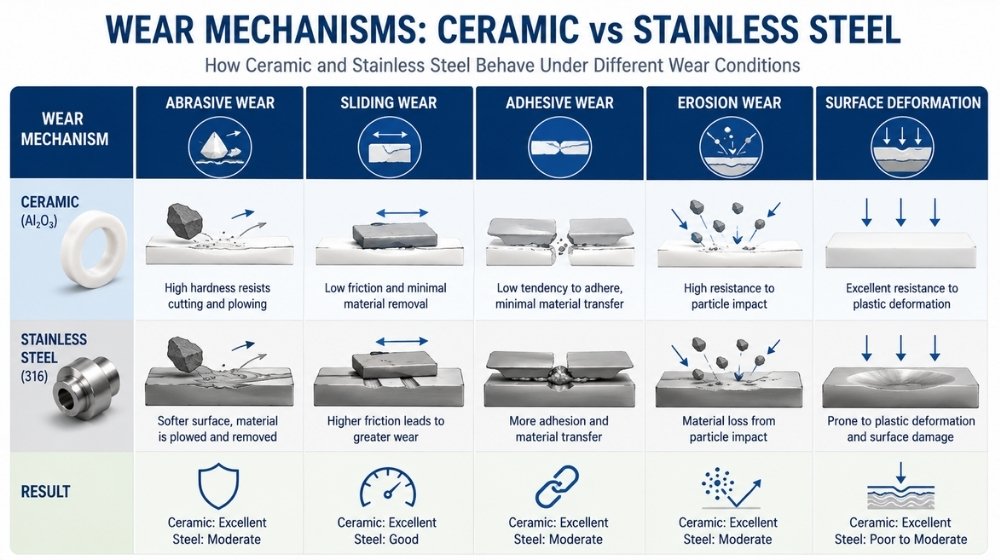
For this reason, engineers evaluate the complete tribological system rather than comparing material hardness alone.
Typical Wear Mechanisms
| Wear Mechanism | Ceramic | Stainless Steel |
|---|---|---|
| Abrasive Wear | Excellent | Moderate |
| Sliding Wear | Excellent | Good |
| Particle Erosion | Excellent | Moderate |
| Adhesive Wear | Excellent | Moderate |
| Surface Deformation | Very Low | Higher |
Engineering Insight
In many pump, valve, textile, and food-processing applications, component failure results from progressive surface wear rather than sudden fracture. Selecting a material with higher wear resistance can therefore improve dimensional stability and extend maintenance intervals.
Corrosion Resistance Comparison
Corrosion is another major factor influencing material selection.
Stainless steel forms a passive chromium oxide layer that protects the underlying metal. Under many industrial environments this passive film performs extremely well.
However, in chloride-containing media, acidic solutions, high-temperature chemicals, or stagnant environments, localized corrosion may gradually develop.
Typical corrosion forms include:
- Pitting corrosion
- Crevice corrosion
- Stress corrosion cracking
- Intergranular corrosion
Industrial ceramics do not rely on passive films for protection.
Most engineering ceramics are chemically stable and therefore resist oxidation, acids, alkalis, solvents, and seawater far more effectively than conventional stainless steels.
Nevertheless, no material is universally corrosion-proof. Certain ceramics may still be attacked by hydrofluoric acid, molten alkalis, or specific high-temperature chemical environments.
Material compatibility should always be verified according to the intended application.
Typical Corrosion Resistance
| Environment | Ceramic | Stainless Steel |
|---|---|---|
| Water | Excellent | Excellent |
| Salt Water | Excellent | Good |
| Acid Solutions | Excellent* | Good |
| Alkali | Excellent* | Good |
| Organic Solvents | Excellent | Excellent |
| Oxidation | Excellent | Good |
Note: * Depends on ceramic type and chemical concentration.
Temperature Performance
Temperature capability is often overlooked during material selection.
As operating temperatures increase, stainless steel gradually loses strength, while oxidation and thermal expansion become more significant.
Engineering ceramics maintain dimensional stability over a much wider temperature range because of their strong atomic bonding and lower thermal expansion.
This makes ceramics attractive for applications involving continuous high-temperature operation, thermal cycling, or environments where dimensional precision must remain stable.
However, temperature capability should be evaluated together with thermal shock resistance, since rapid heating or cooling may introduce stresses that differ from those experienced under steady-state conditions.
Precision Stability
Precision is increasingly important in modern industrial equipment.
Wear, thermal expansion, creep, and plastic deformation can gradually alter component dimensions, affecting sealing performance, bearing clearance, positioning accuracy, or product quality.
Because engineering ceramics exhibit high hardness, low thermal expansion, and excellent creep resistance, they generally maintain tighter dimensional tolerances during long-term operation.
For this reason, ceramic components are widely used in semiconductor equipment, precision pumps, textile machinery, and high-speed automation systems where dimensional consistency directly influences product performance.
Machining Comparison
Machining capability is another important consideration during material selection.
Stainless steel is relatively easy to machine using conventional turning, milling, drilling, and welding processes. Complex geometries can often be produced efficiently with standard manufacturing equipment.
Engineering ceramics require a different manufacturing approach. Most ceramic components are shaped before sintering and then finished using diamond grinding, laser machining, ultrasonic machining, or other precision processes after sintering.
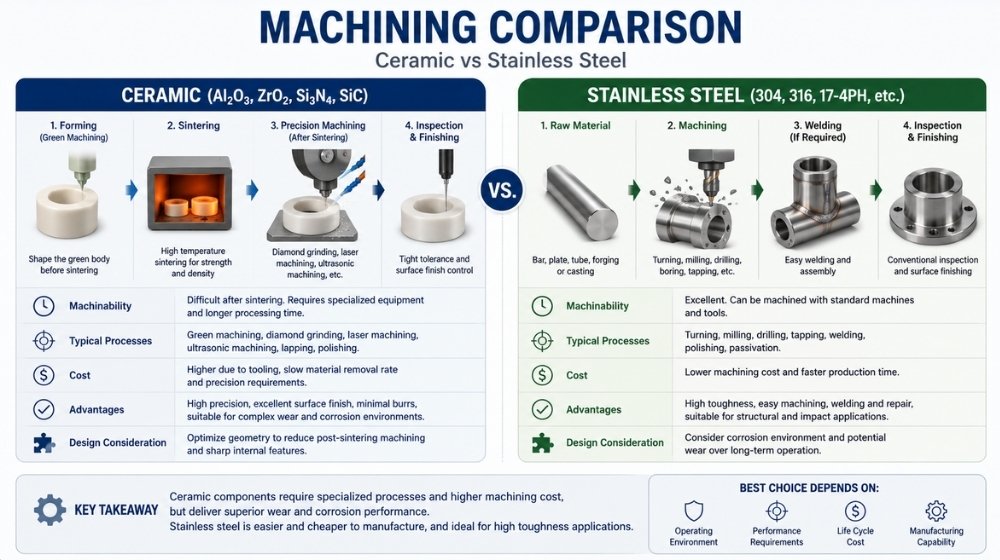
As a result, ceramic machining generally requires longer lead times and higher manufacturing costs, particularly for complex geometries or tight tolerances.
Nevertheless, in applications where component longevity outweighs machining cost, ceramics often provide better overall economic value over the product life cycle.
Typical Industrial Applications
Material selection should always begin with the application’s operating conditions rather than with the material itself.
Instead of asking “Which material is better?”, engineers usually ask “Which material performs better under this specific operating environment?”
For example, a chemical pump operating in abrasive slurry requires excellent wear and corrosion resistance, while a large structural frame carrying heavy impact loads requires high toughness and weldability.
The same material rarely performs best in every situation.
The following comparison summarizes typical industrial applications.
Typical Application Comparison
| Industry | Ceramic | Stainless Steel | Engineering Recommendation |
|---|---|---|---|
| Pump Components | ★★★★★ | ★★★★☆ | Ceramic for wear parts; stainless steel for housings |
| Mechanical Seal | ★★★★★ | ★★★☆☆ | Ceramic preferred for sealing faces |
| Valve Components | ★★★★★ | ★★★★☆ | Ceramic for seats and discs under severe wear |
| Textile Machinery | ★★★★★ | ★★★☆☆ | Ceramic guides greatly reduce yarn wear |
| Food Processing | ★★★★★ | ★★★★★ | Depends on wear conditions and hygiene requirements |
| Chemical Equipment | ★★★★★ | ★★★★☆ | Ceramic performs better in aggressive media |
| Semiconductor Equipment | ★★★★★ | ★★☆☆☆ | Ceramic preferred because of insulation and cleanliness |
| Mining Equipment | ★★★★★ | ★★★☆☆ | Ceramic wear parts extend maintenance intervals |
| Medical Devices | ★★★★☆ | ★★★★★ | Stainless steel still dominates structural instruments |
| General Machinery | ★★★☆☆ | ★★★★★ | Stainless steel remains more economical |
Engineering Insight
Many industrial systems combine both materials rather than replacing one with the other.
For example, a pump may use stainless steel for the housing while using ceramic for the seal faces, shaft sleeves, or wear rings. This combination balances manufacturing cost with long-term reliability.
When Ceramic Is the Better Choice
Engineering ceramics are often selected when reliability, dimensional stability, and wear performance are more important than structural toughness.
Typical situations include:
- Severe abrasive wear
- Corrosive chemicals
- High-speed sliding contact
- Electrical insulation
- High-temperature operation
- Precision positioning
- Low particle generation
- Long maintenance intervals
Under these operating conditions, the higher initial cost of ceramic components may be justified by lower maintenance requirements and longer service life.
When Stainless Steel Remains the Better Option
Despite the advantages of ceramics, stainless steel continues to be the preferred engineering material in many applications.
Typical situations include:
- Heavy impact loading
- Frequent mechanical shock
- Large structural components
- Complex welded assemblies
- Low-cost equipment
- Field repair requirements
- Large-volume production
Stainless steel also provides greater design flexibility because it can be machined, welded, bent, and repaired using conventional manufacturing methods.
Engineering Material Selection Matrix
Instead of selecting materials based on a single property, engineers often evaluate multiple performance requirements simultaneously.
The following matrix provides a simplified decision guide.
| Working Condition | Recommended Material |
|---|---|
| Severe Abrasion | Ceramic |
| Strong Corrosion | Ceramic |
| High Temperature | Ceramic |
| Electrical Insulation | Ceramic |
| Precision Positioning | Ceramic |
| Low Particle Generation | Ceramic |
| Heavy Impact | Stainless Steel |
| Structural Support | Stainless Steel |
| Complex Machining | Stainless Steel |
| Low Initial Budget | Stainless Steel |
Engineering Case Studies
Case Study 1 — Chemical Pump Seal Ring
A chemical processing pump originally used 316 stainless steel seal rings. Continuous exposure to corrosive media led to localized corrosion and accelerated sealing wear. After replacing the seal rings with alumina ceramic components, leakage frequency decreased and maintenance intervals became longer. The pump housing remained stainless steel, while only the high-wear sealing components were upgraded.
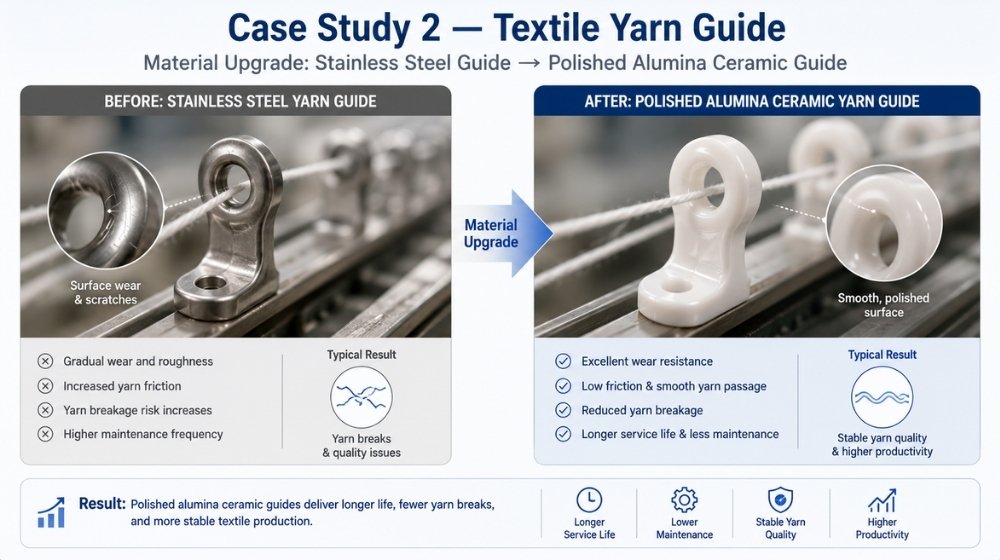
Case Study 2 — Textile Yarn Guide
High-speed textile machinery requires smooth yarn guidance with minimal surface wear. Stainless steel guides gradually developed surface scratches after prolonged operation, increasing yarn friction. Replacing them with polished alumina ceramic guides improved wear resistance and helped maintain stable yarn quality over extended production cycles.
Case Study 3 — Food Processing Valve Seat
A food-processing valve handling abrasive ingredients experienced frequent seat wear. Switching from stainless steel to zirconia ceramic valve seats reduced dimensional wear and extended maintenance intervals while maintaining hygienic operation.
Case Study 4 — Semiconductor Handling Equipment
Semiconductor manufacturing requires low particle generation and electrical insulation. Ceramic components such as alumina and aluminum nitride are widely used for wafer handling fixtures and insulating supports, while stainless steel is generally limited to external structural frames.
Engineering Misconceptions
Myth 1: Harder Materials Always Perform Better
Hardness is an important material property, but it is not the only factor determining service life. Components operating under heavy impact or vibration may fail because of fracture rather than surface wear. Material selection should consider wear, toughness, loading conditions, and overall system design instead of hardness alone.
Myth 2: Stainless Steel Never Corrodes
The term “stainless” does not mean corrosion-proof. Stainless steel performs well in many environments because of its passive chromium oxide layer, but chloride solutions, acidic chemicals, stagnant water, and elevated temperatures may still lead to localized corrosion or stress corrosion cracking.
Myth 3: Ceramics Can Replace Stainless Steel Everywhere
Engineering ceramics offer excellent wear and corrosion resistance, but they are not universal replacements. Components exposed to severe impact loading, large structural deformation, or frequent mechanical shock may still require stainless steel because of its superior toughness and ductility.
Myth 4: Material Price Determines Total Cost
Initial purchase price is only one part of the total ownership cost. Maintenance frequency, downtime, replacement labor, contamination risks, and service life often have a greater influence on long-term operating expenses. Engineers increasingly evaluate life cycle cost instead of purchase price alone.
Conclusion
Industrial ceramics and stainless steel are not competing materials but complementary engineering solutions.
Stainless steel continues to provide excellent toughness, machinability, and cost efficiency for structural components, while engineering ceramics excel in demanding environments involving severe wear, aggressive corrosion, electrical insulation, dimensional stability, and long service life.
Successful material selection is rarely based on a single property. Instead, engineers evaluate operating conditions, loading, temperature, chemical exposure, maintenance strategy, manufacturing capability, and life cycle cost before making a decision.
Rather than asking “Which material is better?”, a more practical engineering question is “Which material delivers the best long-term performance in this application?”
Choosing the right material at the design stage can reduce maintenance, improve equipment reliability, and lower the total cost of ownership throughout the product’s service life.
Frequently Asked Questions
1. Is ceramic always better than stainless steel?
No. Engineering ceramics are generally superior in wear resistance, corrosion resistance, electrical insulation, and dimensional stability, while stainless steel offers better toughness, impact resistance, and manufacturing flexibility. The most appropriate material depends on the operating environment, loading conditions, maintenance requirements, and overall system design rather than on a single material property.
2. Why are ceramic components usually more wear resistant?
Most engineering ceramics have extremely high hardness and strong atomic bonding, allowing them to resist abrasive particles and surface deformation more effectively than stainless steel. However, actual wear performance also depends on lubrication, contact pressure, sliding speed, operating temperature, and the characteristics of the wear media.
3. Can ceramic completely replace stainless steel in industrial equipment?
Not always. Ceramic components perform exceptionally well in high-wear and corrosive environments, but stainless steel remains advantageous for applications requiring high impact resistance, structural strength, welding, or field repair. Many industrial systems combine both materials to achieve the best balance between durability and manufacturing cost.
4. Which ceramic material is most commonly used as an alternative to stainless steel?
There is no single answer. Alumina is widely used because of its balance of cost and wear resistance. Zirconia is often selected where higher fracture toughness is required. Silicon carbide is suitable for highly abrasive environments, while silicon nitride performs well in demanding thermal and mechanical applications. Material selection should always match the application’s operating conditions.
5. Is ceramic always more expensive than stainless steel?
Ceramic components generally have a higher initial manufacturing cost because of powder processing, sintering, and precision machining. However, in applications where wear or corrosion limits component life, ceramics may reduce maintenance frequency and replacement costs. Evaluating life cycle cost often provides a more meaningful comparison than comparing purchase price alone.
6. Can ceramic components be machined after sintering?
Yes, but machining fully sintered ceramics is much more challenging than machining stainless steel. Diamond grinding, laser machining, ultrasonic machining, and other specialized processes are typically required. Therefore, component geometry should be optimized during the design stage whenever possible to minimize post-sintering machining.
7. Which material performs better in corrosive chemical environments?
Many engineering ceramics demonstrate excellent resistance to a wide range of acids, alkalis, and solvents because they are chemically stable. Stainless steel also performs well in many industrial environments, but certain chemicals—particularly chloride-containing media—may cause localized corrosion. Compatibility should always be confirmed based on the specific chemical composition and operating conditions.
8. Why do many precision machines use ceramic wear parts?
Precision equipment often requires consistent dimensions over long operating periods. Ceramic wear parts maintain surface finish and dimensional accuracy because they resist wear, thermal deformation, and corrosion. This stability can improve product consistency and reduce maintenance, particularly in high-speed or high-precision manufacturing processes.
9. How should engineers choose between ceramic and stainless steel?
Engineers should begin by defining the application’s operating conditions rather than comparing material specifications alone. Factors such as wear mechanism, corrosion environment, temperature, impact loading, precision requirements, maintenance strategy, manufacturing capability, and total ownership cost should all be evaluated before selecting a material.
10. What should OEM buyers evaluate when sourcing ceramic or stainless steel components?
OEM buyers should evaluate more than material certificates. Manufacturing consistency, dimensional tolerance capability, surface finish, inspection methods, quality management, production capacity, and technical support all influence long-term component performance. A supplier’s engineering expertise can be as important as the material itself.