

Introduction
When engineers begin a ceramic component project, one of the most common questions is: “Which ceramic material is the best?”
It sounds like a simple question, but technically it is the wrong question.
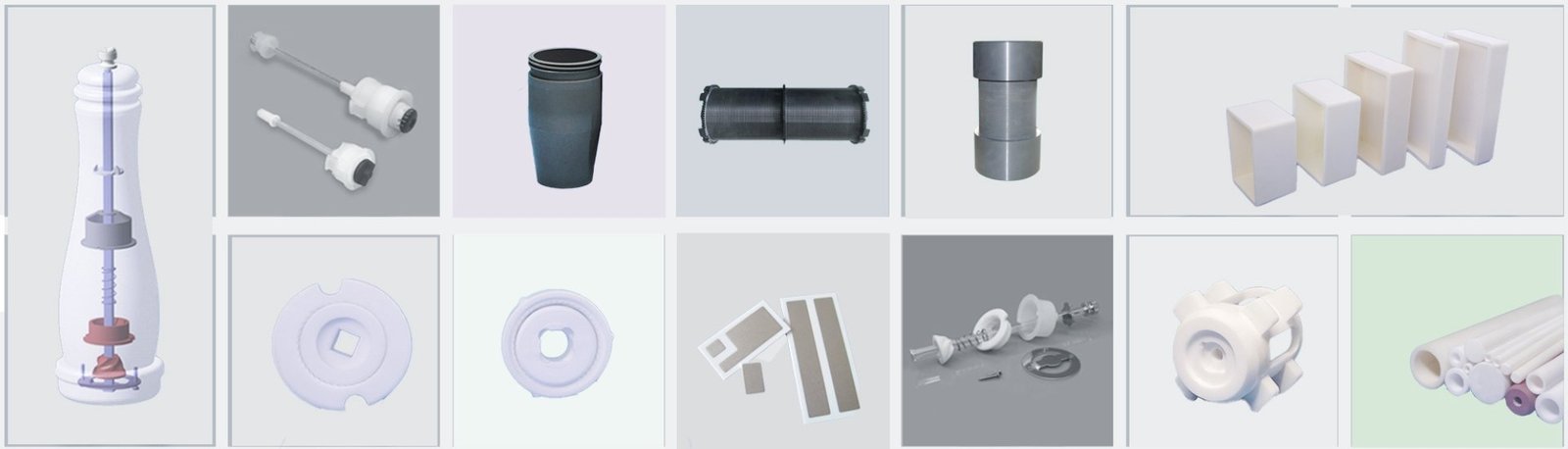
Alumina may be an excellent choice for electrical insulation and general wear resistance. Zirconia may be more suitable when fracture toughness and resistance to impact are important. Aluminum nitride may be selected when heat dissipation and electrical insulation are required at the same time. Silicon nitride can become attractive when mechanical reliability and thermal cycling are critical.
None of these materials is universally “the best.”
The right question is:
Which ceramic material best matches the actual requirements of this component?
That difference may appear small, but it changes the entire material-selection process.
A Material Can Be Excellent at One Property and Poor at Another
Engineering ceramics are inherently multi-property materials.
A material may provide excellent hardness but relatively limited fracture toughness. Another may provide better toughness but higher density or more demanding processing requirements. A ceramic with excellent thermal conductivity may not be the most economical choice when heat dissipation is not the primary requirement.
This is why comparing materials using only one property can lead to the wrong conclusion.
For example, a wear component should not be selected simply by asking which material is hardest. If the component also experiences impact, vibration, or cyclic loading, fracture toughness and structural design become equally important.
Similarly, choosing a substrate only by thermal conductivity may overlook electrical insulation, coefficient of thermal expansion, mechanical reliability, processing capability, and cost.
The highest value in a datasheet is not automatically the most valuable property in the application.
The Application Changes What “Best” Means
Consider four different ceramic components:
| Application | Main Requirement | Materials Commonly Considered |
|---|---|---|
| Electrical insulator | Insulation + stability + cost | Alumina |
| Power electronics substrate | Heat dissipation + insulation | AlN, Al₂O₃, Si₃N₄ |
| Wear or sealing component | Wear + fracture resistance | Alumina, Zirconia, SiC, ZTA |
| High-speed mechanical component | Strength + thermal shock + reliability | Silicon Nitride |
The purpose of this table is not to rank materials. It demonstrates why a universal ranking does not work.
For an electrical insulator, paying for extremely high thermal conductivity may provide little practical benefit.
For a power module, however, thermal conductivity can become a major design constraint.
For a valve or sealing component, wear resistance alone may not be sufficient because impact, pressure cycling, friction, and chemical exposure can also determine service life.
The “best” material therefore changes with the failure mode that the component must avoid.
Material Family Is Only the Starting Point
Another common mistake is treating a ceramic family as if every grade within that family behaves identically.
“Alumina,” “zirconia,” or “silicon nitride” is not always a complete material specification.
Different grades can have different purity, microstructure, additives, density, grain structure, mechanical properties, thermal behavior, and manufacturing characteristics.
For zirconia, stabilization systems and phase composition can strongly influence performance.
For alumina, purity and microstructure affect the balance between electrical, mechanical, thermal, and manufacturing properties.
For aluminum nitride, material quality and processing conditions are particularly important when high thermal conductivity is required.
For silicon nitride, the grade and processing route can significantly affect mechanical and thermal performance.
Therefore, material selection should eventually move from “material family” to “specific grade + manufacturing process.”
Manufacturing Can Change the Practical Choice
Material properties are only part of the engineering equation.
A ceramic component must eventually be formed, sintered, machined, inspected, and possibly metallized or joined to other materials.
A material that looks excellent on a datasheet may become difficult to manufacture when the component has:
- Thin walls
- Deep holes
- Tight dimensional tolerances
- Complex geometry
- Large flat surfaces
- Difficult surface-finish requirements
- Ceramic-to-metal joining requirements
This is particularly important for custom industrial ceramics.
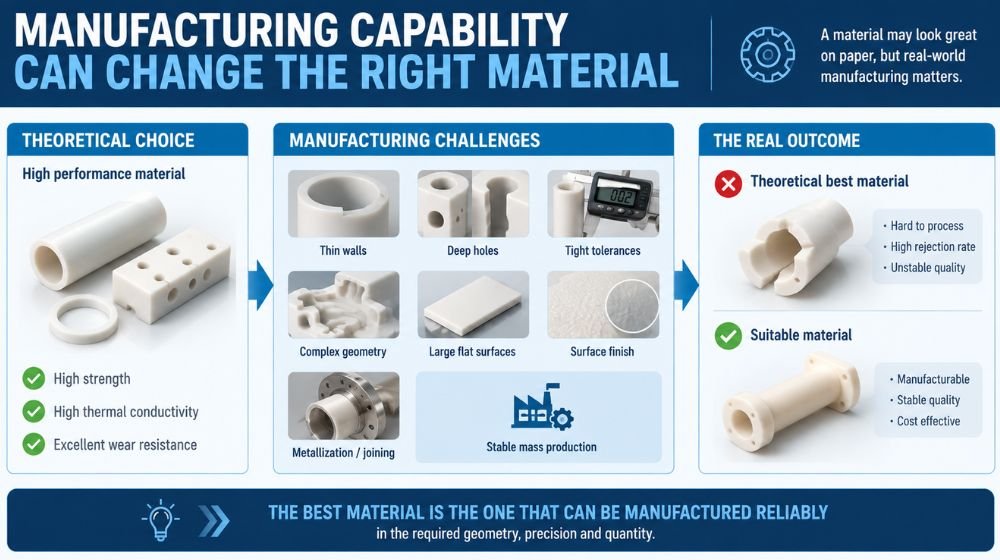
The question is not simply whether a material can meet a theoretical performance target. The more practical question is whether the selected material can be manufactured consistently in the required geometry and quantity.
A theoretically excellent material is not necessarily the best production material.
Start Material Selection From the Failure You Need to Prevent
A more reliable way to select ceramic materials is to start from the expected failure mode.
Instead of asking: Which ceramic is strongest?
Ask:
What is most likely to cause this component to fail?
For example:
Wear failure
If continuous abrasion is the dominant problem, hardness and wear resistance may receive greater priority.
Impact or fracture
If the component experiences impact or vibration, fracture toughness and structural design become more important.
Thermal failure
If the component experiences repeated heating and cooling, thermal shock resistance, thermal expansion, thermal conductivity, and geometry must be considered together.
Electrical failure
For an insulating component, dielectric performance, leakage behavior, operating temperature, surface condition, and contamination may all matter.
Chemical failure
For pumps, valves, seals, and fluid-handling components, the actual chemical medium, concentration, temperature, and exposure time should be considered—not simply a generic statement such as “corrosion resistant.”
This approach changes material selection from a property comparison into a failure-prevention process.
A Better Ceramic Material Selection Process
For most industrial ceramic projects, material selection can follow a practical sequence:
1. Define the operating environment
Temperature, pressure, load, speed, chemical medium, humidity, vacuum, electrical conditions and thermal cycling.
2. Identify the dominant failure mode
Wear, fracture, thermal shock, corrosion, electrical breakdown, dimensional instability, or another application-specific failure.
3. Define the critical properties
Select only the properties that directly influence the identified failure mode.
4. Compare suitable material families
Narrow the choices instead of comparing every available ceramic.
5. Check manufacturability
Evaluate forming, sintering, machining, surface finishing, inspection, metallization and joining requirements.
6. Consider total cost
Material price is only one part of the cost. Manufacturing difficulty, machining time, rejection risk, assembly requirements and service life can also influence the total economic result.
The final choice should therefore be the material that provides an appropriate balance between performance, reliability, manufacturability and cost.
Conclusion
There is no “best” ceramic material.
There is only a material that is better matched to a particular combination of load, temperature, environment, electrical requirements, failure mode, geometry, manufacturing process and cost target.
This is why experienced ceramic engineers do not select materials simply by looking for the highest hardness, highest strength, highest thermal conductivity, or highest temperature capability.
They start with the application.
They identify what can cause failure.
They determine which material properties actually matter.
Then they consider whether the material can be manufactured reliably in the required component design.
That is the real meaning of ceramic material selection.
The best ceramic material is not the material with the most impressive datasheet. It is the material that solves the actual engineering problem with sufficient reliability and reasonable manufacturing cost.
FAQ
Q1. Is there a single best ceramic material for industrial applications?
No. Different ceramic materials are optimized for different combinations of mechanical, thermal, electrical, chemical and manufacturing requirements. Material selection should therefore be based on the actual operating environment and dominant failure mode rather than a universal material ranking.
Q2. Is alumina better than zirconia?
Neither material is universally better. Alumina is widely used where electrical insulation, wear resistance, chemical stability and cost balance are important. Zirconia becomes attractive when fracture toughness and resistance to impact or mechanical stress are more important.
Q3. Should ceramic material selection start with material properties?
Material properties are important, but selection should start with the application. First define the operating environment and potential failure modes, then identify the material properties that directly affect those risks.
Q4. Can manufacturing capability affect ceramic material selection?
Yes. A material that meets the theoretical performance requirements may still be unsuitable if the required geometry, dimensional tolerance, surface finish, sintering stability, machining process or joining process cannot be controlled consistently in production.