

Introduction
For precision ceramic components, going from a drawing to a finished part is not simply a matter of choosing one machining method. The appropriate manufacturing route needs to be determined based on the part’s geometry, dimensional requirements, surface quality, and functional requirements.
In actual production, CNC machining and diamond grinding serve different primary purposes. CNC machining is better suited for complex geometries, holes, slots, threads, and other localized features, while grinding is more suitable for material removal and dimensional and form control. For parts with more demanding requirements for flatness, parallelism, or surface roughness, additional finishing processes such as lapping may be required after the preceding machining operations.
Therefore, the practical question is rarely simply “CNC or grinding?” More often, the question is:
How should different machining processes be combined to meet geometric accuracy, dimensional tolerances, and surface quality requirements while maintaining reasonable machining efficiency and cost?
This article explains the roles of CNC machining, grinding, and lapping, the types of requirements each process is best suited to address, and how to select an appropriate machining route based on the drawing requirements of a ceramic component.
What Do CNC Machining, Grinding, and Lapping Each Do?
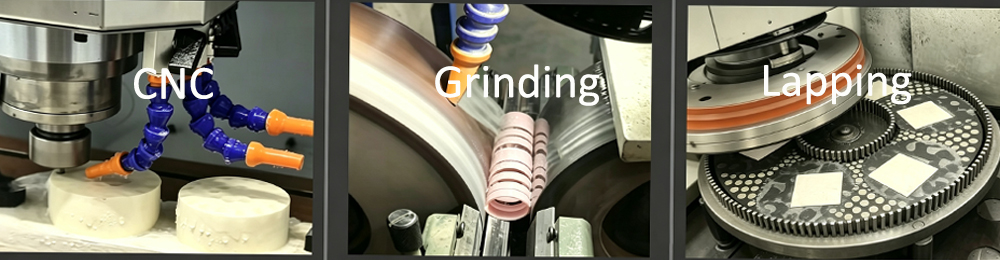
CNC machining, grinding, and lapping are not three completely interchangeable processes. Each serves a different purpose in precision ceramic manufacturing.
| Process | Key Strength | Typical Applications |
| 5-Axis CNC Machining | High geometric flexibility | Complex contours, holes, slots, threads, and other localized features |
| Diamond Grinding | Material removal and dimensional control | OD, ID, thickness, flat surfaces, and other regular geometries |
| Precision Lapping | Form and surface quality control | Flatness, parallelism, thickness consistency, and low surface roughness |
Simply put:
These processes are often complementary rather than competing options. The right choice depends on the geometry, dimensional requirements, and surface requirements of the component.
CNC vs. Grinding: What Is the Difference Between These Two Main Machining Processes?
CNC machining and diamond grinding are both major material-removal processes for ceramic components, but they are suited to different types of requirements.
CNC Machining: Better for Complex Geometries and Localized Features
Two Applications of CNC Machining in Ceramic Manufacturing
Ceramic CNC machining can be used both for forming complex structures in green ceramic bodies and for precision machining after sintering. For us, post-sintering 5-axis CNC machining is primarily used for precision machining of complex contours, holes, slots, threads, and other features.
Because sintered ceramics are hard and brittle, machining requires careful control of tooling, fixturing, and machining parameters.
Our CNC Machining Capability
Under suitable machining conditions, our CNC machining capability can achieve:
- Roundness: down to 0.02 mm
- Concentricity: down to 0.02 mm
- Hole diameter: down to 0.02 mm
We can also machine slots and threads in different sizes. The specific capability depends on the material, part geometry, feature size, and machining conditions.
Please note that these figures represent capability limits for specific features and do not mean that the same dimensional tolerance can be guaranteed for all parts. Actual achievable results need to be evaluated based on the specific drawing.
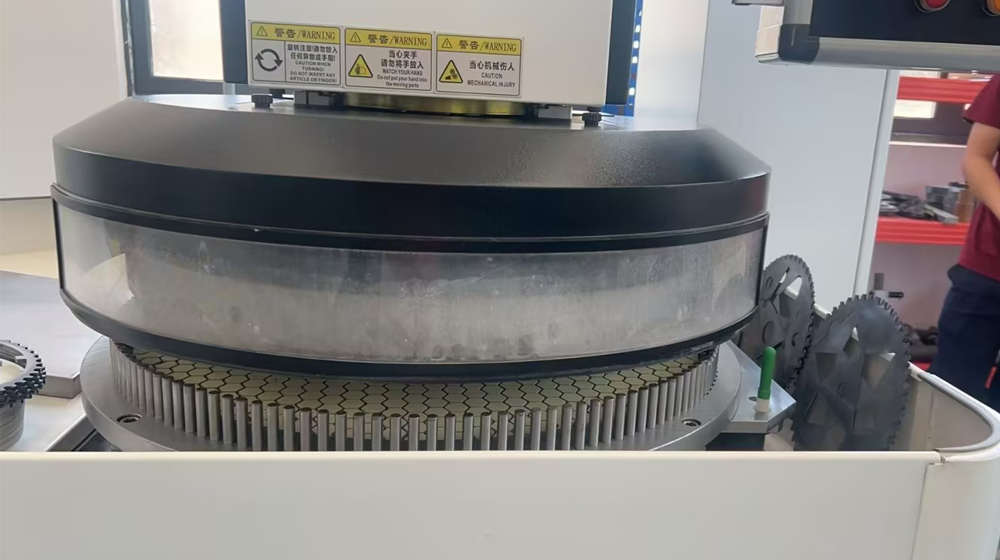
For precision ceramic CNC machining, the key is not simply to pursue a particular “minimum size,” but to select the appropriate machining method and process route based on the part’s geometry and functional requirements.
Grinding: Better for Material Removal and Dimensional Control
Diamond grinding is a commonly used material-removal process for precision ceramics. It can be used for both material removal and precision finishing to control critical dimensions and form.
Compared with CNC machining, grinding is better suited to regular features such as outside diameters, inside diameters, flat surfaces, and thickness.
Key advantages of grinding include:
- Relatively high material removal efficiency
- Suitable for dimensional control of regular geometries
- Suitable for OD, ID, flat surfaces, and thickness
- The machining stages can be adjusted according to the machining allowance and final accuracy requirements
For parts with relatively simple geometries but tighter dimensional tolerances, grinding is often a direct and effective machining method.
However, grinding also has limitations. Grinding can leave a characteristic surface texture, and if grinding forces and heat are not properly controlled, it may cause damage to the ceramic surface layer. Therefore, when a drawing specifies tighter requirements for flatness, parallelism, or surface roughness, additional finishing processes may be required.
Why Are CNC and Grinding Often Used Together?
CNC and grinding are not simply an either-or choice.
For example, a ceramic component may first undergo CNC machining to create complex holes, slots, contours, or other localized features, followed by grinding to control critical dimensions.
Simply put:
CNC machining creates complex geometries, while grinding further controls critical dimensions and form.
Therefore, a complex ceramic component may follow a process route such as:
CNC → Grinding
If the final part also requires strict flatness, parallelism, or surface roughness, an additional process may be required:
CNC → Grinding → Lapping
The appropriate machining route should be determined based on the drawing requirements and the specific role each process needs to perform.
When Is Lapping Needed?
CNC machining and grinding can address the geometry and dimensional requirements of most ceramic components. However, some functional surfaces require higher levels of form and surface quality.
In such cases, lapping may be introduced as a subsequent finishing process.
What Does Lapping Mainly Achieve?
Lapping uses loose abrasive particles to remove material in a controlled manner and can further improve:
- Flatness
- Parallelism
- Thickness consistency
- Surface roughness
Unlike CNC machining and grinding, which are mainly used for geometric forming and material removal, lapping focuses on bringing an already machined surface to its final requirements.
Therefore:
Lapping is primarily a precision finishing process rather than a process for forming complex geometries.
Which Parts May Require Lapping?
Lapping is particularly suitable for functional surfaces with demanding requirements for flatness, parallelism, or surface quality, such as precision ceramic substrates, flat ceramic components, and certain sealing or sliding surfaces.
Our lapping capabilities are mainly focused on flat components, with an emphasis on controlling flatness, parallelism, thickness consistency, and surface roughness.
For certain cylindrical components, suitable lapping or finishing solutions can also be evaluated based on the specific geometry and accuracy requirements.
However, although lapping can provide fine material removal and high surface quality, it is not suitable for removing large amounts of material or forming complex geometries.
Therefore, for a part requiring substantial material removal, the main material removal should normally be completed through CNC machining or grinding first, followed by lapping if required by the final specifications.
How to Determine the Machining Process from the Drawing Requirements
The most reliable way to select a ceramic machining process is to start with the specific drawing requirements and evaluate them one by one.
A practical evaluation sequence is:
Geometry → Dimensions → Surface Requirements → Application Requirements → Volume
Step 1: Evaluate Geometric Complexity
If the drawing includes:
- Freeform surfaces
- Complex contours
- Irregular slots
- Holes
- Cross holes
- Threads
- Other complex localized features
CNC machining is generally the first process to consider.
If the part mainly consists of:
- Flat surfaces
- Outside diameters
- Inside diameters
- Thickness
- Other regular geometries
grinding is generally more suitable for the main dimensional machining.
Step 2: Evaluate Dimensional and Form Requirements
If the drawing places particular emphasis on:
- Outside diameter
- Inside diameter
- Thickness
- Regular flat-surface dimensions
- Tight dimensional tolerances
grinding should be carefully evaluated.
If the part combines complex geometry with tight dimensional requirements, a combination of:
CNC + Grinding
may be appropriate.
For example:
CNC
Complete complex holes, slots, and contours
↓
Grinding
Control critical dimensions and form
Step 3: Evaluate Surface Requirements
If the drawing additionally specifies:
- Tight flatness
- Parallelism
- Thickness consistency
- Low surface roughness
- Functional surfaces that are sensitive to surface texture
lapping or polishing may need to be considered.
For precision flat ceramic components, lapping is particularly suitable for final control of form and surface quality.
Step 4: Check for Multiple Requirements
Many precision ceramic components cannot meet all requirements through a single machining process.
For example:
Complex geometry + tight dimensions
→ CNC + Grinding
Tight dimensions + high flatness / low Ra
→ Grinding + Lapping
Complex geometry + tight dimensions + high surface quality
→ CNC + Grinding + Lapping
Therefore, the actual machining route is often not about choosing one process from several options. Instead, it is about determining:
What role should each machining process play at each stage of manufacturing?
Step 5: Consider Volume and Cost
The machining route should also be evaluated based on production volume, material utilization, machining allowance, tooling, cutting tools, inspection, and other cost factors.
Why Does Precision Ceramic Machining Typically Cost More Than Metal Machining?
Ceramic machining typically costs more than conventional metal machining, and this is not simply because the ceramic material itself may be more expensive.
The main reasons include:
1. High Material Hardness
Advanced ceramics after sintering are highly hard and difficult to machine, and diamond tooling is typically required.
2. Lower Material Removal Efficiency
Compared with many metal materials, ceramic machining requires more careful control of material removal to reduce the risk of chipping, cracking, and subsurface damage.
3. Potentially More Machining Operations
A precision ceramic component may require a process route such as:
CNC → Grinding → Lapping → Inspection
Each additional process may increase machining time, equipment usage, tooling consumption, and inspection costs.
4. Higher Inspection Requirements
When a drawing specifies tight dimensional tolerances, flatness, parallelism, or surface roughness requirements, appropriate inspection and quality-control procedures are also required.
Therefore, the real cost of a ceramic component is influenced not by one individual machining operation, but by the entire manufacturing process chain.
At the same time, an appropriate process combination can help reduce costs.
Precision Ceramic Machining: Why Is Inspection Equally Important?
For precision ceramic components, machining capability and inspection capability are closely related.
A dimensional, flatness, or surface roughness requirement only has practical engineering value when it can be reliably and repeatedly measured and verified.
We use appropriate inspection methods for different inspection requirements, including:
| Inspection Item | Inspection Equipment | Main Purpose |
| Flatness | Optical flat / flatness testing equipment | Verify flatness requirements |
| Dimensions and height | Height gauge and other dimensional inspection equipment | Verify dimensions and height |
| Surface roughness | Surface roughness tester | Verify Ra and other surface quality requirements |
| Overall dimensions | Dimensional inspection equipment | Verify dimensions according to drawing requirements |
Precision is not only achieved through machining; it also needs to be verified through reliable inspection.
Inspection results are used not only for final acceptance, but also to provide feedback for machining parameter adjustments and machining allowance control.
Therefore, a complete precision ceramic manufacturing process should form a closed loop:
Drawing Requirements → Process Selection → Machining → Inspection → Process Feedback
rather than focusing only on what a machine is theoretically capable of achieving.
Frequently Asked Questions
Q1: Can a ceramic component be completed using only one machining process?
A1: Some simple parts can be, but for precision ceramic components, multiple machining processes are more common.
For example, a complex component may follow a process route such as:
Green machining (if applicable) → Sintering → Grinding → Lapping
The specific process route depends on the material, geometry, dimensions, and final requirements of the component.
Q2: Can CNC machining and grinding replace each other?
A2: They should not simply be viewed as interchangeable.
CNC machining is better suited for complex geometries, holes, slots, threads, and other localized features, while grinding is better suited for material removal and dimensional and form control of regular geometries.
In actual projects, the two processes are often used together.
Q3: When is lapping needed?
A3: When a component has completed its basic geometry and dimensional machining through CNC or grinding but still requires further control of:
- Flatness
- Parallelism
- Thickness consistency
- Surface roughness
lapping can be considered.
Lapping is generally a subsequent finishing process rather than a primary process for forming complex geometries.
Q4: What tolerances can ceramic machining achieve?
A4: There is no single tolerance value that applies to all ceramic components.
The achievable tolerance depends on:
- Ceramic material
- Part size
- Geometry
- Sintering behavior
- Machining process
- Fixturing method
- Inspection method
Therefore, critical dimensions should be evaluated individually based on the specific drawing requirements.
Conclusion
Choosing CNC machining, grinding, or lapping is not about finding one “best” process. It is about determining the most appropriate machining route based on the drawing requirements.
CNC machining is best suited for complex geometries, grinding is best suited for material removal and dimensional control, and lapping is best suited for final form accuracy and surface quality.
For complex precision ceramic components, these processes are often not competing alternatives. Instead, they perform different functions at different stages of manufacturing.
Start with the drawing, identify what the component needs, and then determine which combination of machining processes is best suited to achieve those requirements.
If you have a ceramic component that needs a machining-process evaluation, send us your drawing. We can help assess whether CNC machining, grinding, lapping, or a combination of these processes is most suitable based on the part geometry, dimensional tolerances, flatness, parallelism, and surface roughness requirements.