


Introduction
In the medical device industry, material selection has a direct impact on device safety, reliability, and service life. For many years, metals and polymers have remained the primary material choices for medical devices. However, advanced ceramics are being used increasingly in medical device components because of their excellent biocompatibility, good electrical insulation, wear resistance, and corrosion resistance.
From artificial joints and dental restorations to pacemakers and large medical imaging systems, the use of precision ceramic components continues to expand.
This article examines the growing use of advanced ceramics in medical devices from three perspectives: material properties, application areas, and material selection.
Why Are Ceramics Used in Critical Medical Device Components?
In medical applications, traditional metals and polymers may face performance limitations when exposed to demanding physiological or complex electromagnetic environments. Advanced ceramics are increasingly used in critical medical device components because of several important material characteristics.
High Wear Resistance and Low Wear
Advanced ceramics such as alumina and zirconia offer excellent wear resistance. Under long-term friction, they can maintain low wear rates and generate relatively little wear debris, making them suitable for certain artificial joints and other wear-resistant components.
Good Biocompatibility and Chemical Stability
Advanced ceramics generally offer good chemical stability and biocompatibility. Materials such as alumina and zirconia have a long history of use in specific medical applications and can be found in certain long-term implants and devices that come into contact with human tissue.
However, the biocompatibility of a medical device still needs to be evaluated based on the material composition, manufacturing process, and intended use environment of the final device.
Electrical Insulation and Hermetic Sealing
Some advanced ceramics, particularly alumina, have high volume resistivity and can provide stable electrical insulation. Ceramics can combine electrical isolation with reliable hermetic sealing in assemblies produced through ceramic-to-metal brazing, making them suitable for ceramic feedthroughs, sensor packages, and other medical electronic components.
In addition, some non-magnetic ceramics can be used in structural and moving components operating in strong magnetic fields, such as MRI systems, helping to minimize interference with the magnetic field and imaging process.
Corrosion Resistance and Sterilization Compatibility
Alumina and zirconia generally offer good thermal and chemical resistance. They can withstand various commonly used sterilization methods and maintain relatively stable properties under appropriate sterilization conditions. Their actual resistance, however, needs to be evaluated based on the material, component design, and sterilization parameters involved.
By comparison, some metals may face corrosion issues under long-term exposure to body fluids or certain sterilization conditions, while some polymers may experience changes in properties after repeated sterilization. Therefore, in specific applications, the chemical resistance and sterilization stability of ceramics can be important factors in material selection.
Where Are Advanced Ceramics Used in Medical Devices?
Dental Restorations: A Balance of Aesthetics and Function
Core Material: Medical-grade zirconia (ZrO₂)
Why It Is Used: Zirconia ceramics offer good mechanical properties and biocompatibility, along with increasingly improved aesthetic performance. They are now widely used in dental crowns and other dental restorations.
All-ceramic crowns and bridges can also serve as alternatives to certain metal-based restoration solutions, particularly when aesthetics or specific concerns related to metal use are important.
Artificial Joints: High-Load Implants
Core Material: Zirconia-toughened alumina (ZTA)
Why It Is Used: ZTA ceramics are widely used for femoral heads and liners in total hip replacement. In specific wear tests conducted under simulated physiological conditions, studies have reported steady-state wear rates of approximately 0.1 mm³ per million cycles.
Their low-wear characteristics make ZTA suitable for joint components that require long-term wear resistance and load-bearing performance.
Active Implantable Medical Devices
Key Components: Pacemakers, deep brain stimulators (DBS), cochlear implants, ceramic feedthroughs, and multilayer ceramic capacitors for hermetic sealing and signal isolation.
Why It Is Used: In pacemakers, deep brain stimulators, and cochlear implants, ceramic feedthroughs are important components. They take advantage of the electrical insulation and hermetic sealing capabilities of precision ceramics to provide reliable hermetic packaging while electrically isolating signals between the inside and outside of the body.
Surgical Instruments
Core Materials: Al₂O₃-TiN composite ceramics and silicon nitride (Si₃N₄)
Why It Is Used: Al₂O₃-TiN composite ceramics incorporate a TiN conductive phase to provide electrical conductivity while retaining the thermal and chemical stability associated with ceramic materials. Related research has shown that these ceramic electrodes can reduce the electrode-tissue interface temperature and tissue adhesion compared with conventional stainless steel electrodes.
Medical Imaging Equipment (MRI / CT / X-ray)
Core Materials: High-purity alumina (>99.6%) and silicon nitride
Why It Is Used: In CT and X-ray imaging equipment, high-purity alumina can be used in components such as electrical insulation supports and vacuum components. In strong magnetic fields, such as those found in MRI systems, non-magnetic ceramics can also be used for certain moving and structural components.
Silicon nitride offers high strength, wear resistance, and non-magnetic properties, making it useful in certain precision motion systems.
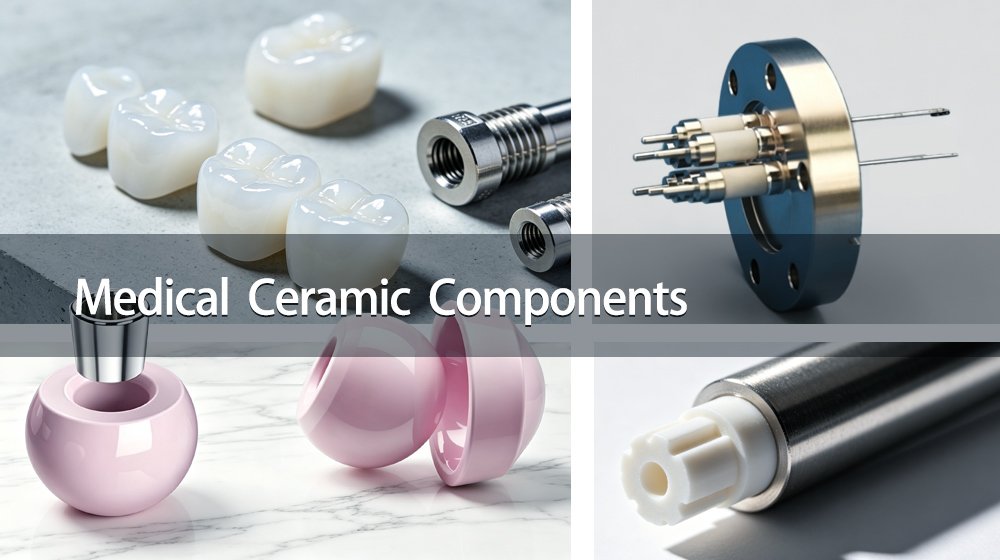
Key Ceramic Materials Used in Medical Devices
The performance requirements for advanced ceramic materials can vary significantly depending on the application. Based on our experience with ceramic projects, the table below summarizes four commonly used advanced ceramics, their key characteristics, and typical medical applications.
| Ceramic Material | Key Advantages | Typical Medical Applications |
| Alumina 99.6% / 99.9% | High hardness, good electrical insulation, relatively controllable cost | Vacuum insulation components, sensor housings, feedthrough substrates |
| Zirconia 3Y-TZP | High fracture toughness, flexural strength >800 MPa | Artificial joints, dental restorations, minimally invasive surgical tools |
| Zirconia-Toughened Alumina (ZTA) | Balance of hardness and toughness | High-load implants, hip joint femoral heads |
| Silicon Nitride (Si₃N₄) | Non-magnetic, good fatigue resistance, wear resistance | Precision guides, non-magnetic bearings, spinal fusion cages |
Material Selection Consideration: The main advantages of ceramics include wear resistance, electrical insulation, and chemical stability. However, their inherent brittleness means that they are not suitable for every load-bearing application. For components that require significant plastic deformation or must withstand substantial impact, metals may offer advantages.
Conclusion
The use of advanced ceramics in medical devices continues to expand because their electrical insulation, wear resistance, chemical stability, and other material properties can meet combinations of requirements that are difficult for traditional materials to achieve simultaneously.
However, ceramics are not suitable for every medical application. Material selection needs to take into account the specific operating environment, structural requirements, and performance requirements of the device.
For ceramic components, material selection is only the first step. Structural design, assembly methods, and manufacturing processes also affect the final reliability of the component. For example, sharp corners, localized stress concentrations, or inappropriate assembly methods can increase the risk of ceramic cracking. Considering the characteristics of ceramic materials early in product development can therefore help reduce subsequent design and manufacturing risks.
FAQ: Ceramics in Medical Devices
Q1: Which ceramic materials are most commonly used in medical devices?
A1: From our experience with ceramic projects, commonly used advanced ceramics in medical devices include high-purity alumina (Al₂O₃, purity ≥99.6%), zirconia (ZrO₂, 3Y-TZP), zirconia-toughened alumina (ZTA), and silicon nitride (Si₃N₄).
Q2: What are the biggest machining challenges for ceramic components used in medical devices?
A2: Ceramics have high hardness and relatively low ductility, so precision machining requires careful control of equipment, tooling, and process parameters. This is particularly important when machining thin-walled parts, micro-holes, and complex geometries.
With appropriate grinding, cutting, and precision machining processes, edge defects such as chipping and microcracks can be effectively controlled, allowing many precision ceramic components to meet their dimensional and surface-finish requirements.
Q3: Do you have relevant certifications for ceramic components used in medical devices?
A3: We are currently certified to the ISO 9001 quality management system and have experience in the manufacturing and quality control of precision ceramic components.
For medical device projects, specific certification and validation requirements generally depend on the intended application, the type and duration of contact with the human body, and the target market. Based on project requirements, we can support material testing, dimensional inspection, and relevant validation activities, as well as provide the necessary technical support.