

Introduction
Zirconia ceramic is widely recognized as one of the toughest engineering ceramics available today. Unlike traditional ceramics that are hard but brittle, zirconia combines high hardness, high strength, and exceptional fracture toughness through a unique mechanism known as transformation toughening. In materials engineering, toughness describes a material’s ability to resist crack propagation after damage has initiated.
Typical zirconia ceramics exhibit fracture toughness values of approximately 6.5–11 MPa·m½, significantly higher than alumina ceramics, silicon carbide ceramics, and glass. This superior resistance to crack propagation makes zirconia an ideal material for demanding applications such as mechanical seals, bearings, medical components, and precision wear parts.
This article explains why zirconia ceramic is so tough, how transformation toughening works, and where these remarkable properties create value in real-world applications. To learn more about its composition, properties, and typical applications, explore our zirconia ceramic guide.
Why Is Zirconia Ceramic So Tough
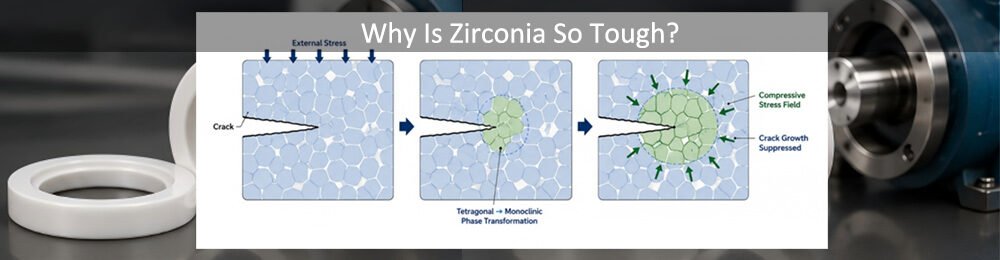
Zirconia ceramic owes its toughness to a unique phenomenon called transformation toughening. When a crack begins to form, stress concentrated at the crack tip triggers a crystal phase transformation in nearby zirconia grains. This transformation causes a slight volume expansion that generates compressive stress around the crack, effectively slowing or preventing further crack growth.
As a result, zirconia achieves fracture toughness values that are typically two to three times higher than those of alumina ceramics, making it one of the toughest commercially available oxide ceramics.
Hardness vs. Toughness: A Critical Difference
Before discussing zirconia’s toughening mechanism in detail, it’s important to understand the difference between hardness and toughness.
Hardness
Hardness measures a material’s resistance to scratching, indentation, or wear.
For example:
- Diamond exhibits extremely high hardness.
- Sapphire glass offers excellent scratch resistance.
Toughness
Toughness refers to a material’s ability to absorb energy and resist crack propagation before fracturing. A tough material can withstand impact, vibration, and stress concentrations without catastrophic failure.
Many traditional ceramics possess high hardness but relatively low toughness. Once a crack forms, it can propagate rapidly through the material, resulting in sudden failure. Understanding how cracks initiate and propagate is an important part of ceramic failure analysis.
By contrast, zirconia ceramic successfully combines high hardness with exceptional fracture toughness. This distinction is particularly important in engineering applications, where components are more likely to fail because cracks propagate than because their surfaces are scratched. As a result, fracture toughness often has a greater influence on long-term reliability than hardness alone.
So how does zirconia achieve this rare combination of hardness and toughness? The answer lies in its unique transformation toughening mechanism.
How Transformation Toughening Works
The secret behind zirconia’s toughness lies in its microscopic crystal structure. This unique self-protective mechanism is known as transformation toughening.
Metastable Tetragonal Phase
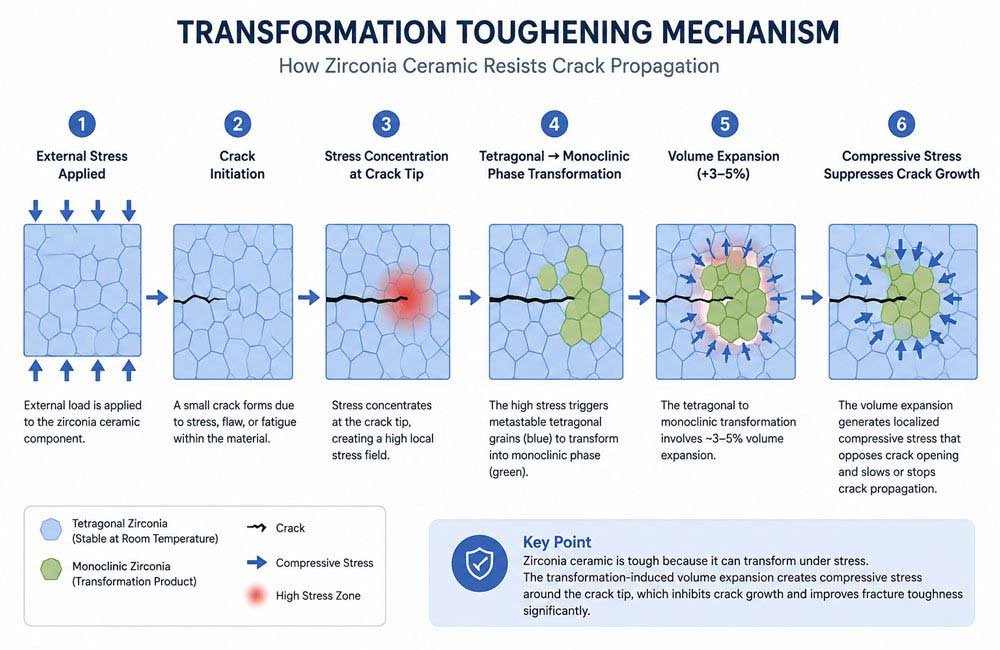
At room temperature, zirconia ceramics contain a large number of metastable tetragonal zirconia grains.
These grains act like tiny compressed springs or dormant guardians. Under normal conditions, they remain stable while storing internal energy that they release when stress triggers phase transformation.
Stress-Induced Transformation
When external stress causes a crack to form, a highly concentrated stress field develops at the crack tip.
This stress activates the surrounding tetragonal zirconia grains, causing them to transform into a more stable monoclinic crystal structure.
Crack Suppression
The transformation from the tetragonal phase to the monoclinic phase is accompanied by approximately 3–5% volume expansion. This expansion generates localized compressive stress around the crack tip, creating a natural barrier to crack propagation.
This transformation toughening mechanism improves zirconia toughness through two complementary effects:
Compressive Stress
The localized compressive stress counteracts the tensile forces that would normally drive crack growth, helping prevent the crack from propagating further.
Energy Absorption
The phase transformation itself consumes part of the applied mechanical energy, leaving less energy available for crack extension.
Together, these two effects give zirconia its exceptional fracture toughness and remarkable resistance to crack propagation.
How Tough Is Zirconia Ceramic
Fracture Toughness Comparison
Engineers commonly use fracture toughness to evaluate a material’s resistance to crack propagation. The table below compares zirconia ceramic with several commonly used engineering materials.
| Material | Fracture Toughness (MPa·m½) | Relative Toughness |
| Zirconia Ceramic | 6.5–11 | Very High |
| Alumina Ceramic | 3–5 | Moderate |
| Silicon Carbide Ceramic | 3–4 | Moderate |
| Sapphire Glass | 2–3 | Low |
| Ordinary Glass | 0.7–0.8 | Very Low |
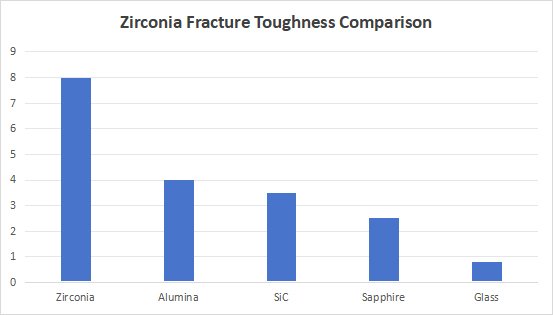
Compared with other commonly used engineering ceramics, zirconia offers significantly higher fracture toughness, resulting in greater resistance to crack initiation and propagation. These values help explain why many engineers refer to zirconia as the “steel of ceramics.”
Zirconia Ceramic Properties: A Performance Breakdown
Fracture toughness is only one aspect of zirconia’s performance. To understand why zirconia performs so well in engineering applications, it is also important to consider its overall mechanical properties.
| Property | Typical Value |
| Density | ~6.0 g/cm³ |
| Fracture Toughness | 6.5–11 MPa·m½ |
| Flexural Strength | ≥750 MPa |
| Vickers Hardness | 1070–1230 HV |
| Compressive Strength | 1750–2500 MPa |
| Water Absorption | 0% |
| Corrosion Resistance | Excellent |
| Wear Resistance | Excellent |
Most engineering materials require trade-offs.
– Tool steels offer excellent toughness but lower hardness.
– Alumina ceramics provide high hardness but relatively low toughness.
– Glass offers high hardness but poor fracture resistance.
Zirconia ceramics, on the other hand, successfully combine high hardness with excellent fracture toughness. Thanks to transformation toughening, they also provide superior resistance to impact damage, cyclic loading, and crack propagation compared with many other engineering ceramics.
This balanced property profile explains its success in demanding industrial applications. Choosing the right engineering ceramic ultimately depends on the operating environment, mechanical loading, and performance requirements. Our industrial ceramic materials guide provides a practical comparison of common ceramic materials.
Advantages and Limitations of Zirconia Ceramic
Advantages
- Exceptional fracture toughness
- High flexural strength
- Excellent wear resistance
- Outstanding corrosion resistance
- Good biocompatibility
- Low coefficient of friction
- Long service life
Limitations
- Higher cost than alumina ceramic
- Lower thermal conductivity than silicon carbide or aluminum nitride
- Limited thermal shock resistance
- More difficult and expensive to machine
Understanding these strengths and limitations helps engineers select the most appropriate ceramic material for a given application.
Where Does Zirconia Toughness Make a Difference?
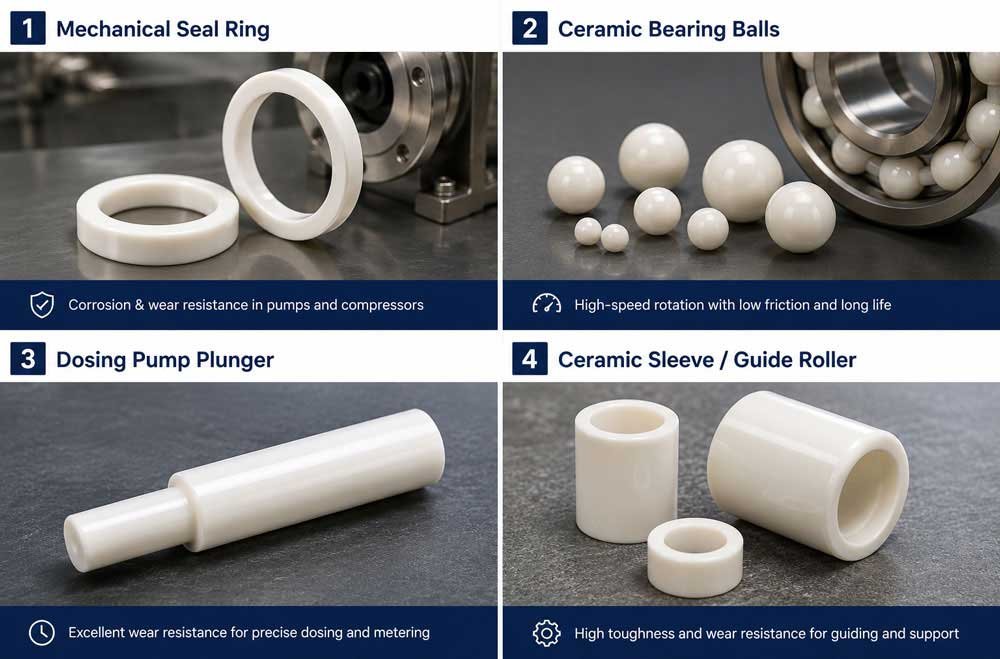
High fracture toughness allows zirconia ceramic to perform reliably in applications where more brittle engineering ceramics are prone to edge chipping, impact damage, or premature fracture. The following examples illustrate how zirconia’s toughness contributes to longer service life and improved mechanical reliability across different industries.
Mechanical Seal Rings
Mechanical seal rings operate under continuous friction, pressure fluctuations, and occasional dry-running conditions. These demanding environments can cause edge chipping or crack initiation in brittle materials. Thanks to its high fracture toughness, zirconia ceramic resists crack propagation while maintaining excellent wear and corrosion resistance. This makes zirconia an excellent material for ceramic seal rings used in demanding pump and sealing systems.
Ceramic Bearings
Ceramic bearings are often subjected to repeated contact stress and occasional impact during operation. Zirconia’s high fracture toughness helps reduce the risk of chipping and premature failure while retaining excellent wear resistance, corrosion resistance, electrical insulation, and low-friction performance.
Ceramic Plungers and Sleeves
Plungers and sleeves experience repeated mechanical loading and sliding wear during every operating cycle. Zirconia combines excellent wear resistance with high fracture toughness, making it an ideal material for ceramic plungers and sleeves used in pumps and high-pressure fluid handling equipment.
Medical and Dental Components
Dental restorations and medical components must withstand repeated mechanical loading over long service periods. Zirconia’s high fracture toughness improves resistance to chipping and fracture, while its excellent biocompatibility makes it a preferred material for dental crowns, implants, and surgical components.
Precision Wear Components
Guide rollers, nozzles, and textile components often operate under continuous wear and localized mechanical stress. Zirconia’s combination of wear resistance and fracture toughness helps maintain dimensional stability while reducing the risk of cracking during long-term service.
Conclusion
The exceptional toughness of zirconia ceramic comes from transformation toughening, a unique mechanism that helps prevent crack propagation under stress. Combined with high strength and wear resistance, this makes zirconia one of the most reliable advanced ceramics for demanding engineering applications.
If you’re evaluating zirconia ceramic for your project, our engineering team can help with material selection and custom manufacturing support.
Frequently Asked Questions
Q1: What is the fracture toughness of zirconia ceramic?
A1: Typical zirconia ceramics have a fracture toughness of approximately 6.5–11 MPa·m½. The exact value varies depending on the zirconia grade and manufacturing process.
Q2: Zirconia vs. alumina: which ceramic is tougher?
A2: Zirconia is tougher than alumina because zirconia undergoes transformation toughening, which generates compressive stress around crack tips and slows crack propagation. Alumina lacks this mechanism, making it more susceptible to brittle fracture.
Q3: Is zirconia the toughest ceramic?
A3: No. While some advanced ceramic composites may achieve higher toughness under specific conditions, zirconia is widely regarded as one of the toughest commercially available engineering ceramics because of its unique transformation toughening mechanism.
Q4: Can zirconia ceramic crack?
A4: Yes, zirconia ceramic can crack if subjected to excessive impact, improper installation, severe thermal shock, or stresses beyond its design limits. However, compared with most engineering ceramics, zirconia is significantly more resistant to crack initiation and propagation due to its transformation toughening mechanism.
Q5: Does zirconia ceramic have good thermal shock resistance?
A5: Not particularly. Although zirconia has excellent fracture toughness, its thermal shock resistance is limited because of its relatively low thermal conductivity and high coefficient of thermal expansion.
Q6: Can zirconia ceramic parts be custom manufactured?
A6: Yes. Zirconia ceramic parts can be custom manufactured in a wide range of shapes, sizes, and tolerances to meet specific application requirements. Common components include seal rings, plungers, sleeves, bearings, and other precision ceramic parts.