

Introduction
When discussing advanced ceramics in electronic packaging, many people first think of ceramic substrates. Whether power modules should use Al₂O₃ or AlN, and whether DBC or AMB technology is more suitable, has already been extensively discussed in technical literature.
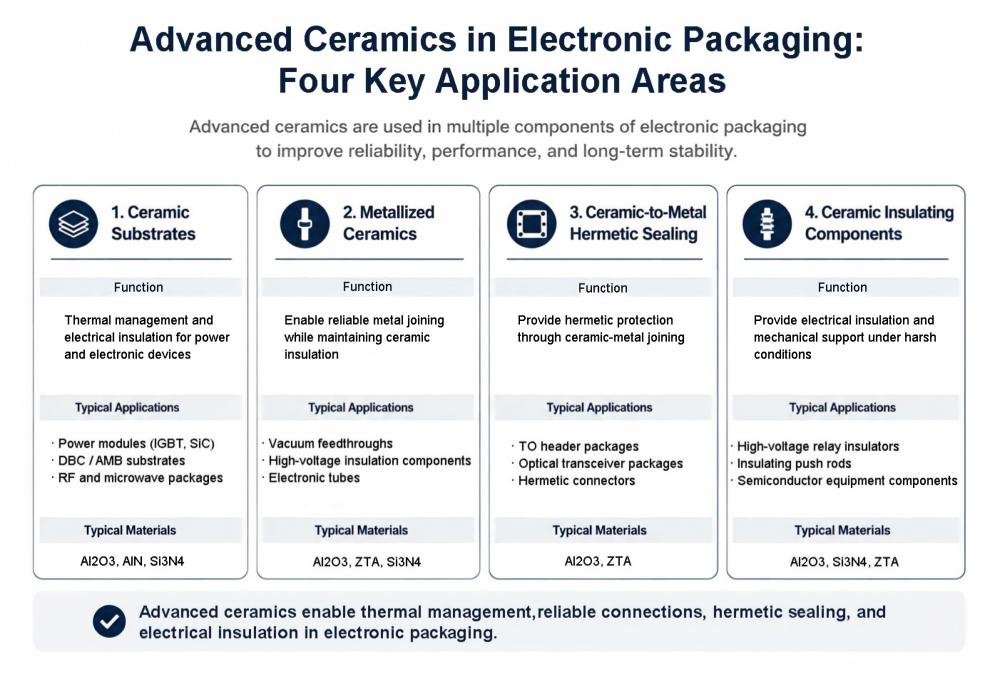
This article does not focus on ceramic substrates themselves. Instead, it explores three other equally important categories of advanced ceramic components used in electronic packaging: Metallized ceramics, ceramic-to-metal hermetic sealing components, and ceramic insulating components.
Whether used in power modules, optical communication devices, or high-voltage relays, these ceramic components directly influence package reliability and long-term performance.
Through typical product examples, this article explains their applications, material selection considerations, and key manufacturing technologies.
Why Are Advanced Ceramics Needed in Electronic Packaging?
In recent years, electronic packaging has placed increasingly demanding requirements on material performance. These requirements are mainly driven by three major trends.
Increasing Power Density
With the growing adoption of SiC power devices in electric vehicles, higher power density and higher operating temperatures are creating greater challenges for packaging materials.
Selecting the right ceramic material for power modules requires balancing thermal conductivity, reliability, and cost. A detailed comparison of ceramic materials for power modules can help engineers choose the most suitable solution for their applications.
Organic materials such as epoxy resins and PPS may experience significant performance degradation above 200°C. Ceramic materials, however, can maintain stable electrical insulation performance even under elevated temperature conditions.
Limited Space for Heat Dissipation
As electronic devices become smaller and power density continues to increase, heat flux per unit area rises accordingly, placing higher demands on thermal management.
In applications such as laser devices and RF power amplifiers, traditional organic packaging materials typically have thermal conductivities of only 0.2–0.5 W/m·K, which can become a major thermal bottleneck.
By comparison, AlN ceramics offer thermal conductivity of 170–230 W/m·K, which is approximately two orders of magnitude higher. Therefore, AlN is widely used in high thermal conductivity electronic packaging applications.
Increasing Requirements for Long-Term Reliability
Automotive power modules may require more than one million power cycles, while aerospace components may require more than 20 years of hermetic reliability.
Ceramic materials exhibit excellent creep resistance and fatigue resistance, providing significant advantages under long-term thermal cycling conditions.
These three trends are driving ceramics from being an optional material to an essential solution.
Beyond ceramic substrates, critical components such as heat spreaders, feedthroughs, sealing connectors, and insulating push rods are increasingly adopting advanced ceramics.
Common Advanced Ceramic Materials in Electronic Packaging
Electronic packaging commonly uses advanced ceramics including Al₂O₃, AlN, Si₃N₄, and ZTA. These materials have different characteristics in thermal conductivity, mechanical strength, electrical insulation, and cost, making them suitable for different packaging applications. For more information about ceramic material properties and selection considerations, please refer to our advanced ceramic materials guide.
The following table provides a brief comparison of these four commonly used materials.
| Material | Key Characteristics | Main Applications |
| Al₂O₃ | The most widely used electronic packaging ceramic with balanced overall performance and cost efficiency | General insulation, metallization, hermetic sealing, structural components |
| AlN | High thermal conductivity and low thermal expansion coefficient ceramic insulator (170–230 W/m·K) | High thermal conductivity and high power density electronic packaging |
| Si₃N₄ | High-strength structural ceramic with excellent fracture toughness | High reliability, thermal shock resistance, and vibration-resistant applications |
| ZTA | Enhanced strength and crack resistance compared with Al₂O₃ | High-strength, high-reliability insulating and hermetic structural components |
There is no single “best” ceramic material for all applications. The right choice depends on the specific requirements of each application.
Although different packaging scenarios may require different materials, Al₂O₃ remains the most widely used advanced ceramic material in electronic packaging due to its mature manufacturing process, balanced properties, and cost-effectiveness.
Material selection not only affects device performance but also directly influences subsequent metallization, sealing processes, and long-term reliability.
Typical Applications of Advanced Ceramics in Electronic Packaging
Beyond ceramic substrates, electronic packaging also relies on various advanced ceramic functional components.
Based on their different roles, this article focuses on three typical application categories:
- Metallized ceramicsfor reliable metal connections
- Ceramic-to-metal hermetic sealingfor high-reliability packaging
- Ceramic insulating componentsfor high-voltage insulation and mechanical support
Metallized Ceramics
Ceramics themselves are electrically insulating and cannot be directly soldered or brazed to metals. To enable reliable metal joining, a metallic layer must first be applied to the ceramic surface. The most commonly used process is Mo-Mn metallization, which creates a solderable metal layer on the ceramic surface for subsequent brazing or joining processes.
Metallized ceramics are widely used in hermetic packages, electrical feedthroughs, and high-voltage insulation components, providing reliable connections between ceramic and metal components in demanding environments. Compared with glass or plastic sealing solutions, metallized ceramics generally provide higher mechanical strength and better long-term hermetic reliability.
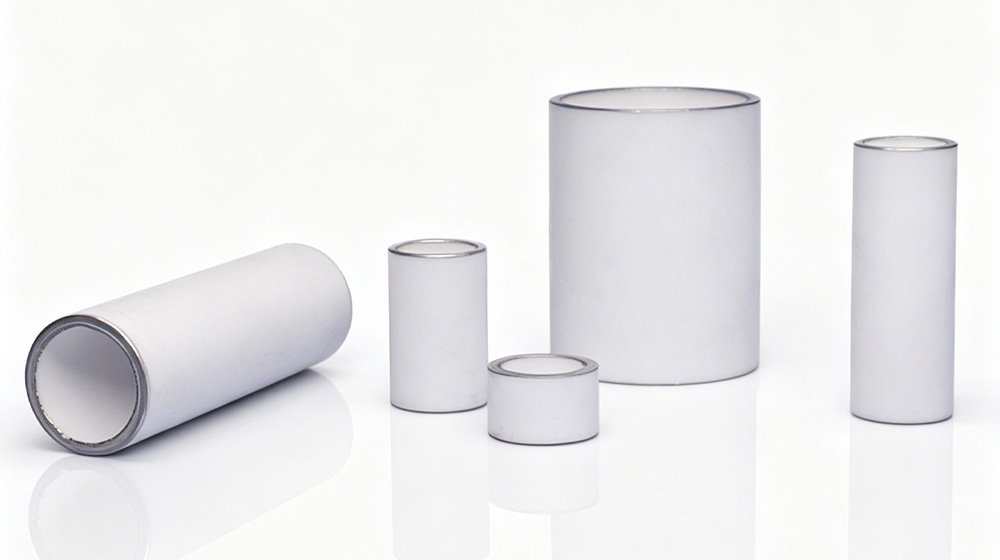
Metallized Ceramic Rings/Tubes
(Vacuum Feedthroughs and High-Voltage Insulation Components)
Product form
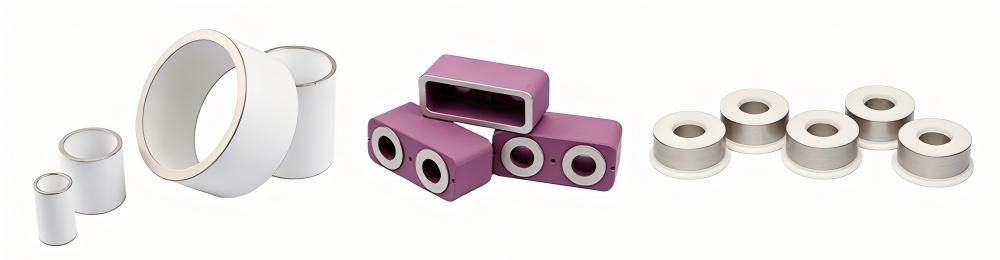
Precision ceramic components such as alumina ceramic rings and tubes. The surfaces are metallized to enable reliable joining with metal components, and various dimensions and structures can be customized according to application requirements.
Typical applications
Vacuum feedthroughs, high-voltage insulation components, electronic tubes, vacuum switches, and other high-reliability applications.
Core value
The metallization layer enables ceramic components to be connected with metal electrodes or housings while maintaining the excellent electrical insulation and high-temperature resistance of ceramics. These components are suitable for high-voltage and high-vacuum environments.
Metallization process
Mo-Mn metallization is commonly used to form a solderable metal layer on the ceramic surface, followed by nickel plating to improve brazing reliability.
Material selection
95%, 96%, or 99% Al₂O₃ can be selected depending on voltage requirements, dimensional accuracy, and cost considerations.
Metallized Ceramic Insulation Supports
(High-Voltage and High-Current Applications)
Product form
Precision ceramic components in rod, tube, ring, or plate shapes. Customized designs can be provided according to voltage level, installation method, and available space.
Typical applications
High-voltage and high-current insulation supports, electrode supports in vacuum equipment, and signal or power feedthrough structures.
Core value
The metallization layer enables ceramic insulating components to be reliably connected with metal electrodes or structural parts, while maintaining the excellent insulation, high-temperature resistance, and wear resistance of ceramics. These components are suitable for high-voltage and high-current environments.
Metallization process
Mo-Mn metallization combined with nickel plating is commonly used. Silver or gold metallization solutions may also be selected depending on the connection method.
Material selection
95%/96% Al₂O₃ is the most commonly used material. ZTA or Si₃N₄ can be considered for applications requiring higher strength or impact resistance.
Ceramic-to-Metal Hermetic Sealing
Ceramic-to-metal hermetic sealing uses metallized ceramic components to achieve reliable sealing between ceramics and metals such as stainless steel and copper under high-vacuum or high-pressure conditions. For more details about sealing principles, common failure modes, and reliability considerations, see our guide to ceramic-to-metal hermetic sealing.
Electronic tubes, sensors, optical communication devices, and some power packages often adopt this technology when high-reliability hermetic protection is required.
The key challenge is the coefficient of thermal expansion (CTE) compatibility between ceramic and metal materials.
For example, Al₂O₃ has a CTE of approximately 6.5 ppm/°C, while copper has a CTE of around 16.8 ppm/°C and aluminum around 23 ppm/°C. Due to the significant difference in thermal expansion, direct hermetic joining between these materials is generally not practical.
In actual engineering applications, metals with CTE values closer to ceramics, such as Kovar alloy, are commonly used to reduce thermal stress generated during cooling and improve sealing reliability.
Therefore, after achieving reasonable CTE matching, Mo-Mn metallization is typically applied to make the ceramic surface brazable, followed by brazing to achieve a reliable ceramic-to-metal hermetic seal.
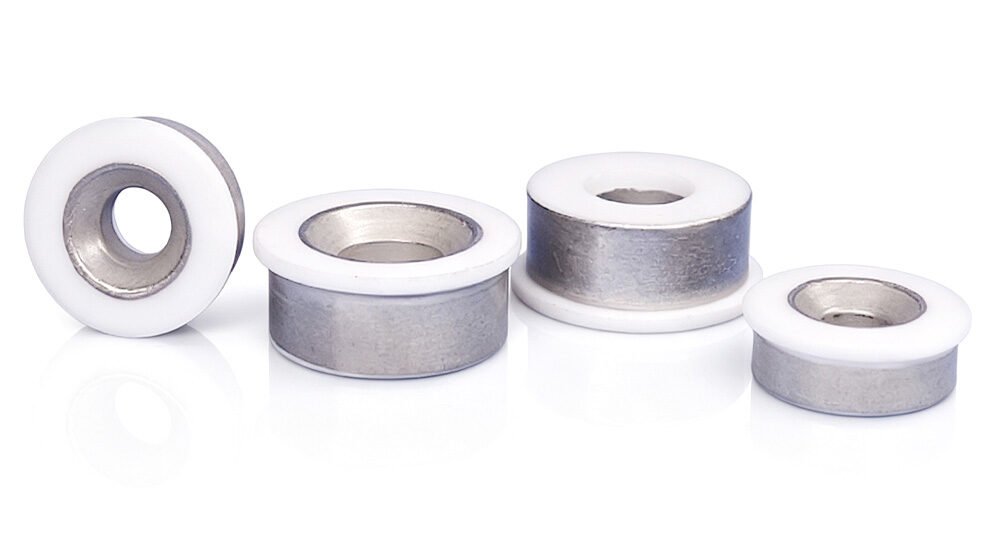
TO Header Ceramic Sealing Bead
Product form
A small alumina ceramic insulating ring with an outer diameter of 2–5 mm. The center hole is used for metal leads or optical fiber feedthroughs. The ceramic component is brazed to a Kovar alloy base to provide both electrical insulation and hermetic sealing.
 Typical applications
TO (Transistor Outline) packaged optical devices such as TOSA/ROSA, lasers, photodetectors, small sensors, and other hermetic electronic packages.
Core value
Al₂O₃ ceramics have a relatively well-matched CTE with Kovar alloy, which helps reduce thermal stress during thermal cycling. Through Mo-Mn metallization, the ceramic can be reliably brazed to the metal base to achieve long-term hermetic packaging performance.
Key indicators
Metallization adhesion strength, helium leak rate, and thermal cycling reliability are important factors for evaluating the performance of these packages.
Material selection
95%/96% Al₂O₃ is mainly used, providing a good balance between electrical insulation, manufacturability, and CTE compatibility with Kovar alloy.
Ceramic-Metal Hermetic Package
(Optical Communication Device Packaging)
Product form
Hermetic packaging housings consisting of ceramic substrates, metal frames, and covers, designed to protect internal optical chips, lasers, or detectors.
Typical applications
Butterfly laser packages, TOSA/ROSA optical transceiver components, and high-reliability photodetector packages.
Core value
Ceramic and metal structures are reliably joined to form a hermetic cavity, providing long-term protection against moisture and oxygen penetration while meeting the low leakage and long-term reliability requirements of optical devices.
Key indicators
Helium leak rate, sealing strength, thermal cycling reliability, and CTE compatibility between ceramic and metal materials are key parameters for evaluating package performance.
Material selection
95%/96% Al₂O₃ is the most commonly used material for optical communication hermetic packages. Higher-purity alumina may be considered for special high-reliability requirements.
Ceramic Insulating Components
Ceramic insulating components are widely used in electronic packaging and high-voltage electrical equipment.
Unlike metallized ceramics and ceramic-to-metal hermetic sealing components, these ceramic parts mainly serve to provide reliable electrical insulation and prevent surface flashover. They are often required to operate reliably under harsh conditions involving high voltage, elevated temperatures, or frequent mechanical movement.
Taking electric vehicle high-voltage DC relays as an example, ceramics typically perform two critical functions:
- Acting as high-voltage insulators to electrically isolate contacts
- Acting as insulating push rods to separate the driving mechanism from the high-voltage circuit
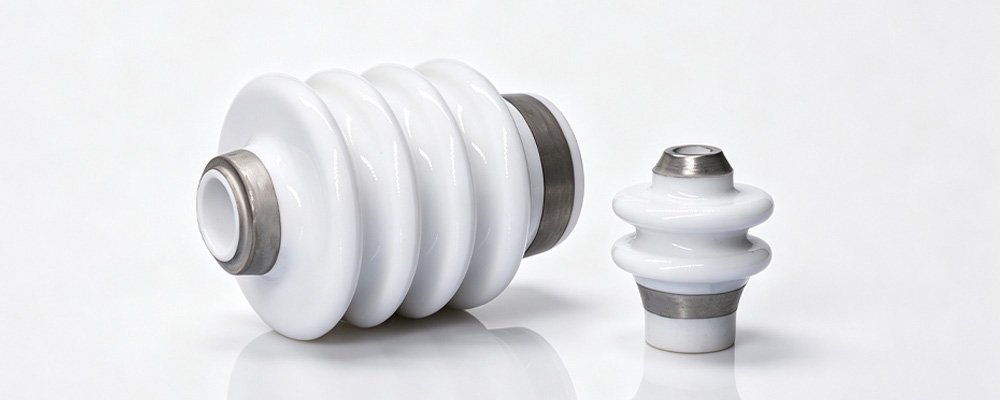
Ceramic Insulators in High-Voltage DC Relays
Product form
Rod-shaped, tubular, or threaded ceramic insulating components used for high-voltage isolation between moving and fixed contacts inside relays.
Core value
During relay switching operations, high-temperature electric arcs may occur, creating demanding requirements for insulation materials. Al₂O₃ ceramics can maintain stable electrical insulation performance under elevated temperatures while also providing high hardness and wear resistance, making them suitable for long-term reliable operation in high-voltage relays.
Material selection
96% Al₂O₃ is commonly used. For applications requiring high vibration resistance or higher reliability, such as commercial vehicle platforms, high-toughness ceramics such as Si₃N₄ can be considered.
Insulating Push Rods in High-Voltage DC Relays
Product form
Rod-shaped or threaded ceramic push rods. One end connects to the armature, while the other end drives the moving contact, electrically isolating the 800V high-voltage side from the low-voltage control side.
Core value
Push rods must withstand mechanical movement, elevated temperatures, and long-term electrical insulation requirements simultaneously. Compared with engineering plastics, Al₂O₃ ceramics can maintain stable insulation performance at high temperatures while offering excellent wear resistance and dimensional stability, making them more suitable for high-reliability relay applications.
Manufacturing characteristics
For complex push rod designs with threads, side holes, or other irregular structures, Ceramic Injection Molding (CIM) is commonly used. Control of sintering shrinkage and dimensional compensation design are critical for achieving consistent production quality.
Material selection
96% Al₂O₃ is commonly used due to its balance of insulation performance, wear resistance, and cost. For high-reliability or high-impact applications, high-toughness ceramics such as Si₃N₄ can be considered.
Ceramic Selection Process for Electronic Packaging Applications
There is no universal solution when selecting ceramics for electronic packaging. Different applications focus on different performance requirements.
In practical projects, instead of directly comparing material datasheets, it is more effective to first identify the application and potential failure modes, then determine the key performance requirements and select suitable materials and manufacturing processes.
A typical selection approach is:
Application → Failure Mode → Key Performance Requirements → Material and Manufacturing Process Matching
The following sections explain this selection process in detail.
Initial Material Selection Based on Application Requirements
The first step is to select suitable materials based on the most critical performance requirements of the product.
Different applications prioritize different factors. Some products focus mainly on heat dissipation, while others require superior hermetic reliability or mechanical strength. Therefore, material selection should be guided by the actual application needs.
| Application Requirement | Key Considerations | Recommended Solution |
| High thermal conductivity / heat dissipation | Thermal conductivity, CTE matching | AlN for high heat flux applications; Al₂O₃ for general thermal management requirements |
| Hermetic sealing | CTE matching, metallization compatibility, helium leak requirements | Al₂O₃ as the preferred choice; ZTA can be considered for higher reliability applications |
| Vibration and impact resistance | Flexural strength, fracture toughness | Si₃N₄ for severe vibration or impact environments; Al₂O₃ for general applications |
| High-voltage insulation | Dielectric strength, volume resistivity, surface flashover resistance | 96% Al₂O₃ for most applications; Si₃N₄ for extreme reliability requirements |
The above recommendations apply to common electronic packaging applications. After initial material selection, further evaluation is still required based on manufacturing processes, product structure, and cost considerations.
Further Selection Based on Manufacturing Processes
Material properties are only one part of ceramic selection. Manufacturing processes also have a significant impact on product reliability, dimensional accuracy, and production cost.
The same ceramic material may have different application ranges and manufacturing challenges depending on the process used.
| Manufacturing Process | Common Materials | Selection Considerations |
| Mo-Mn Metallization | Al₂O₃, ZTA, AlN | Al₂O₃ offers the most mature process; AlN has higher processing difficulty and cost |
| DBC (Direct Bonded Copper) | Al₂O₃, AlN, Si₃N₄ | Used for copper-clad ceramic substrates in power modules; different ceramics provide different reliability and cost advantages |
| AMB (Active Metal Brazing) | Si₃N₄, AlN | Provides strong copper bonding and is suitable for high-reliability power modules, but requires higher equipment investment |
| CIM (Ceramic Injection Molding) | Al₂O₃, Si₃N₄ | Suitable for complex-shaped components; shrinkage control and mold cost must be considered |
Therefore, after determining the material, product structure, packaging process, and production volume should also be evaluated together to develop a practical ceramic solution.
Key Parameters to Confirm Before Supplier Communication
Before communicating with ceramic suppliers, it is recommended to clarify the following key parameters.
These factors not only affect material selection but also directly influence manufacturing processes, machining difficulty, and overall project cost.
- Operating temperature range → Determines material selection
- Operating voltage/current → Determines insulation requirements
- Hermetic sealing requirement → Determines metallization and leak rate requirements
- Connection method → Determines joining process (brazing, eutectic bonding, resistance welding, etc.)
- Dimensional accuracy and production volume → Determines forming process and manufacturing cost
Clearly defining these requirements in advance helps suppliers provide faster material recommendations and process evaluations, while reducing design changes and prototype costs.
How to Select an Electronic Packaging Ceramic Supplier?
The requirements for electronic packaging ceramic components are not limited to material performance. Manufacturing precision, process stability, and production consistency are equally important factors.
When selecting a supplier, it is recommended to evaluate the following capabilities:
- Material and process capabilities:
Whether the supplier can provide different ceramic materials such as Al₂O₃, AlN, and Si₃N₄, as well as supporting processes including Mo-Mn metallization, nickel plating, and brazing. Suppliers with integrated custom ceramic manufacturing capabilities can provide better support throughout material selection, machining, metallization, and final component production. - Machining and dimensional control:
Whether the supplier can consistently manufacture complex structures with tight tolerances and maintain batch-to-batch consistency. - Engineering support capability:
Whether the supplier can provide technical recommendations based on application requirements, including material selection, CTE matching, and process optimization, rather than simply manufacturing according to drawings.
For high-reliability electronic packaging projects, selecting a supplier with integrated capabilities in materials, manufacturing, and sealing technologies can help reduce development risks and improve project success.
Frequently Asked Questions About Ceramic Materials for Electronic Packaging
Q1: How is the hermetic sealing requirement determined? Is helium leak testing required?
A1: It depends on the application requirements. Optical communication devices typically require helium leak rates of ≤ 1×10⁻⁹ Pa·m³/s, while automotive, military, and aerospace applications may require even stricter standards.
Ordinary insulating components without hermetic sealing requirements usually do not require helium leak testing.
At the early stage of a project, it is important to first define whether hermetic packaging is required and what leak rate specification needs to be achieved before determining the appropriate testing method.
Q2: What is the difference between ceramic sealing and glass sealing?
A2: Glass sealing generally offers lower cost and is suitable for standard electronic packaging applications.
Ceramic-to-metal hermetic sealing provides higher mechanical strength, better high-temperature resistance, and superior long-term hermetic reliability. It is more suitable for high-reliability applications such as high-voltage devices, vacuum systems, optical communication components, and aerospace electronics.
The appropriate solution depends mainly on the operating environment and required service lifetime.
Q3: What parameters should be considered when selecting ceramics for RF/microwave packaging?
A3: High-frequency applications mainly focus on dielectric constant (Dk) and dielectric loss (loss tangent, tanδ).
Standard Al₂O₃ typically has a dielectric loss of approximately 2×10⁻⁴ to 4×10⁻⁴, which is sufficient for many RF applications.
For higher-frequency applications such as millimeter-wave systems, high-purity Al₂O₃ or other low-loss ceramic materials are usually selected.
In addition, the temperature stability of dielectric properties should also be considered to maintain consistent signal transmission performance.
Q4: Do ceramic complex-shaped components always require CIM?
A4: Not necessarily. Simple ceramic components are usually manufactured by dry pressing or isostatic pressing, which offer lower production costs.
Complex structures with features such as threads, side holes, or thin walls are more suitable for Ceramic Injection Molding (CIM).
CIM requires higher upfront mold investment and careful consideration of 15–20% sintering shrinkage. Therefore, it is generally more suitable for mass production, while small-volume prototypes may not be cost-effective.
Q5: Which material is best for electronic packaging: Al₂O₃, AlN, or Si₃N₄?
A5: There is no single ceramic material that is best for all electronic packaging applications.
Al₂O₃ is the most widely used option due to its low cost and mature manufacturing processes.
AlN is preferred for applications requiring high thermal conductivity.
Si₃N₄ is better suited for high-reliability applications requiring excellent thermal shock resistance and vibration resistance.
The final material selection should consider thermal management, electrical insulation, mechanical reliability, and cost requirements together.
Conclusion
The role of advanced ceramics in electronic packaging goes far beyond ceramic substrates.
From metallized ceramics and ceramic-to-metal hermetic sealing components to high-voltage insulating parts, advanced ceramics perform critical functions including reliable connection, long-term sealing, and electrical insulation.
There is no “best” ceramic material for electronic packaging—only the most suitable solution for a specific application.
Instead of simply comparing material datasheets, it is more effective to first identify the actual challenges the product needs to solve, then select the appropriate material and manufacturing process based on reliability requirements.
For high-reliability electronic packaging applications, material properties provide the foundation, while manufacturing processes and process control ultimately determine the reliability of the final package.