

Introduction
In modern industry, creating a reliable bond between ceramics and metals is a fundamental challenge in advanced manufacturing. However, ceramics, such as alumina ceramics, are highl chemically stable, making their surfaces difficult to wet with molten metals. In addition, the significant difference in the coefficient of thermal expansion (CTE) between ceramics and metals makes direct joining highly prone to failure.
To overcome these challenges, the industry developed the Mo-Mn (Molybdenum-Manganese) metallization process. After decades of industrial application and continuous refinement, the Mo-Mn metallization process has become one of the most mature and widely used metallization methods for alumina ceramics. It is also a key technology used in metallized ceramic manufacturing, where a conductive metallization layer is formed on ceramic surfaces to enable reliable joining with metals.
This article explains how the Mo-Mn metallization process enables reliable ceramic-to-metal joining, why humidified hydrogen sintering is essential, and which ceramic materials are suitable for this process.

What Is Mo-Mn Metallization
At its core, the Mo-Mn metallization process works by forming a metallization layer on the ceramic surface to create a reliable bonding interface between ceramics and metals.
During high-temperature sintering in a controlled reducing atmosphere (humidified hydrogen), molybdenum (Mo) and manganese (Mn) powders undergo a series of complex physicochemical reactions on the ceramic surface, forming a metallization layer that is typically 15–25 μm thick. This metallization layer is firmly anchored to the ceramic body while providing a solderable surface, making subsequent nickel plating and ceramic-to-metal brazing possible.
In essence, the Mo-Mn metallization process does not directly join metal to the ceramic. Instead, it forms a metallization layer that acts as a transition layer between the ceramic body and the metal.
How the Mo-Mn Metallization Process Works
Although manufacturers complete the Mo-Mn metallization process through four main steps—paste preparation, coating, sintering, and nickel plating—the quality of the final metallization depends less on the number of steps than on whether the interfacial reactions during sintering are properly controlled.
At its core, the Mo-Mn metallization process is about precisely controlling the chemical behavior of manganese (Mn) at elevated temperatures. Molybdenum (Mo) forms the primary structural framework of the metallization layer and remains relatively stable throughout the process. Manganese (Mn), on the other hand, acts as the active element, promoting interaction with the glass phase in the ceramic body and enabling strong bonding between the metallization layer and the ceramic body.
The overall Mo-Mn metallization process includes four key steps:
Mo-Mn Metallization Process Steps
| Step | Process | Purpose |
| 1 | Paste preparation | Mix Mo powder, Mn powder, organic binders, and solvents to prepare the metallization paste. |
| 2 | Coating | Apply the Mo-Mn paste onto designated areas of the ceramic surface with controlled thickness and uniformity. |
| 3 | High-temperature sintering | Form a strong metallization layer through controlled reactions between Mn, the glass phase, and Mo particles. |
| 4 | Nickel plating | Deposit a nickel layer to improve solderability and prepare the metallized ceramic for brazing. |
Preparation of the Metallization Paste
The process starts by mixing high-purity Mo powder and Mn powder in a specific ratio to prepare the metallization paste. In most production processes, Mo powder is the major component, typically accounting for 60–80%, while Mn powder makes up 20–40% and acts as the key activating additive. The process then adds organic binders and solvents to achieve a paste with suitable viscosity for coating. The exact formulation may vary depending on the ceramic material being metallized.
Coating
Before coating, the ceramic surface should be properly prepared and inspected. See our guide to ceramic surface preparation before metallization for key checks and pretreatment considerations.
After the ceramic surface is pretreated, manufacturers apply the prepared paste precisely to the areas requiring metallization using screen printing, spraying, or mechanical coating methods.
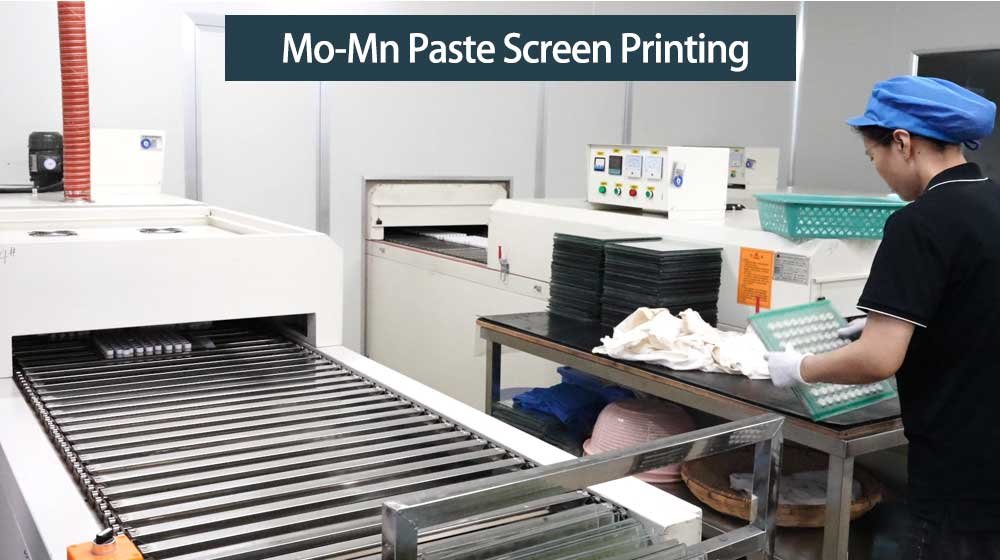
To ensure reliable ceramic-to-metal sealing, the coating thickness must be uniform, as both its thickness and consistency directly affect the final bond strength. In most applications, the paste thickness is controlled within 40–50 μm.
High-Temperature Sintering
High-temperature sintering is the most critical step in the entire Mo-Mn metallization process, as it directly determines the bond strength between the metallization layer and the ceramic body.
Why Is a Humidified Hydrogen Furnace Required
After coating, the ceramic components enter a high-temperature molybdenum-wire hydrogen furnace for sintering.

Instead of using completely dry hydrogen, a small amount of water vapor is intentionally introduced to control the furnace dew point and regulate the oxygen potential.
The purpose of the humidified hydrogen atmosphere is not simply to provide a reducing environment. More importantly, it precisely controls the oxidation behavior of manganese. The controlled amount of water vapor allows Mn to form stable MnO while preventing excessive oxidation or reduction, thereby creating the proper conditions for subsequent interfacial reactions.
Formation of MnO and Reaction with the Glass Phase
As the temperature rises to approximately 800°C, manganese (Mn) in the paste is selectively oxidized to form MnO. The MnO then reacts with the glass phase in the alumina ceramic, primarily silica (SiO₂)-based phases, reducing its viscosity and improving its fluidity. This creates favorable conditions for interfacial diffusion during the subsequent high-temperature stage.
Glass Phase Infiltration and Formation of the Metallization Layer
When the furnace reaches its peak temperature of 1400–1500°C, the molten glass phase flows into the microscopic gaps between the Mo particles through capillary action.
Upon cooling, the glass phase solidifies and firmly anchors the Mo particles to the ceramic body, resulting in a dense, electrically conductive metallization layer with excellent bond strength.
Formation Mechanism of the Mo-Mn Metallization Layer
The formation of the Mo-Mn metallization layer relies on the interaction between Mo particles, Mn additives, and the glass phase in the ceramic body.
During high-temperature sintering, Mn is oxidized to MnO under a controlled humidified hydrogen atmosphere. The MnO modifies the glass phase, improving its wettability and promoting the bonding between Mo particles and the ceramic body.
As the glass phase infiltrates between Mo particles and solidifies during cooling, it firmly anchors the Mo particles to the ceramic surface.
The combination of chemical bonding and mechanical interlocking forms a strong metallization layer, providing a reliable foundation for subsequent nickel plating and ceramic-to-metal brazing.
Mo + Mn powder
↓
Humidified hydrogen sintering
↓
Mn → MnO formation
↓
Glass phase modification and improved wetting
↓
Mo particle bonding with ceramic body
↓
Mo-Mn metallization layer formation
Material Compatibility
The success of the Mo-Mn metallization process largely depends on the participation of the glass phase within the ceramic body. As a result, the process is best suited for alumina ceramics containing an appropriate amount of glass phase, particularly 95% and 96% alumina.
For ceramics such as 99% or higher purity alumina and aluminum nitride (AlN), the limited glass phase content cannot adequately support the interfacial reactions required for conventional Mo-Mn metallization. Consequently, achieving high bond strength becomes much more difficult.
In these cases, manufacturers typically modify the paste formulation by adding glass frits or adopt alternative metallization technologies, such as active metal brazing (AMB).
Nickel Plating
After sintering, a 3–5 μm electroplated nickel layer is deposited on the Mo-Mn metallization surface.

This step is essential because the sintered Mo-Mn metallization layer is susceptible to oxidation when exposed to air, which reduces the wettability of subsequent brazing alloys. Timely nickel plating forms a protective barrier against oxidation while significantly improving the wettability and spreading of brazing alloys on the metallization layer. As a result, it helps ensure a sound, defect-free ceramic-to-metal brazed joint.
Proper surface preparation and nickel plating quality are also critical for long-term reliability. Learn more about common nickel plating failures in our article on nickel plating delamination on metallized ceramics.
Why Is the Mo-Mn Metallization Process Still Widely Used
Why has the Mo-Mn metallization process remained the preferred solution for high-reliability ceramic-to-metal sealing after decades of industrial use? The answer lies in its proven performance under demanding operating conditions.
Excellent Bonding with Alumina Ceramics
During high-temperature sintering, the metallization layer formed during the Mo-Mn metallization process combines chemical bonding with microscopic mechanical interlocking. This results in strong interfacial bond strength and high tensile strength, enabling the joint to withstand both the shear stresses caused by differences in the coefficient of thermal expansion (CTE) between ceramics and metals and external mechanical loads.
Outstanding Hermetic Sealing Reliability
For ultra-high vacuum (UHV) applications, Mo-Mn metallization provides exceptional hermetic sealing performance. Metallized ceramic components manufactured using this process can maintain extremely low leak rates—typically better than 1 × 10⁻⁸ Pa·m³/s—over many years of service without developing micro-leaks.
The long-term reliability of ceramic-to-metal hermetic seals depends on proper interface design, material compatibility, and brazing quality. For more details, see our guide on ceramic-to-metal hermetic seal failure analysis.
Mature and Reliable for High-Volume Production
After decades of industrial development, the Mo-Mn metallization process has become one of the most mature manufacturing technologies for ceramic metallization. Compared with newer metallization methods that require tighter control of material systems, the Mo-Mn metallization process benefits from well-established equipment, a stable process window, and extensive mass-production experience.
From paste preparation and coating to humidified hydrogen sintering and nickel plating, the entire manufacturing process has been highly standardized, resulting in excellent batch-to-batch consistency. For ceramic-to-metal sealing components that require long-term, reliable supply, the Mo-Mn metallization process remains the preferred choice in many engineering applications.
Applications of the Mo-Mn Metallization Process
The Mo-Mn metallization process creates a reliable bonding interface between ceramics and metals while providing excellent hermeticity and high-temperature stability. Therefore, engineers widely use it in ceramic-to-metal sealing applications where long-term reliability is critical.

Typical applications include:
- Vacuum electronic devices: Such as vacuum interrupters, vacuum relays, and other vacuum components requiring high-integrity hermetic seals. The Mo-Mn metallization layer enables reliable long-term bonding between ceramic insulators and metal housings.
- Ceramic feedthroughs: Used in vacuum systems, electrical equipment, and sensor assemblies, where both electrical insulation and hermetic sealing are essential.
- Electronic packaging and power devices: Mo-Mn metallization is widely used for alumina ceramic packages and components, providing a reliable metallization layer for subsequent ceramic-to-metal brazing.
- High-reliability sensor assemblies: In pressure sensors, temperature sensors, and other industrial sensing devices, dependable ceramic-to-metal sealing is essential for long-term operational stability.
Limitations of the Mo-Mn Metallization Process
Despite its many advantages, the Mo-Mn metallization process also has several inherent limitations that should be considered during material selection and process design.
Complex Manufacturing Process
The complete manufacturing process involves multiple production steps, including paste preparation, screen printing or coating, high-temperature reducing-atmosphere sintering, and nickel plating. As a result, the production cycle is relatively long.
High Energy Consumption
Mo-Mn metallization requires prolonged sintering in a high-temperature hydrogen atmosphere. This places stringent demands on furnace equipment and results in relatively high energy consumption.
Limited Material Compatibility
The Mo-Mn metallization process is primarily designed for alumina ceramics containing a glass phase. For materials such as 99% or higher purity alumina and aluminum nitride (AlN), adjustments to the paste formulation or alternative metallization technologies are often required. Consequently, the process is not universally applicable to all ceramic materials.
Conclusion
The essence of the Mo-Mn (Molybdenum-Manganese) metallization process lies in creating a reliable metallization layer between the ceramic body and the metal through carefully controlled high-temperature interfacial reactions. This metallization layer provides the foundation for subsequent nickel plating and ceramic-to-metal brazing, enabling a strong and durable bond between two fundamentally different materials.
From early vacuum tubes to today’s power electronics, vacuum devices, and aerospace components, the Mo-Mn metallization process has proven its reliability through decades of industrial application. Its mature manufacturing process and consistent performance continue to make it one of the most widely used ceramic metallization technologies.
Understanding how the process works, where it performs best, and its material limitations helps engineers select the most appropriate metallization solution for different ceramic-to-metal joining applications.
Frequently Asked Questions
Q1: How to evaluate the quality of a Mo-Mn metallization layer?
A1: The quality of a Mo-Mn metallization layer is typically evaluated through bond strength testing and helium leak testing.
Common defects include metallization layer peeling caused by insufficient bond strength or improper sintering, porosity or leakage resulting from non-uniform coating or inadequate glass phase flow, and nickel blistering caused by poor surface preparation before electroplating.
Q2: Is the Mo-Mn metallization process suitable for all ceramic materials?
A2: No. The Mo-Mn metallization process is mainly used for alumina ceramics, especially 95% and 96% alumina, because the glass phase inside these materials plays an important role in forming a strong bonding interface.
For 99% or higher purity alumina and aluminum nitride (AlN), other metallization methods, such as active metal brazing (AMB), are often considered.
Q3: How does the thickness of the metallization layer affect brazing reliability?
A3: The thickness of the Mo-Mn metallization layer needs to be carefully controlled.
If the layer is too thin (<10μm), it may be partially dissolved by the molten brazing alloy during brazing, reducing joint reliability.
If it is too thick (>40μm), excessive residual stress between the ceramic body and the metal may increase the risk of cracking during cooling or service.
Q4: Why should nickel plating be performed as soon as possible after metallization?
A4: The sintered Mo-Mn metallization layer has a porous microstructure that can gradually absorb moisture and oxidize when exposed to air, reducing the wettability of brazing alloys. For this reason, electroplated nickel is typically applied shortly after sintering to protect the surface and provide a stable interface for subsequent brazing.
Q5: Why is the Mo-Mn metallization process sintered in a humidified hydrogen atmosphere?
A5: A humidified hydrogen atmosphere provides precise control of the oxygen potential during sintering, allowing manganese (Mn) to form MnO at the ceramic interface. The MnO then reacts with the glass phase in the ceramic body, promoting chemical bonding and improving the bond strength of the metallization layer.