

Introduction
The grinding mechanism is the core component that determines the performance of a pepper mill, salt grinder, spice grinder, or seasoning mill. Regardless of how attractive the exterior design may be, the overall grinding experience depends largely on the quality of the internal burr system.
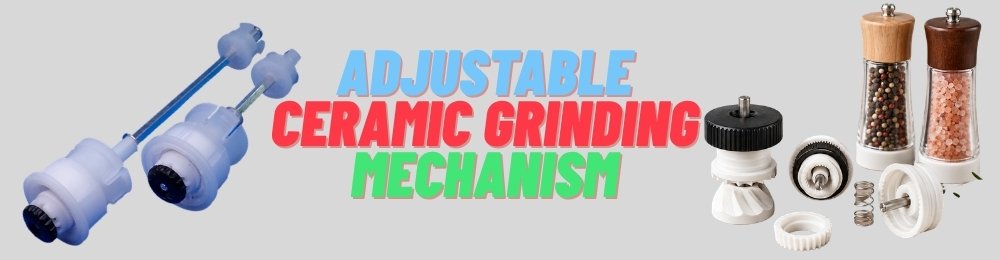
Among various grinding materials, ceramic grinding mechanisms have become increasingly popular because they combine excellent wear resistance, corrosion resistance, food safety, and long service life. Unlike carbon steel burrs, ceramic burrs do not rust when exposed to salt or moisture. Compared with stainless steel, ceramic provides better resistance to chemical corrosion while maintaining stable grinding performance over many years.
For manufacturers, distributors, and OEM brands, selecting the right adjustable ceramic grinding mechanism involves much more than choosing a burr size. Material selection, burr geometry, adjustment system, assembly tolerance, and intended application all influence grinding consistency, durability, and customer satisfaction.
This guide explains the engineering principles behind adjustable ceramic grinding mechanisms and provides practical recommendations for selecting the most suitable solution for different applications.
What Is an Adjustable Ceramic Grinding Mechanism?
An adjustable ceramic grinding mechanism is a complete grinding assembly designed to crush, grind, or mill spices and seasonings into different particle sizes. Unlike fixed grinding systems, adjustable mechanisms allow users to change the grinding gap between the inner and outer ceramic burrs, producing coarse, medium, or fine particles according to personal preference.
The adjustment mechanism usually operates through a threaded knob, rotating cap, or click-stop system. As the adjustment component moves, the spring force changes the axial position of the inner burr, thereby altering the grinding clearance.
This simple mechanical design allows one grinder to produce a wide range of particle sizes without replacing any components.
Because ceramic burrs maintain dimensional stability during long-term use, the grinding consistency remains highly repeatable even after thousands of grinding cycles.
Main Components of a Ceramic Grinding Mechanism
Although grinding mechanisms vary among manufacturers, most adjustable ceramic grinding assemblies contain the following components:
| Component | Function |
|---|---|
| Outer Ceramic Burr | Provides the fixed grinding surface |
| Inner Ceramic Burr | Rotates to crush materials |
| Stainless Steel Shaft | Transfers rotational torque |
| Compression Spring | Maintains grinding pressure |
| Adjustment Knob | Controls grinding coarseness |
| Washer | Stabilizes spring movement |
| Locking Ring | Prevents component loosening |
| Plastic Housing | Supports assembly and positioning |
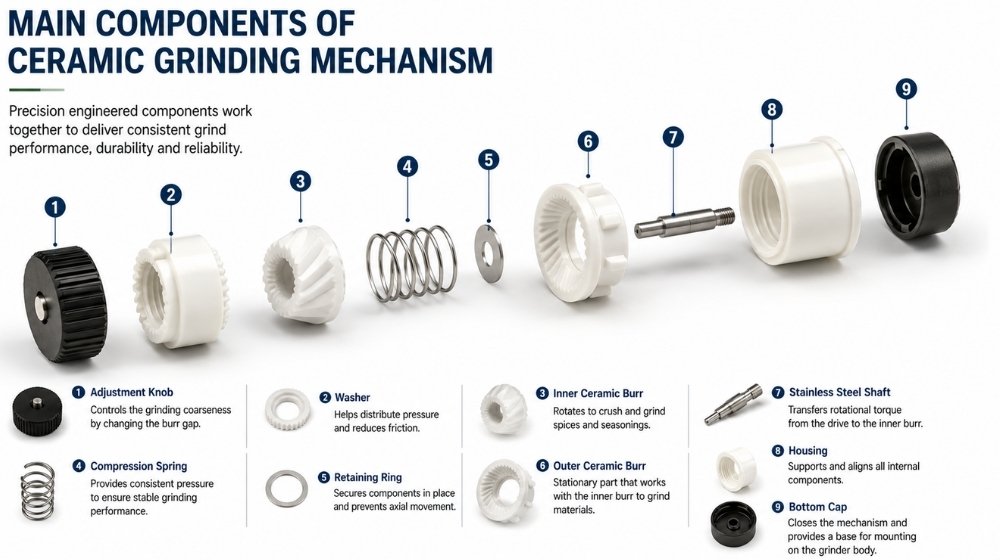
Each component contributes to the overall grinding performance. Even small variations in spring force or machining tolerance may significantly affect grinding consistency.
How Does the Grinding Adjustment Mechanism Work?
The grinding size is controlled by adjusting the distance between the inner and outer ceramic burrs.
When the adjustment knob is tightened, the compression spring pushes the inner burr closer to the outer burr. The grinding gap becomes smaller, producing finer particles.
When the knob is loosened, the spring pressure decreases, allowing a larger grinding gap and producing coarser particles.
Because ceramic burrs are manufactured with high dimensional accuracy, the adjustment remains stable and repeatable throughout the product’s service life.
Modern premium grinding mechanisms may also incorporate click-stop adjustment systems, enabling users to return to previously selected grinding settings with excellent repeatability.
Types of Grinding Adjustment Systems
The adjustment mechanism directly determines the user experience, grinding consistency, manufacturing complexity, and overall product positioning. Although ceramic burr geometry is important, the adjustment system is equally critical because it controls the grinding gap during operation.
Bottom Adjustment Mechanism
Bottom adjustment is the most common design used in traditional pepper mills and salt grinders. The adjustment knob is located beneath the grinder. Users rotate the knob clockwise or counterclockwise to change the grinding gap.
Its greatest advantage is structural simplicity. Fewer components mean lower manufacturing cost, excellent durability, and high assembly efficiency. This design is widely adopted in OEM projects because it offers reliable performance while remaining cost-effective.
However, adjusting the grind size usually requires turning the grinder upside down, making frequent adjustment less convenient.
Typical Applications
- Pepper grinders
- Salt mills
- Disposable spice grinders
- Entry-level kitchen products
Top Adjustment Mechanism
Top adjustment mechanisms have become increasingly popular in premium kitchen products. The adjustment knob is positioned on the top of the grinder, allowing users to modify grinding coarseness without turning the grinder upside down.
Besides offering greater convenience, this design also minimizes spice residue falling onto the countertop after adjustment, making it cleaner during everyday use.
Because additional transmission components are often required, manufacturing costs are generally higher than bottom adjustment systems.
Typical Applications
- Premium pepper mills
- Wooden grinders
- Stainless steel grinders
- Commercial kitchen equipment
Click Adjustment System
Click adjustment mechanisms divide the grinding range into fixed positions. Every click corresponds to a predefined burr gap.
Compared with continuous adjustment, click systems provide much better repeatability. Users can easily return to the same grinding setting without guessing.
This design is particularly suitable for premium grinders where consistent particle size is required.
Advantages
- Excellent repeatability
- Easy operation
- Stable grinding consistency
Stepless Adjustment
Stepless adjustment allows users to select any grinding size within the adjustment range rather than fixed positions.
This provides maximum flexibility and enables manufacturers to fine-tune grinding performance for different spices.
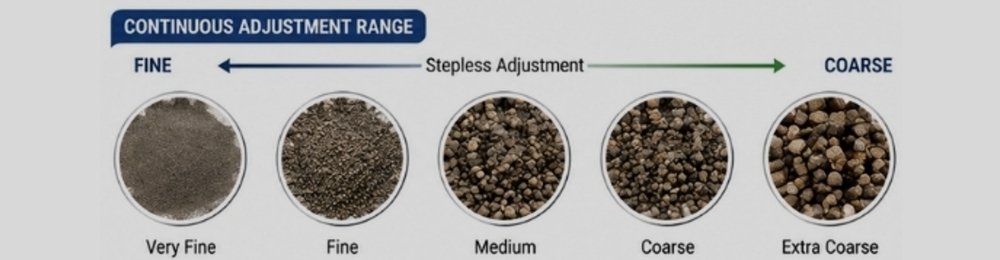
However, stepless mechanisms require higher machining precision and better thread quality to maintain stable adjustment over long-term use.
Ceramic Burr Material Selection
Although various engineering ceramics are available today, only a few are suitable for food grinding applications.
95% Alumina Ceramic
95% alumina is currently the most widely used ceramic material for adjustable grinding mechanisms.
It provides an excellent balance between hardness, wear resistance, manufacturing cost, dimensional stability, and food safety.
Most OEM pepper grinder mechanisms on the global market are manufactured from this material.
Advantages
- Excellent wear resistance
- High hardness
- Food-safe
- Cost-effective
- Stable mass production
96% Alumina Ceramic
96% alumina offers slightly higher hardness and wear resistance than 95% alumina.
It is sometimes selected for premium grinding mechanisms where tighter dimensional tolerances and longer service life are desired.
However, the performance improvement is relatively small compared with the additional manufacturing cost.
Why Zirconia Is Rarely Used
Zirconia possesses excellent fracture toughness and high strength.
However, for grinding mechanisms, hardness and wear resistance are usually more important than fracture toughness.
In addition, zirconia is significantly more expensive and has lower thermal conductivity during sintering, increasing manufacturing complexity.
For these reasons, zirconia is rarely selected for commercial pepper grinder burrs.
Why Silicon Nitride Is Not Used
Silicon nitride is an outstanding engineering ceramic used in bearings, turbine components, and semiconductor equipment.
Its mechanical properties far exceed those required for household grinding mechanisms.
Because of its extremely high production cost, silicon nitride provides little economic advantage for food grinders.
Flat Burr vs. Conical Burr
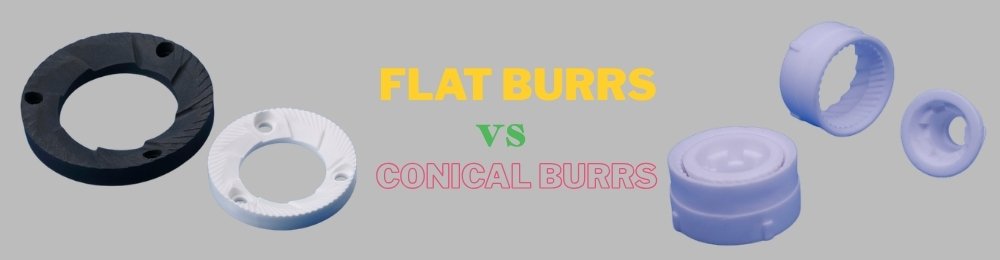
Choosing between a flat ceramic burr and a conical ceramic burr is one of the first design decisions when developing a grinding mechanism. Although both designs use ceramic as the grinding material, their geometry produces different grinding characteristics, torque requirements, manufacturing costs, and application suitability.
Flat Ceramic Burr
Flat burrs consist of two parallel grinding surfaces that process materials through radial cutting and crushing. Because the grinding area is relatively large, flat burrs are capable of producing highly uniform particle sizes.
This design is commonly used where grinding consistency is more important than grinding speed.
Typical applications include premium coffee grinders and certain precision spice grinding systems.
Advantages
- Excellent particle size consistency
- Stable grinding accuracy
- Suitable for repeated grinding settings
- Good for premium applications
Limitations
- Higher manufacturing precision required
- Larger installation space
- More components in some assemblies
Conical Ceramic Burr
Conical burrs use a cone-shaped inner burr rotating inside a matching outer burr. Materials are gradually crushed while moving downward through the grinding chamber.
Because the grinding force increases progressively, conical burrs generally require lower operating torque and provide smoother grinding.
This geometry has become the dominant choice for pepper mills, salt grinders, spice mills, and household seasoning grinders.
Advantages
- Compact structure
- Lower grinding torque
- Smooth operation
- High production efficiency
- Lower manufacturing cost
Typical Applications
- Pepper mills
- Salt grinders
- Spice grinders
- Herb mills
Flat vs Conical Comparison
| Property | Flat Burr | Conical Burr |
|---|---|---|
| Grinding Uniformity | Excellent | Very Good |
| Grinding Speed | Medium | High |
| Operating Torque | Higher | Lower |
| Structure | Larger | Compact |
| Manufacturing Cost | Higher | Lower |
| Household Pepper Mills | Less Common | Most Common |
Ceramic Burr vs Stainless Steel Burr
Selecting the burr material directly affects grinding performance, corrosion resistance, maintenance requirements, and product lifespan.
Comparison Table
| Property | Ceramic Burr | Stainless Steel Burr |
|---|---|---|
| Hardness | Excellent | Good |
| Wear Resistance | Excellent | Good |
| Corrosion Resistance | Excellent | Medium |
| Salt Grinding | Excellent | Limited |
| Food Safety | Excellent | Excellent |
| Rust Resistance | Will Not Rust | May Rust |
| Service Life | Long | Medium |
| Cost | Medium | Medium |
Why Ceramic Is Preferred for Salt Grinders
Salt is highly corrosive, particularly in humid environments. Although stainless steel offers good corrosion resistance, prolonged exposure to salt crystals and moisture may eventually lead to surface oxidation.
Ceramic is chemically inert toward salt and does not rust. This makes ceramic burrs the preferred choice for salt grinders and mixed seasoning grinders.
Particle Size Consistency
Many consumers assume that a grinder simply crushes spices. In reality, particle size consistency has a significant influence on flavor release, cooking performance, and user experience.
Uniform particles allow spices to release aroma more consistently during cooking, while irregular particles may cause uneven seasoning and reduced grinding efficiency.
For OEM brands, consistent grinding quality often becomes one of the strongest competitive advantages.
Engineering Design Considerations
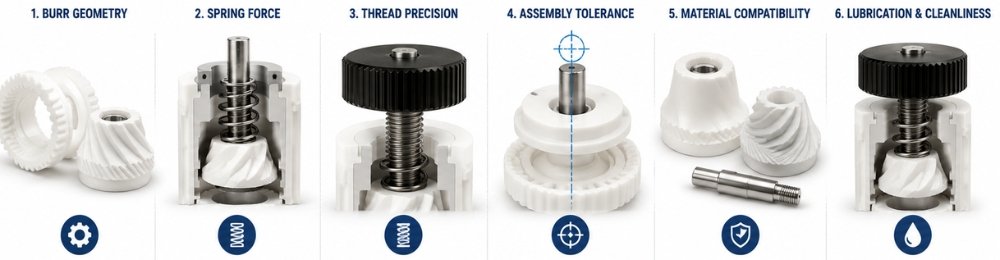
When selecting an adjustable ceramic grinding mechanism, engineers should evaluate the complete grinding system rather than focusing only on the ceramic burr.
1. Burr Geometry
Different burr tooth designs influence grinding efficiency and particle distribution.
2. Spring Force
The compression spring controls grinding pressure. Excessive force increases operating torque, while insufficient force reduces grinding consistency.
3. Thread Precision
Thread quality determines adjustment repeatability and long-term durability.
4. Assembly Tolerance
Poor assembly tolerance may lead to eccentric rotation, increased wear, and unstable grinding.
5. Material Compatibility
Plastic housings, stainless steel shafts, and ceramic burrs should be designed as a complete system to ensure long-term mechanical stability.
Engineering Recommendation
Rather than selecting the lowest-cost grinding mechanism, manufacturers should evaluate grinding consistency, service life, corrosion resistance, adjustment repeatability, and production stability. These factors have a greater influence on customer satisfaction than material cost alone.
Frequently Asked Questions
1. Why are ceramic grinding mechanisms preferred over stainless steel mechanisms?
Ceramic grinding mechanisms offer superior corrosion resistance, making them particularly suitable for grinding salt, pepper, and other spices exposed to moisture. Unlike stainless steel, ceramic burrs do not rust and maintain consistent grinding performance over long periods of use. In addition, alumina ceramic has excellent hardness and wear resistance, allowing the burr geometry to remain stable after thousands of grinding cycles. For most household and commercial spice grinders, ceramic mechanisms provide a longer service life with minimal maintenance.
2. Which ceramic material is most commonly used for grinding burrs?
Most commercial ceramic grinding mechanisms are manufactured from 95% or 96% alumina ceramic. This material provides an excellent balance between hardness, wear resistance, dimensional stability, food safety, and manufacturing cost. Although zirconia and silicon nitride offer higher mechanical performance, their additional cost rarely provides practical benefits for spice grinding applications. Therefore, alumina remains the industry standard for most OEM grinding mechanisms.
3. Are ceramic burrs suitable for grinding salt?
Yes. Ceramic burrs are considered one of the best solutions for salt grinding because alumina ceramic is chemically inert and does not react with sodium chloride. Unlike carbon steel burrs, ceramic will not rust even after long-term exposure to humid environments. This is why most premium salt grinders on the market use ceramic grinding mechanisms instead of metal burrs.
4. How long should a ceramic grinding mechanism last?
The service life depends on burr material, grinding frequency, spice type, and assembly quality. Under normal household conditions, a high-quality alumina ceramic grinding mechanism can maintain stable grinding performance for many years. In commercial applications, regular cleaning and proper adjustment also help maximize service life by reducing unnecessary wear and contamination.
5. What factors influence grinding consistency?
Grinding consistency depends on multiple engineering factors, including burr geometry, ceramic machining accuracy, assembly tolerance, shaft concentricity, spring force, and adjustment precision. Even a high-quality ceramic burr may produce inconsistent particles if the surrounding mechanism is poorly designed. Therefore, evaluating the complete grinding mechanism is more important than considering burr material alone.
6. Can ceramic burrs become dull?
Ceramic burrs gradually experience wear after extensive use, but the wear rate is significantly lower than that of many metal burrs. High-purity alumina maintains its cutting edges much longer because of its excellent hardness. Under normal kitchen use, most ceramic grinding mechanisms retain effective grinding performance for a very long time without noticeable dulling.
7. Is a larger ceramic burr always better?
Not necessarily. Larger burrs generally provide higher grinding efficiency and greater throughput, but they also increase product size, manufacturing cost, and operating torque. The optimal burr size should be selected according to the grinder capacity, intended application, ergonomic requirements, and target market rather than assuming larger is always superior.
8. Should OEM buyers customize the grinding mechanism?
Yes. OEM customization allows manufacturers to optimize burr geometry, adjustment range, shaft length, housing dimensions, spring force, and branding according to specific product requirements. A customized grinding mechanism not only improves product performance but also enhances brand differentiation and reduces direct competition with standard off-the-shelf products.
9. What quality inspections are recommended for ceramic grinding mechanisms?
A comprehensive quality control program should include dimensional inspection, burr concentricity, ceramic appearance, crack detection, torque testing, grinding consistency evaluation, corrosion testing, assembly verification, and life-cycle testing. For OEM projects, sampling based on international quality standards can further improve production consistency and customer confidence.
10. How do I choose the right ceramic grinding mechanism supplier?
When evaluating a supplier, consider more than price. Assess ceramic manufacturing capability, grinding mechanism design experience, dimensional consistency, quality control procedures, customization capability, production capacity, and long-term supply stability. A supplier with integrated ceramic production and assembly capabilities is generally better positioned to deliver consistent quality for OEM projects.
Conclusion
An adjustable ceramic grinding mechanism is far more than a simple kitchen component. It is a precision-engineered assembly that directly determines grinding performance, particle consistency, durability, and user experience.
Selecting the right grinding mechanism requires evaluating ceramic material, burr geometry, adjustment system, assembly quality, and intended application as a complete system. For OEM manufacturers and global brands, investing in a reliable ceramic grinding mechanism can significantly improve product quality, reduce warranty claims, and strengthen market competitiveness.
Whether you are developing a premium pepper mill, a commercial spice grinder, or a customized seasoning solution, choosing the appropriate ceramic grinding mechanism is a key step toward long-term product success.
Looking for a reliable ceramic grinding mechanism manufacturer?
Our engineering team provides OEM and ODM solutions for pepper mills, salt grinders, spice grinders, coffee grinders, and customized grinding systems. From ceramic burr design to complete grinding mechanism assembly, we support product development with consistent quality and flexible manufacturing.
Contact us today to discuss your project.