

Introduction
A common challenge engineers face when selecting engineering ceramic materials is this: They check datasheets, compare material properties, and review similar applications, believing that they have considered everything carefully.
However, after the ceramic parts are manufactured and put into service for a period of time, problems still occur.
After reviewing the failure, they often find that: The material itself was not necessarily wrong — the way the problem was approached from the beginning was.
Some engineers assume:
- “The hardest material must always have the best wear resistance.”
- “If a ceramic can withstand 1600°C, it should be safe to use continuously at 1200°C.”
- “A ceramic manufacturer can simply make the part according to the metal drawing provided.”
These are not problems caused by a lack of material knowledge. They are common misconceptions caused by applying metal design and material selection experience directly to ceramics.
However, ceramics behave very differently from metals. Before selecting a ceramic material, engineers need to understand the differences between common engineering ceramic materials.
This article summarizes 7 common misconceptions in ceramic material selection and design. If you are planning a ceramic component project, understanding these mistakes can help you avoid common problems during material selection, design, and manufacturing.
Hardness Alone Does Not Guarantee Wear Resistance
Many engineers naturally focus on hardness when selecting ceramic materials.
“The hardest ceramic must be the most wear-resistant.” This assumption is very common in ceramic material selection.
Hardness is indeed an important factor affecting wear resistance, but it is not the only factor.
Silicon carbide has a hardness of approximately 2800 HV, about 1.8 times higher than 99% alumina. However, its fracture toughness is only around 4 MPa·m¹/², which is relatively low among advanced structural ceramics.
We once worked with a customer who selected silicon carbide for a wear-resistant component. The application involved frequent impact loading. Within less than two weeks, the part developed a through crack.
The silicon carbide did not fail because of wear. It failed because of impact.
Its hardness successfully resisted abrasion, but its toughness was insufficient to withstand repeated impact.
Silicon carbide performs extremely well against abrasion, but it is not the best choice for repeated impact loading.
How to Select the Right Material
Before selecting a ceramic material, first define the actual operating conditions:
- Is the main issue wear or impact?
- Is the load continuous abrasion or intermittent shock?
- Is the component under static stress or repeated impact?
Both hardness and toughness need to be considered. Do not focus on only one property:
- For abrasive wear: prioritize hardness. Silicon carbide and alumina are often preferred.
- For impact or vibration: prioritize fracture toughness. Zirconia and silicon nitride are usually better choices.
- For combined wear and impact conditions: materials such as ZTA or silicon nitride can provide a better balance.
This mistake is especially common in components such as mechanical seal rings, bearing balls, valve seats, and wear nozzles, where the parts often experience both wear and impact loads.
Maximum Temperature ≠ Continuous Operating Temperature
Many engineers see a datasheet stating that “alumina can withstand 1600°C” and assume that a 1200°C application should be completely safe.
“The operating temperature is still 400°C below the limit, so there should be enough margin.” This logic sounds reasonable, but it can be misleading.
A temperature rating of 1600°C usually represents the maximum temperature range that the material can withstand under specific conditions. It does not necessarily represent the temperature at which the material can maintain long-term continuous performance.
We once had a customer who used alumina for a structural support component operating at 1200°C. They believed the temperature margin was sufficient.
However, after extended operation, the component began to creep and deform, eventually leading to failure.
Further analysis showed that:
- The flexural strength of alumina decreases significantly at 1200°C.
- Long-term creep behavior at elevated temperatures was underestimated.
The single number “1600°C” on the datasheet hid an important fact:
The material performance had already degraded significantly at 1200°C.
What to Evaluate Instead
The maximum temperature rating and the safe continuous operating temperature are two different concepts.
For high-temperature applications, ask the ceramic supplier:
- How does the material performance change during continuous operation at the target temperature?
- What is the remaining flexural strength at that temperature?
(Room-temperature data may not be representative.) - Are there existing application examples under similar operating conditions?
If a supplier only provides a “maximum operating temperature” value without additional performance information, that data alone has limited value for material selection.
This misconception is especially common in furnace tubes, kiln furniture, and high-temperature support components that operate continuously at elevated temperatures.
Finalizing the Design Before Consulting Ceramic Suppliers
Many engineers follow this workflow:
Create the 3D model → define tolerances → complete the design → send the drawing to a ceramic manufacturer for quotation.
This process works well for metal parts, but for ceramic components, it may already be too late.
Ceramic forming and machining processes are very different from metal manufacturing.
Features that are common in metal parts — such as deep holes, thin walls, sharp corners, and internal threads may be impossible to manufacture in ceramics, or may increase costs dramatically.
We once worked with a customer who designed a silicon nitride component with a small through-hole of diameter 1.5 mm and depth 30 mm.
From a metal manufacturing perspective, this hole was relatively easy to make.
However, silicon nitride after sintering has a hardness close to that of machining tools. Producing such a deep, narrow hole typically requires specialized processes such as laser machining, ultrasonic machining, or high-cost precision grinding, depending on the dimensions, accuracy requirements, and material condition.
As a result, the machining cost increased several times and eventually exceeded the material cost itself.
Design Considerations Before Production
Ceramic component design should involve the manufacturer before the drawing is finalized, not after the drawing is completed.
Important points to confirm early include:
- Can the required geometry be produced with available manufacturing processes?
- Are there more cost-effective alternatives? For example: changing through holes to blind holes, replacing deep holes with stepped holes, or adding fillets instead of sharp corners.
- Can the specified tolerances be achieved consistently? In some cases, relaxing tolerances by half can significantly reduce cost.
The earlier you discuss manufacturability, the easier and cheaper it is to make adjustments.
If a design issue is discovered only after the drawing is finalized, engineers may have no choice but to redesign the part or accept a much higher cost.
Do Not Treat Ceramic Parts Like Metal Parts
Using ceramics to replace metals for wear resistance or electrical insulation is common. This is especially important for ceramic-to-metal assemblies, where differences in thermal expansion and mechanical behavior must be carefully considered during design.
However, directly sending the original metal drawing to a ceramic manufacturer and saying “Please make it exactly the same.” may create serious problems.
Ceramics and metals have completely different mechanical behaviors.
Metals have plastic deformation capability. During interference assembly, metals can deform slightly and redistribute stress.
Ceramics cannot do this. Stress tends to concentrate at sharp corners, hole edges, and sudden changes in wall thickness.
As a result, the ceramic part may crack during assembly.
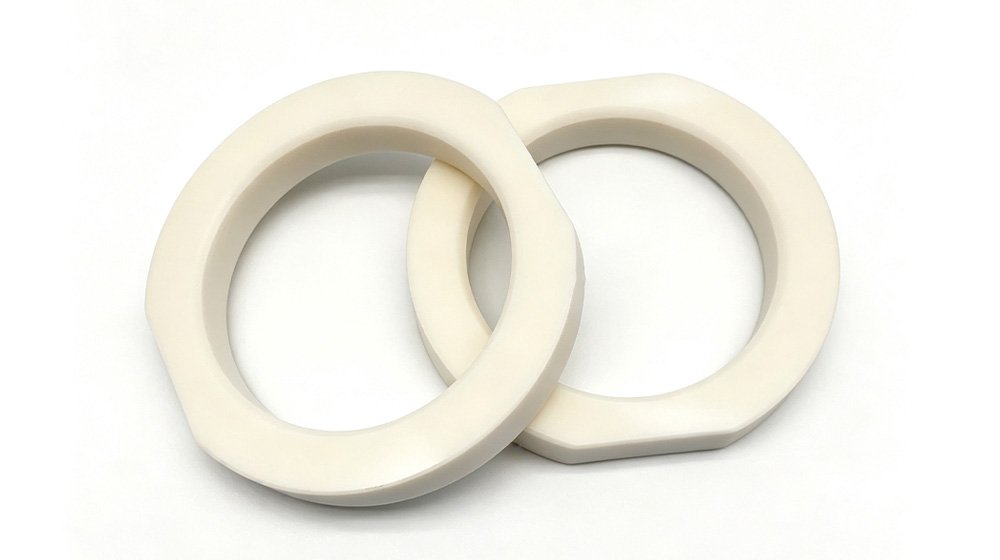
We once worked with a customer who converted a metal sealing ring into alumina without modifying the dimensions.
The part developed cracks near the flange mounting holes shortly after installation.
The investigation identified two issues:
First, the mounting holes were too close to the edge. This was acceptable for the metal version, but drilling holes in ceramics reduced the remaining cross-sectional strength significantly.
Second, the original interference fit relied on the elastic deformation of metal to absorb assembly stress. Ceramics cannot accommodate the same deformation. The same assembly conditions directly caused cracking.
How Ceramic Designs Should Be Different
Ceramic components should be redesigned based on ceramic properties. Replacing the material is not enough.
Key design differences include:
| Design Aspect | Metal Components | Ceramic Components |
| Sharp corners and edges | Usually acceptable | Add fillets to reduce stress concentration |
| Hole-to-edge distance | Can be relatively small | Maintain sufficient distance to preserve strength |
| Assembly method | Press fitting may work | Use compliant assembly methods; avoid excessive force |
| Wall thickness | Uneven thickness may be acceptable | Keep thickness as uniform as possible to reduce sintering variation and internal stress |
This is not simply a material substitution — it is a change in design philosophy.
A ceramic component designed specifically for ceramic properties is usually more reliable and often more cost-effective than simply converting a metal part into ceramic.
This issue is especially common in metal-to-ceramic replacement projects, ceramic insulating parts, housings, and structural components.
Lab Tests Do Not Always Predict Field Performance
A prototype is manufactured, tested according to standard procedures, and meets every specification. The product is then released for production. Several months later, failures begin appearing in the field.
This situation is surprisingly common in ceramic applications. The reason is simple: Standard laboratory tests rarely reproduce real service conditions. Some failure mechanisms only develop after long-term exposure and cannot be detected during short-term testing.
We once worked with a customer who selected zirconia for steam sealing applications. All room-temperature tests produced excellent results. However, after several months of operation, the sealing components developed surface microcracks and gradually lost strength.
The root cause was hydrothermal aging. Certain zirconia grades may undergo low-temperature degradation when exposed to water vapor at 200–300°C. During this process, the crystal structure transforms from the tetragonal phase to the monoclinic phase, causing volume expansion and the formation of microcracks.
This degradation mechanism cannot be identified by room-temperature testing alone. It only becomes apparent after prolonged exposure under actual operating conditions. Understanding common failure mechanisms can help engineers better evaluate potential risks before production.
Similar situations include:
- Chemical attack on silicon carbide in strong alkaline environments.
- Aluminum nitride requiring moisture protection and proper surface protection during long-term exposure to high-humidity environments.
These limitations may receive only a brief mention in a datasheet, yet they can become the primary cause of field failures.
How to Validate Ceramic Components Properly
Passing laboratory tests does not necessarily mean the component will survive in service.
If your application involves any of the following conditions, additional evaluation is recommended:
- Water vapor, especially steam above 200°C→ Evaluate zirconia carefully.
- Strong acids or alkalis→ Verify chemical compatibility. Silicon carbide is vulnerable to strong alkalis.
- High-humidity environments→ Aluminum nitride may require moisture protection.
The most reliable approach is to review successful applications under similar service conditions or conduct long-term testing that closely simulates the actual operating environment.
Spending an extra week on validation is usually far less costly than troubleshooting failures after mass production.
Considering Only Material Price Instead of Life Cycle Cost
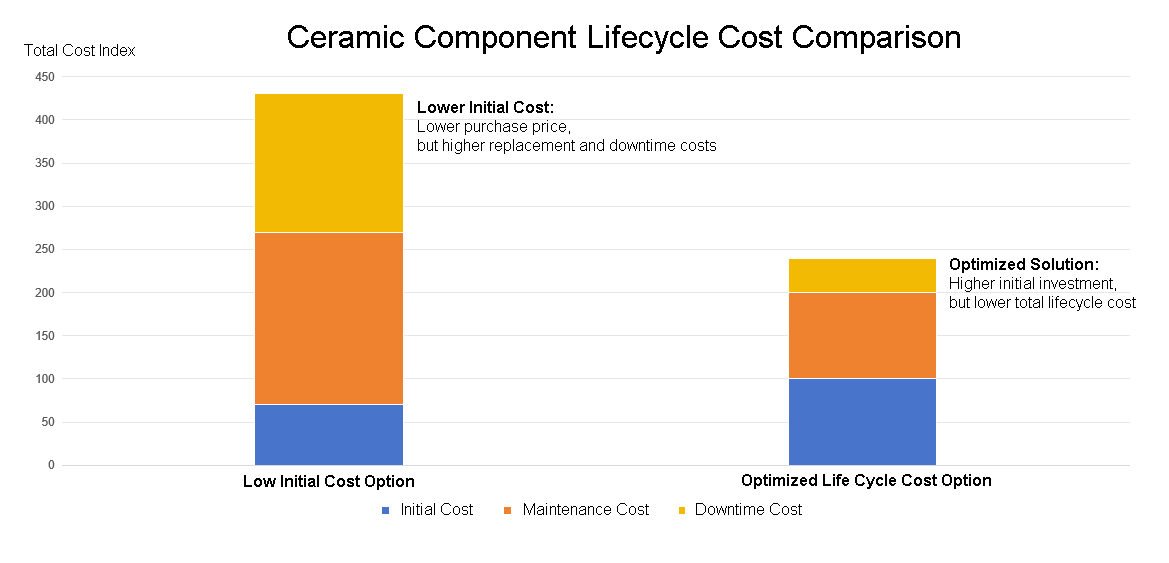
When comparing quotations, the material price is often the first number that attracts attention. Alumina is much less expensive than zirconia. Choosing alumina therefore seems like the obvious decision. However, when viewed over the entire service life of the product, that conclusion may not be correct.
One customer used a low-cost alumina wear component that required replacement every three months. An alternative material cost more than twice as much, but lasted for more than a year.
After calculating the total annual cost, the low-cost option actually became the more expensive solution. It required four replacements each year, equipment downtime during every replacement, maintenance labor, and spare part inventory. Although the material price was 30% lower, the total operating cost was more than twice as high.
What Engineers Should Consider
When selecting ceramic materials, evaluate the total life cycle cost, not simply the purchase price.
The calculation should include:
- Material cost
- Machining cost (which varies significantly among ceramic materials)
- Installation labor
- Downtime associated with each replacement
- Expected service life (often the most important factor)
A lower-priced material that requires frequent replacement is not necessarily the most economical choice.
For critical ceramic components, the cost of production downtime may far exceed the difference in material price.
High Temperature Resistance ≠ Thermal Shock Resistance
“This furnace tube can withstand 1250°C.” Many engineers see this specification and assume the application will be safe.
However, in actual operation, the furnace tube is rarely held at a constant temperature. Instead, it may experience dozens of heating and cooling cycles every day.
High-temperature capability and thermal shock resistance are two completely different properties. Ceramics are much more sensitive to temperature gradients than metals. Rapid temperature changes generate thermal stresses that can easily initiate cracks in brittle materials.
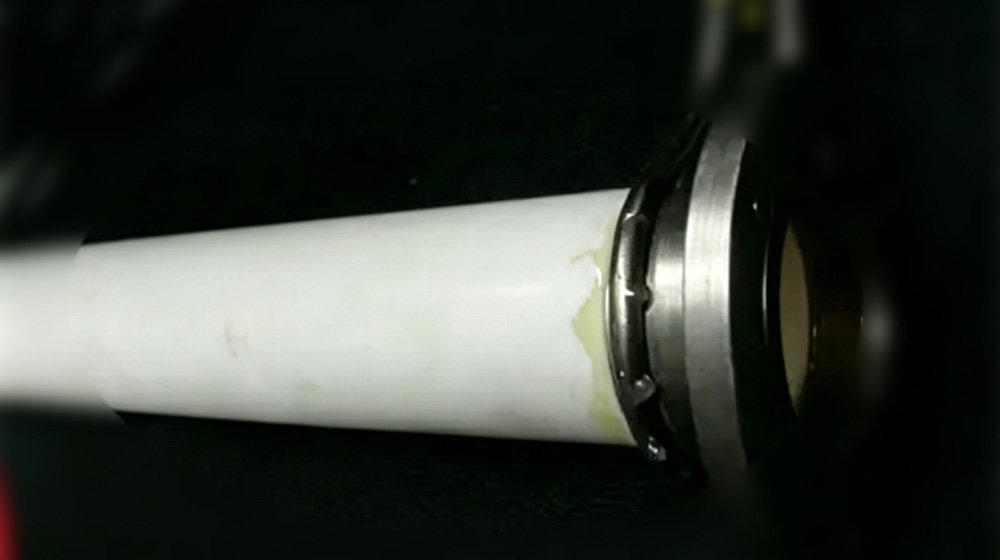
One customer used a silicon carbide furnace tube in a heat treatment furnace operating at 1250°C. The material had sufficient temperature capability and excellent thermal conductivity.
The problem was the operating cycle. The furnace door was opened and closed more than 40 times every day. Each cycle caused localized cooling followed by rapid reheating, creating a significant axial temperature gradient along the tube.
Although silicon carbide has excellent thermal conductivity, its relatively low fracture toughness makes it more sensitive to thermal stress. Repeated thermal cycling subjected the tube to alternating tensile and compressive stresses. After only one or two months, the furnace tubes began cracking.
The customer later switched to an alumina furnace tube and optimized the wall thickness to improve thermal stress distribution. The result was a significantly longer service life at a lower overall cost.
Recommended Approach
If your equipment experiences frequent heating and cooling cycles, thermal shock resistance should take priority over maximum temperature capability.
Thermal shock resistance mainly depends on three factors:
- Higher fracture toughnesshelps prevent crack propagation.
- Lower coefficient of thermal expansionreduces thermal deformation.
- Higher thermal conductivitypromotes more uniform temperature distribution.
Among commonly used engineering ceramics, silicon nitride ceramics are often considered one of the best choices for thermal shock resistance because they combine high fracture toughness with a low coefficient of thermal expansion.
Silicon carbide has excellent thermal conductivity, but its relatively low toughness may make it less reliable under repeated thermal cycling.
If the application operates continuously at a stable temperature, the maximum service temperature remains an important selection criterion.
If the component is subjected to frequent thermal cycling, thermal shock resistance should become the primary consideration.
This issue is particularly common in heat-treatment furnace tubes, thermocouple protection tubes, mechanical seals, burner components, and other ceramic parts exposed to repeated heating and cooling cycles.
Before Choosing a Ceramic Material: 6 Questions Engineers Should Ask
The seven mistakes discussed above all come down to one common issue: The material itself is often not the problem. The real problem is that the application requirements were not clearly defined.
Before selecting a ceramic material, engineers should answer the following questions.
1. What is the main failure mode of the ceramic component?
Consider if the part is mainly exposed to wear, impact, thermal shock, corrosion, electrical insulation failure, etc.
Different failure modes require different material priorities. For example:
- Wear applications require higher hardness.
- Impact applications require higher fracture toughness.
2. What is the long-term operating temperature?
Do not only ask “What is the maximum temperature this ceramic can withstand?” Also consider continuous operating temperature, temperature fluctuations, and thermal cycling frequency.
A material that survives a short-term temperature peak may not maintain performance during long-term operation.
3. What environment will the ceramic part be exposed to?
Consider steam, chemicals, vacuum, high humidity, corrosive media, etc.
Chemical conditions can sometimes cause failure faster than mechanical loads.
Examples include:
- Hydrothermal aging of zirconia in steam environments.
- Chemical attack on certain ceramic materials in strong alkaline conditions.
4. Does the component have special design features?
Before finalizing the drawing, check thin walls, deep holes, sharp corners, and complex geometries.
Component design affects not only manufacturing cost, but also sintering deformation, stress distribution, and final reliability.
5. Is the priority the initial purchase price or the total life cycle cost?
The lowest-priced material is not always the most economical solution.
The evaluation should include service life, maintenance requirements, and downtime costs.
A more expensive ceramic material may provide a lower total cost over the entire operating period.
6. Has manufacturing feasibility been discussed with a ceramic supplier?
Many problems are not caused by the material itself.
They can often be prevented during the design stage through design optimization, process selection, and manufacturing feedback.
If these six questions are clearly answered, ceramic material selection usually becomes much easier.
On the other hand, if these basic requirements are unclear, even a detailed material property chart cannot guarantee the right material choice.
Material Selection Is Only Half the Job
Many engineers assume that if two manufacturers use the same material grade and follow the same drawing, the final ceramic components should perform similarly.
In reality, performance differences often come from the manufacturing process, not just the material name.
For example:
Two suppliers may both produce 99% alumina sealing rings. One supplier may use standard surface grinding. Another supplier may additionally apply double-sided lapping and polishing.
The sealing performance and service life can be completely different.
Therefore, selecting the right material is only half the job. Manufacturing capability determines the other half.
Frequently Asked Questions
Q1: What is the most common misconception when selecting ceramic materials?
A1: The most common mistake is applying metal selection experience directly to ceramics.
Assumptions such as “Harder always means more wear-resistant.”, “Higher temperature rating means unlimited high-temperature operation.”, or “A ceramic manufacturer can simply follow a metal drawing.” may be reasonable in some metal applications, but they do not always apply to ceramics.
Q2: Which is more dangerous: thermal shock or high temperature?
A2: For many brittle engineering ceramics, thermal shock can cause sudden failure more easily than stable high-temperature exposure.
Temperature changes generate internal stresses, and repeated thermal cycles can eventually initiate cracks.
If the operating temperature remains below the safe continuous temperature limit, constant high-temperature operation may be less damaging than repeated heating and cooling cycles.
Q3: Why do prototype parts pass testing but fail after mass production?
A3: There are several possible reasons:
- Prototype and mass-production processes may not be identical.
- Testing conditions may not fully represent long-term service conditions.
- Production quality control may not be stable, causing defects in individual parts.
During the prototype stage, it is important to confirm the planned production process and quality control methods with the manufacturer.
Q4: What are the basic design principles for ceramic components?
A4: Three principles are especially important:
- Add fillets instead of sharp corners. This is one of the simplest ways to reduce stress concentration.
- Keep wall thickness as uniform as possible. This helps reduce sintering deformation and internal stress.
- Discuss manufacturing feasibility before finalizing the drawing. Do not wait until the drawing is completed to ask whether the part can be manufactured.
Q5: Why do ceramic parts made from the same 99% alumina material have different service lives from different suppliers?
A5: Because service life depends on more than the material grade. It is also affected by powder quality, forming process, sintering process, precision machining, and quality control.
Although two suppliers may both specify “99% alumina,” differences in density, grain structure, dimensional accuracy, and surface finish can significantly affect component reliability and service life.
Conclusion
The real reason ceramic projects fail is often not a lack of material knowledge. It is the habit of applying metal-based thinking to ceramic components.
Looking back at the seven common mistakes discussed in this article, the key lessons can be summarized into three points:
1. Do not treat ceramics like metals.
Metal selection rules such as “higher hardness means better wear resistance”, “higher temperature rating means the material can always be used at that temperature”, and “finalized drawing can always be manufactured” do not always apply to ceramics.
Ceramics are much more sensitive to impact loading, sharp corners, and thermal cycling than metals.
2. Discuss manufacturing feasibility before finalizing the design.
Many ceramic manufacturing problems can be identified and solved during the design stage. Waiting until the drawing is completed and asking “Can this be manufactured?” is often too late.
3. Evaluate total cost, not just material price.
The cheapest material is not always the most economical option. Service life, replacement frequency, and maintenance costs often have a greater impact on total cost than the initial material price.
The key to successful ceramic material selection is not simply knowing more material property data. It is being able to move beyond traditional metal-selection thinking.
Once this mindset changes, many common ceramic design and material selection mistakes can be avoided.
If you are unsure which ceramic material is suitable for your application, or whether your current design has potential risks, feel free to contact our engineering team with your operating conditions, and we can help evaluate the suitable material and design approach.
Reviewing material selection and design requirements together before production is often much more efficient than solving problems after failure occurs.