


Overview
Jinghui supplies custom silicon nitride (Si₃N₄) ceramic rods for industrial components that require high mechanical strength, low density, wear resistance and excellent thermal shock resistance.
From solid cylindrical rods to precision-ground pins and custom-machined components, we review your drawings and operating requirements to identify a suitable material and manufacturing route.
Product Options:
- Solid silicon nitride ceramic rods
- Precision-ground rods and pins
- Rods for wear-resistant and high-load applications
- Custom lengths, diameters and end configurations
- Drawing-based machining and finishing, subject to feasibility
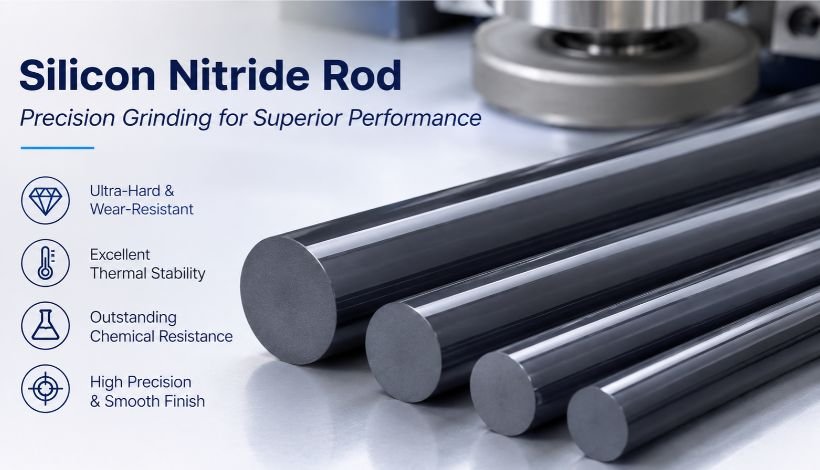
Custom Silicon Nitride Rods Manufactured to Your Specifications
Silicon nitride (Si₃N₄) is an advanced structural ceramic used in mechanical components where conventional metals or other ceramics may not provide the required combination of strength, weight and thermal performance.
Its relatively low density helps reduce the mass and rotational inertia of moving components. Its high mechanical strength and fracture toughness make it suitable for selected applications involving repeated mechanical loading, while its low coefficient of thermal expansion and good thermal shock resistance help maintain dimensional stability during temperature changes.
These characteristics make silicon nitride a material worth considering for precision shafts, positioning pins, wear-resistant rods and other structural components exposed to demanding operating conditions.
However, silicon nitride is not automatically the best choice for every ceramic rod. The material grade, manufacturing process, rod geometry, surface finish and actual loading conditions all influence the performance of the finished component.
Jinghui reviews custom rod projects based on the intended function, drawing dimensions and operating environment.
Silicon Nitride Rods by Features
Silicon nitride rods can be manufactured in different forms depending on the component design and required function. Typical configurations include:
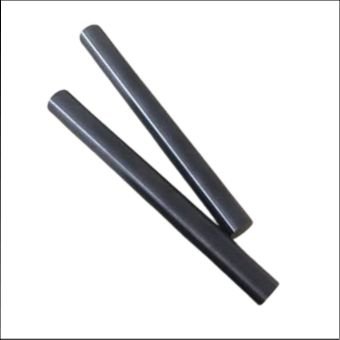
Solid cylindrical rods for use as structural elements, support components and custom-machined blanks. Diameter and length are determined by the application and manufacturing feasibility.
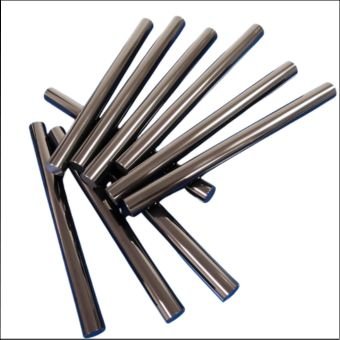
Rods with ground outer surfaces for applications requiring controlled diameter, roundness and surface quality. Suitable for selected precision fitting and sliding-contact designs.
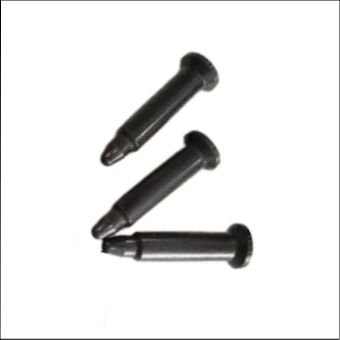
Short rod-shaped components used for positioning, alignment, mechanical support or wear-resistant contact. End geometry and fit requirements should be specified on the drawing.
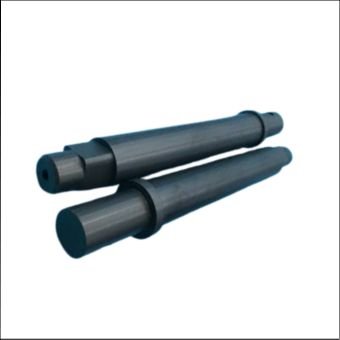
Rod-shaped components designed for selected mechanical assemblies, reciprocating mechanisms or fluid-handling equipment. Bending loads, contact conditions and mounting arrangements should be evaluated before material selection.
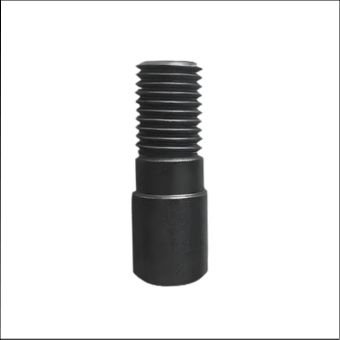
Non-standard designs with steps, grooves, chamfers or other functional features can be reviewed according to the drawing.
Selecting the Right Silicon Nitride Material for Your Rods
Silicon nitride ceramics are produced through different forming and densification processes. These processes influence the material’s density, microstructure, mechanical properties, dimensional characteristics and cost.
For rod applications, the manufacturing route should be considered together with the required diameter, length, geometry and performance. Typical silicon nitride material routes include:
Reaction-Bonded Silicon Nitride (RBSN)
RBSN is produced by nitriding a formed silicon-containing compact. It can offer good thermal shock resistance and relatively low manufacturing shrinkage. However, residual porosity and mechanical properties differ from those of fully densified silicon nitride grades.
Gas-Pressure-Sintered Silicon Nitride (GPSN)
Gas-pressure sintering uses controlled nitrogen pressure during densification. It is used to produce dense silicon nitride with high mechanical strength and reliability for demanding structural applications.
Hot-Pressed Silicon Nitride (HPSN)
Hot pressing applies heat and pressure during densification, producing a dense material with useful mechanical properties. The process can impose limitations on component size and geometry, so suitability for long or non-standard rods needs to be reviewed.
Hot Isostatically Pressed Silicon Nitride (HIP-Si₃N₄)
Hot isostatic pressing uses high temperature and gas pressure to further densify the ceramic. It can be used for demanding applications where material density and mechanical reliability are critical. Cost and component availability should be considered.
Important: These are established silicon nitride manufacturing routes, not a confirmation that every route or grade is currently available for every Jinghui rod project. Please confirm the required material route and availability with our team before specifying it in a purchase order.
Why Choose Silicon Nitride for Ceramic Rod Applications
Silicon nitride is particularly attractive when a rod-shaped component needs to combine mechanical strength, relatively low weight and thermal reliability.

Silicon nitride offers high flexural strength compared with many conventional engineering ceramics. This is useful for selected slender components and mechanical parts exposed to bending or repeated loading.

With a typical density around 3.2–3.3 g/cm³, silicon nitride is lighter than many steel alloys. Lower component mass can help reduce inertia in rotating or reciprocating mechanisms.

Silicon nitride combines relatively low thermal expansion with good thermal shock resistance. It is worth considering for components exposed to rapid heating and cooling or repeated temperature changes.

Silicon nitride is used in demanding bearing and wear-related applications because of its hardness and mechanical properties. It may be suitable for selected sliding or rolling contact components.

Silicon nitride maintains useful mechanical properties in selected elevated-temperature environments. Its oxidation behavior and high-temperature strength depend on the grade, atmosphere and exposure conditions.

Many silicon nitride grades exhibit electrical insulating behavior. However, electrical properties can vary with composition, additives, porosity and manufacturing route.
Precision Grinding and Custom Machining
The performance of a silicon nitride rod depends not only on the material itself but also on its dimensional accuracy, surface condition and geometric consistency. For precision mechanical assemblies, the following machining and finishing requirements may be reviewed:
Outer Diameter Grinding
Grinding the external cylindrical surface to achieve the specified diameter and improve dimensional consistency. This is important for precision fits, guide components and selected rotating assemblies.
End-Face Grinding
Machining the rod ends to the required length and end-face condition. Perpendicularity and flatness may need to be specified where the rod locates against another component.
Chamfering and Edge Finishing
Chamfers or rounded edges can help reduce sharp-edge damage and facilitate assembly. Edge dimensions should be clearly defined on the drawing.
Grooves and Stepped Features
Selected grooves, shoulders and stepped geometries may be considered for functional positioning or assembly. Their feasibility depends on feature size, location, wall thickness and machining access.
Surface Finishing
Where contact friction or surface quality is critical, additional finishing may be evaluated. Specify the required surface roughness and the functional surface to be inspected.
Silicon nitride is difficult to machine using conventional metalworking tools. Diamond grinding and other suitable ceramic machining processes are generally required. Long, slender rods and complex features need particular attention because machining can introduce surface damage or geometric deviation.
We recommend confirming the critical dimensions and inspection method before production. Send your drawing for a machining feasibility review.
Dimensional and Quality Requirements
For silicon nitride rods, a drawing should define more than nominal diameter and overall length. The required dimensions and geometric tolerances should reflect the actual assembly and operating function. Consider specifying the following:
| Requirement | Engineering Purpose |
|---|---|
| Outer diameter | Controls fit and clearance |
| Overall length | Defines installation position and working stroke |
| Diameter tolerance | Controls dimensional consistency |
| Straightness | Important for long rods and guided movement |
| Roundness / cylindricity | Relevant to precision fitting and rotation |
| End-face squareness | Helps control alignment and contact |
| Surface roughness | Affects friction and contact behavior |
| Chamfer / edge condition | Helps prevent edge interference and damage |
| Groove or step dimensions | Controls positioning and assembly |
| Visual condition | Helps identify chips, cracks or surface damage |
Not every dimension needs the tightest possible tolerance. Excessively tight tolerances may increase machining cost and reduce manufacturing yield without improving actual component performance.
For critical applications, identify the functional dimensions and specify how they should be measured. The achievable tolerance must be confirmed for the actual rod diameter, length, geometry and material route.
Silicon Nitride vs. Alumina vs. Zirconia
Silicon nitride, alumina and zirconia are all engineering ceramics, but they serve different mechanical and operating requirements. The best material is the one that meets the actual load, temperature, contact and cost requirements of your component.
- Comparison Items
- When to Consider Silicon Nitride
- When to Consider Alumina
- When Zirconia
| Selection Factor | Silicon Nitride (Si₃N₄) | Alumina (Al₂O₃) | Zirconia (ZrO₂) |
|---|---|---|---|
| Mechanical strength | High | Depends on grade; generally lower than high-performance Si₃N₄ | High for selected grades |
| Fracture toughness | Relatively high for structural ceramics | Generally lower | High for transformation-toughened grades |
| Density | Relatively low | Moderate | Relatively high |
| Thermal shock resistance | Excellent in suitable grades | Generally more limited | Depends on grade and design |
| Wear performance | Good in suitable contact conditions | Good hardness and abrasion resistance | Good in selected sliding and wear applications |
| Electrical behavior | Usually insulating; grade-dependent | Excellent insulation | Generally insulating |
| Typical selection focus | High strength, low mass and thermal shock | Insulation, hardness and cost balance | Toughness and wear resistance |
- The component needs a high strength-to-weight ratio.
- Reduced inertia is important in rotating or moving assemblies.
- The part experiences repeated temperature changes.
- Mechanical reliability under demanding loading is a key requirement.
- A suitable silicon nitride grade and manufacturing route are available.
- Electrical insulation is a primary requirement.
- High hardness and general wear resistance are needed.
- The application does not require the higher mechanical performance of silicon nitride.
- Cost is a major consideration.
- Higher fracture toughness is a key requirement.
- The component is exposed to selected sliding or contact-wear conditions.
- The design benefits from zirconia’s material characteristics and the higher density is acceptable.

Typical Applications
Silicon nitride rods are worth considering for industrial components where mechanical strength, reduced moving mass, thermal shock resistance or wear performance is important.
1. Precision Machinery and Motion Systems
Used as selected guide pins, positioning elements and structural components in precision mechanisms. Low density can be beneficial in moving assemblies where inertia needs to be reduced.
2. Bearing and Rotating Equipment
Silicon nitride is widely used in bearing technology. Rod-shaped components may be considered for selected bearing-related structures, shafts or mechanical elements, depending on design and load conditions.
3. Industrial Pumps and Fluid-Handling Equipment
Potential applications include selected plungers, guide components and wear-related parts. Chemical compatibility should be checked against the actual fluid, concentration and operating temperature.
4. High-Temperature Mechanical Components
Suitable for evaluation in selected components exposed to repeated heating and cooling or elevated operating temperatures. The atmosphere and mechanical loading must be considered.
5. Automotive and Energy Equipment
Silicon nitride is used in selected automotive and energy-related ceramic components because of its strength, low density and thermal performance. The suitability of a rod-shaped design depends on the actual component function and manufacturing requirements.
6. Wear-Resistant Industrial Components
Can be considered for selected pins, contact rods and mechanical parts exposed to repeated friction or abrasive wear. The mating material, lubrication and contact pressure should be reviewed.
Looking for Custom Silicon Nitride Ceramic Rods?
Whether you need a solid Si₃N₄ rod, a precision-ground pin or a custom-machined structural component, JHCERAM can review your drawing and application requirements.
To help us evaluate your project, please provide:
- Required material grade or target properties
- Rod diameter and overall length
- Dimensional and geometric tolerances
- Surface roughness requirements
- End geometry, grooves, steps or other features
- Operating temperature and atmosphere
- Mechanical load, contact conditions and mating material
- Prototype quantity or expected production volume
Send us your drawing and application details. We will review the material and manufacturing requirements before preparing a quotation.
A silicon nitride ceramic rod is a rod-shaped structural component made from silicon nitride (Si₃N₄). It is selected for applications that require a combination of high mechanical strength, relatively low density, wear resistance and thermal shock resistance. Its suitability depends on the material grade and operating conditions.
The main advantages include high mechanical strength, relatively low density, good fracture toughness for an engineering ceramic, thermal shock resistance and good wear performance in suitable conditions. These characteristics are useful in selected precision mechanical and high-temperature applications.
High-performance silicon nitride grades can offer higher flexural strength and fracture toughness than many conventional alumina grades. However, the comparison depends on the specific material grade, test method and component design. The correct choice should be based on the actual loading conditions.
Precision grinding can be evaluated for selected silicon nitride rod dimensions and geometries. The achievable diameter tolerance, straightness and surface finish depend on rod length, diameter, material condition and process capability. Please send a drawing for confirmation.
Selected grooves, shoulders and stepped features may be achievable through specialized ceramic machining. Feasibility depends on the feature dimensions, position, depth, rod geometry and required tolerance. A detailed drawing is recommended.
In selected applications, silicon nitride may replace metal components where reduced weight, wear resistance, thermal stability or electrical insulation is important. However, ceramics are brittle and less tolerant of impact and tensile deformation. The load, mounting design and failure risks must be reviewed before replacement.
Please provide the material grade or required performance, diameter, length, dimensional tolerances, surface finish, end geometry, special features, order quantity and operating conditions. A 2D drawing or 3D model is especially helpful for custom components.
Silicon nitride rods are structural ceramic components mainly used for mechanical functions such as support, positioning, wear resistance and motion-related applications. Silicon nitride substrates are thin ceramic plates used mainly in power electronics and thermal management. Although they use the same base material, their manufacturing processes, product structures and application requirements are different.