

Introduction
Ceramic-to-metal hermetic sealing is a critical joining technology used in vacuum electronics, power module packaging, and high-reliability sensors to ensure long-term airtight performance between ceramic and metal components.
Although many assemblies can pass initial helium leak testing, failures may still occur during thermal cycling or long-term operation in ceramic-to-metal assembly. These issues are typically caused by combined factors such as material mismatch, interface quality, metallization defects, and process variations.
This article explains the key causes of ceramic-to-metal hermetic seal failure and summarizes related material selection, manufacturing process control, and testing methods to improve long-term reliability.
.jpg)
What is a typical ceramic-to-metal hermetic sealing structure like?
In most hermetically sealed structures, the interface between ceramics and metals is typically a multi-layered structure, as shown in the figure below.
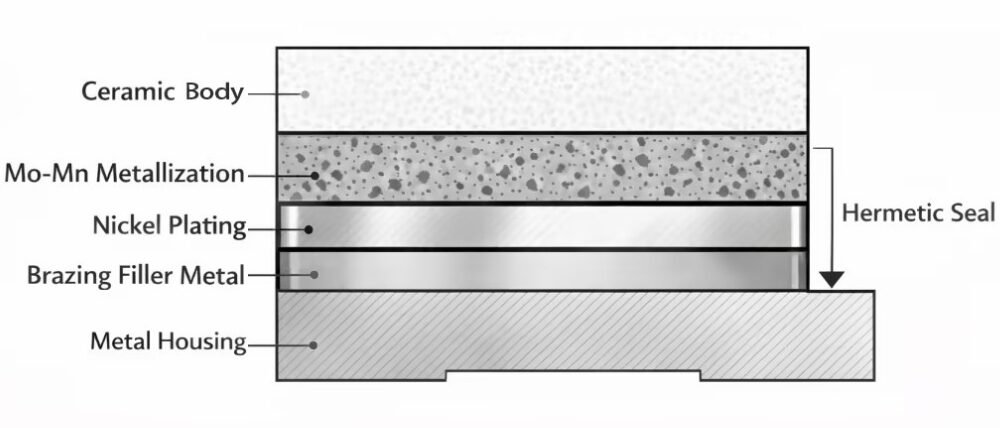
Each of the above interfaces could cause the product’s hermetic seal to fail. In actual production, the hermetic seal failure often does not originate from the material itself, but may be caused by factors such as microscopic defects or mechanical stress concentration in the interface.
What are the key factors affecting hermetic seal reliability?
Key takeaway: Ceramic-to-metal hermetic seal reliability mainly depends on thermal expansion coefficients (CTE) matching, metallization interface quality, and brazing stability—any mismatch or defect can create microcracks over time and lead to leakage.
The long-term stability of the product’s hermetic sealing structure mainly depends on the following three aspects:
- Matching of CTE between ceramic and metallization
- Interface integrity of the metallization layer
- Stability of brazed connections
These three factors interact with each other during metalizing, cooling, and using of the metallized ceramic component.
CTE matching
Ceramic and metallic slurry have different CTEs during temperature changes. If the difference in CTE between the two is too big, significant residual stress will form in the interface region during the cooling process after metalizing.
In this way, the component may not leak during the initial helium test, but after undergoing multiple temperature cycles, it will gradually create microcracks. These microcracks will usually extend along the metallization layer or the brazing interface, eventually forming a leakage channel.
Therefore, the CTE matching between materials needs to be considered during the product’s design phase. For a deeper understanding of how thermal expansion differences affect ceramic-to-metal reliability, see our detailed guide on CTE matching in ceramic-to-metal systems.
Metallization layer interface quality
The metallization layer is the crucial interface for establishing a strong bond between ceramics and metals.
The main factors affecting its reliability include:
- Uniformity of the metallization layer thickness
- Internal porosity of the metallization layer
- Bond strength between the metallization layer and the ceramic surface
- Stability of the metallization sintering temperature profile
- Control of the metallization sintering atmosphere
If there are too many pores or microcracks within the metallization layer, although leakage may not occur in the short term, it often reduces the long-term reliability of the hermetic sealing structure.
Brazing joint quality
Brazing is a manufacturing process that joins metallized ceramics to metal components. Reliable brazing joints typically require the following conditions to be met:
- The brazing filler adequately wets the surface of the ceramic plating surface.
- A continuous and stable reaction layer is formed at the brazing joint.
- Excessive formation of brittle intermetallic compounds (IMCs) is avoided during brazing.
(Note: IMCs are new metallic structures formed during the brazing process when the brazing filler metal reacts with the metal-basis part. Excessive formation can make the joint brittle.)
- The weld thickness is maintained at a reasonable and uniform level.
During the welding process, improper brazing temperature control or inadequate gap design can lead to localized stress concentration or weld defects.
Since brazing quality directly determines long-term seal stability, we recommend reviewing our analysis of brazed ceramic assembly reliability under thermal cycling conditions.
Where do hermetic seal failures typically occur?
Key takeaway: Ceramic-to-metal hermetic seal failures mainly occur at material interfaces and are usually caused by multiple small issues building up over time.
Through actual product failure analysis, the following three interface areas are often the focus of attention:
- Ceramic and metallization layer interface
- Metallization layer and electroplating interface
- Electroplating and brazing interface
These areas are prone to becoming weak points, usually due to the following reasons:
- Abrupt changes in material composition between different interfaces
- Significant differences in CTE of the materials
- Discontinuities in the microstructure of the interfaces
In many failure cases, leakage or hermetic seal failures can often be traced back to changes in the microstructure of these interfaces. For a more systematic breakdown of failure mechanisms, refer to our article on three critical interfaces in ceramic-to-metal hermetic seals.
Common hermeticity failure risks and engineering controls during mass production
In actual production, hermeticity failure is usually related to multiple factors. Below are some common sources of risk.
| Sources of risk | Typical issues | Long-term effects | Engineering Control |
| CTE mismatch | Microcracks form at the interface after thermal cycling | Delayed leakage or hermetic seal failure | Material CTE matching during the design phase |
| Excessive porosity in the metallization layer | Helium test results are unstable or fluctuating | Decreased sealing reliability | Optimize metallization sintering process |
| Insufficient coating adhesion | Localized coating peeling | Brazing failure | Conduct coating adhesion test |
| The reaction layer is too thick | Embrittlement of the joint area | Decreased mechanical strength of joint | Controlling brazing temperature and time |
| Overheating of brazing | Interface structure is destroyed | Reduced sealing stability | Strictly control the process window |
| Inadequate traceability system | Difficulty in locating the source of the defect | Defects recurring | Build a complete batch traceability system |
In many cases, hermeticity failure is not caused by a single factor, but by the accumulation of multiple small deviations.
Material selection for hermetic packaging
Many of the hermeticity risks discussed above are ultimately influenced by material selection at the design stage. While process control can reduce manufacturing variation, material compatibility defines the upper limit of sealing reliability.
Key material factors typically include thermal expansion behavior, thermal conductivity, mechanical strength, and metallization compatibility.
In ceramic-to-metal sealing systems, alumina and AlN are two commonly used materials, each with different performance trade-offs in hermetic applications.
Material selection should therefore be treated as an early-stage design decision that directly affects overall system reliability.
For a detailed comparison, see our analysis of metallized alumina vs AlN for hermetic packaging selection.
Process selection: Mo-Mn metallization vs active brazing
After material selection is determined, the next key decision is the selection of the appropriate metallization or brazing process route.
The choice between different metallization and brazing routes is critical for hermetic reliability. We have analyzed this in detail in a separate comparison of Mo-Mn metallization and active brazing processes.
In some structural designs, engineers need to choose between the most mature Mo-Mn metallization process and active brazing. The following aspects can generally be considered for evaluation:
| S/N | Application conditions | Recommended solution |
| 1 | Ultra-high hermeticity requirements | Mo-Mn metallization |
| 2 | Simple structure | Active brazing |
| 3 | Larger number of thermal cycles required | Mo-Mn metallization, more stable |
| 4 | Cost sensitive | More flexible with active brazing |
Final process selection should be based on a comprehensive evaluation of design requirements, reliability targets, and application conditions.
Key control points in the manufacturing process
While material and process selection define the upper limit of hermetic reliability, manufacturing process control determines how closely the final product can approach that limit in practice.
Hermetic seal reliability depends on tight control of every manufacturing step, from ceramic forming to brazing and final assembly. Even when suitable materials are selected, process variations can still introduce defects that affect long-term sealing performance.
1. Ceramic forming
- Powder formulation consistency
- Stable forming process
- Controlled sintering profile
2. Metallization process
- Paste composition control
- Uniform printing thickness
- Stable metalizing atmosphere
3. Nickel plating process
- Coating thickness control
- Adhesion stability
- Porosity reduction
Interface issues such as plating delamination can still occur if process control is insufficient. See our detailed failure analysis of nickel plating delamination on metallized ceramics.
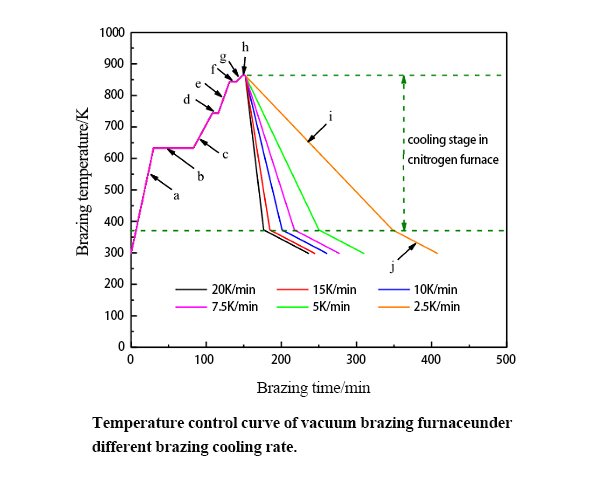
4. Brazing process
- Filler material selection
- Temperature and time control
- Joint geometry stability
5. Assembly
- CTE matching implementation
- Stress control during cooling
- Positioning accuracy
In practice, manufacturing quality is the result of both material selection and process control working together. Neither can independently ensure long-term hermetic performance.
How to verify the hermeticity of a product?
Key takeaway: Hermeticity must be verified through multi-stage testing across the whole process, not just a final helium leak test.
Our product verification typically combines multiple testing methods. Some routine testing methods include:
Before metallizing
- Dimensional inspection
- Appearance quality inspection
- Density testing
- Fluorescent penetrant testing for cracks in ceramic parts
After metallizing
- Visual inspection
- Metallization adhesion test
- Metallization layer thickness test
- Fluorescent penetrant testing for cracks in the ceramic component
Before brazing
- Inspect the weld gap between ceramics and metals
- Check the assembly position and alignment
After brazing
- Helium mass spectrometry leak detection
However, helium leak testing alone does not fully represent long-term hermetic reliability. For a deeper explanation, see Helium leak testing limitations and hermetic standards.
- Thermal cycling test
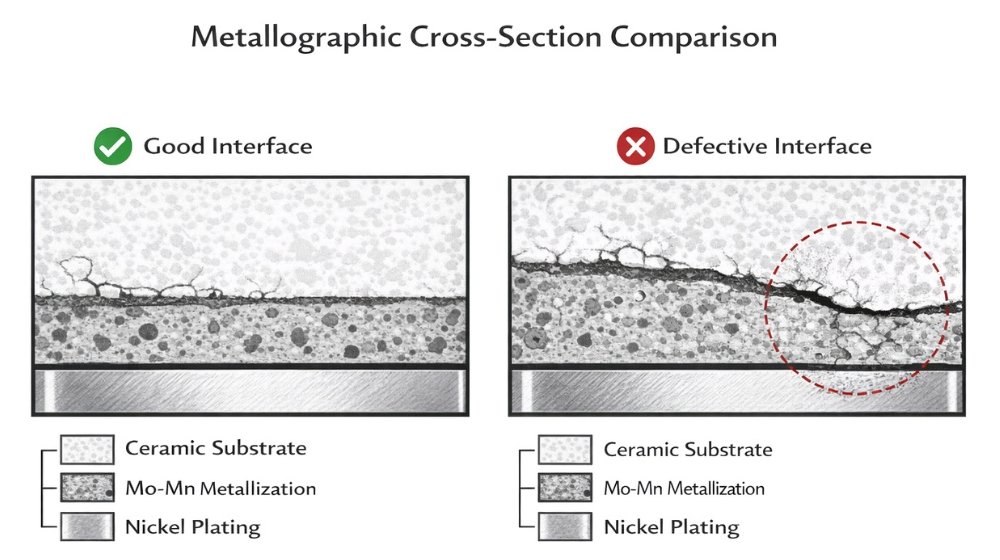
- Metallographic cross-section analysis, as shown in the figure below
A real case we ever experienced
We sampled ceramic high-voltage vacuum metallized insulators to a client, checking for cracks using fluorescence penetrant testing, and all passed. The client’s helium test for gas tightness after welding also showed no issues. However, micro-cracks appeared during the final 20-cycle thermal test, ss shown in the figure below.
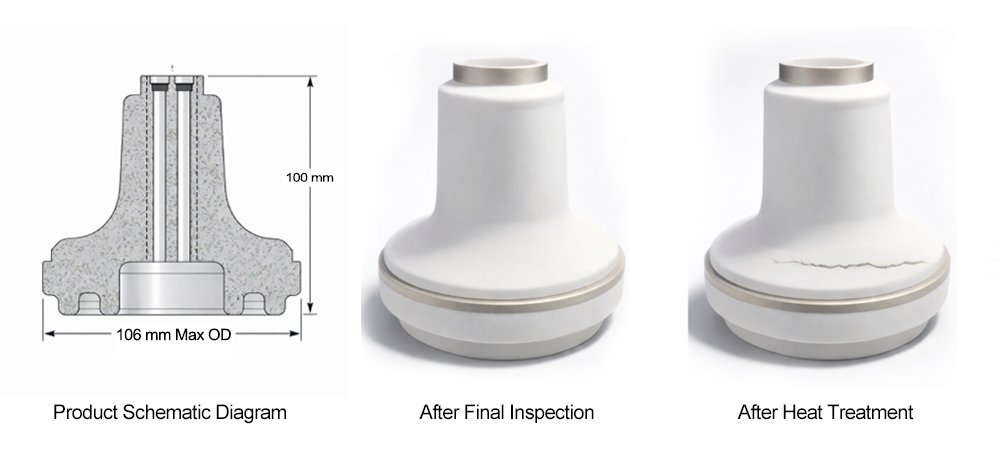
Below we summarized the lessons learned and improvements made from this case:
1. Fluorescent penetrant testing can only detect larger cracks and surface pores. It is unable to identify micron-sized cracks, grain boundary defects, and micro-stress in sintered ceramic parts.
2. For ceramic products with complex structures and large dimensions, we have improved the inspection process. The new procedure is as follows: finished product fluorescent penetrant testing → microscopic inspection → 5-cycle thermal screening of sampled products → fluorescent testing → shipment.
3. Verification has shown that 5-cycle thermal screening effectively identifies products at risk of failure, significantly reducing the likelihood of cracking after delivery to the client.
Frequently asked questions
Q1: Does a helium leak test guarantee hermetic seal reliability?
A1: No. A helium leak test only verifies whether a hermetic seal is leak-free at the time of testing. It does not guarantee long-term hermetic seal reliability. Under thermal cycling or mechanical stress, microcracks may develop and lead to delayed leakage.
Q2: What is the optimal thickness of a ceramic metallization layer?
A2: The typical thickness of a ceramic metallization layer is 10–25 μm. If the layer is too thin, adhesion may be insufficient. If too thick, residual stress can increase, reducing interface stability and sealing reliability.
Q3:What ceramic materials are used in hermetic seals?
A3: Common ceramic materials used in hermetic seals include alumina (Al₂O₃), aluminum nitride (AlN), and silicon nitride (Si₃N₄). Al₂O₃ is widely used due to its stability and cost-effectiveness, while AlN and Si₃N₄ are preferred for high thermal performance applications.
Q4: What is the ideal brazing joint clearance?
A4: The ideal brazing joint clearance is typically 20–80 μm. Proper clearance allows the filler metal to flow and wet the joint effectively. Too small a gap may prevent flow, while too large a gap can reduce joint strength.
Q5. What causes hermetic seal failure?
A5: Hermetic seal failure is typically caused by CTE mismatch between materials, poor metallization quality, or defects during brazing. These factors can create residual stress, weak bonding, or microcracks, which may eventually lead to leakage under thermal cycling or mechanical stress.
Q6. How do you test hermeticity?
A6: Hermeticity is commonly tested using helium leak test, which can identify extremely small leaks. This method measures the leak rate to ensure the seal meets hermeticity standards. Additional tests such as thermal cycling may be used to verify long-term reliability.
Technical insight
In ceramic-to-metal hermetic sealing systems, failures are rarely caused by a single defect. Instead, they are typically the result of coupled effects between material selection, interface quality, and process stability.
This means that hermetic seal reliability should be understood as a system-level engineering outcome, rather than an isolated result of individual process steps or tests. Stable long-term performance can only be achieved when material compatibility, process control, and structural design are properly aligned.
Final thoughts
As a professional manufacturer of ceramic-to-metal hermetic sealing components, JINGHUI provides a wide range of metallized ceramic parts and brazed assemblies for different application needs.
We offer one-stop customization support, from design assistance and prototyping to mass production, helping customers achieve stable and reliable hermetic sealing solutions across various industries.
If you are developing related products, feel free to contact us for technical support or customized solutions.
Further reading:
– How Metallization Porosity Affects Hermetic Performance
– Mo-Mn (Molybdenum-Manganese) Metallization Process Explained
– Material Selection Guide for Metallized Ceramics