

Introduction
If you are working with ceramic-to-metal brazed assemblies, you already know one thing: they don’t usually fail immediately. They pass initial inspection. They pass leak tests. They even work well during early operation.
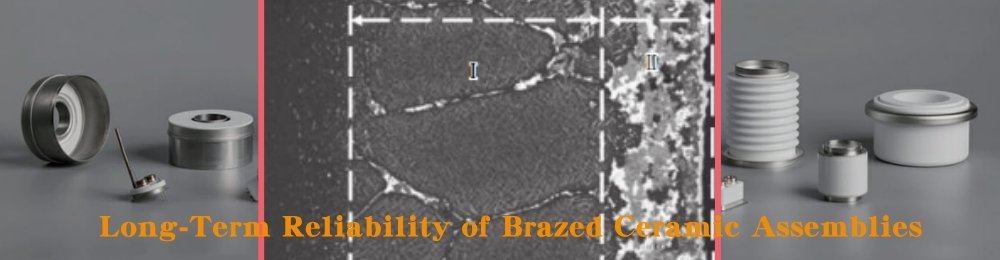
But months later, sometimes after thermal cycling or continuous operation, problems begin to appear. You may see leakage, cracking, or performance instability. At that point, the question is no longer “what is brazing”, but “why did this fail”.
What You Are Really Dealing With: A Stress System, Not Just a Joint
When you design or purchase a brazed ceramic assembly, it is easy to think of it as a simple joint. But in reality, you are dealing with a complex stress system. You have at least three materials:
- Ceramic
- Metal
- Brazing alloy
Each of them expands differently when temperature changes.
Thermal Expansion Reality
| Material | Behavior |
|---|---|
| Ceramic | Low expansion, brittle |
| Metal | High expansion, ductile |
| Brazing alloy | Intermediate |
This mismatch is not a small issue. It is the root of almost every long-term failure.
Where Failure Actually Starts (Not Where You Think)
You may assume failure starts at a visible crack. But in most cases, failure starts much earlier, at the microscopic level.
Stage 1: Residual Stress After Brazing
After brazing, the assembly cools down from high temperature. Because materials shrink differently, residual stress is locked inside. You cannot see it, but it is already there.
Stage 2: Microcrack Initiation
During operation, especially under thermal cycling, stress begins to concentrate. Tiny microcracks start forming at:
- Ceramic edges
- Interface boundaries
- Weak bonding areas
Stage 3: Crack Propagation
Once microcracks exist, they grow slowly. You will not detect them in early testing. But over time, they link together.
Stage 4: Final Failure
Eventually, you see:
- Leakage
- Visible cracks
- Mechanical breakage
Why Thermal Cycling Is Your Biggest Enemy
If your component experiences temperature changes, reliability becomes much harder to control. Each heating and cooling cycle creates expansion and contraction. This means repeated stress loading.
Thermal Fatigue Mechanism
| Cycle | Effect |
|---|---|
| Heating | Expansion mismatch |
| Cooling | Stress reversal |
| Repetition | Crack growth |
You are not dealing with one-time stress. You are dealing with accumulated damage.
The Interface: Your Most Critical and Most Fragile Area
If you want to understand reliability, you must focus on the interface. This is where ceramic, metal, and alloy meet.
What Can Go Wrong
- Poor wetting
- Weak bonding
- Excessive reaction layer
- Voids or pores
Even a small defect here can lead to leakage later.
Design Mistakes That Quietly Reduce Reliability
In many projects, failure is not caused by materials, but by design. Common Issues are as following:
1. Asymmetrical Design
Uneven geometry creates uneven stress distribution.
2. Sharp Corners
Sharp edges concentrate stress.
3. Thick Rigid Joints
Too thick means less flexibility.
Therefore, the three issues encountered in ceramic brazing are summarized in the table below; these must be thoroughly considered during the design phase prior to production.
Design Optimization Table
| Problem | Improvement |
|---|---|
| Stress concentration | Add fillet |
| Mismatch | Use buffer layer |
| Rigid joint | Reduce thickness |
Although the cooling process was optimized—specifically by slowing down the rate of thermal cycling—the problem was not ultimately resolved. Subsequently, the product design underwent a modification: a thin layer of Kovar alloy was inserted between the alumina substrate and the original metal component. This modification successfully resolved the issue; the product has now been in service for two years without any signs of cracking—a service life that meets the client’s requirements. Therefore, when designing products, incorporating a buffer layer serves as an excellent solution.
How You Can Improve Long-Term Reliability
If you want to improve reliability, you need to control stress, not just materials.
Practical Strategies
| Strategy | Why It Works |
|---|---|
| Match CTE | Reduce stress |
| Use Kovar | Compatible expansion |
| Add buffer layer | Absorb strain |
| Control cooling | Reduce residual stress |
FAQ Section
Q1:How reliable are brazed ceramic assemblies over time?
A1:If properly designed and manufactured, brazed ceramic assemblies can be highly reliable and last for many years. However, their reliability depends heavily on thermal conditions, material compatibility, and stress management. In applications with significant thermal cycling, reliability risks increase if stress is not properly controlled.
Q2:Why do brazed ceramic assemblies fail after passing initial tests?
A2:Initial tests such as leak testing only verify the current condition, not long-term behavior. Failures often occur due to accumulated stress and fatigue over time. Microcracks may already exist but are too small to detect. Under repeated thermal cycles, these defects grow and eventually lead to failure.
Q3:What is the most effective way to improve reliability?
A3:The most effective way is to reduce thermal stress through material matching and structural design. This includes using compatible materials like Kovar, adding buffer layers, and optimizing geometry. Process control during brazing is also critical to ensure a strong and stable interface.
Conclusion
If you want long-term reliability, you must think beyond the joint itself. You are not just joining materials. You are managing stress over time. Once you understand this, you can prevent failure before it happens.