

Introduction
Hermetic sealing is one of the most critical requirements in ceramic-to-metal assemblies used in aerospace, medical devices, semiconductor equipment, power electronics, sensors, and vacuum systems.
A properly metallized ceramic component can provide decades of reliable service. However, even when brazing parameters and material selection are correct, poor hermetic performance may still occur.
One frequently overlooked factor is metallization porosity.
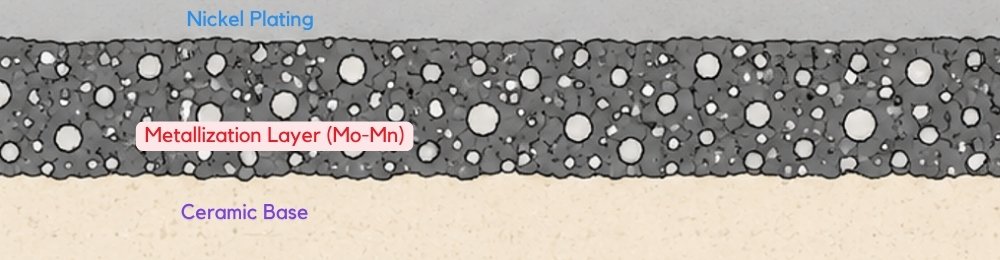
The porosity of a ceramic metallization layer directly affects brazing quality, leak rate, long-term reliability, and vacuum integrity. Understanding how porosity influences hermetic performance is essential when designing high-reliability ceramic-to-metal seals.
What Is Metallization Porosity?
Metallization porosity refers to the volume fraction of microscopic voids present within the metallized layer deposited on a ceramic surface.
In Mo-Mn metallization systems, the metallized layer is not fully dense. Instead, it consists of interconnected metal particles, glass phases, and microscopic pores formed during firing.
Porosity is usually measured as:
Porosity (%) = Void Volume / Total Volume × 100
Typical metallization porosity ranges from:
- 5–15% (dense structure)
- 15–30% (normal structure)
- Above 30% (high porosity)
Why Is Some Porosity Necessary?
Many engineers assume that lower porosity is always better.
This is not entirely correct.
Controlled porosity actually helps:
- Mechanical anchoring
- Nickel plating adhesion
- Braze alloy infiltration
- Metallization bonding strength
Without sufficient porosity, metallization adhesion may decrease significantly.
How Excessive Porosity Creates Leak Paths
The primary risk of excessive porosity is the formation of interconnected pore networks.
When pores become connected:
Gas can travel through:
External Surface → Metallization Layer → Brazed Interface → Internal Cavity
This creates microscopic leak channels that compromise hermeticity.
Even if the braze seam appears visually sound, leakage may still occur through these hidden pathways.
Relationship Between Porosity and Leak Rate
Leak rate generally increases as interconnected porosity increases.
Typical trends:
| Metallization Quality | Hermetic Performance |
|---|---|
| Dense uniform porosity | Excellent |
| Controlled open porosity | Good |
| High interconnected porosity | Poor |
| Cracked porous layer | Very Poor |
Leak rates are commonly evaluated using helium mass spectrometry.
High-reliability packages often require: ≤ 1×10⁻⁹ atm·cc/sec
Case Study
1: Vacuum Feedthrough Failure
One of our clients commissioned a custom vacuum feedthrough component. A month after sample delivery, they reported intermittent gas leakage during use.
Although visual inspection showed the brazing process was completely qualified, helium testing revealed instability.
Factory technicians investigated the cause by cutting a section of the product and using testing equipment. They discovered numerous through-pores within the Mo-Mn metallization layer.
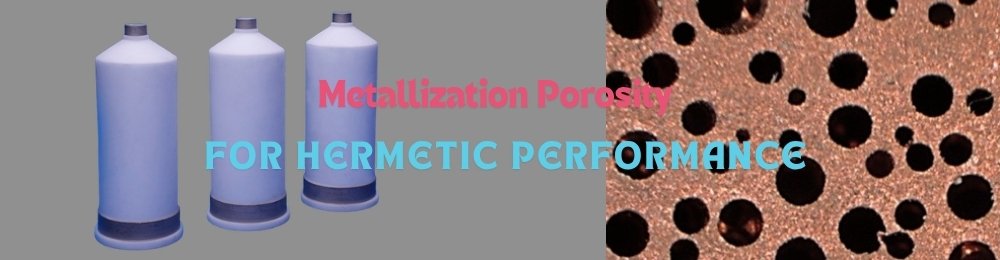
The crux of the problem was that helium gas had entered the internal structure through this porous network. The factory’s process engineers optimized the sintering process. After several trials and adjustments to process parameters, the leakage rate improved by more than an order of magnitude. The improved sample was sent to the client’s site, and no further quality issues were reported.
2: Medical Implant Package
One of our clients requested a prototype product for use in medical implantable devices, requiring a sealing lifespan exceeding 10 years.
Initially, the prototype passed airtightness tests, but after a period of fatigue testing, leakage occurred due to thermal cycling aging.
Failure analysis revealed a localized high-porosity region beneath the nickel plating. This region gradually expanded during thermal cycling, forming a leakage path. Through trying several improvement schemes, the problem was ultimately resolved by optimizing porosity control.
Factors Affecting Metallization Porosity
Key factors include:
Metallization Paste Composition
- Mo particle size
- Mn content
- Glass additives
Firing Temperature
Too low:
- Poor sintering
Too high:
- Abnormal grain growth
Firing Atmosphere
- Hydrogen
- Wet hydrogen
- Nitrogen-hydrogen mixtures
Ceramic Surface Quality
- Surface roughness
- Density
- Open porosity
How to Optimize Hermetic Performance
Best practices include:
- Control metallization porosity between 10–20%
- Maintain uniform microstructure
- Avoid interconnected pore networks
- Optimize firing profiles
- Ensure complete nickel coverage
- Verify braze wetting performance
- Perform helium leak testing
The goal is not the lowest porosity, but the optimum porosity.
FAQ
Q1:Does lower metallization porosity always improve hermeticity?
Not always. Extremely dense metallization layers may reduce mechanical interlocking and nickel adhesion. The best hermetic performance is usually achieved with a controlled porosity structure that balances bonding strength and sealing reliability. Excessively low or excessively high porosity can both negatively affect long-term package performance.
Q2:What porosity level is typically recommended for Mo-Mn metallization?
For most hermetic ceramic packages, a porosity range of approximately 10–20% is often considered optimal. This range generally provides sufficient braze infiltration and plating adhesion while minimizing interconnected leakage paths. The exact target depends on package design and reliability requirements.
Q3:How is metallization porosity measured?
Metallization porosity is commonly evaluated through metallographic cross-section analysis, image analysis software, scanning electron microscopy (SEM), and sometimes mercury intrusion porosimetry. Cross-sectional image analysis remains one of the most widely used methods in ceramic metallization quality control.
Q4:Why do hermetic packages fail leak testing even when brazing looks good?
A visually acceptable braze joint does not guarantee hermeticity. Hidden defects such as interconnected metallization porosity, microcracks, incomplete nickel coverage, or localized wetting failures may create microscopic leak paths. Helium leak testing is therefore essential for validating true hermetic performance.
Conclusion
Metallization porosity is one of the most important but often overlooked factors affecting hermetic ceramic packaging. Properly controlled porosity enhances adhesion, brazeability, and long-term reliability, while excessive interconnected porosity can create leakage pathways that compromise vacuum integrity. For high-reliability ceramic-to-metal seals, metallization porosity should be engineered—not simply minimized.