

Introduction
When you adjust a pepper mill, salt grinder, or coffee grinder from coarse to fine, you may assume that the adjustment mechanism simply changes the distance between the grinding components. That is generally true, but there is another mechanical component that plays an important role: the spring.
In many grinding mechanisms, a spring applies pressure to a movable grinding component, helping it remain in position during operation. It can reduce unwanted movement, compensate for certain assembly variations, and maintain stable contact between mechanical components.

However, spring force does not always determine grind size directly. In most adjustable grinders, the grinding gap is the primary factor controlling particle size, while the spring helps maintain the intended gap. In other designs, spring force also contributes to the positioning of the grinding components.
Understanding this relationship is important when designing or sourcing ceramic grinding mechanisms. The spring, adjustment structure, shaft, and ceramic grinding elements must work together to deliver consistent grinding performance.
How Does a Grinding Adjustment Mechanism Work?
Most adjustable grinders use two grinding components that move relative to each other. Depending on the design, they may be conical burrs, flat grinding discs, or other specially shaped grinding elements.
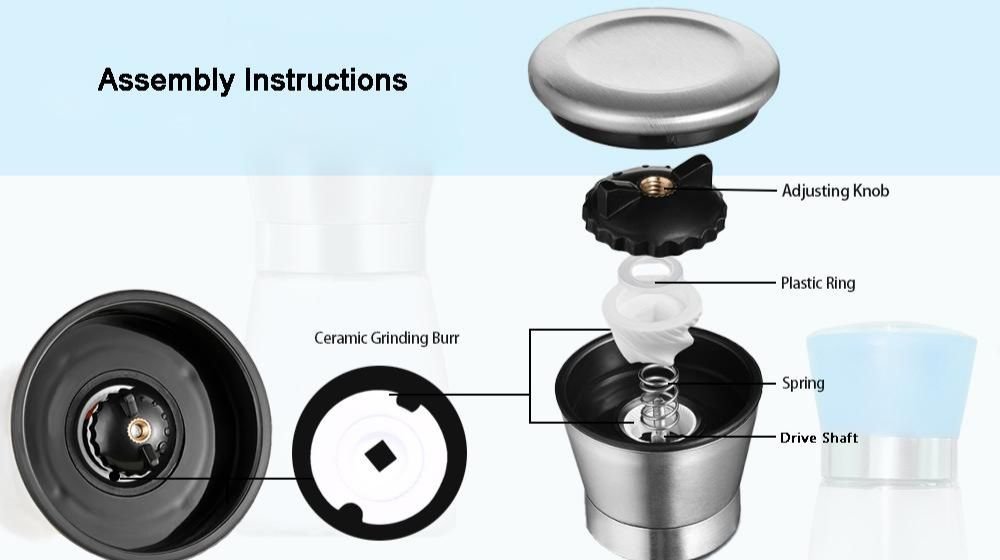
For a typical ceramic pepper or salt grinder, the mechanism may include:
- Inner grinding element: The rotating or movable component that participates in crushing the material.
- Outer grinding element: The stationary or relatively fixed component that forms the grinding area with the inner element.
- Drive shaft: Transfers rotational force from the handle or motor.
- Adjustment knob or ring: Changes the relative position of the grinding components.
- Spring: Applies preload to maintain positioning and reduce unwanted movement.
- Support and positioning components: Keep the shaft and grinding elements aligned.
When you turn the adjustment knob, the mechanism changes the relative axial position of the grinding components. This changes the effective grinding gap through which the material passes.
A smaller gap generally produces finer particles, while a larger gap allows larger particles to pass through. The actual particle-size distribution also depends on grinding tooth geometry, material properties, rotational speed, and feeding conditions.
What Is the Role of a Spring in a Grinding Mechanism?
A spring is not simply an accessory used to hold the grinder together. It is a functional mechanical component that helps control the position and movement of the grinding assembly.
Its main functions include:
1 Providing Spring Preload
A spring is often compressed during assembly to generate an initial force, known as spring preload.
This force helps keep movable components in contact with their positioning surfaces. In a pepper mill, for example, a spring may push the inner grinding element against an adjustment ring or positioning structure.
Without sufficient preload, the grinding element may move axially during operation, making the actual grinding gap less stable.
2 Compensating for Assembly Variations
Ceramic grinding components, shafts, plastic housings, and metal supports all have manufacturing tolerances.
A spring provides a certain degree of compliance, allowing the mechanism to accommodate small variations in the assembled dimensions.
This can help reduce looseness and maintain contact between components. However, a spring cannot correct major dimensional errors, excessive runout, or poor alignment.
3 Reducing Unwanted Movement
During grinding, particles enter the grinding area and create changing mechanical resistance.
The spring helps resist unwanted axial movement of the movable grinding component. When properly designed, it can improve positional stability and reduce variations in the effective grinding gap.
The spring must therefore be selected according to the mechanism’s operating travel, load, and required positioning accuracy.
How Does Spring Force Affect Grinding Consistency?
The relationship between spring force and grinding performance depends on how the adjustment mechanism is designed.
In many grinders, the adjustment knob sets the grinding gap, while the spring maintains contact between the movable grinding component and its positioning structure.
In this arrangement:
- The adjustment mechanism determines the intended grinding gap.
- The spring provides preload to keep the components in position.
- The grinding gap remains more stable when the grinder is operating.
- Reduced axial movement helps maintain more consistent grinding conditions.
Some mechanisms use the spring as part of the adjustment system. In these designs, changing the spring compression or adjustment position may also change the axial position of the grinding component.
It is therefore important to distinguish between two functions:
Gap adjustment: Determines the intended distance between grinding components.
Spring preload: Helps maintain the position and contact condition of the components.
A well-designed spring system supports consistent grinding, but it does not replace accurate machining of the ceramic grinding elements.
What Happens When Spring Force Is Too High or Too Low?
Spring force needs to match the mechanical requirements of the grinder. Both insufficient and excessive preload can affect the operation of the mechanism.
| Spring condition | Possible mechanical effect | Potential grinding impact |
|---|---|---|
| Too little preload | Loose components or axial movement | Less stable grinding gap |
| Appropriate preload | Stable positioning and contact | More consistent grinding conditions |
| Excessive preload | Higher mechanical resistance | Increased operating torque or risk of jamming |
| Spring too soft | Larger displacement under changing loads | Greater variation in grinding gap |
| Spring too stiff | Limited compliance | Greater sensitivity to dimensional variation |
When spring force is too low, the movable grinding element may not remain firmly against its positioning surface. This can result in unwanted movement, noise, or inconsistent grinding.
When spring force is too high, the mechanism may require more effort to operate. Excessive loading may also increase stress on supporting components and, depending on the design, the ceramic grinding elements.
However, stronger spring force does not automatically produce finer particles. If the grinding gap is fixed by a rigid adjustment structure, increasing preload may change the mechanical loading without changing the nominal grinding gap.
The correct spring force is therefore the force needed to maintain stable operation without creating unnecessary resistance or loading.
How Is Spring Force Calculated?
For a conventional compression spring operating within its linear range, the relationship between spring force and compression can be described by Hooke’s Law:
F=kx
(F = Spring force (N),k = Spring rate or stiffness (N/mm),x = Spring compression (mm))
For example, assume a grinder uses a compression spring with a spring rate of 2 N/mm and an installed compression of 3 mm.
F=2\times3=6N,If the compression increases to 4 mm:F=2\times4=8N,The spring force increases from 6 N to 8 N.
This example illustrates the relationship between spring stiffness and compression. It is not a recommended specification for every pepper, salt, spice, or coffee grinder.
In actual product development, you also need to consider the spring’s working range, fatigue life, material, installation space, temperature conditions, and long-term force retention.
Spring Mechanisms in Different Grinders
Pepper, salt, spice, and coffee grinders do not necessarily use the same spring arrangement. Their grinding structures, materials, and operating requirements are different.
1 Pepper Grinders
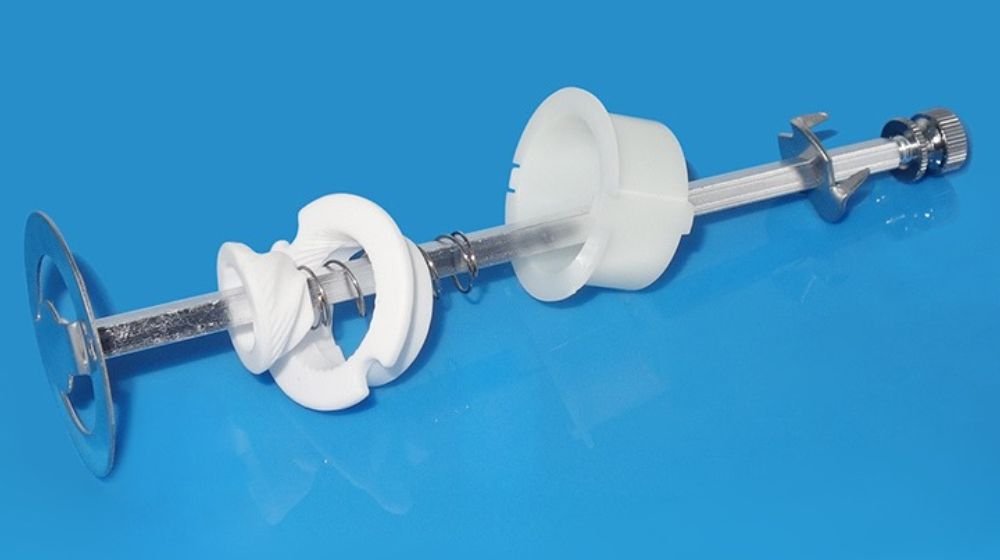
Many manual pepper mills use conical or specially shaped grinding components. A spring may be installed around the central shaft to push the movable grinding element toward an adjustment ring or positioning surface.
The main purpose is to maintain the relative position of the grinding elements while peppercorns enter the grinding area and create changing resistance.
2 Salt Grinders
Salt grinders commonly use ceramic grinding components because of their corrosion resistance and suitability for grinding salt crystals.
Depending on the design, a spring may provide axial preload to maintain the position of the movable grinding component. The mechanism must also accommodate variations in crystal size and the resulting grinding loads.
3 Spice Grinders
Spices include many different materials, with variations in hardness, shape, fiber content, and oil content.
A spring can help maintain stable positioning, but it cannot solve problems caused by unsuitable grinding tooth geometry, poor material feeding, or blockage.
The grinding mechanism must be designed around the physical characteristics of the spices being processed.
4 Coffee Grinders
Coffee grinders commonly use flat or conical burrs. Their adjustment mechanisms are more varied than those of many manual pepper mills.
In some designs, springs provide axial preload to the burr carrier or support assembly. The adjustment ring changes the relative position of the burrs, while the spring helps maintain mechanical stability.
Coffee grinder springs should not all be treated as direct grind-size adjustment components. Their actual function depends on the burr carrier, adjustment mechanism, and overall machine design.
Why Does Ceramic Grinding Burr Accuracy Matter?
Spring performance alone cannot guarantee consistent grinding. The dimensional accuracy and geometry of the ceramic grinding components are equally important.
For ceramic grinding burr manufacturers, several characteristics deserve attention:
| Ceramic component feature | Why it matters |
|---|---|
| OD and ID | Ensure correct assembly and positioning |
| Height and thickness | Affect axial assembly dimensions |
| Concentricity | Helps reduce eccentric movement and uneven gaps |
| Parallelism | Important for flat grinding discs |
| Flatness | Helps prevent uneven contact |
| Grinding tooth geometry | Influences crushing behavior and particle distribution |
| Surface quality | Affects contact conditions and wear behavior |
For example, if a grinding component has excessive eccentricity, the effective gap may vary as the component rotates. If two flat grinding discs are not sufficiently parallel, the gap may be smaller in one area and larger in another.
A spring may help maintain contact and compensate for small assembly variations, but it cannot correct these fundamental geometric problems.
For this reason, spring selection and ceramic component manufacturing should be considered together during grinder development.
How Can You Test Spring and Grinding Performance?
If you are developing a new grinder or evaluating a supplier’s design, testing is more reliable than judging the mechanism by feel alone.
The following tests can help evaluate the interaction between spring force and grinding performance:
| Test | Purpose |
|---|---|
| Spring Force Test | Measure spring force at different compression levels |
| Axial Displacement Test | Check movement of the grinding component under load |
| Grinding Gap Test | Verify the gap at different adjustment settings |
| Operating Torque Test | Measure the force required to adjust or operate the grinder |
| Particle Size Distribution Test | Evaluate the particle sizes produced at different settings |
| Durability Test | Check whether the mechanism maintains performance after repeated use |
Particle size distribution is particularly useful when evaluating grinding performance.
Three common statistical values are:
- D10: 10% of the measured particles are smaller than this size.
- D50: The median particle size; 50% of the measured particles are smaller.
- D90: 90% of the measured particles are smaller than this size.
By comparing particle-size distributions under different grinding gaps and spring preload conditions, you can determine whether the spring system actually improves grinding consistency.
For a meaningful comparison, keep the grinding material, moisture condition, feed quantity, rotational speed, and test method consistent.
Finding the Right Balance Between Spring Force and Grinding Gap
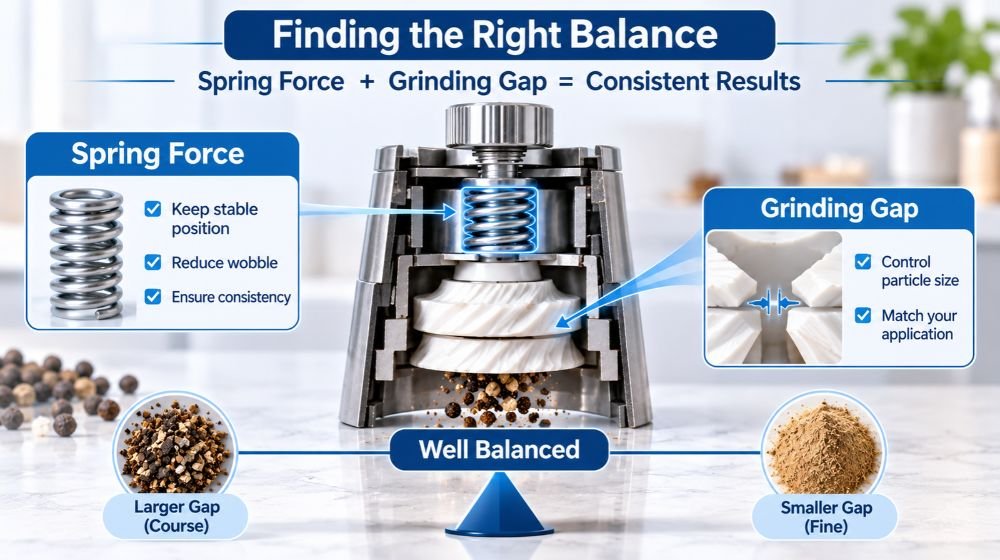
Good grinding performance does not come from maximizing spring force or minimizing the grinding gap. It comes from matching the mechanical components to the intended application.
A well-designed grinding mechanism should provide:
- A suitable grinding gap for the required particle size.
- Enough spring preload to maintain stable positioning.
- Appropriate spring stiffness for the operating load and travel.
- Accurate alignment of the shaft and grinding components.
- Consistent ceramic dimensions and grinding tooth geometry.
If you are selecting a ceramic grinding component supplier, do not focus only on the ceramic material or hardness. Ask how the supplier controls dimensions, concentricity, parallelism, and grinding tooth geometry.
These characteristics affect how the ceramic components work with the spring, shaft, and adjustment mechanism.
Ultimately, the spring maintains the mechanical conditions needed for grinding, while the grinding gap and burr geometry determine how the material is processed. Both must work together to achieve reliable and repeatable results.
Frequently Asked Questions
Q1. Does a stronger spring make coffee or pepper grind finer?
Not necessarily. In most adjustable grinding mechanisms, the grinding gap is the main factor controlling particle size. A stronger spring may help maintain stable contact or positioning, but it does not automatically reduce the gap. Only when the spring is directly involved in positioning the movable grinding component can a change in spring force affect the actual gap. The effect depends on the mechanism design.
Q2. What happens if the spring in a pepper grinder becomes weak?
If the spring loses too much force, the movable grinding component may no longer remain firmly against its positioning structure. This can cause axial movement, looseness, or inconsistent grinding conditions. The grinder may produce less repeatable particle sizes, even when the adjustment knob remains at the same setting. However, similar symptoms can also result from worn positioning parts or dimensional problems, so the entire assembly should be inspected.
Q3. Is spring preload more important than grinding gap?
No. They perform different functions. The grinding gap primarily determines the space available for material to pass through the grinding zone, while spring preload helps maintain the position of the grinding components. A suitable preload is necessary for stable operation, but it cannot compensate for an incorrectly designed grinding gap or inaccurate ceramic components.
Q4. What should you check when sourcing ceramic grinding burrs?
You should check more than material composition and hardness. Important characteristics include overall dimensions, concentricity, parallelism, flatness, grinding tooth geometry, and surface quality. You should also provide the supplier with the assembly drawing and relevant operating requirements. This allows the ceramic component to be evaluated as part of the complete grinding mechanism rather than as an isolated ceramic part.