

Introduction
With the widespread adoption of 800V high-voltage platforms and SiC power devices, electric vehicle (EV) power modules are facing higher thermal loads, more stringent thermal cycling, and higher reliability requirements.
Traditional alumina (Al2O3) substrates are still widely used due to their cost advantages, while aluminum nitride (AlN) substrates are known for their excellent thermal conductivity. However, as automotive-grade reliability requirements continue to increase, more and more high-end power modules are beginning to adopt silicon nitride (Si3N4) substrates.
This is mainly because different ceramic materials vary in thermal conductivity, mechanical reliability, and thermal stress control, while silicon nitride offers a more balanced overall performance.
| Challenges Facing EV Power Modules | Advantages of Silicon Nitride Substrates |
| High heat flux density | Moderate thermal conductivity combined with excellent thermal stress buffering capabilities |
| Harsh thermal cycling | High fracture toughness, effectively suppressing crack propagation and thermal fatigue |
| High-voltage operation | Superior insulation properties and long-term dielectric stability |
| Vibration and mechanical shock | High strength and toughness, enhancing structural reliability |
While Si3N4 exhibits lower thermal conductivity than AlN, it significantly surpasses it in fracture toughness and crack propagation resistance, making it superior for automotive-grade applications requiring frequent thermal cycling and mechanical shock.
Furthermore, its lower coefficient of thermal expansion (CTE) helps reduce thermal stress generated during thermal cycling, thereby improving the long-term stability of the module.
Therefore, silicon nitride has become one of the most widely used substrate materials in high-reliability 800V electric drive systems and SiC power modules.

Heat Dissipation
EV power modules (especially SiC power modules) have high power density, resulting in high local heat flux density during operation.
This requires the substrate material to not only possess good thermal conductivity but also effective thermal stress buffering capabilities to mitigate the impact of electro-thermal coupling stresses on structural reliability.
When the CTE between the substrate and the chip or packaging materials do not match, cyclic thermal strain occurs during repeated heating and cooling cycles, leading to the gradual accumulation of fatigue damage at the solder joints or interfaces.
As the number of cycles increases, this damage may gradually evolve into microcracks, ultimately compromising structural reliability.
The CTE of silicon nitride is approximately 3.0~3.2×10⁻⁶/℃, which is relatively close to that of Si and SiC chips, helping to reduce thermal stresses generated during thermal cycling.
Furthermore, the thermal conductivity of silicon nitride substrates used for power module packaging typically reaches 70~90 W/m·K, which ensures high mechanical reliability while also meeting the basic thermal management requirements of power modules.
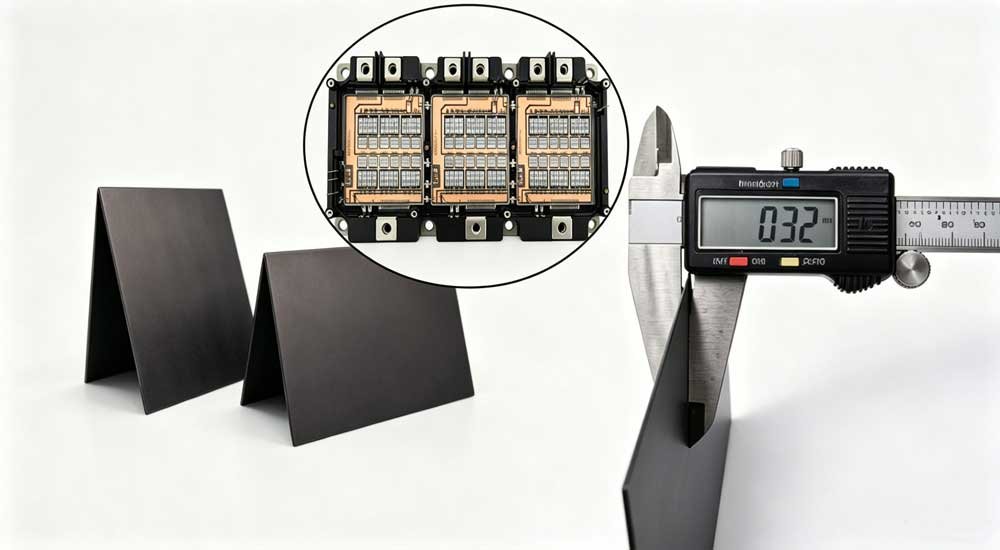
In actual packaging, optimizing the substrate thickness (e.g., 0.32 mm) can further reduce thermal resistance, thereby enhancing system-level thermal management capabilities.
Thermal Cycling
Vehicles must adapt to a wide range of temperatures, from the bitter cold of Heilongjiang (- 30℃) to the extreme high temperatures of Turpan (> 50℃).
In contrast, EV power modules face not only changes in ambient temperature but also rapid fluctuations in internal junction temperature caused by operating conditions such as high-power operation of power devices, frequent acceleration, energy recovery, and fast charging.
Under these conditions, the temperature of the power module fluctuates repeatedly within a short period, creating high-frequency thermal cycling. The rate of change and number of cycles are far higher than those in traditional automotive powertrain systems.
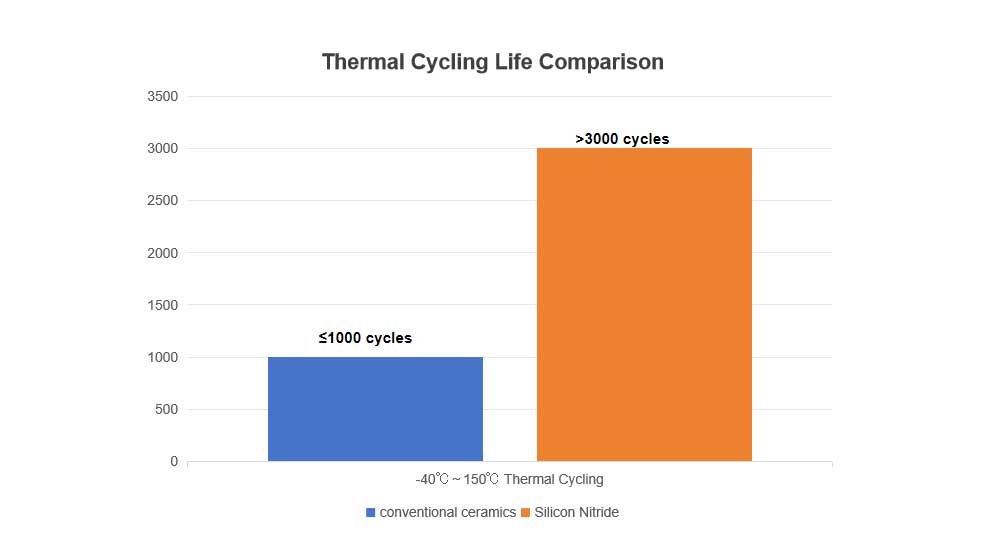
Conventional ceramic substrates are prone to developing microcracks under prolonged thermal expansion and contraction, which gradually propagate and may ultimately lead to degraded insulation performance or copper layer failure, compromising module reliability.
The key reason silicon nitride is suitable for harsh thermal cycling environments lies in its high fracture toughness. Compared to alumina and aluminum nitride, it can more effectively suppress crack initiation and propagation, thereby enhancing thermal cycling reliability.
Results from numerous engineering applications indicate that under thermal cycling conditions ranging from -40℃ to 150℃, silicon nitride substrates typically demonstrate superior durability and reliability.
High-Voltage Resistance
With the rapid adoption of 800V high-voltage platforms in EVs, some high-end models have already begun to evolve toward 1000V and higher voltage levels.
The increase in voltage levels not only improves system efficiency but also places stricter demands on the insulation performance of power module substrates—requiring not only sufficient breakdown strength but, more importantly, stable insulation reliability under long-term electro-thermal-mechanical coupled stresses.
In actual power modules, substrates are often subjected to multiple stresses simultaneously, including high voltage, current surges, and thermal cycling, making the material’s long-term dielectric stability particularly critical.
Silicon nitride offers excellent insulation properties and good dielectric stability, meeting the application requirements of 800V and higher voltage platforms under long-term operating conditions. Even with relatively thin substrate thicknesses (such as 0.32 mm), it can still provide reliable electrical insulation while meeting low thermal resistance requirements.
Furthermore, silicon nitride possesses excellent chemical stability and resistance to environmental corrosion, enabling it to maintain stable electrical and mechanical properties in humid environments, salt spray environments, and complex operating conditions where it may come into contact with coolant, thereby further enhancing the long-term reliability of power modules.
Toughness
Speed bumps, manhole covers, and gravel roads encountered while driving, as well as the inertial forces generated by sudden acceleration and braking, are all transmitted to the power modules.
Alumina and aluminum nitride have relatively low fracture toughness, making them more susceptible to crack propagation under the combined effects of long-term vibration and thermal cycling.
Silicon nitride exhibits the highest fracture toughness among mainstream ceramic substrate materials for power modules. Its unique long-columnar grain structure enables a “crack bridging effect.”
Specifically, when microcracks form, some grains span across both sides of the crack and bear the load, thereby dissipating the energy required for crack propagation and significantly inhibiting further crack growth. This is one of the key reasons why silicon nitride maintains excellent reliability under thermal cycling, vibration, and mechanical shock conditions.
This high fracture toughness offers two practical engineering advantages:
First, it is better suited for thick-copper AMB processes: Thick copper layers generate significant residual stress during cooling, and silicon nitride can more effectively suppress crack initiation and propagation, thereby enhancing structural reliability.
Second, it supports the design of larger-sized substrates: Its higher mechanical strength and thermal shock resistance allow it to maintain structural stability even in large-area packaging, thereby helping to reduce the need for segmented module designs and improve overall reliability.
Common Applications of Silicon Nitride Substrates in the Automotive Industry
What are the typical applications of silicon nitride substrates in the automotive industry? Here are a few of the most common examples.
| Application | Function and Benefit |
| Main drive inverter power modules | Supports IGBT/SiC chips, balancing heat dissipation, insulation, and reliability. |
| On-board chargers (OBC) | Supports high power density and high-voltage insulation designs. |
| DC-DC converters | Improves heat dissipation and long-term reliability of power devices. |
| High-voltage fast-charging systems | Meets the insulation and heat dissipation requirements of platforms above 800V. |
Frequently Asked Questions
Q1: The cost of silicon nitride substrates is significantly higher than that of aluminum nitride. Is it worth using them?
A1: Yes, it is. Although the initial purchase cost of silicon nitride substrates is higher, their significantly improved reliability often reduces the total cost of ownership for automotive-grade applications.
Q2: Can aluminum nitride replace silicon nitride?
A2: Whether it can be replaced depends on the specific application’s trade-off between “heat dissipation capability” and “mechanical reliability.”
Aluminum nitride has superior thermal conductivity compared to silicon nitride, making it advantageous in applications with extremely high heat dissipation requirements and relatively stable operating conditions. However, in automotive-grade applications such as EV main drive inverters, which involve high vibration and high thermal cycling, silicon nitride typically offers higher long-term reliability due to its higher fracture toughness and superior crack propagation resistance. For more selection details, please refer to Al2O3 vs AlN vs Si3N4: which is best for power modules
Q3: What copper layer thickness can a silicon nitride substrate support?
A3: Using the AMB process, the copper layer thickness can reach 0.3mm or even 0.8mm. Silicon nitride’s high toughness allows it to withstand the shrinkage stress during the cooling process of thick copper, while aluminum nitride is more sensitive to residual stress in thick copper structures.
Q4: Is a 0.32mm thick silicon nitride substrate sufficient? Can it be made thinner?
A4: It is perfectly sufficient. The current mainstream thickness is 0.32mm. Although it can be processed to 0.25mm, this will lead to a decrease in yield and limited marginal benefits. Unless there are special requirements, 0.32mm is the most cost-effective choice.
Conclusion
Silicon nitride is not the material with the best individual properties, but it offers a more balanced combination of thermal conductivity, mechanical reliability, and electrical performance.
In EV power modules, where high voltage, high power density, and high reliability must coexist, these combined advantages make it an increasingly important choice for substrate materials.