

Engineering Selection of Al₂O₃, AlN, and Si₃N₄ Substrates
Selecting a ceramic substrate for power modules is rarely a material-property exercise alone. Thermal performance, reliability, and cost must all be considered at the system level. They provide electrical insulation between the copper circuit and the cooling system while simultaneously serving as a critical heat-transfer path. Mechanical durability is equally important, particularly under repeated thermal loading. For this reason, material selection is rarely based on thermal conductivity alone.
In practice, engineers balance thermal performance, thermal-cycling reliability, manufacturability, and system cost. A ceramic substrate with higher thermal conductivity does not necessarily deliver a longer service life, just as a more robust material may not always provide measurable system-level benefits.
Al₂O₃, AlN, and Si₃N₄ remain the most widely used substrate materials for IGBT and SiC power modules. Each offers a different combination of thermal behavior, fracture resistance, and economic considerations. The optimal choice depends on the dominant design constraint, whether that constraint is junction-temperature margin, lifetime under cyclic loading, or overall cost-performance balance.
This article explores the engineering trade-offs of Al₂O₃, AlN, and Si₃N₄ Substrates.
| Application | Common Choice | Primary Reason |
| Industrial Drives | Al₂O₃ DBC | Lowest total cost |
| UPS Systems | Al₂O₃ DBC | Mature and reliable |
| PV Inverters | AlN DBC | Improved thermal performance |
| Energy Storage PCS | Al₂O₃ DBC / AlN DBC | Better heat dissipation |
| High-Power SiC Modules | AlN DBC / Si₃N₄ AMB | Thermal performance and reliability |
| EV Traction Inverters | Si₃N₄ AMB | Thermal-cycling durability |
| Railway Converters | Si₃N₄ AMB | Mechanical robustness |
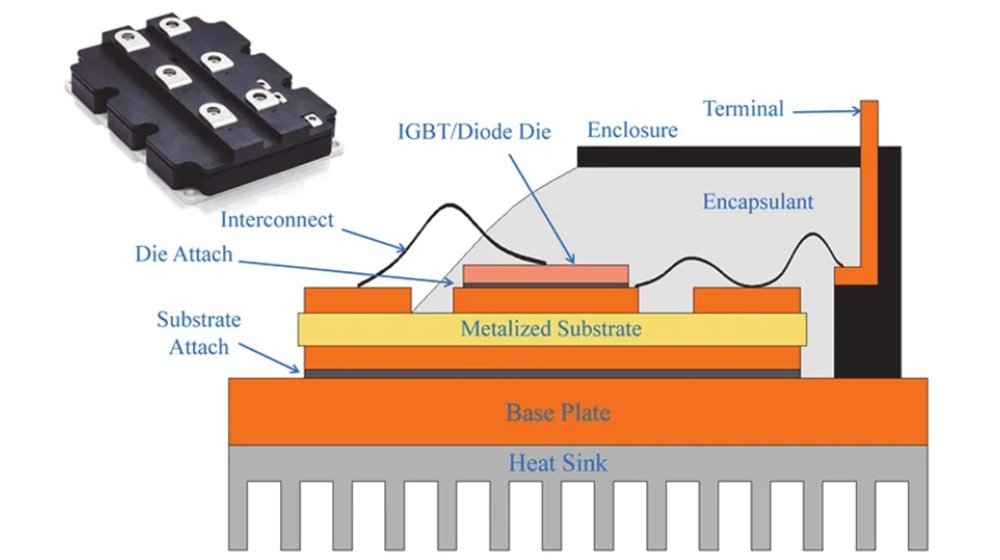
Although these applications often use different substrate materials, the underlying selection logic remains similar. Understanding the role of the ceramic substrate within the power-module package helps explain why different materials are chosen under different operating conditions.
Why Ceramic Substrates Matter in Modern IGBT and SiC Power Modules
Understanding the role of a ceramic substrate for power modules helps explain why different materials are selected for different operating conditions. Within a power-module package, the ceramic substrate forms the foundation. It electrically isolates the copper circuitry from the heatsink while providing a thermal path for heat generated by the semiconductor devices.
Beyond thermal and electrical functions, the substrate contributes to the mechanical integrity of the package. During operation, it must withstand temperature gradients, thermal cycling, and assembly-related stresses without compromising performance.
As high-power IGBTs and SiC devices become more common devices has raised the demands placed on substrate materials. As operating temperatures and power densities continue to rise, substrate performance has become an important factor in determining module reliability and service life.
Al₂O₃, AlN, and Si₃N₄: Understanding the Trade-Offs
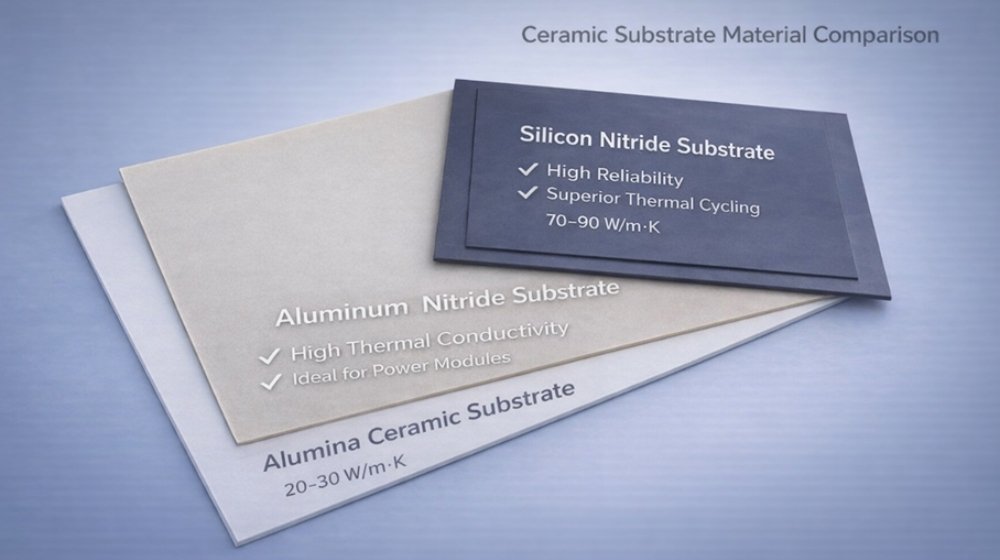
Against this background, Al₂O₃, AlN and Si₃N₄ remain the most widely used substrate materials. Each material provides a different combination of thermal conductivity, mechanical properties, and manufacturing cost. For this reason, substrate selection is generally driven by application requirements rather than by a single performance parameter.
Ceramic Substrate Property Comparison: Al₂O₃, AlN, and Si₃N₄
| Property | Al₂O₃ | AlN | Si₃N₄ |
| Thermal Conductivity | 20–30 W/m·K | 170–230 W/m·K | 70–90 W/m·K |
| Fracture Toughness | Low | Medium | High |
| Thermal-Cycling Capability | Moderate | Good | Excellent |
| Relative Cost | Low | Medium | High |
Engineers commonly select AlN when thermal resistance becomes a limiting factor. Whereas Si₃N₄ is often preferred when long-term reliability is the dominant concern. Al₂O₃ remains widely used due to its mature manufacturing base and favorable cost-performance ratio.
| Design Consideration | Material Commonly Selected | Engineering Reason |
| Cost-sensitive applications | Al₂O₃ | Mature manufacturing base and favorable cost-performance ratio |
| High heat-flux applications | AlN | High thermal conductivity reduces substrate thermal resistance |
| Thermal-cycling-intensive applications | Si₃N₄ | High fracture toughness improves resistance to thermal-mechanical stress |
| EV traction inverters | Si₃N₄ | Long-term reliability under cyclic thermal loading |
| High-power SiC modules | AlN or Si₃N₄ | Selection depends on thermal requirements and reliability targets |
In practice, thermal requirements, expected service life, operating environment, and system cost are typically evaluated together when selecting a substrate material. However, thermal conductivity alone rarely determines long-term module reliability. Mechanical interactions within the package must also be considered.
More importantly, material properties extend beyond thermal conductivity and cost. Thermo-mechanical stress often influences long-term reliability. How the substrate responds to thermo-mechanical stress during operation.
Why CTE Matching Matters
Thermal conductivity is not the only property that influences substrate performance. Differences in the coefficient of thermal expansion (CTE) between copper and ceramic materials generate mechanical stress during heating and cooling cycles.
As power modules repeatedly expand and contract, this stress can contribute to copper delamination, ceramic cracking, and long-term reliability degradation. For this reason, substrate selection often involves balancing thermal performance with thermo-mechanical durability. While AlN is valued for its high thermal conductivity, Si₃N₄ is frequently selected in demanding applications because its high fracture toughness helps tolerate stresses associated with thermal-expansion mismatch.
When to Choose Al₂O₃, AlN or Si₃N₄
When Al₂O₃ Remains a Practical Choice
Despite the increasing use of AlN and Si₃N₄, Al₂O₃ continues to be widely used in industrial power electronics. One reason is straightforward: its thermal performance is often sufficient. Al₂O₃ benefits from a mature manufacturing base, established DBC processing, and broad supplier availability. These factors help control both cost and supply-chain risk.
Consider a conventional industrial inverter. The substrate is only one element within the overall thermal path. Heat must still pass through the solder layer, copper, baseplate, thermal interface material, and cooling system.
Under these conditions, replacing Al₂O₃ with AlN may reduce substrate thermal resistance, but the effect on junction temperature is not always significant. The engineering question is therefore not whether AlN performs better. It usually does.
When AlN Becomes a Practical Option
AlN is seldom selected for thermal conductivity alone. It typically enters consideration when thermal margins become increasingly constrained. Compared with Al₂O₃, the ceramic layer contributes less resistance to heat flow, making the benefit more apparent as power density rises.
A liquid-cooled SiC module is a typical example. When junction temperatures are already close to the design limit, reducing substrate resistance can create additional design margin. The result is not necessarily a lower operating temperature. In many cases, the gain appears as higher power density, reduced cooling demand, or greater reliability headroom.
Before specifying AlN, engineers should nevertheless identify the thermal bottleneck. In many designs, limitations originate from the heatsink, thermal interface material, or cooling architecture rather than the substrate itself.
This situation is particularly common in energy-storage PCS applications. Conventional Al₂O₃ DBC substrates frequently provide sufficient thermal capability at a competitive cost. As system power density increases, AlN DBC may become attractive for extending thermal margin without major changes to the cooling system.
Thermal considerations alone rarely determine the final choice. At the same time, high-power SiC modules, EV traction inverters, and other demanding applications must also withstand severe thermal cycling over long service periods. Under these conditions, package durability often becomes the dominant design concern, shifting the evaluation toward long-term reliability rather than heat dissipation alone.
Why Si₃N₄ Is Frequently Used in High-Reliability Power Modules
Unlike AlN, The reasons for selecting Si₃N₄ are often different from those for selecting AlN. In many applications, the challenge is not achieving lower thermal resistance. It is maintaining reliability under repeated thermal and mechanical loading. Thermal cycling generates stress within the substrate assembly. Differences in thermal expansion between copper and ceramic materials can gradually lead to crack formation, copper delamination, or other package-related failures.
Si₃N₄ is particularly resistant to these failure mechanisms. Its high fracture toughness helps suppress crack propagation and improves tolerance to thermo-mechanical stress. This becomes increasingly relevant in traction inverters, railway power converters, and other systems expected to operate under demanding load cycles for many years.
A reduction in thermal resistance is valuable. Long-term durability may be even more important. Once substrate cracking or copper delamination occurs, the limitation is no longer the semiconductor device. The package itself becomes the failure point.
For automotive power modules, industry qualification standards often assess thermal-cycling and power-cycling performance. Such as AQG 324 and relevant JEDEC reliability methodologies. These qualification approaches focus on long-term package reliability, under repeated thermo-mechanical loading, which is one reason why, substrate selection has become increasingly important in high-reliability applications.
Selecting the ceramic material is only part of the substrate decision. Equally important, the method used to bond copper to the ceramic can also influence thermal performance and long-term reliability.
DBC and AMB: Different Approaches to Copper–Ceramic Bonding
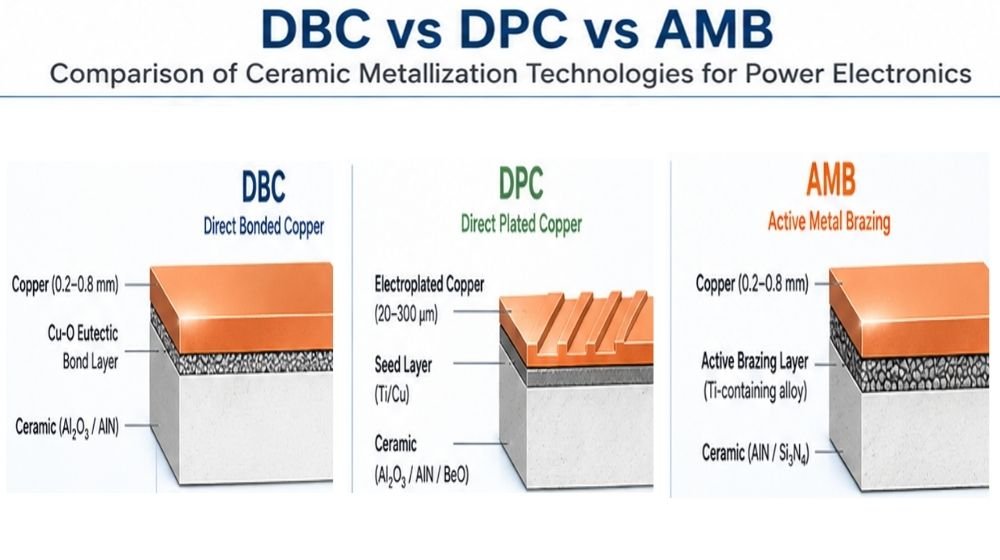
From a structural perspective, the ceramic material is only one part of the substrate structure. Equally important is the interface between the copper layer and the ceramic. This region experiences significant thermo-mechanical stress during operation and frequently contributes to long-term reliability failures.
Advantages of DBC
DBC remains the dominant technology in industrial power modules. The process is mature, widely available, and supported by decades of field experience.
Advantages of AMB
AMB is typically considered under different conditions. In high-power applications, repeated thermal cycling can gradually weaken the copper–ceramic interface. Reliability testing frequently reveals crack formation and copper delamination.
DBC vs AMB Selection Guidelines
In high-reliability applications, high thermal-cycling reliability requirements often drive the adoption of Si₃N₄ AMB substrates. However, long-term performance depends not only on the bonding technology itself, but also on ceramic properties, copper design, manufacturing quality, and overall package construction. Reliability depends on far more than bonding technology alone.
In many applications, DBC substrates already provide excellent thermal and lifetime performance when properly designed and manufactured. The selection between DBC and AMB therefore requires consideration of ceramic material, copper thickness, thermal-cycling conditions, and service-life targets. This becomes particularly relevant in traction inverters, railway converters, and other systems expected to operate under severe thermal-cycling conditions for many years.
For many industrial modules, DBC already satisfies both thermal and lifetime requirements. When reliability targets become more demanding, Si₃N₄ AMB may offer additional margin against thermo-mechanical fatigue. While AMB is often associated with high-reliability power modules, reliability is ultimately a system-level characteristic rather than a property of a single manufacturing process.
In practice, ceramic material selection, copper thickness, metallization layout, residual stress, and process consistency all influence substrate lifetime. For this reason, neither DBC nor AMB should be considered universally superior in all applications.
Thermal Conductivity and Junction Temperature: Not a Linear Relationship
Higher thermal conductivity does not automatically result in a proportional reduction in junction temperature. The substrate represents only one portion of the overall thermal path.
Junction → Solder → Copper → Ceramic → Baseplate → TIM → Cooling System
A simplified thermal-resistance model illustrates the concept. Actual thermal-resistance values vary significantly with module design, chip size, substrate dimensions, copper thickness, interface materials, and cooling conditions. The following values serve only as representative examples.
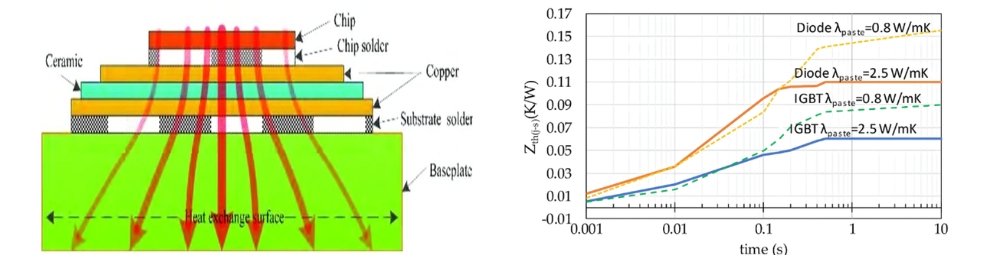
Assume a typical ceramic substrate for IGBT module applications in a 1200 V industrial drive dissipating 300 W:
- Chip and solder: 0.06 °C/W
- Copper layers: 0.02 °C/W
- Ceramic substrate: 0.03 °C/W
- Baseplate and interface materials: 0.04 °C/W
Total thermal resistance: Rth,total = 0.15 °C/W, Resulting temperature rise: ΔT = 45 °C
If the ceramic layer is changed from Al₂O₃ to AlN and the ceramic contribution decreases from 0.03 °C/W to 0.015 °C/W, the total thermal resistance becomes:
Rth,total = 0.135 °C/W, The corresponding temperature rise is reduced to approximately 40.5 °C.
As a result, the reduction in junction temperature is often modest compared with the increase in ceramic thermal conductivity. This outcome is not unusual. In many practical designs, a significant portion of the thermal resistance exists outside the ceramic substrate itself.
For this reason, Substrate selection therefore requires evaluation within the context of the complete thermal-management system.
Failure Mechanisms Observed in Ceramic Substrates
Field failures rarely originate from a single event. Among these failure mechanisms, copper delamination is one of the most common.
Copper Delamination
Thermal-expansion mismatch between copper and ceramic generates cyclic stress at the bonding interface. Copper delamination typically begins locally. The affected area may remain small for an extended period before thermal resistance starts to increase measurably.
Ceramic Cracking
By contrast, Cracks frequently initiate near stress-concentration regions such as corners, holes, or metallization edges. Crack initiation is not always the primary concern. Once propagation begins, substrate reliability can deteriorate rapidly.
Insulation Breakdown
Ceramic material properties alone rarely determine electrical breakdown. Contamination, voids, local defects, or electric-field concentration often contribute to failure. In some cases, degradation progresses unnoticed until insulation failure occurs during operation.
Additional Failure Mechanisms in Substrate Assemblies
Although ceramic cracking and copper delamination are among the most commonly discussed substrate-related failures, other degradation mechanisms may also affect long-term module reliability.
Solder fatigue can develop under repeated thermal cycling, particularly at interfaces between the substrate and baseplate. Over time, cyclic thermo-mechanical stress may lead to crack initiation and propagation within solder joints. Void growth is another concern in high-power modules. Voids may increase local thermal resistance, creating hot spots that accelerate package degradation.
In addition, metallization fatigue can also occur after prolonged thermal cycling. Repeated expansion and contraction of metallic layers may gradually reduce mechanical integrity and contribute to reliability degradation. For this reason, engineers should generally evaluate substrate reliability as part of the complete package structure rather than as an isolated ceramic component.
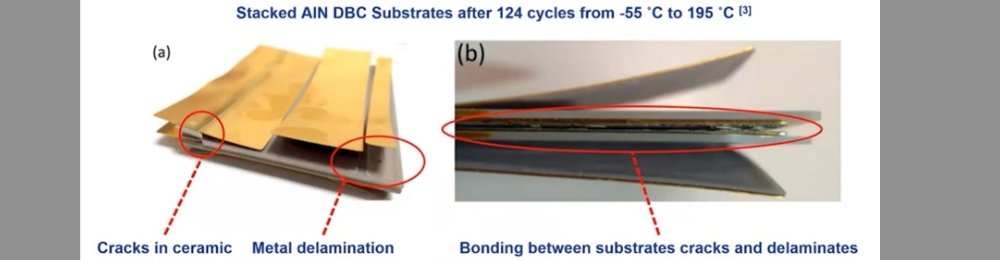
These observations help explain why design teams often use thermal-cycling performance as a key reliability indicator in power-module design. Nevertheless, thermal conductivity remains important, but it is seldom the only factor governing service life.
Understanding how substrates fail helps explain why different materials are selected for different applications. The next step is translating these engineering considerations into a practical selection process.
How to Select a Ceramic Substrate for Power Modules
Substrate Selection Decision Tree
Power Module Design
│
├─ Is junction-temperature margin sufficient?
│
│ ├─ YES
│ │
│ │ ├─ Is cost a primary consideration?
│ │ │
│ │ └─ YES → Al₂O₃ DBC
│ │
│ └─ NO
│
│ ├─ Is substrate thermal resistance limiting performance?
│ │
│ └─ YES → Evaluate AlN DBC
│
└─ Is thermal-cycling reliability a critical requirement?
│
├─ YES → Evaluate Si₃N₄ AMB
│
└─ NO → Reassess thermal path and package design
Application-Based Selection Matrix
| Application | Typical Substrate Choice | Primary Engineering Consideration |
| Industrial Drives | Al₂O₃ DBC | Cost-performance balance |
| UPS Systems | Al₂O₃ DBC | Mature manufacturing and proven field performance |
| Welding Equipment | Al₂O₃ DBC | Sufficient thermal capability at competitive cost |
| PV Inverters | AlN DBC | Reduced thermal resistance |
| Energy Storage PCS | Al₂O₃ DBC / AlN DBC | Higher power density and thermal management |
| High-Power SiC Modules | AlN DBC / Si₃N₄ AMB | Thermal performance and reliability requirements |
| EV Traction Inverters | Si₃N₄ AMB | Thermal-cycling durability |
| Railway Converters | Si₃N₄ AMB | Resistance to thermo-mechanical fatigue |
| Aerospace Power Electronics | Si₃N₄ AMB | Reliability under severe operating conditions |
Selecting a ceramic substrate for power modules rarely begins with thermal conductivity alone. Engineers typically begin by identifying the dominant design constraint.Cost-sensitive industrial systems often favor Al₂O₃. When thermal resistance restricts junction-temperature performance, high thermal conductivity often makes AlN an attractive option. Some applications, though, demand both superior thermal performance and long-term reliability. In such cases, both AlN and Si₃N₄ may be evaluated, with the final choice depending on lifetime targets, thermal-cycling conditions, and overall system requirements.
Although useful as a starting point, the matrix provides a general guideline. Actual projects, however, often require a more detailed evaluation of thermal performance, reliability requirements, and system-level benefits.
Selection Example: Selecting a Ceramic Substrate for a 1200 V Industrial IGBT Module
Consider a typical a 1200 V IGBT module operating at approximately 300 A in an industrial motor-drive system. Three substrate configurations were initially considered: Al₂O₃ DBC, AlN DBC, and Si₃N₄ AMB.
One observation was immediately apparent. In this case, the existing Al₂O₃ DBC design already satisfied the junction-temperature target. Thermal margin was available. Switching to AlN reduced junction temperature further. Although measurable, the improvement was measurable, but neither output power nor cooling-system design changed as a result.
At the same time, Si₃N₄ AMB provided additional reliability margin. However, the module operated in a relatively stable industrial environment with limited vibration and moderate thermal-cycling exposure.
Under these conditions, the higher-performance substrate offered benefits that were difficult to quantify at the system level. Although AlN and Si₃N₄ offered measurable technical advantages, neither material produced sufficient system-level benefits to justify the additional cost.
The existing Al₂O₃ DBC design already satisfied the junction-temperature target with available thermal margin, making further reductions in thermal resistance less critical at the system level.
Ultimately, the decision became less about material performance and more about application requirements. For this ceramic substrate for IGBT module application, Al₂O₃ DBC remained the most practical engineering solution.
Evaluating Ceramic Substrate Suppliers for IGBT and SiC Modules
However, material selection alone does not guarantee module reliability. In practice, manufacturing control often has a greater influence on field performance than catalogue material values. Two substrates may appear similar on paper yet behave very differently after extended thermal-cycling exposure. The evaluation should therefore move quickly from specifications to supporting data.
- Material Consistency: Ask whether published thermal-conductivity, dielectric-strength, and mechanical-property values represent production averages or laboratory results.
- Bonding Reliability: For DBC and AMB substrates, the copper–ceramic interface frequently becomes the critical region. Bond-strength data and process capability deserve careful review.
- Thermal-Cycling Performance: For power-module applications, thermal-cycling results often provide more useful information than room-temperature material properties.
- Substrate Dimensional Control: Substrate flatness is easy to overlook until assembly yield begins to suffer. Warpage and thickness variation become increasingly important as substrate dimensions increase.
- Traceability: It becomes valuable when investigating field failures. Without it, root-cause analysis can be significantly more difficult.
- Production Capability: Prototype performance and batch production performance are not always equivalent. Consistent volume manufacturing often indicates long-term supply reliability more effectively than isolated sample results. Confidence should ultimately be based on supporting data rather than specifications alone.
Beyond material properties, manufacturing consistency remains equally important today. At the same time, evolving power-electronics architectures are continuing to change what engineers expect from substrate materials.
How Power Electronics Is Changing Substrate Requirements
Today’s ceramic substrates face requirements very different from those of a decade ago. SiC devices support higher switching frequencies and higher power density. The result is often a reduction in thermal-design margin within the power module itself.
Furthermore, the transition from 400 V to 800 V vehicle platforms introduces additional challenges. Insulation coordination, electric-field management, and long-term reliability become increasingly important as system voltage rises.
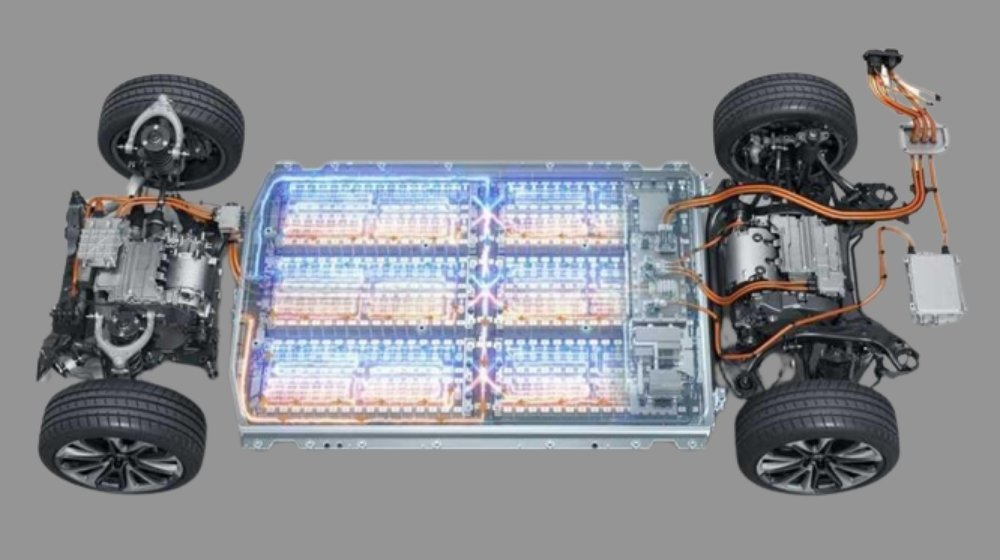
Likewise, a similar trend also appears in energy-storage systems and renewable-energy converters. Many of these installations are expected to remain in service for 15–25 years. Under such conditions, lifetime becomes a design parameter rather than a warranty consideration.
As operating conditions become more demanding, thermal conductivity alone provides an incomplete basis for substrate selection. Thermo-mechanical durability now carries equal weight in many designs. Consequently, applications that previously relied on Al₂O₃ are increasingly evaluating AlN and Si₃N₄ as available design margins become narrower. The focus is gradually shifting from thermal conductivity to lifetime capability.
Common Engineering Questions About Ceramic Power-Module Substrates
Q1: Is AlN always a better choice than Al₂O₃ for power modules?
A1: Not always. In many industrial IGBT modules, Al₂O₃ already provides sufficient thermal performance to meet junction-temperature requirements. Under these conditions, moving to AlN may reduce temperature by only a few degrees while increasing substrate cost.
Instead, the more relevant question is whether thermal performance is actually limiting the design. If cooling targets are already achieved, higher thermal conductivity may offer little practical benefit at the system level.
Q2: Why is Si₃N₄ frequently used in EV traction inverters?
A2: Reliability often becomes the deciding factor. Traction inverters experience continuous thermal cycling, vibration, and mechanical loading throughout the vehicle lifetime. Under these conditions, substrate durability becomes just as important as thermal performance.
Si₃N₄ is widely adopted because its high fracture toughness helps improve resistance to crack propagation and thermo-mechanical fatigue, both of which are common concerns in long-life automotive applications.
Q3: How do DBC and AMB substrates differ in practical applications?
A3: The difference usually appears in reliability rather than electrical performance. DBC remains the dominant solution in industrial power electronics because the process is mature, cost-effective, and supported by decades of field experience.
Consequently, AMB becomes more attractive when thermal-cycling durability is a major design requirement. This is one reason why Si₃N₄ AMB substrates are increasingly used in traction and transportation applications.
Q4: Will higher thermal conductivity always reduce junction temperature significantly?
A4: Not necessarily. The ceramic substrate represents only one part of the thermal path. Heat must still pass through solder layers, copper, baseplates, interface materials, and the cooling system. In many designs, the dominant thermal limitation may exist outside the ceramic layer. As a result, a large increase in substrate thermal conductivity does not always produce an equally large reduction in junction temperature.
Q5: Which ceramic substrate is commonly used for SiC power modules?
A5: Many engineers initially assume AlN is the default choice for SiC modules. In practice, that is only part of the story. For high-power-density designs, AlN often helps reduce substrate thermal resistance. That advantage becomes noticeable when cooling capacity reaches its limit or junction-temperature margin is already tight.
In traction inverters, however, discussions often shift away from thermal conductivity and toward thermal-cycling reliability. That is where Si₃N₄ AMB frequently enters the conversation.
Q6: What should engineers evaluate when selecting a ceramic substrate supplier?
A6: A supplier’s datasheet rarely tells the whole story. Two AlN substrates may show nearly identical material properties on paper yet behave very differently during assembly or thermal-cycling tests.
Engineers usually pay close attention to metallization quality, dimensional consistency, lot traceability, and production stability. These issues tend to appear much later in the project—often after qualification has already started.
Q7: How do engineers choose between AlN and Si₃N₄ substrates?
A7: In practice, the discussion is rarely about AlN versus Si₃N₄. The real question is what problem the module is trying to solve.If therm al resistance remains the primary constraint, AlN often becomes the obvious candidate. If lifetime under repeated thermal stress is more difficult to achieve, the conversation tends to move toward Si₃N₄.
In fact, many modern designs could technically use either material. The trade-off is rarely technical feasibility. More often it is reliability margin versus cost.
Q8: What is the most commonly used ceramic substrate for IGBT modules?
A8: For most industrial IGBT modules, the answer is still Al₂O₃ DBC.Not because it is the best-performing material.Because in many applications it already meets the thermal and reliability requirements at a significantly lower cost. Engineers usually start with Al₂O₃ and move upward only when the application clearly demands it.
Conclusion
Most substrate-selection questions do not begin with the substrate itself. They usually begin with a system requirement: junction temperature is too high, thermal-cycling life is uncertain, package size cannot increase, or qualification targets are difficult to achieve.
If you are working through a similar design challenge, feel free to share the application details. A review of the thermal path, package structure, and reliability targets is often enough to narrow the material options quickly.