

Introduction
Alumina (Al₂O₃) is one of the most widely used engineering ceramics. It offers high hardness, good wear resistance, chemical stability, and relatively low material cost. For many industrial components, it already provides the performance required without introducing unnecessary material costs.
Zirconia-toughened alumina (ZTA) takes a different approach. Instead of replacing alumina entirely, it introduces zirconia particles into an alumina matrix to improve resistance to fracture. This makes ZTA worth considering when conventional alumina components suffer from cracking, edge chipping, or damage under impact and mechanical stress.
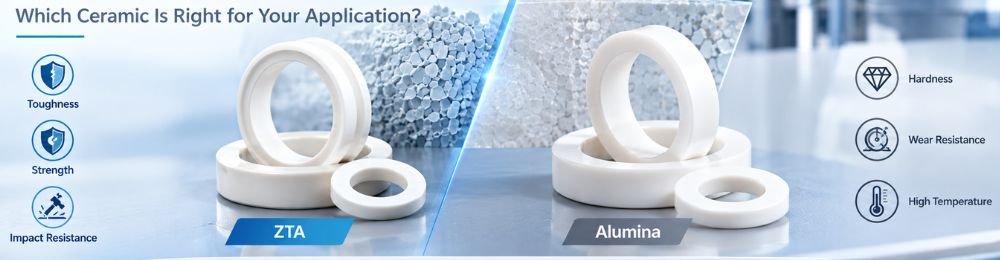
If you are selecting a ceramic for industrial equipment, the key question is not whether ZTA is always better than alumina. It is whether the additional toughness addresses a real limitation in your application.
What Is the Difference Between Alumina and ZTA?
Alumina is a single-phase ceramic in which aluminium oxide is the principal material. Its high hardness makes it suitable for many wear-resistant and precision components, but its relatively low fracture toughness means that cracks can propagate rapidly when local stress becomes excessive.
ZTA is a ceramic composite, typically consisting of an alumina matrix with a dispersed zirconia phase. Under suitable conditions, stress-induced transformation of zirconia particles helps resist crack propagation. The composite can therefore achieve higher fracture toughness and, depending on its formulation and processing, improved strength compared with conventional alumina.
The improvement is not automatic. Zirconia content, stabilizer type, grain structure, porosity, and sintering conditions all influence the final properties. You should compare actual material grades rather than assume that every ZTA formulation performs the same way.
Key Performance Comparison
| Property | Alumina | ZTA |
|---|---|---|
| Hardness | Generally higher | High, but often below comparable alumina |
| Fracture toughness | Relatively low | Generally higher |
| Wear resistance | Excellent in many applications | Can improve under impact-abrasion conditions |
| Impact resistance | More vulnerable to brittle damage | Generally better |
| Chemical resistance | Generally excellent | Generally good; verify the grade |
| Thermal properties | Grade-dependent; often good high-temperature stability | Depends on composition and service temperature |
| Cost | Usually lower | Usually higher |
These are general tendencies, not guaranteed specifications. In particular, ZTA does not always outwear alumina. A published impact-abrasion study found that the relative wear performance varied with alumina grade and test severity. High-alumina grades performed well, while ZTA showed an advantage under certain severe abrasive conditions.
When Is Conventional Alumina the Better Choice?
Choose alumina when its existing performance meets your requirements and fracture is not the main cause of failure.
Typical applications include:
- Electrical insulation components: Alumina is widely used for insulating parts in industrial and electronic equipment.
- Wear-resistant components: Bushings, sleeves, nozzles, and guides can benefit from its hardness and wear resistance.
- Chemical-processing components: Alumina can work well in many fluid-handling environments when chemical compatibility is confirmed.
- Cost-sensitive production: If the component operates reliably under relatively stable loads, alumina may offer the better overall value.
For example, if an alumina guide wears gradually but does not crack or chip, switching to ZTA may not solve the actual problem. You may gain more by reviewing the contact pressure, counterface material, surface finish, or component alignment.
When Should You Consider ZTA?
ZTA is worth evaluating when you need to retain the hardness and wear performance of an alumina-based ceramic while improving resistance to fracture.
Consider it for:
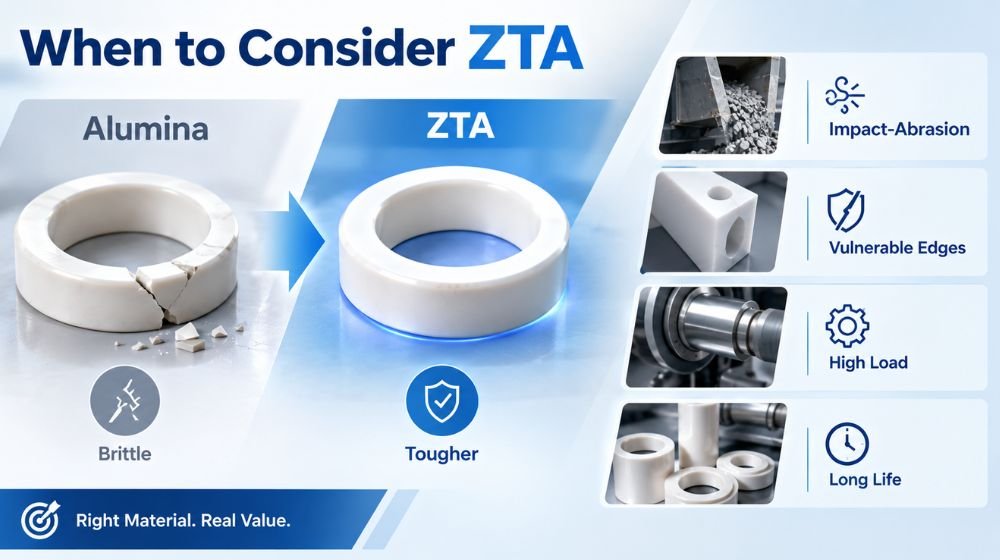
- Impact-abrasion components: Liners and wear parts exposed to both abrasive particles and repeated impact.
- Components with vulnerable edges: Parts with thin sections, corners, holes, or mounting features that may chip during assembly or operation.
- Highly loaded mechanical parts: Components where local stress or intermittent impact makes brittle fracture a concern.
- Long-life wear components: Applications where fracture-related downtime or frequent replacement is more expensive than the initial material premium.
Suppose a ceramic liner wears acceptably but repeatedly breaks when large particles strike its edge. In this case, ZTA may address the failure mechanism more directly than simply choosing a harder alumina grade. However, you should still verify the result through representative testing.
Industrial Applications: Where Can You Use ZTA?
ZTA is used or evaluated in applications where wear resistance must be combined with improved fracture resistance. Examples include wear liners, selected cutting tools, nozzles, valve components, and other mechanically loaded ceramic parts. The suitability of each application depends on the material grade, operating conditions, and manufacturing capability.
The distinction is important: ZTA is not automatically the best material for every component listed. A continuously sliding part under stable lubrication may have different requirements from a liner exposed to irregular impacts. Start with the failure mode, then compare material options.
Manufacturing and Cost: What Should You Check?
Material properties alone do not determine the performance of a finished ceramic component. Forming, sintering, grinding, and final inspection all influence dimensional accuracy and reliability. ZTA’s properties are particularly sensitive to its composition and microstructure, so you should not assume that a supplier’s generic ZTA designation guarantees a particular toughness or wear life.
Before placing an order, ask your supplier:
- What are the alumina content, zirconia content, and stabilizer system?
- Can you provide the relevant material data and test conditions?
- Which dimensions and tolerances are critical to the component’s function?
- How are chipping, cracks, surface finish, and dimensional consistency inspected?
- Can the supplier produce samples for testing under your actual operating conditions?
ZTA usually carries a higher material and processing cost than conventional alumina. Compare total operating cost—not just the unit price—including replacement frequency, downtime, machining requirements, and rejected parts.
A Practical Selection Checklist
Before choosing between alumina and ZTA, answer these five questions:
- Is the main failure mode wear, cracking, chipping, or chemical attack?
- Does the component experience impact or high local stress?
- Is the current alumina grade failing, or is the design itself causing the problem?
- What improvement is needed, and how will you measure it?
- Will the expected service-life improvement justify the additional cost?
If wear is the main issue, compare wear-test data under the same conditions. If cracking or chipping is the problem, prioritize fracture toughness, component geometry, machining damage, and assembly stress.
Conclusion
Alumina and ZTA serve different engineering needs. Alumina remains a strong choice when hardness, wear resistance, chemical stability, and cost are sufficient for the application. ZTA becomes attractive when brittle fracture, impact damage, or edge chipping limits the performance of conventional alumina.
You do not need to choose the more advanced material by default. Identify the failure mechanism, confirm the operating conditions, and compare suitable grades through relevant data or component testing. That is a more reliable way to determine whether ZTA offers a meaningful engineering and cost advantage.
Frequently Asked Questions
1. Is ZTA stronger than alumina?
ZTA generally offers higher fracture toughness than conventional alumina, and some grades also provide improved strength. However, the result depends on zirconia content, stabilizer system, microstructure, porosity, and manufacturing process. You should compare the actual grade’s test data rather than rely on the material name alone.
2. Is ZTA more wear-resistant than alumina?
Not in every situation. Alumina already provides excellent wear resistance in many applications, while ZTA may offer an advantage when abrasive wear occurs together with impact or high mechanical stress. The counterface, particle size, load, sliding speed, and surface finish all affect the result. Test data from comparable conditions is the most useful basis for selection.
3. Is ZTA worth the extra cost?
ZTA may be worth the premium when fracture or chipping causes frequent replacement, production interruptions, or maintenance costs. If the existing alumina component already meets its service-life target, the upgrade may bring little practical benefit. Compare total operating cost, including component price, replacement frequency, downtime, and inspection requirements, before making the decision.
4. Can ZTA replace 99% alumina?
It can in some applications, but replacement should not be based on toughness alone. A 99% alumina component may offer higher hardness or different thermal, electrical, and chemical characteristics. Before switching to ZTA, confirm the required dimensions, operating temperature, medium compatibility, wear behavior, and cost. Prototype testing can help determine whether the change improves overall performance.
5. What information should you provide when requesting a ZTA component?
Provide a drawing or 3D model, critical dimensions and tolerances, operating temperature, contact load, impact conditions, chemical medium, and expected service life. If an existing part has failed, photographs and a description of the failure location are also useful. This information helps the manufacturer assess whether ZTA is appropriate and identify the material grade and machining requirements that need to be verified.