

Introduction
When you specify a ceramic substrate, thickness, flatness, surface quality, and dimensional consistency all affect the final component. These requirements become particularly important when the substrate is used for electronic packaging, power modules, or circuits that need reliable thermal management and electrical insulation.
Tape casting is one of the main manufacturing methods used to produce thin ceramic sheets with controlled thickness and a relatively uniform structure. It is widely used for alumina and aluminum nitride substrates, as well as other ceramic components that require thin, flat geometries.
Understanding how tape casting works helps you evaluate substrate designs, identify potential manufacturing limitations, and ask more useful questions when selecting a supplier.
What Is Tape Casting?
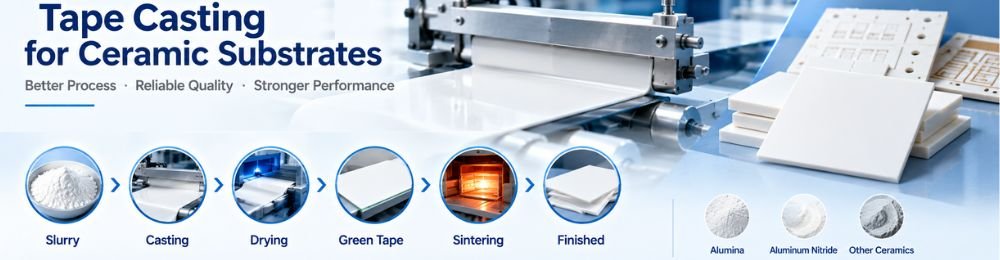
Tape casting is a process in which ceramic powder is dispersed in a liquid-based slurry containing suitable additives. The slurry is spread across a moving carrier film using a casting blade, commonly called a doctor blade. As the liquid evaporates, the slurry forms a thin, flexible ceramic sheet known as green tape.
The green tape is not yet a finished ceramic substrate. It contains organic components that provide temporary strength and flexibility during handling and subsequent processing. These components must be removed during debinding before the ceramic is sintered at high temperature.
The final thickness depends on several factors, including slurry formulation, casting gap, solids content, drying conditions, and sintering shrinkage. A thicker casting gap does not translate directly into the same increase in final ceramic thickness because the material loses liquid and shrinks during processing.
How Does the Process Work?
A typical tape-casting process for ceramic substrates includes the following stages:
- Slurry preparation: Ceramic powder is mixed with a liquid medium, dispersant, binder, and plasticizer as required. The formulation affects flow behavior, green strength, drying, and sintering.
- Casting: The slurry passes beneath a doctor blade and forms a continuous layer on a carrier film. Blade settings and slurry stability help control thickness uniformity.
- Drying: The liquid evaporates under controlled conditions. Uneven drying can cause cracking, curling, or thickness variation.
- Green-sheet processing: The dried tape is cut to size. Depending on the design, holes may be punched, vias formed, or conductive patterns printed.
- Lamination, where required: Multiple green sheets can be aligned and laminated to produce a multilayer structure. Pressure and temperature must be controlled to avoid trapped air, deformation, or poor interlayer bonding.
- Debinding and sintering: Organic additives are removed, and the ceramic is fired to develop its final density and properties.
- Finishing and inspection: Depending on the specification, the substrate may undergo cutting, lapping, grinding, dimensional inspection, or surface-quality checks.
Not every substrate requires every step. A simple single-layer sheet and a multilayer ceramic circuit have different processing requirements.
Why Is Tape Casting Used for Ceramic Substrates?
The main advantage of tape casting is its suitability for producing thin, relatively large-area ceramic sheets with repeatable thickness.
Thickness control. Compared with methods designed mainly for bulk or three-dimensional ceramic parts, tape casting is well suited to thin, flat substrates. However, the achievable tolerance depends on material, thickness, equipment, firing behavior, and finishing requirements.
Uniform sheet geometry. A stable casting and drying process helps maintain consistent thickness across the sheet. This is useful when you need repeatable substrate dimensions for assembly or circuit fabrication.
Scalable production. Continuous casting supports efficient production of large quantities of green tape. For established designs and stable production volumes, this can help reduce unit manufacturing costs.
Support for multilayer designs. Green sheets can be patterned, aligned, and laminated before firing. This makes tape casting particularly useful for multilayer ceramic structures, including certain low-temperature co-fired ceramic (LTCC) applications.
These advantages do not mean every ceramic substrate should be tape-cast. Thick, bulky, or complex three-dimensional components may require a different forming method.
Which Ceramic Materials Can Be Tape-Cast?
Material selection depends on the substrate’s electrical, thermal, mechanical, and operating requirements.
- Alumina (Al₂O₃): A common choice for insulating substrates where cost, electrical insulation, and general-purpose performance are important.
- Aluminum nitride (AlN): Used when higher thermal conductivity is required while maintaining electrical insulation. Its powder characteristics and sintering requirements differ from those of alumina.
- Other ceramic systems: Zirconia, silicon nitride, and specialized ceramic compositions may be tape-cast for particular applications, provided the formulation and process are suitable.
Tape casting describes the forming method, not the material’s final performance. Two substrates made by tape casting can have very different thermal conductivity, strength, dielectric properties, and dimensional stability because their compositions and firing processes differ.
What Should You Check When Designing or Sourcing a Substrate?
If you are developing a new substrate or comparing suppliers, start with the application requirements rather than the forming process alone.
- Final thickness and tolerance: Specify the required fired thickness, allowable variation, and measurement method.
- Flatness and warpage: Define the acceptable flatness or warpage after firing and, where relevant, after metallization.
- Material grade: Confirm the ceramic composition and the required thermal, electrical, and mechanical properties.
- Surface condition: Identify whether you need a ground, lapped, polished, or as-fired surface.
- Metallization and circuit features: If the substrate requires conductive layers, vias, or patterned circuits, confirm the complete process route and whether these features are produced in-house or by a qualified partner.
- Inspection and consistency: Ask how thickness, dimensions, surface defects, and lot-to-lot variation are controlled.
Be specific about the condition in which a tolerance applies. For example, a dimensional tolerance measured after sintering may differ from the tolerance achievable after final grinding. Likewise, metallization and thermal cycling can affect the finished substrate, so the inspection stage should match your actual acceptance requirements.
Is Tape Casting the Right Choice for Your Project?
Tape casting is a strong candidate when you need thin ceramic substrates, controlled sheet geometry, repeatable production, or multilayer construction. It is commonly considered for alumina and aluminum nitride substrates used in electronic and thermal-management applications.
However, the forming process alone does not determine whether a substrate will meet your requirements. Material grade, fired thickness, shrinkage control, finishing, metallization, and inspection all contribute to the final result.
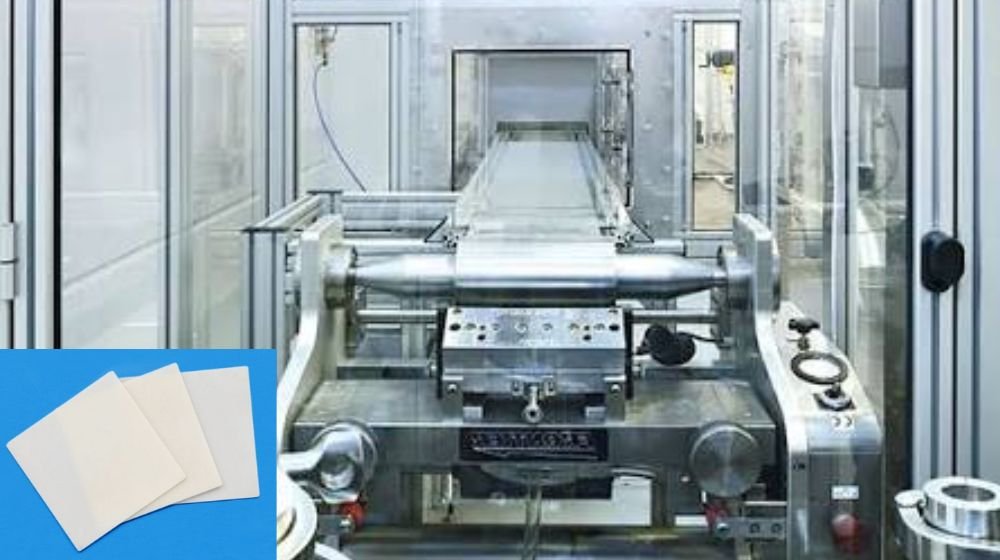
Before placing a production order, request samples or trial parts made using the intended material and process route. Evaluate the properties that matter to your application, including dimensional stability, thermal performance, electrical insulation, and compatibility with subsequent assembly.
The most useful supplier comparison is not simply who offers tape casting. It is who can consistently manufacture the substrate you need, verify its performance, and support your design as it moves from prototype to production.
Frequently Asked Questions
Q1. Is tape casting suitable for thin alumina substrates?
Yes. Tape casting is widely used for thin alumina sheets because it supports controlled thickness and repeatable sheet production. The achievable tolerance depends on the substrate thickness, firing process, equipment, and finishing requirements. You should confirm the supplier’s demonstrated capability for your specific dimensions.
Q2. Does tape casting determine the thermal conductivity of a ceramic substrate?
No. Thermal conductivity is primarily determined by the ceramic composition, material grade, microstructure, and processing quality. Tape casting controls the formation of the green sheet, but it does not by itself guarantee a particular thermal conductivity. Check measured data for the finished material grade.
Q3. Is tape casting the same as DBC or DPC?
No. Tape casting is a ceramic forming process. DBC (Direct Bonded Copper) and DPC (Direct Plated Copper) are metallization approaches used to create conductive copper layers on ceramic substrates. A substrate may be formed using one process and metallized using another, depending on the material and product design.
Q4. What information should you provide when requesting a quotation?
Provide the ceramic material, final thickness, overall dimensions, dimensional tolerances, flatness requirements, surface finish, operating conditions, and annual or trial quantity. If metallization is required, include the copper thickness, pattern, and relevant bonding or electrical requirements. A drawing and intended application will help the supplier assess feasibility.