

Introduction
Industrial pumps operate under demanding conditions where components are repeatedly exposed to high pressure, continuous reciprocating motion, abrasive particles, corrosive chemicals, and fluctuating temperatures. Among these components, the plunger directly contacts the process fluid while simultaneously serving as the dynamic sealing surface. Its condition has a significant influence on pumping efficiency, seal durability, maintenance frequency, and overall equipment reliability.
Although ceramic and stainless steel plungers may appear similar in shape, their performance under real operating conditions can differ substantially. Material selection affects not only wear resistance but also sealing behavior, dimensional stability, corrosion resistance, maintenance requirements, and long-term operating cost.
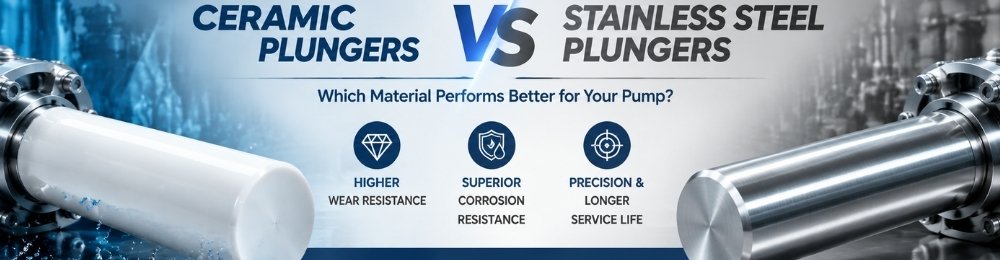
Rather than asking which material is universally better, engineers typically evaluate which material delivers the most reliable performance for a specific combination of operating pressure, fluid characteristics, seal design, and maintenance objectives.
This article compares ceramic and stainless steel plungers from the perspective of engineering performance, failure mechanisms, service life, and application suitability, helping equipment manufacturers and maintenance engineers make informed material selection decisions.
What Is a Pump Plunger?
A plunger is the reciprocating component responsible for generating hydraulic pressure inside a positive displacement pump. During operation, the plunger moves back and forth through sealing elements, alternately drawing fluid into the pump chamber and forcing it toward the discharge outlet.
Unlike pistons that generally move inside cylinders, plungers primarily slide through stationary sealing assemblies. Consequently, the plunger surface itself functions as the sealing interface, making its dimensional accuracy and surface integrity critical to pump performance.
Because every reciprocating stroke produces friction between the plunger and the sealing elements, the plunger surface experiences continuous mechanical interaction throughout its service life. Surface damage, scratches, or dimensional changes can quickly accelerate seal wear and reduce volumetric efficiency.
For this reason, the plunger is often regarded as one of the most critical wear components in high-pressure pumping systems.
Typical Industrial Applications
Plungers are widely used in industries requiring accurate fluid delivery or high-pressure pumping, including:
- High-pressure cleaning systems
- Water jet cutting equipment
- Chemical dosing pumps
- Oil and gas injection systems
- Pharmaceutical processing
- Food and beverage equipment
- Ceramic slurry transfer
- Mining slurry pumps
- Reverse osmosis systems
- Industrial washing equipment
Why Plungers Wear and Fail
Many discussions compare ceramic and stainless steel solely by their material properties. In practice, however, plungers rarely fail because of material strength alone. Their service life is determined by the interaction between the plunger, sealing elements, operating conditions, and the pumped medium.
A plunger operates under continuous reciprocating motion while maintaining contact with dynamic seals. This repeated interaction gradually changes both the sealing surface and the sealing elements. Even minor surface imperfections may eventually develop into leakage paths.
Instead of a single failure event, plunger deterioration usually progresses through multiple stages.
Typical progression includes:
Surface polishing–>Micro scratches–>Seal wear–>Leakage–>Pressure loss–>Reduced pump efficiency–>Unexpected maintenance
This progression explains why the durability of a plunger cannot be evaluated independently from its sealing system. In many industrial pumps, seal failure occurs before the plunger itself reaches its wear limit.
Engineering Insight
A common misconception is that selecting the hardest material automatically produces the longest service life.
In reality, overall pump reliability depends on the interaction among plunger material, seal material, surface finish, alignment accuracy, lubrication conditions, and operating environment.
A ceramic plunger operating with poor alignment may fail earlier than a properly installed stainless steel plunger. Conversely, under highly abrasive conditions, a well-manufactured ceramic plunger may remain dimensionally stable for significantly longer than its metallic counterpart.
Therefore, material selection should be regarded as part of an integrated pump system design rather than an isolated material comparison.
Ceramic Plungers
Ceramic plungers are widely used in high-pressure pumps where long-term dimensional stability, excellent wear resistance, and chemical durability are required. The most commonly used materials include high-purity alumina (Al₂O₃), zirconia (ZrO₂), and, for specialized applications, silicon nitride (Si₃N₄). Material selection depends on operating pressure, pumped media, seal configuration, and the required service life rather than on hardness alone.
Unlike metallic plungers, engineering ceramics maintain their surface integrity even after prolonged exposure to abrasive particles. Their high hardness minimizes plastic deformation and significantly reduces the formation of surface grooves that accelerate seal wear.
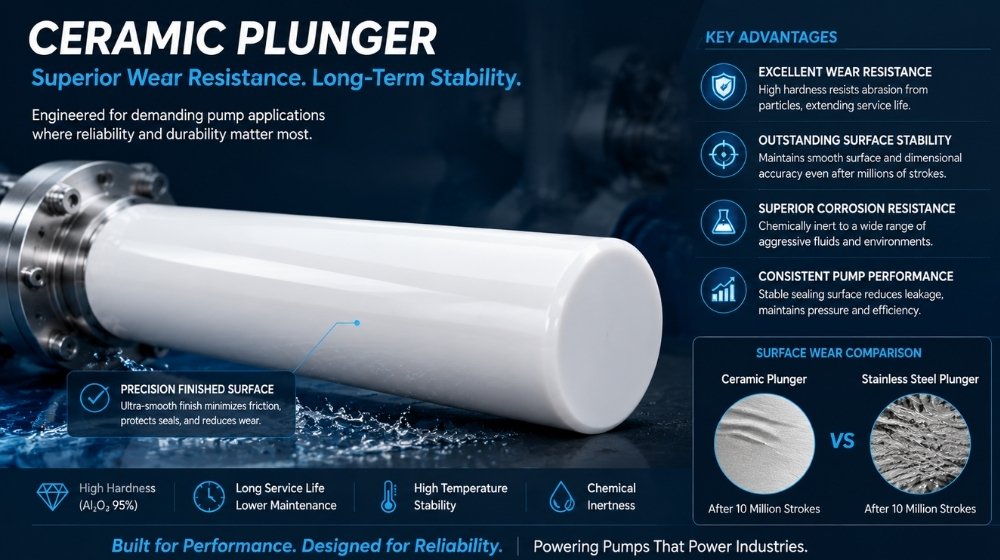
In applications involving continuous operation, maintaining a stable surface profile is often more valuable than simply achieving maximum hardness. A plunger that preserves its geometry throughout millions of reciprocating cycles helps maintain sealing consistency and volumetric efficiency.
Wear Resistance and Surface Stability
The primary advantage of ceramic plungers is their ability to resist abrasive wear.
Industrial fluids frequently contain suspended particles, crystalline salts, pigments, fillers, or other contaminants. These particles repeatedly slide across the plunger surface during operation. Over time, softer materials gradually develop scratches and wear tracks, while ceramics are much less susceptible to this type of surface damage.
Because the sealing elements continuously contact the plunger surface, reduced surface wear also contributes to more stable sealing performance.
From an engineering perspective, the benefit is not merely a harder surface. The more important outcome is the slower change in surface geometry, which delays seal degradation and helps maintain consistent pumping performance.
Corrosion Resistance
Many pumping systems handle chemically aggressive media, including acids, alkalis, oxidizing solutions, and chloride-containing liquids.
Engineering ceramics are generally chemically inert toward a wide range of industrial chemicals. Unlike metallic materials, they do not rely on passive oxide films for corrosion protection and therefore are not vulnerable to localized corrosion mechanisms such as pitting or crevice corrosion.
This characteristic allows ceramic plungers to maintain a smooth sealing surface even after prolonged exposure to corrosive process fluids.
Surface Finish and Seal Compatibility
The sealing performance of a plunger depends not only on dimensional accuracy but also on surface finish.
High-quality ceramic plungers are precision ground and polished to achieve an extremely smooth surface. A smoother sealing surface reduces localized friction, distributes contact pressure more uniformly, and minimizes abrasive interaction with sealing elements.
However, an excessively smooth surface is not always beneficial. Surface finish should be matched with seal material, lubrication conditions, and operating pressure. The optimum roughness is determined through system design rather than by pursuing the lowest possible Ra value.
Stainless Steel Plungers
Stainless steel plungers remain widely used in industrial pumps because they provide a practical balance of mechanical strength, toughness, machinability, and manufacturing cost.
For clean fluids operating under moderate pressure, stainless steel often provides satisfactory performance with relatively low initial investment.
Unlike ceramics, stainless steel possesses considerable ductility. Under accidental overload or impact, metallic plungers are more likely to deform gradually instead of fracturing suddenly.
This characteristic improves tolerance to installation errors, vibration, and unexpected mechanical shock.
Toughness Under Dynamic Loading
Industrial pumps occasionally experience pressure fluctuations, cavitation, vibration, or hydraulic shock. Under these transient conditions, material toughness becomes increasingly important.
Stainless steel generally absorbs impact energy more effectively than engineering ceramics, reducing the likelihood of catastrophic fracture caused by accidental loading.
Nevertheless, higher toughness should not be interpreted as longer service life. In highly abrasive environments, surface wear frequently limits the usable life of stainless steel plungers long before structural failure occurs.
Manufacturing Flexibility
Another advantage of stainless steel is its manufacturing versatility. Complex geometries, threaded sections, oil grooves, internal channels, and customized connection features can be machined relatively easily using conventional manufacturing processes.
This flexibility is particularly valuable during prototype development or low-volume production.
Engineering Insight
Material selection for plungers is often simplified into a comparison of hardness versus toughness. In reality, the decision is governed by the dominant failure mechanism of the pump.
If abrasive wear determines maintenance intervals, ceramic plungers generally provide superior long-term dimensional stability. If accidental impact, frequent assembly, or mechanical abuse dominates field failures, stainless steel may provide a more forgiving solution.
Consequently, selecting a plunger material is fundamentally an exercise in identifying the most critical degradation mechanism within the intended operating environment.
Ceramic Plungers vs Stainless Steel Plungers: Engineering Comparison
Selecting between ceramic and stainless steel plungers requires more than comparing individual material properties. A plunger operates as part of a complete pumping system, where surface condition, sealing behavior, fluid characteristics, and operating parameters collectively determine performance.
A material with excellent mechanical properties may still deliver poor results if it does not match the operating environment. Therefore, engineers usually evaluate plunger materials based on the dominant failure mechanism rather than theoretical material advantages.
1. Hardness and Wear Resistance
Hardness is one of the most significant differences between ceramic and stainless steel materials.
Engineering ceramics such as alumina generally possess much higher hardness than stainless steel. This allows ceramic plungers to resist abrasive particles and maintain a stable surface profile during continuous reciprocating motion.
For applications containing suspended particles, mineral powders, ceramic slurry, pigments, or other abrasive substances, surface wear is often the primary factor limiting plunger life. In these conditions, ceramic plungers usually provide a significant advantage.
However, hardness alone does not determine service life. Excessive hardness without proper seal compatibility, lubrication, and installation accuracy may not produce the expected improvement.
2. Surface Stability During Reciprocating Motion
A plunger may complete millions of reciprocating cycles during its service life. Even microscopic changes on the surface can gradually influence sealing performance.
Stainless steel surfaces may experience gradual wear, especially under abrasive conditions. Small grooves created by particles can become channels that accelerate seal damage and increase leakage.
Ceramic plungers maintain their dimensional stability for a longer period because their high hardness and wear resistance slow down surface degradation.
For high-pressure pumps where leakage control is critical, maintaining the original surface geometry is often more important than initial material cost.
3. Corrosion Resistance
Corrosion behavior is another major consideration in plunger material selection.
Stainless steel provides good corrosion resistance because of its chromium-based passive layer. However, this protection can be reduced under certain conditions, especially when exposed to aggressive chemicals, high chloride concentrations, or elevated temperatures.
Localized corrosion such as pitting corrosion can damage the surface finish and negatively affect sealing performance.
Ceramic materials are generally chemically stable because they do not rely on metallic passive films. This makes ceramic plungers suitable for many chemically aggressive environments.
4. Toughness and Impact Resistance
Although ceramic materials offer excellent hardness and wear resistance, they are inherently more brittle than metals.
Under normal operating conditions, this characteristic is rarely a problem. However, unexpected impact, improper installation, severe misalignment, or foreign particle blockage may create high localized stress.
Stainless steel has superior fracture toughness and can absorb mechanical energy through deformation before failure. Therefore, stainless steel may be preferred in applications where mechanical shock is more likely than abrasive wear.
Engineering Comparison Table
| Performance Factor | Ceramic Plunger | Stainless Steel Plunger |
|---|---|---|
| Hardness | Very High | Moderate |
| Abrasive Wear Resistance | Excellent | Good to Moderate |
| Surface Stability | Excellent | Depends on operating conditions |
| Corrosion Resistance | Excellent | Good, alloy dependent |
| Impact Resistance | Moderate to Low | Excellent |
| Dimensional Stability | Excellent | Good |
| Machinability | More difficult | Excellent |
| Initial Cost | Higher | Lower |
| Long-term Wear Cost | Usually Lower | May Increase under severe wear |
| Customization Flexibility | More limited | Excellent |
The Key Engineering Decision
The correct question is not:”Which material is stronger?”
The more meaningful question is:”Which material better controls the dominant failure mechanism in my pump system?”
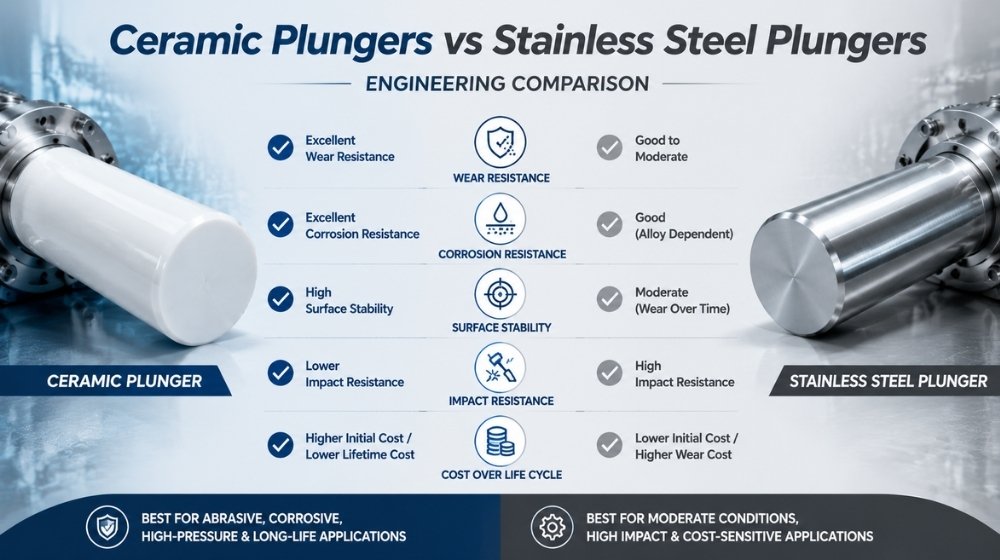
If wear, corrosion, and long maintenance intervals are the primary concerns, ceramic plungers often provide advantages. If impact resistance, easy machining, and lower initial investment are more important, stainless steel may remain the preferred solution.
Engineering Insight
A plunger is not simply a wear component. It is a precision sealing component whose material directly influences the interaction between the moving surface and the sealing system.
The best plunger material is determined by the complete operating system, not by a single material property.
Performance Under Different Operating Conditions
The performance difference between ceramic and stainless steel plungers becomes more obvious when evaluated under actual operating conditions. A material that performs well in one application may not provide the same advantage in another.
Therefore, engineers should evaluate plunger materials according to:
- Pumping pressure
- Fluid characteristics
- Particle contamination level
- Chemical exposure
- Operating hours
- Maintenance strategy
The following sections analyze common industrial scenarios.
1. Clean Water Pump Applications
For clean water applications with low particle contamination, stainless steel plungers often provide sufficient performance. In these systems, abrasive wear is limited, and the major design priorities are cost efficiency, reliability, and ease of maintenance.
A properly selected stainless steel grade can provide long service life when the water quality is controlled and operating conditions are stable. However, if the pump operates continuously at high pressure or maintenance downtime is expensive, ceramic plungers may still provide advantages because they maintain surface integrity for a longer period.
Engineering Recommendation
Choose stainless steel when:
- Clean fluid
- Moderate pressure
- Cost-sensitive equipment
- Frequent maintenance is acceptable
Choose ceramic when:
- Continuous operation
- High-pressure service
- Minimal maintenance requirement
2. Chemical Pump Applications
Chemical processing environments create additional challenges because the plunger must resist both mechanical wear and chemical attack.
Stainless steel performance depends strongly on alloy selection. While common stainless steels provide good general corrosion resistance, certain chemicals may cause localized corrosion or stress corrosion cracking.
Examples include:
- Chloride-containing solutions
- Strong acids
- Oxidizing chemicals
- High-temperature chemical fluids
Ceramic plungers are often considered when chemical stability and surface preservation are critical. Because ceramics generally do not suffer from electrochemical corrosion mechanisms, they can maintain a stable sealing surface in many aggressive chemical environments.
3. Abrasive Slurry Applications
Abrasive slurry is one of the most demanding environments for plunger materials.
Examples include:
- Ceramic slurry
- Mining slurry
- Pigment suspension
- Mineral processing fluids
- High-solid-content liquids
In these applications, particles repeatedly contact the plunger surface during every reciprocating cycle. Because ceramic materials are significantly harder than most abrasive particles found in industrial fluids, ceramic plungers can greatly reduce this degradation process.
4. High-Pressure Pump Applications
High-pressure systems place additional requirements on dimensional stability.
Small changes in plunger diameter or surface condition can significantly influence sealing pressure and leakage performance.
Ceramic plungers offer advantages because they resist wear-related dimensional changes. This is especially important in equipment where:
- Pressure consistency is critical
- Fluid metering accuracy is required
- Downtime has high economic impact
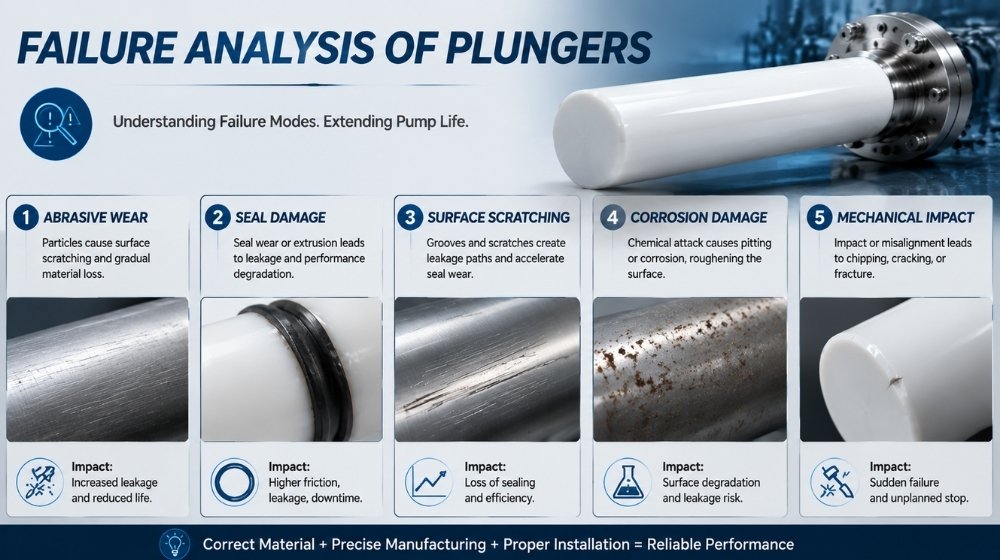
Failure Analysis of Plungers
Understanding failure mechanisms is more valuable than simply comparing material properties. Common plunger failures include:
1. Abrasive Wear
Particles trapped between the plunger and seal create scratches and accelerate wear. Ceramic generally provides better resistance due to higher hardness.
2. Seal Damage
Seal wear may occur before the plunger reaches its material limit. Causes include:
- Excessive friction
- Poor surface condition
- Misalignment
- Temperature increase
3. Surface Scratching
Small scratches can become leakage paths. This is one reason why surface finish is critical.
4. Corrosion Damage
Metallic plungers may suffer from localized corrosion depending on chemical conditions. Ceramics generally avoid electrochemical corrosion.
5. Mechanical Impact Damage
Ceramic failure may occur under severe impact or improper handling. Stainless steel generally offers higher impact tolerance.
Engineering Insight
The longest-lasting plunger is not always the hardest one.
The best solution is the material that minimizes the dominant failure mechanism under actual operating conditions.
Life Cycle Cost Analysis: Ceramic vs Stainless Steel Plungers
When selecting plunger materials, many purchasing decisions are initially based on unit price. However, the lowest initial cost does not always represent the lowest overall operating cost.
For industrial equipment operating continuously, the total cost of ownership includes not only the purchase price but also:
- Replacement frequency
- Maintenance labor
- Production downtime
- Seal replacement cost
- Equipment efficiency loss
A stainless steel plunger may have a lower initial cost, but frequent replacement caused by wear or corrosion can significantly increase long-term expenses.
A ceramic plunger typically requires a higher initial investment because of advanced ceramic processing, precision grinding, and finishing requirements. However, when longer service intervals and reduced maintenance requirements are considered, ceramic plungers may provide a more favorable life cycle cost in demanding applications.
Example of Life Cycle Thinking
Consider two pumping systems operating continuously:
Stainless Steel Plunger
Low Initial cost–>Higher wear rate under abrasive media–>More frequent replacement–>Higher maintenance frequency–>Possible production interruption
Ceramic Plunger
High Initial cost–>Lower wear rate–>Longer service interval–>Reduced maintenance requirement–>Higher equipment availability
The correct comparison should therefore focus on cost per operating hour rather than purchase price alone.
OEM Manufacturing Considerations for Ceramic Plungers
For equipment manufacturers, ceramic plunger performance depends not only on ceramic material selection but also on manufacturing capability and quality control. A high-quality ceramic plunger requires precise control throughout the manufacturing process.
1. Material Selection
Different ceramic materials provide different performance characteristics. Common choices include:
Alumina (Al₂O₃)
Advantages:
- High hardness
- Excellent wear resistance
- Good chemical stability
- Cost-effective
Zirconia (ZrO₂)
Advantages:
- Higher fracture toughness
- Better impact resistance
- Suitable for demanding mechanical environments
Silicon Nitride (Si₃N₄)
Advantages:
- High strength
- Thermal shock resistance
- Lightweight
2. Dimensional Accuracy
Plunger performance is highly sensitive to dimensional accuracy. Important parameters include:
- Diameter tolerance
- Cylindricity
- Straightness
- Roundness
- Surface finish
Poor dimensional control can cause:
- Uneven seal contact
- Increased friction
- Leakage
- Reduced pump efficiency
3. Surface Finishing
The sealing surface is one of the most critical areas of a ceramic plunger. Precision grinding and polishing determine:
- Surface roughness
- Seal compatibility
- Wear behavior
- Leakage performance
A ceramic plunger with excellent material properties but poor surface finishing may not deliver reliable pump performance.
4. Quality Inspection
OEM suppliers should establish inspection procedures covering:
- Dimensional inspection
- Surface inspection
- Material verification
- Batch consistency evaluation
Consistency between production batches is particularly important for industrial equipment manufacturers.
Procurement Checklist for Ceramic Plungers
When evaluating a ceramic plunger supplier, engineers should consider:
| Evaluation Item | Why It Matters |
|---|---|
| Ceramic grade | Determines wear and mechanical performance |
| Density and material consistency | Influences reliability |
| Diameter tolerance | Controls sealing performance |
| Cylindricity | Affects leakage and friction |
| Surface roughness | Determines seal interaction |
| Grinding capability | Influences final accuracy |
| Inspection system | Ensures batch consistency |
| Packaging protection | Prevents transportation damage |
Frequently Asked Questions
FAQ 1: Are ceramic plungers always better than stainless steel plungers?
No. Ceramic plungers are not universally superior because the best material depends on the actual operating conditions. Ceramic provides advantages in abrasive, corrosive, and high-cycle applications because it maintains surface stability and wear resistance. However, stainless steel may be more suitable when impact resistance, machining flexibility, or lower initial cost is the primary concern.
FAQ 2: Why do ceramic plungers usually last longer in abrasive applications?
Ceramic plungers usually provide longer service life in abrasive applications because their high hardness reduces surface damage caused by particles. Maintaining a stable sealing surface slows down seal wear and reduces leakage development. The benefit comes not only from hardness itself but from the ability to preserve dimensional accuracy during millions of reciprocating cycles.
FAQ 3: Can stainless steel plungers replace ceramic plungers?
In some applications, yes. Stainless steel plungers can perform well in clean fluids, moderate pressure systems, and applications where impact resistance is more important than wear resistance. However, replacing ceramic with stainless steel in abrasive or chemically aggressive environments may significantly reduce service life and increase maintenance frequency.
FAQ 4: What ceramic material is commonly used for industrial plungers?
Alumina, zirconia, and silicon nitride are commonly considered for industrial plunger applications. Alumina is widely used because of its excellent hardness, wear resistance, and cost balance. Zirconia provides higher toughness, while silicon nitride is selected for specialized applications requiring high strength and thermal performance.
FAQ 5: What quality factors should OEMs check when purchasing ceramic plungers?
OEM customers should evaluate more than ceramic material grade. Important factors include dimensional tolerance, cylindricity, surface roughness, grinding capability, inspection methods, and production consistency. A reliable supplier should demonstrate stable manufacturing capability because small variations in plunger geometry can directly affect sealing performance and pump reliability.
FAQ 6: Is ceramic plunger cost-effective despite its higher price?
Ceramic plungers can be cost-effective when evaluated through total operating cost rather than purchase price alone. In applications where wear, downtime, and maintenance frequency are significant concerns, the longer service interval of ceramic components may reduce overall operating expenses and improve equipment availability.
Conclusion
The choice between ceramic and stainless steel plungers should be based on engineering requirements rather than material preference alone.
Ceramic plungers provide outstanding wear resistance, chemical stability, and dimensional reliability for demanding applications. Stainless steel plungers remain an excellent option where toughness, flexibility, and cost efficiency are more important.
The most reliable solution comes from matching the plunger material with the actual operating environment, sealing system, and long-term maintenance objectives.