

Introduction
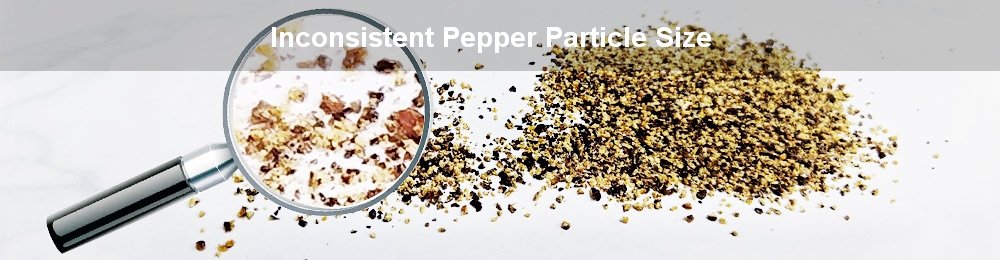
Uneven grinding is one of the most common problems when using a pepper grinder. You may experience inconsistent powder output, uneven particle sizes, or even situations where the grinder rotates multiple times but fails to produce pepper powder properly.
From an engineering perspective, unstable grinding performance is usually not caused by a single factor. Instead, it is closely related to burr structure, material properties, and overall assembly accuracy. For example, insufficient gripping of peppercorns, changes in the burr gap, or wear after long-term use can all result in inconsistent particle output.
This article analyzes the main causes of uneven pepper grinder output from three aspects: burr structure, material characteristics, and assembly tolerances. We will also share a customization case involving large peppercorn grinding and demonstrate how targeted ceramic burr solutions can improve grinding stability and particle consistency. For a complete overview of ceramic burrs, including materials, design considerations, and OEM customization options, see our ceramic burr guide.
Three Common Causes of Uneven Pepper Grinder Output
Based on our years of experience in ceramic burr development and manufacturing, uneven grinding performance usually results from a combination of the following three factors:
- Burr tooth profile and grinding structure
- Material characteristics and powder adhesion
- Assembly tolerance, wear, and burr alignment
Understanding these causes is essential for targeted optimization and effective troubleshooting.
How Burr Tooth Profile Affects Grinding Consistency
The burr tooth profile is one of the important factors affecting grinding performance.
In general, pepper grinder burrs use a two-stage stepped grinding mechanism:
- Upper coarse teeth: Responsible for initial crushing.
- Lower fine teeth: Responsible for fine grinding.
This tooth structure needs to maintain precise shear angles and cutting tolerances.
The number of coarse and fine teeth, tooth angles, and depth ratios need to be optimized based on the hardness and size of the peppercorns being processed.
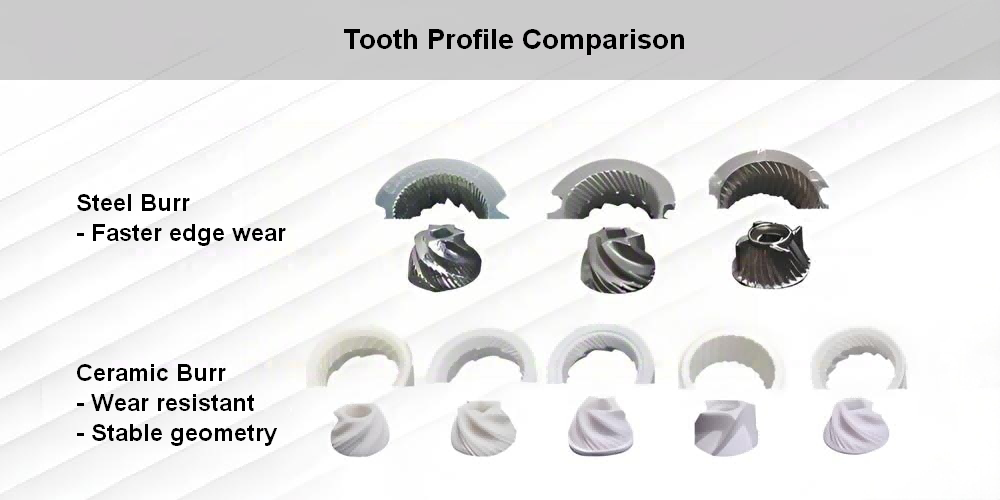
Some manufacturers directly use standard molds without optimizing the tooth profile according to the physical characteristics and size of peppercorns.
As a result, peppercorns may not be effectively engaged and cut inside the grinding chamber during operation, leading to interrupted powder output and inconsistent particle sizes.
Professional Advice
High-quality customized burrs should be optimized and tested based on peppercorn size and hardness to ensure that the coarse teeth provide stable material gripping while the fine teeth continuously produce consistent particles.
Burr Material Properties and Powder Adhesion
Different burr materials have significantly different surface characteristics, which directly affect powder adhesion behavior.
Ceramic Burrs (Zirconia / Alumina)
The surface microstructure and roughness of sintered ceramic burrs can influence powder adhesion behavior.
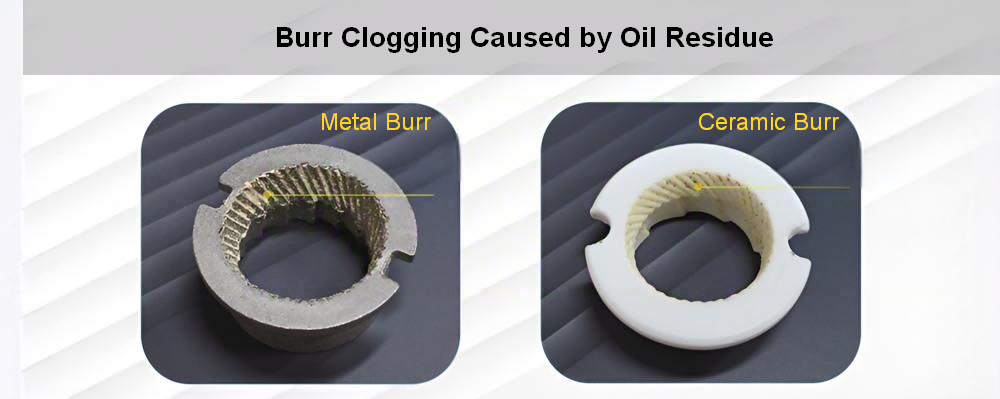
During long-term use, natural oils in peppercorns may combine with residual powder and gradually accumulate inside the burr grooves. This buildup not only reduces the gripping force and grinding efficiency of the burrs, but may also cause previously accumulated powder residues to detach and mix with newly ground particles, resulting in inconsistent particle sizes.
Metal Burrs (Carbon Steel / Stainless Steel)
Stainless steel burrs
If the surface roughness is not properly controlled after stamping, microscopic scratches may retain powder particles and form an adhesion layer.
Carbon steel burrs
When exposed to moisture, carbon steel burrs may rust. The burrs can gradually shift from a “cutting mode” to a “compression mode,” causing severe instability in particle size distribution.
The image below shows typical oil residue buildup inside the burr grooves of metal and ceramic burrs. These deposits can directly change the effective geometry of the burr teeth, becoming one of the key factors that reduce gripping performance and cause inconsistent particle output.
Professional Advice
- Ceramic burrs should be cleaned regularly to remove hardened oil residue. (A soft brush with mild detergent is recommended. Allow the burrs to dry completely before reuse.)
- High-quality ceramic burrs with precision grinding and polishing can reduce surface roughness and powder retention, minimizing oil and powder accumulation inside the burr grooves.
- Metal burrs should be stored in dry conditions. Carbon steel burrs should be wiped dry promptly after use.
If you are comparing ceramic burrs and stainless steel burrs for grinding applications, understanding their differences in wear resistance, consistency, and long-term performance can help with material selection.
Assembly Tolerance, Wear, and Burr Alignment Issues
Regardless of the burr material, the burr does not work independently. It forms a complete grinding system together with the center shaft, positioning structure, and adjustment mechanism.
The following factors can reduce the overall system accuracy:
Geometric Tolerance Issues of Ceramic Burrs
During ceramic sintering, shrinkage occurs (typically around 13–20%), which can easily cause the circularity tolerance of the burr’s outer teeth to exceed the required range, resulting in out-of-roundness.
During operation, the gap between the inner and outer burrs may periodically change as the burr rotates, leading to inconsistent particle sizes.
In addition, ceramic materials have relatively high brittleness. Excessive assembly interference or foreign particles entering the grinding mechanism may cause tooth chipping.
When the mechanical stress applied to the burr teeth exceeds the flexural strength limit of the ceramic material, microcracks may initiate and gradually propagate.
Assembly and Wear Issues of Metal Burrs
For stamped stainless steel burrs, poor concentricity or axial misalignment during assembly may cause uneven loading during long-term grinding.
As a result, one side of the burr teeth may wear faster than the other side, causing unstable particle size distribution.
As mentioned earlier, rusting of carbon steel burrs is essentially caused by changes in surface conditions, which eventually affect the grinding mechanism.
Professional Advice
- Choose ceramic burr suppliers with stable sintering control and precision machining capabilities to help maintain long-term grinding consistency.
- During assembly, strictly follow the recommended torque and clearance range provided by the manufacturer to avoid excessive tightening.
- Regularly inspect the burr teeth for chipping or abnormal wear and replace the burrs when necessary.
How to Identify the Cause of Uneven Pepper Grinding
The following troubleshooting table is based on burr failure analysis. You can use the actual symptoms to identify possible causes and perform an initial inspection.
| Problem | Possible Cause | Recommended Check |
| Mixed particle sizes | Excessive radial clearance | Check whether the shaft has eccentric movement; consider replacing with a model using bearing support |
| Increased grinding resistance | Dull cutting edges or hardened oil residue | Inspect the burr surface; grind uncooked rice to remove absorbed oil residues |
| Sudden changes in particle size | Loose adjustment nut or weakened spring preload | Check whether the adjustment knob has shifted; replace with a higher-strength preload spring |
| Intermittent output or grinding slippage | Burr buildup or damp peppercorns | Check pepper moisture content; store in a dry environment or dry at low temperature if necessary |
| Adjustment setting failure | Excessive assembly tolerance or foreign particles | Disassemble and check for hard particles such as stones trapped between the teeth, or excessive assembly stress |
In many cases, improving grinding consistency requires more than replacing the burr material. A comprehensive solution often involves optimizing tooth geometry, feeding structure, and manufacturing precision based on the specific application requirements.
Case Study: Improving Grinding Consistency for Large Peppercorns
Customer Challenge
Last year, a European customer approached us with an optimization requirement for a large pepper grinder.
The customer wanted to develop a ceramic burr capable of consistently processing 3–6 mm peppercorns. However, the existing standard burr design frequently experienced gripping failure, idle rotation, and inconsistent particle output during actual use.
To solve the grinding stability issue for large-size materials, we carried out three rounds of targeted optimization tests and finally developed an effective solution.
Optimization Process
Stage 1: Optimizing Burr Tooth Structure to Improve Peppercorn Gripping
Problem
Testing showed that the main issue with the original design was that large peppercorns could not enter the grinding area consistently.
As a result, the burrs experienced idle rotation and unstable feeding.
Therefore, we redesigned the tooth profile.
Solution
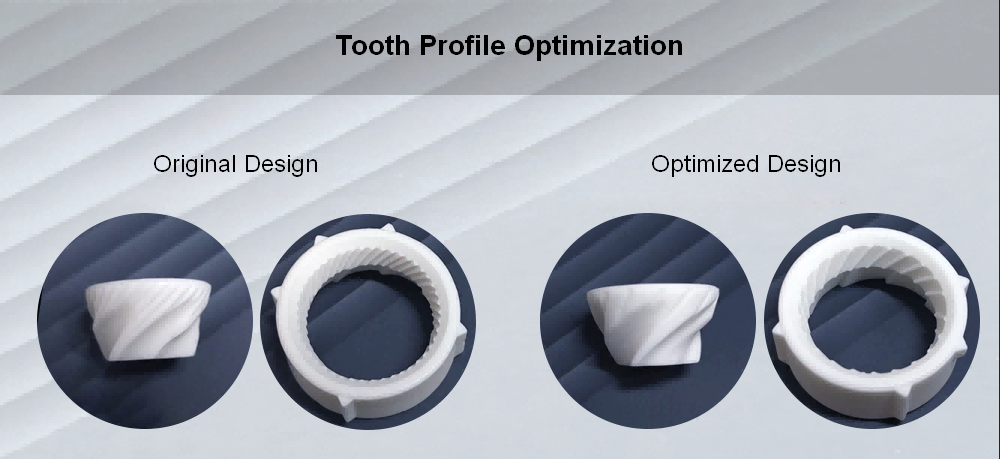
We increased the spacing between the fine teeth to 2–2.5 times the original design.
The comparison between the original and optimized tooth profiles is shown below.
Result
The gripping issue was resolved. However, the particle size distribution still fluctuated significantly, resulting in unstable output with a mixture of coarse and fine particles.
Stage 2: Optimizing Engagement Angle to Reduce Peppercorn Slipping
Solution
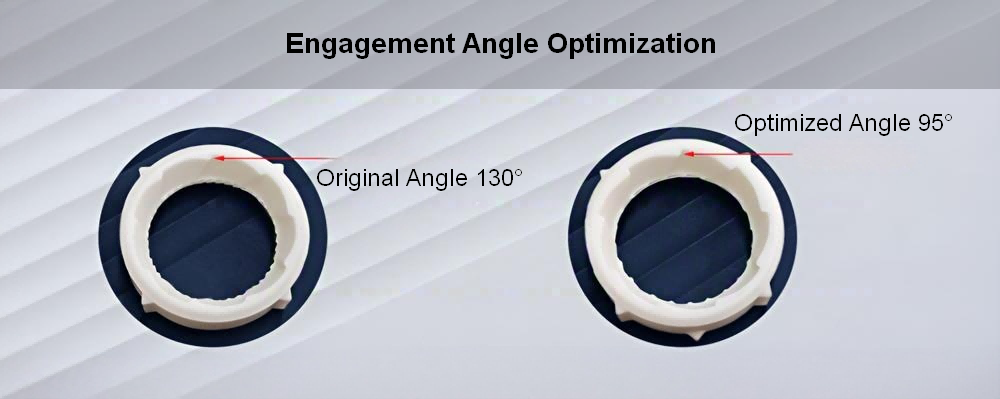
We adjusted the rotation angle of the outer coarse teeth from approximately 130° to 95°.
This improved the ability of the burrs to capture peppercorns and prevented large particles from slipping and idling inside the grinding chamber.
The comparison between the original and optimized engagement angles is shown below.
Result
The continuity of powder output improved significantly. However, particle uniformity still did not fully meet the customer’s requirements, with some oversized particles remaining.
Stage 3: Optimizing the Guiding Structure for Better Feeding Stability and Particle Consistency
Solution
While maintaining sufficient gripping force and powder evacuation capability, we optimized the helical structure of the ceramic burr to solve the unstable feeding issue caused by large peppercorn size.
The original design used six evenly distributed helical guide angles, with a wall thickness of 1.7 mm (as shown in the left image below).
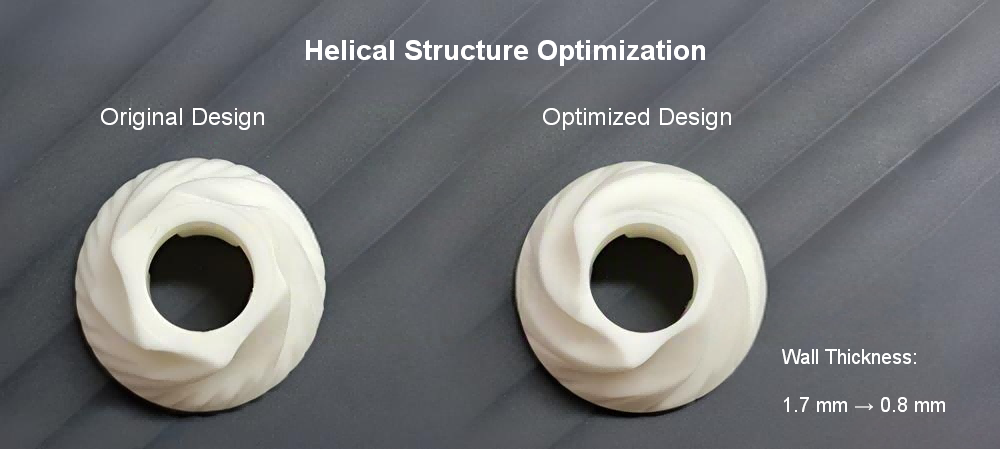
The optimized design adopted a new helical guide structure consisting of:
- Three large helical angles
- Two small helical angles
- One arc-shaped helical angle
At the same time, the wall thickness was reduced from 1.7 mm to 0.8 mm to increase the effective grinding space, allowing larger peppercorns to enter the grinding area more smoothly.
By simplifying the helical angle design and increasing the effective grinding volume, large-size peppercorns could be accurately captured and consistently guided toward the grinding center.
Final Result
Two weeks after receiving the samples, the customer provided positive feedback: “The grinding performance is extremely ideal.”
Engineering Summary
This case demonstrates that for large-size or special material grinding applications, grinding consistency depends not only on burr material selection but also on the combined optimization of:
- Tooth profile design
- Feeding capability
- Manufacturing precision
Conclusion
The grinding consistency of a pepper grinder is influenced by multiple factors, including burr structure, material properties, assembly accuracy, and the characteristics of the processed material.
Whether using ceramic burrs or metal burrs, stable grinding performance requires a balance between gripping capability, powder evacuation efficiency, and manufacturing precision.
Based on our understanding of different material characteristics, we provide customized ceramic burr solutions for applications such as pepper, salt, coffee, and other grinding systems.
If you are developing a high-performance grinder or are experiencing inconsistent grinding results with your existing burrs, please share your material parameters and target particle size distribution. We can provide a free grinding solution assessment.
Frequently Asked Questions About Pepper Grinder Grinding Issues
Q1: Why does my pepper grinder spin but not grind?
A1: A pepper grinder that rotates but fails to produce powder usually indicates that the burrs cannot effectively grip the material.
Common causes include: Excessive burr clearance, burr tooth profile not suitable for the peppercorn size, oil or powder residue buildup on the burr surface, and damp peppercorns causing slipping.
In addition, worn burrs or assembly misalignment may also cause the grinding mechanism to rotate without effective grinding.
It is recommended to check the burr condition, clean any residue from the burr grooves, and confirm that the grinding gap is adjusted correctly.
Q2: How can I fix uneven pepper grinder output?
A2: Solving uneven pepper grinder output requires checking three areas: burr condition, material factors, and assembly accuracy.
First, check whether the burr tooth profile matches the peppercorn size and inspect for wear or chipped teeth.
Second, clean oil and powder buildup from the burr surface to prevent reduced gripping and cutting performance.
Finally, inspect the center shaft, burr clearance, and assembly accuracy to ensure that the inner and outer burrs maintain a stable gap during operation.
For high-performance grinders, using precision-manufactured ceramic burrs with optimized geometry can further improve particle output consistency.
Q3: What is the average lifespan of ceramic burrs in a pepper grinder?
A3: Under normal household usage conditions, high-quality alumina ceramic burrs can typically last for many years.
Some high-quality ceramic burrs can achieve a service life of more than 8 years under normal operating conditions.
The actual lifespan depends on factors such as material grade, usage frequency, assembly accuracy, and maintenance.
Q4: Ceramic burr vs stainless steel burr: Which material provides better grinding consistency?
A4: Grinding consistency depends not only on the burr material but also on tooth profile design, manufacturing precision, and assembly stability.
Ceramic burrs offer high hardness, excellent wear resistance, and strong chemical stability, allowing them to maintain a more stable grinding gap over long-term use. This makes them suitable for applications requiring consistent particle output.
Stainless steel burrs offer better toughness and impact resistance, but the cutting edges may gradually wear during long-term operation, affecting particle uniformity.
Therefore, for pepper grinders requiring long-term stable grinding performance, high-precision ceramic burrs generally provide advantages.
Q5: Why does a pepper grinder perform differently when grinding black pepper and white pepper?
A5: Black pepper and white pepper have different physical properties, which affect burr gripping and grinding performance.
Black pepper retains its outer skin and contains higher levels of volatile oils. During grinding, these oils may accumulate on the burr surface and reduce gripping efficiency.
White pepper undergoes a peeling process, resulting in a drier surface and generally allowing more stable powder output.
Therefore, the same burr design may produce different particle sizes and output consistency when processing different types of pepper.
Optimizing the tooth profile according to specific material characteristics can further improve grinding consistency.