

Introduction
When evaluating ceramic burr performance, many people first focus on the material — ceramic or metal. However, material alone does not determine grinding results.
Based on our testing and application experience, burr geometry, surface roughness, dimensional accuracy, and assembly compatibility often have a more direct impact on grinding consistency. Even when high-performance ceramic materials are used, improper structural design or poor assembly matching can still limit the final grinding results.
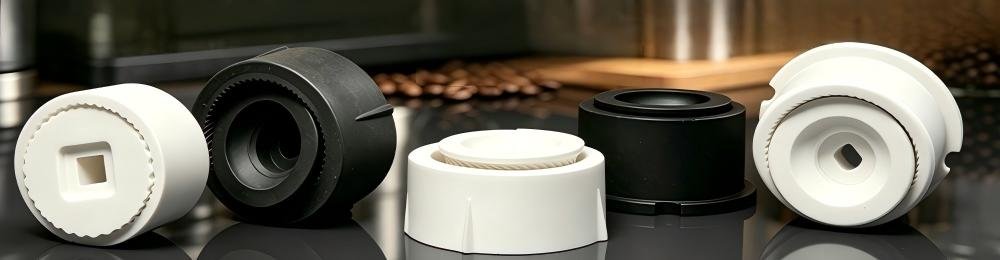
Ceramic burr design refers to the engineering process of developing the burr structure, surface characteristics, dimensional specifications, and mounting interface to meet specific grinding requirements.
In practical applications, these design elements work together to determine whether a ceramic burr can achieve stable operation, consistent particle output, and reliable long-term grinding performance.
This article explores the four key design factors that influence ceramic burr performance.
Ceramic Burr Geometry Design: The Core of Grinding Performance
Among all structural factors, burr geometry has the greatest influence on grinding behavior.
It determines how materials enter the grinding zone, how they are fractured and cut, and how particle size is distributed in the final output.
The Role of Coarse and Fine Teeth in the Grinding Process
Many ceramic burrs used for grinding coffee, pepper, salt, and other food materials adopt a two-stage burr geometry.
The upper coarse teeth are responsible for gripping and initially breaking down the material, while the lower fine teeth further shear the particles and control the final particle size.
These two sections need to work together properly to achieve stable particle output.
Coarse teeth
If the tooth angle or feeding structure is not properly designed, the material may not enter the grinding zone smoothly, resulting in reduced gripping ability.
Insufficient spacing between teeth may also restrict the entry of larger particles.
Fine teeth
The spacing between fine teeth affects material passage and cutting performance. However, the final particle size also depends on tooth profile design, burr clearance, and material properties.
Why Different Materials Require Different Tooth Profiles
Different materials have different requirements for tooth profile design. The tooth profile needs to be adjusted according to the hardness, brittleness, and toughness of the material to achieve stable grinding consistency.
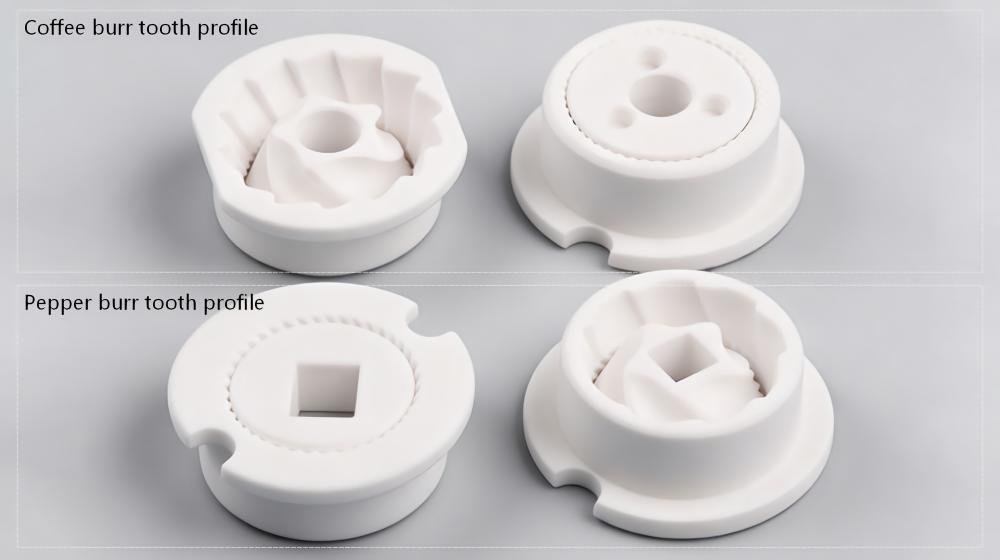
| Material | Physical Properties | Recommended Tooth Profile Design |
| Coffee beans | Relatively hard and brittle; easily fracture under compression | A combined crushing and cutting tooth profile design |
| Peppercorns | Certain toughness with fibrous structure | Progressive grinding structure with gradual shearing for stable output |
| Salt crystals | Clear crystal structure and brittle fracture behavior | A tooth design that balances impact strength and corrosion resistance to avoid ceramic tooth damage caused by localized impact |
A burr designed for coffee grinding often cannot achieve ideal results when used for pepper or salt grinding.
The problem is usually not burr quality, but rather a mismatch between the tooth profile design and the material properties.
If you are selecting ceramic burrs for different grinding applications, you can refer to our ceramic burr selection and OEM guide to learn more about the design features and application considerations of different burr types.
Ceramic Burr Surface Roughness
Many people believe that the smoother the burr surface is, the better the grinding performance will be. However, this is not always the case.
The working surface of a burr needs to maintain an appropriate level of microscopic roughness to effectively grip material particles and achieve consistent particle output.
Too smooth
The material may slide across the surface more easily, reducing gripping ability and lowering grinding efficiency. In manual grinding applications, this may appear as unstable feeding and increased grinding resistance.
Too rough
Oil, fine particles, and material residues can accumulate inside microscopic surface pits, gradually forming hardened deposits.
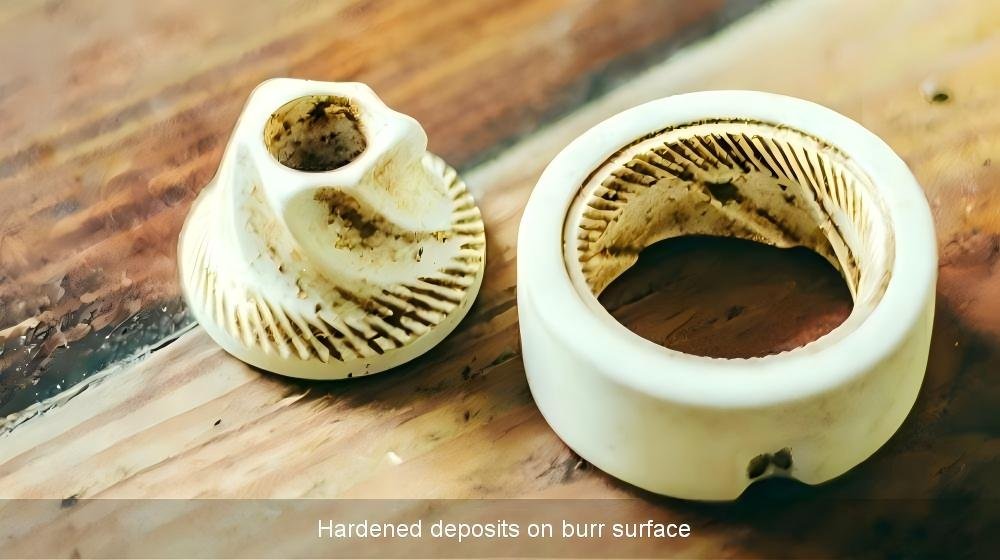
These deposits can partially cover the cutting edges, changing the effective burr geometry and gradually shifting particle distribution.
How Surface Roughness Affects Grinding Efficiency and Heat Generation
Surface roughness not only affects material gripping ability but also influences friction behavior during the grinding process.
Excessive surface roughness may increase friction resistance and generate more heat under high-load grinding conditions.
For coffee grinding applications, excessive frictional heat may influence particle consistency and, in some cases, flavor preservation.
Different Materials Require Different Surface Roughness
There is no single surface roughness standard suitable for all applications.
Different materials vary in viscosity, oil content, and grinding requirements, so an appropriate surface condition must be selected accordingly.
| Application | Recommended Surface Condition |
| Coffee grinding | Balance particle gripping ability and surface cleanliness (for easier oil removal) |
| Spice grinding | Smoother surface to reduce oil adhesion |
Therefore, surface treatment is not simply about making the surface as smooth as possible.
The key is to find the right balance between gripping ability, grinding efficiency, and cleaning.
Ceramic Burr Dimensional Accuracy and Tolerance Control
Tolerance control is another often overlooked factor. It directly affects grinding consistency and long-term reliability.
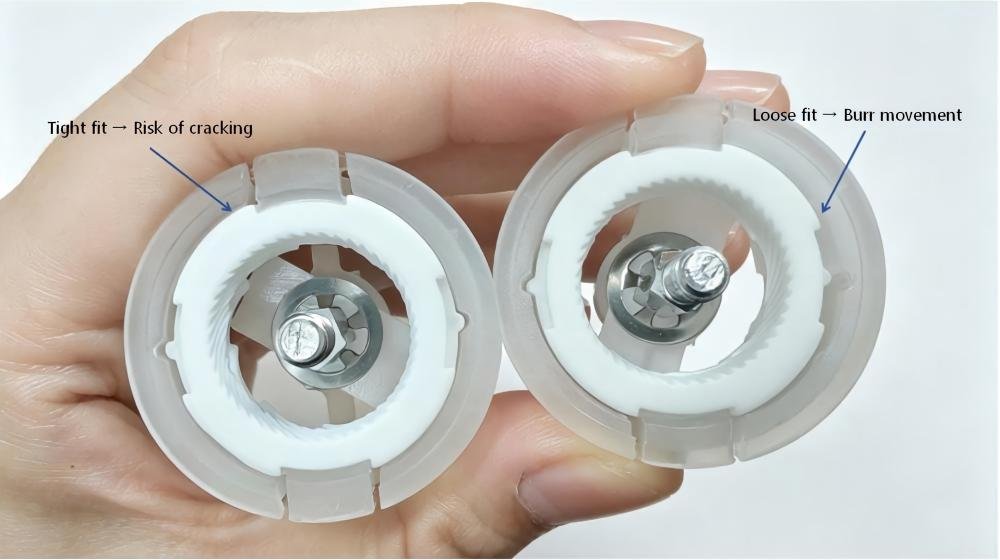
Problems Caused by an Overly Tight Fit
An overly tight fit can introduce localized stress during assembly.
The issue may not be immediately visible, but after extended operation, it may eventually result in tooth chipping or ceramic fracture.
We have encountered similar cases before. After disassembly, we found that the damage was not caused by grinding wear, but by stress introduced during assembly.
Problems Caused by an Excessively Loose Fit
If the fit is too loose, the burr may experience radial movement during rotation.
Even a movement of less than 0.1 mm can cause periodic changes in the grinding gap, affecting particle output consistency.
How Ceramic Sintering Shrinkage Affects Dimensional Accuracy
Ceramic burrs are manufactured through high-temperature sintering, during which shrinkage inevitably occurs.
The final dimensions are affected by factors such as powder condition, material system, and sintering temperature.
This is why two ceramic burrs produced from the same drawing may still show noticeable dimensional differences after sintering.
For critical mating areas, dimensional and geometric tolerances must be carefully matched according to the actual assembly structure. Otherwise, both grinding consistency and assembly reliability can be difficult to guarantee.
Ceramic Burr Assembly Compatibility
A burr cannot work independently. It must work together with the shaft, mounting structure, adjustment mechanism, bearing, and housing to form a complete grinding system.
Even if the burr itself is well designed, output consistency may still suffer if there are issues with assembly positioning, clearance control, or load distribution.
How Assembly Errors Affect Grinding Stability
In actual applications, many grinding problems do not originate from the burr itself, but from small deviations during assembly.
These deviations can change the relative position between the inner and outer burrs, ultimately affecting particle consistency and grinding stability.
| Assembly Factor | Common Issues | Impact on Grinding Stability |
| Concentricity between inner and outer burrs | Assembly runout, loose bearing seat fit | Periodic changes in grinding gap, unstable particle size |
| Axial positioning and preload | Incorrect spring force, fatigue relaxation, or insufficient positioning | Fluctuating grinding pressure and reduced output consistency |
| Gap adjustment mechanism | Insufficient adjustment accuracy or locking failure | Gradual particle size drift during operation |
As shown above, assembly errors affect final grinding performance by changing the grinding gap and load conditions.
Therefore, ceramic burr design should not focus only on the burr itself, but also consider the entire grinding system.
Key Considerations During Ceramic Burr Design
Before finalizing a burr design, several factors should be considered together, including positioning method, torque transmission path, axial load support, and gap adjustment mechanism.
In many grinding systems, the real issue is not the burr itself, but the compatibility between the burr and surrounding components.
If assembly compatibility is insufficient, even a burr with excellent material properties and structural design may not fully deliver its intended grinding performance.
Based on our experience, evaluating assembly compatibility at the design stage is far more efficient and cost-effective than modifying components after mass production.
For customers developing new grinding equipment or optimizing existing designs, we provide custom ceramic burr solutions, including tooth profile design, dimensional optimization, and OEM manufacturing support.
Case Study: How Assembly Errors Cause Inconsistent Ceramic Burr Output
We once investigated a grinding consistency issue reported by a customer.
Problem
The customer reported unstable powder output from their equipment and initially suspected insufficient dimensional accuracy or manufacturing consistency of the burr itself.
Investigation Process
At the beginning, both sides focused on inspecting and adjusting the burr.
However, after multiple optimization attempts, the problem remained unresolved.
The equipment was then returned for disassembly and inspection. The results showed that the burr dimensions and geometry were within specification.
Root Cause
The actual problem was traced back to the assembly structure.
Although the burr was designed with positioning steps, the customer’s mounting base did not have matching positioning grooves. The burr was mainly fixed by a single screw.
During long-term operation, the screw gradually loosened slightly, causing the burr to move radially by less than 0.1 mm.
For ordinary mechanical structures, such a small displacement may appear insignificant. However, in a precision grinding system, this small radial movement periodically changes the effective gap between the inner and outer burrs during rotation, eventually resulting in unstable particle output.
Solution
A positioning groove was added to engage with the positioning step on the burr.
This allowed the screw to only provide axial preload, rather than being responsible for radial positioning.
Result
After repeated testing, grinding consistency improved significantly, and the customer achieved more stable powder output in subsequent production.
Lesson Learned
This case demonstrates that grinding performance is not determined by the burr itself alone.
Even when a burr has good material properties and structural design, insufficient assembly positioning and system matching can still have a significant impact on final grinding results.
If you would like to learn more about the common causes of uneven grinding output, please refer to our article uneven powder output in pepper grinders.
Frequently Asked Questions About Ceramic Burrs
What is the difference between ceramic burrs and stainless steel burrs? How should I choose?
Ceramic burrs offer high hardness, corrosion resistance, and good food-contact stability. They are suitable for applications such as salt, pepper, and some coffee grinding.
Stainless steel burrs generally provide higher mechanical strength and impact resistance, making them more suitable for high-load and high-speed professional grinding equipment.
The two types differ significantly in wear resistance, grinding performance, application scenarios, and cost. For a detailed comparison, please refer to our article comparison between ceramic and stainless steel burrs.
The final choice should be based on the grinding material, usage frequency, and cost requirements.
Why does a ceramic burr produce uneven powder output?
Inconsistent particle output from ceramic burrs is usually caused by multiple factors rather than a single issue.
Common causes include mismatched tooth profile design, unstable burr clearance, assembly misalignment, and insufficient tolerance control.
For grinders that have been used for a long time, it is also important to check whether burr wear or changes in the mounting structure have affected performance.
How long does a ceramic burr last?
Due to the high hardness and excellent wear resistance of ceramic materials, ceramic burrs can generally maintain stable grinding performance over a long service period under normal operating conditions.
In industrial or commercial applications, service life should be evaluated based on material being ground, operating frequency, load conditions, and maintenance requirements.
Can ceramic burrs be customized?
Yes. Ceramic burrs can be customized according to customer requirements, including tooth profile design, dimensions and tolerances, mounting interfaces, surface treatment, and brand markings.
We provide OEM/ODM development support based on different grinding materials and equipment structures.
Do new ceramic burrs need sharpening or a break-in period?
Generally, ceramic burrs do not require “sharpening” or an initial break-in period like cutting tools.
After machining and inspection, ceramic burrs are ready for use.
Before first use, we recommend simple cleaning and installation checks according to the equipment requirements to ensure stable grinding performance.
Conclusion
A high-quality ceramic burr is not defined by material alone.
Material determines wear resistance, service life, and application range, while tooth profile design, surface condition, tolerance control, and assembly compatibility determine whether the grinding performance can be delivered consistently.
In practical applications, stable particle distribution is not achieved by a single factor. It is the result of the combined effects of material selection, structural design, and manufacturing precision.
Understanding these design factors is the foundation for developing ceramic burrs that deliver consistent particle output, reliable operation, and long-term performance.