

Introduction
Advanced ceramics, also known as engineering ceramics or technical ceramics, are high-performance inorganic non-metallic materials engineered for demanding industrial applications. Compared with traditional ceramics, advanced ceramic materials provide significantly higher hardness, wear resistance, thermal stability, corrosion resistance, and electrical insulation.
Today, advanced ceramics are widely used in semiconductor manufacturing, aerospace systems, electric vehicles, medical devices, energy equipment, and industrial machinery. As industries continue demanding higher efficiency, higher temperatures, and longer service life, technical ceramics are increasingly replacing metals and polymers in critical applications.
This guide introduces the major types of advanced ceramics, their properties, manufacturing technologies, and industrial applications.
What Are Advanced Ceramics?
Advanced ceramics are inorganic, non-metallic materials manufactured through precise powder processing and high-temperature sintering technologies. Unlike conventional ceramics used for household or construction applications, engineering ceramics are designed with carefully controlled purity, composition, grain size, and microstructure to achieve specific mechanical, thermal, or electrical performance.
Advanced ceramics are commonly divided into:
- Oxide Ceramics
- Non-Oxide Ceramics
- Composite Ceramics
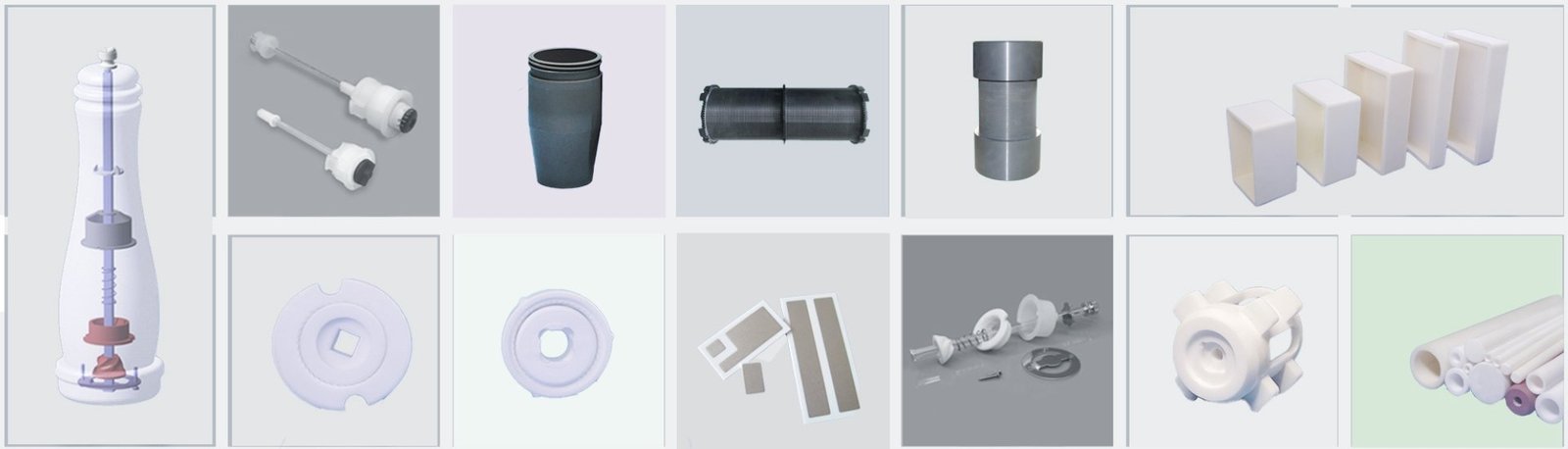
Typical advanced ceramic materials include alumina (Al₂O₃), zirconia (ZrO₂), silicon nitride (Si₃N₄), silicon carbide (SiC), aluminum nitride (AlN), and boron nitride (BN).
Types of Advanced Ceramic Materials
Alumina Ceramics (Al₂O₃)
Alumina ceramics are among the most widely used technical ceramics because of their excellent electrical insulation, wear resistance, chemical stability, and cost effectiveness.
Typical applications include:
- Semiconductor components
- Electrical insulators
- Ceramic substrates
- Wear-resistant parts
- Mechanical seals
Zirconia Ceramics (ZrO₂)
Zirconia ceramics provide high fracture toughness, high strength, and excellent crack resistance through transformation toughening mechanisms.
Applications include:
- Medical implants
- Precision blades
- Pump components
- Structural ceramic parts
Silicon Nitride Ceramics (Si₃N₄)
Silicon nitride ceramics combine high strength, excellent thermal shock resistance, and low density, making them ideal for high-speed and high-temperature applications.
Typical applications include:
- Ceramic bearings
- Turbocharger rotors
- Semiconductor equipment
- Industrial machinery
Silicon Carbide Ceramics (SiC)
Silicon carbide ceramics offer extremely high hardness, high thermal conductivity, and outstanding corrosion resistance.
Applications include:
- Semiconductor wafer processing
- Mechanical seals
- Heat exchangers
- High-temperature furnaces
Aluminum Nitride Ceramics (AlN)
Aluminum nitride combines high thermal conductivity with excellent electrical insulation, making it ideal for thermal management applications in electronics.
Applications include:
- Power module substrates
- IGBT modules
- LED heat sinks
- Semiconductor packaging
Mechanical Properties of Advanced Ceramics
Advanced ceramics are known for:
- High hardness
- Excellent wear resistance
- High compressive strength
- Good dimensional stability
- Superior corrosion resistance
Compared with metals, ceramics generally provide significantly higher hardness and wear resistance but lower ductility.
Thermal and Electrical Properties
Thermal and electrical properties are critical in selecting engineering ceramics for industrial applications.
Important thermal properties include:
- Thermal conductivity
- Thermal shock resistance
- Coefficient of thermal expansion (CTE)
- Maximum operating temperature
Important electrical properties include:
- Dielectric constant
- Dielectric loss
- Volume resistivity
- Electrical insulation strength
Materials such as AlN and SiC are widely used for thermal management and semiconductor applications.
Manufacturing Processes of Technical Ceramics
The performance of advanced ceramics depends heavily on manufacturing technologies.
Common manufacturing methods include:
- Dry pressing
- Isostatic pressing
- Injection molding
- Tape casting
- Hot pressing
- Hot isostatic pressing (HIP)
- CNC machining
- Ceramic metallization
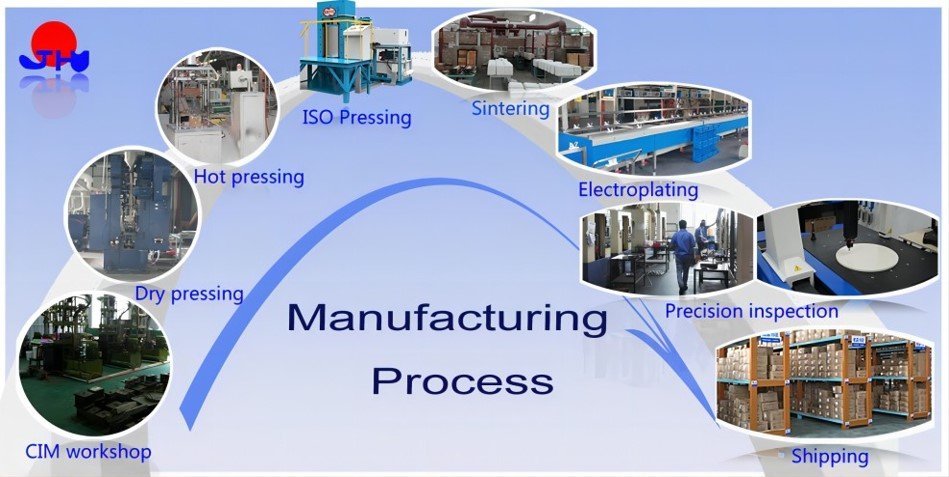
Advanced sintering technologies help achieve high density, improved mechanical properties, and better microstructural control.
Industrial Applications of Advanced Ceramics
Advanced ceramics are widely used in many industries.
Semiconductor Industry
Wafer handling components, vacuum chucks, ceramic heaters, insulating parts.
Aerospace Industry
Thermal protection systems, lightweight structures, wear-resistant components.
Medical Industry
Dental implants, surgical tools, orthopedic implants.
Electric Vehicles (EV)
Power electronics substrates, insulating components, thermal management systems.
Industrial Machinery
Pumps, valves, bearings, seals, cutting tools.
FAQ
Q1:What are advanced ceramics used for?
Advanced ceramics are used in semiconductor, aerospace, medical, automotive, energy, and industrial applications because of their excellent thermal, mechanical, and electrical properties.
Q2:What is the difference between technical ceramics and traditional ceramics?
Technical ceramics are engineered for industrial performance and manufactured with tightly controlled purity and microstructure, while traditional ceramics are mainly used for household or construction purposes.
Q3:Which ceramic has the highest thermal conductivity?
Among commonly used engineering ceramics, aluminum nitride and silicon carbide offer relatively high thermal conductivity.
Conclusion
Advanced ceramics continue redefining modern engineering through their exceptional hardness, wear resistance, thermal stability, and electrical insulation. As industrial applications become increasingly demanding, engineering ceramics will play a more important role in semiconductor manufacturing, aerospace systems, energy equipment, and advanced industrial technologies.