

As Jinghui Ceramic continued to expand its international business and product portfolio, the company recognized the need for a more integrated management system to support daily operations across different departments. After evaluating several ERP solutions suitable for manufacturing and export-oriented companies, Jinghui began paying close attention to the Ruibei ERP system in 2023.

One of the reasons for selecting Ruibei was its bilingual Chinese and English interface and its modular design, which allows companies to configure different functions according to their business needs. During the evaluation period, our sales, purchasing, finance, warehouse, and management teams participated in multiple rounds of testing to better understand how the system could fit our existing workflow.
Rather than deploying the system immediately, we spent several months reviewing practical business scenarios, including customer management, email communication, quotations, purchasing, inventory control, financial processes, and export order management. Throughout the testing phase, we identified a number of areas that required adjustment and discussed them with the Ruibei implementation team.
The implementation process also included system initialization, organizational structure setup, user permissions, approval workflows, and customized business fields, allowing the ERP system to better match our internal management practices before it was officially launched.
To ensure a smooth transition, the implementation engineers provided on-site guidance and user training. Employees from different departments gradually became familiar with the new operating procedures through practical daily work rather than intensive short-term training.
In March 2024, Jinghui Ceramic officially completed the initial deployment of the Ruibei ERP system and began using it in daily operations.
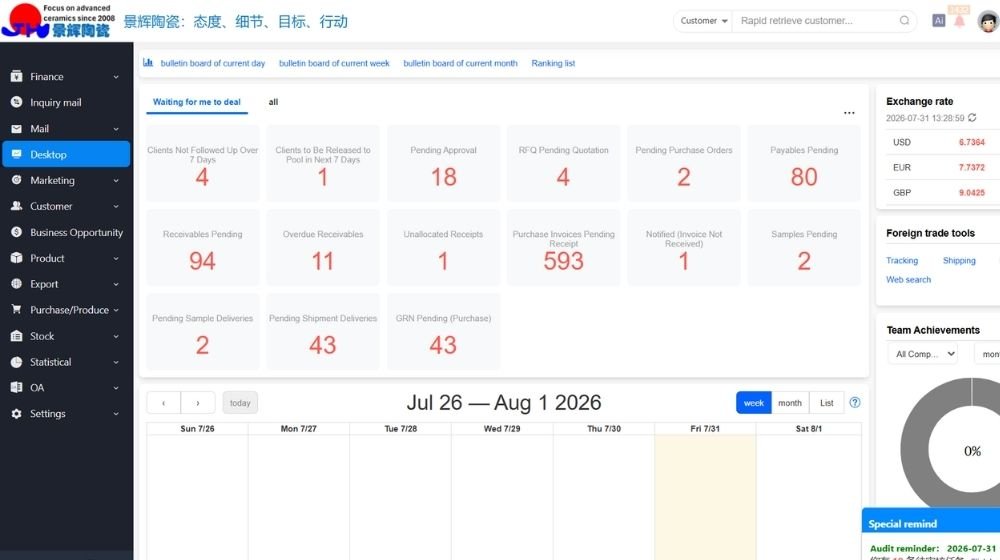
Since then, the ERP platform has gradually become part of our routine workflow. Different departments now collaborate through a unified system covering customer information, quotations, purchase orders, inventory records, production coordination, financial data, email communication, and export documentation. Managers are also able to review operational data through dashboard reports, making internal communication and decision-making more transparent.
Like any digital transformation project, adopting a new ERP system is an ongoing process rather than a one-time upgrade. As our business continues to develop, we will keep optimizing internal processes and make full use of digital tools to improve collaboration and operational efficiency.