

Introduction
In pepper mills, coffee grinders, and industrial crushers, ceramic burrs have gradually replaced metal burrs to become the mainstream choice for mid- to high-end grinding equipment.
However, many procurement professionals often find themselves confused when selecting ceramic burrs: despite their similar appearance, there are significant price differences.
This disparity is not simply the result of manufacturers’ marketing tactics, but is determined by actual factors in the manufacturing process, including raw materials, mold costs, burr geometry, sintering cycle, and quality control systems.
This article will analyze the pricing structure of ceramic burrs from both technical and economic perspectives, helping you find a solution that balances lifespan and cost-effectiveness when choosing a product.
For a comprehensive understanding of ceramic burr design and selection, please refer to our complete ceramic burr guide.
Raw Material Grade: The Basis for Ceramic Burr Pricing
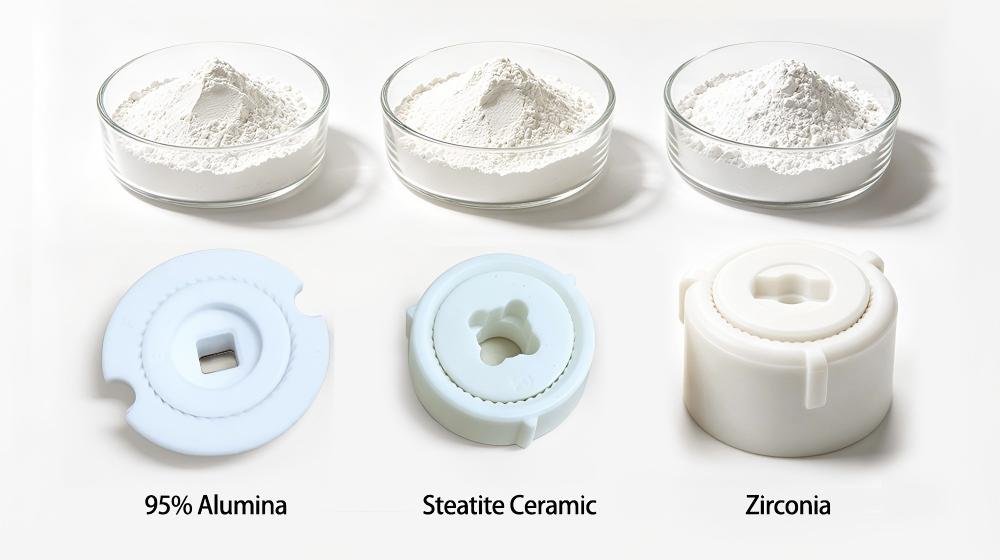
The choice of ceramic raw materials is a core factor determining the manufacturing cost and lifespan of ceramic burrs. Currently, the mainstream materials used in the market are mainly divided into the following four categories:
Steatite Ceramics: Low Cost/Disposable Use
- Cost Overview: The most economical material option.
- Best Applications: Budget-friendly spice grinders, disposable pepper mills, or low-load applications.
- Performance Trade-offs: Limited wear resistance, but sufficient to meet the basic needs of the average consumer.
Alumina Ceramics: The Industry Mainstay
- Cost Overview: Offering a balanced cost-performance ratio, this is the most widely used material for ceramicburrs.
- Minor Differences: Prices vary according to purity grades (75%, 85%, 95%, and 99%). The higher the purity, the higher the cost of the raw material.
- Applications: For standard pepper or spice grinders, 95% alumina provides an ideal balance between durability and cost; high-end coffee grinders, however, require 99% alumina to achieve superior wear resistance.
Zirconia Ceramics: High-End Grade
- Cost Overview: Prices are more than 10 times higher than those of alumina.
- Reasons for High Cost: The market price of zirconia raw material is much higher than that of alumina; the sintering cycle is longer and requires greater precision; the process window is narrow, with almost zero tolerance for temperature deviations.
- Advantages: Zirconia possesses excellent fracture toughness and high impact resistance, effectively preventing edge chipping under high-load conditions.
Composite Ceramics: A Compromise Solution
- Cost Overview: Priced in the mid-range.
- Best Applications: Suitable for applications where users do not wish to bear the high cost of zirconia but require a certain level of impact toughness from the material.
Suggestions for Procurement and Engineering
For standard grinding requirements in the food and spice industries, 95% alumina ceramic burrs are a highly reliable and cost-effective solution.
Do not blindly choose expensive materials simply to pursue a “high-end” label. Please select the appropriate ceramic material based on actual operating loads.
To understand how material structure affects final particle uniformity, read our analysis article what determines ceramic burr grinding performance.
Mold Costs: Initial Investment for Custom Designs
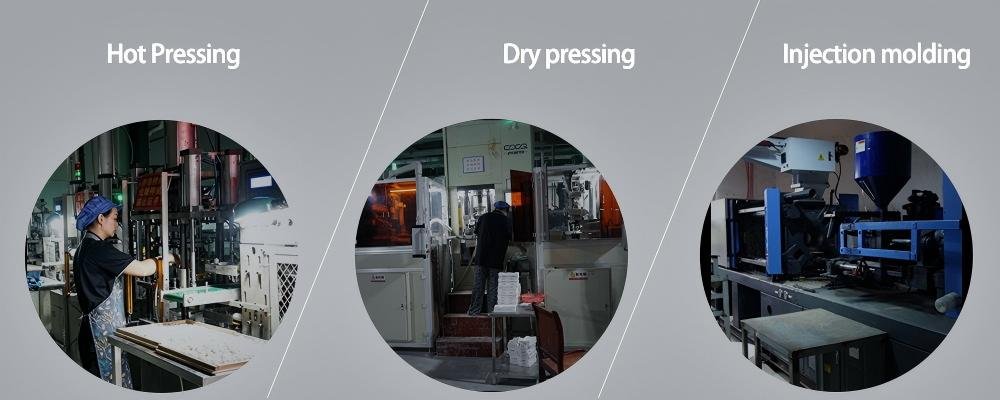
Each custom ceramic burr requires specific forming techniques, such as dry pressing, hot pressing, or ceramic injection molding (CIM), to achieve precise tooth profiles and geometry. Therefore, mold costs are an essential initial investment.
Standard Ceramic Burrs
- Cost Overview: The supplier has already achieved mass production, therefore no additional mold costs are required.
- Best Applications: Suitable for standard projects where the supplier’s existing sizes can meet your needs.
Custom Ceramic Burrs
When standard ceramic burrs do not meet your requirements, you will need to design a custom ceramic burr, which requires the additional fabrication of a dedicated mold.
The mold cost for custom ceramic burrs primarily depends on the following three manufacturing variables:
1. Part Complexity: Complex contours, internal steps, or deep holes in the ceramic burrincrease the precision requirements of the mold base, thus increasing machining time.
2. Tooth Density and Demolding Limitations: The finer the tooth arrangement, the more difficult the micromachining of the mold cavity.
Straight walls or negative draft angles significantly increase demolding difficulty. In such cases, complex multi-piece sliding combination molds are needed, rather than simple upper and lower pressure plate structures.
3. The number of mold cavities (single or multi-cavity) depends on product size, geometry, and annual production volume.
Upgrading from a single-cavity prototype mold to a 6- or 10-cavity mass-production mold, the mold dimensions increase accordingly, leading to higher consumption of mold steel raw materials and a corresponding rise in CNC wire EDM costs.
| Product Type | Mold Requirements | Impact on Price |
| Standard Ceramic Burrs | None (using existing molds from the factory) | Basis Price |
| Custom Ceramic Burrs | High initial mold costs | Higher unit costs until production reaches scale |
Suggestions for Procurement and Engineering
The initial unit cost of custom ceramic burrs is typically high because factories need to amortize the costs of engineering design and mold wear over a certain period.
To mitigate this financial risk, we recommend prioritizing manufacturers that offer a mold cost reimbursement mechanism.
A reliable partner will fully refund the initial mold costs when your cumulative purchase volume reaches mutually agreed milestones (such as 100,000 or 200,000 units).
Manufacturing Processes: The Key Factors Behind Pricing
Two ceramic burrs may appear similar to the naked eye, but their internal engineering structures, microscopic densities, and production yields can vary significantly. These hidden process choices are precisely what determine the final price.
The table below outlines how specific production requirements directly impact a factory’s cost structure:
| Cost Factors | Technical Options/Requirements | Impact on Pricing and Costs |
| Forming Process | Hot Pressing | Low cost; suitable for moderately complex shapes, but with lower density uniformity |
| Dry Pressing | Low cost; suitable for simple, flat geometries. High production efficiency and high green body density | |
| Ceramic Injection Molding (CIM) | High cost; essential for highly complex three-dimensional conical structures and ultra-fine tooth profiles. | |
| Sintering Yield Rate | High Stability (Yield Rate ≥ 95%) | Low Cost: Mature production lines minimize waste. A low scrap rate reduces the unit cost. |
| Standard Control (Yield Rate 80%–90%) | Medium-to-High Cost: Scrap losses must be factored into total production costs. | |
| Unstable Control (Yield Rate < 80%) | High Cost: The cost of defective products is passed on to the pricing of qualified products through financial means. | |
| Surface Quality | Functional Grade Only | Low Cost: Focuses solely on grinding performance; strict visual inspections are omitted. |
| Premium Aesthetic Grade | High Cost: Zero tolerance for black spots, pinholes, color variations, or minor edge chipping. Inspection time is longer, and the rejection rate is higher. |
Suggestions for Procurement and Engineering
When reviewing supplier quotes, be sure to assess the stability of their sintering yield rate.
Factories with unstable processes and poor thermal profile control often pass on scrap costs to the purchaser.
We recommend establishing clear criteria for distinguishing between cosmetic and functional defects as early as possible to avoid unnecessary budget waste.
Procurement and Supply Chain Strategy: How to Reduce the Manufacturing Costs
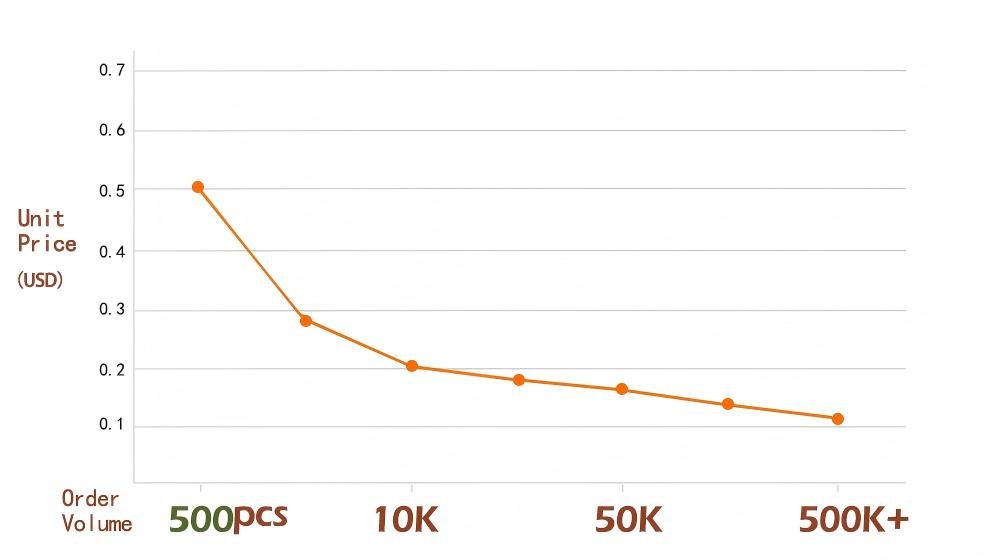
The unit price of ceramic burrs is directly related to production volume.
In addition, the manufacturer’s quality control system and level of automation are also key factors influencing the overall cost structure.
The impact of order volume on unit price is as follows:
| Annual Order Volume | Pricing Features |
| Samples/Pilot Production (<100 units) | Highest unit price |
| Low order volume (5,000–10,000 units/year) | Mid-to-high price range |
| Medium order volume (50,000–250,000 units/year) | Economic range |
| High order volume (>500,000 units/year) | Optimal pricing
Maximum automation, continuous kiln sintering, and minimal material waste. (For reference: Our core Tier 1 customers maintain a stable order volume of 1 million units per month.) |
Case Study: Maximizing Cost Efficiency for a Leading European Brand
In large-scale production scenarios, striking a balance between unit cost and long-term wear resistance is a key engineering challenge.
Last year, a well-known French kitchen appliance brand contacted us regarding a procurement need for ceramic burrs, with an annual demand of up to 50 million units.
To assess our production capacity and quality consistency, their technical and procurement teams visited our factory four times to conduct on-site inspections and audits.
With our highly optimized 95% alumina proprietary wear-resistant formula and automated hot pressing technology, we have not only successfully passed its stringent European quality standards, but also offered highly competitive prices.
This achievement demonstrates that, for large-scale procurement needs, 95% alumina ceramic burrs remain the most cost-effective solution without compromising grinding performance.
Suggestions for Procurement and Engineering
Beware of the “Large Manufacturer Premium Trap”: As shown in the image below, during the pilot phase of small-batch production of 500 to 10,000 units, leading manufacturers often quote prices 2 to 3 times higher than those of medium-sized lean factories.
This high premium is primarily due to the significant overhead costs amortized by large manufacturers, as well as the substantial fixed energy costs (gas and power base costs) incurred during small-batch start-up in the giant industrial tunnel kilns used for sintering.
Conclusion
Ultimately, the pricing of ceramic burrs is not determined by a single factor, but rather reflects a combination of factors such as material formulation, mold design, forming processes, sintering yield, and cumulative production volume.
An effective procurement strategy should not aim solely for the lowest price. Instead, it should involve selecting a cost structure and quality grade that perfectly align with the product’s market positioning, based on a clear understanding of your specific application requirements.
If you are evaluating manufacturers and need engineering or technical selection support, please feel free to contact our team at any time. We can provide a transparent breakdown of customized quotes and share our standard batch inspection procedures.
For a deeper understanding of the technical details of alternative materials, please read our comparison article ceramic vs stainless steel burr.