

Introduction
Metallized ceramics are widely used in electronic packaging, vacuum devices, hermetic assemblies, power modules, sensors, and aerospace components. While the metallization layer provides a conductive surface on ceramic materials, it is usually not the final functional surface. Additional plating—most commonly nickel or gold—is often required to improve solderability, brazing reliability, corrosion resistance, or wire bonding performance.
For many engineers, selecting between nickel plating and gold plating is not simply a cost decision. The choice directly affects electrical performance, long-term reliability, joining methods, storage life, and manufacturing cost. An inappropriate plating system may lead to oxidation, poor solder wetting, delamination, or premature failure in demanding applications.
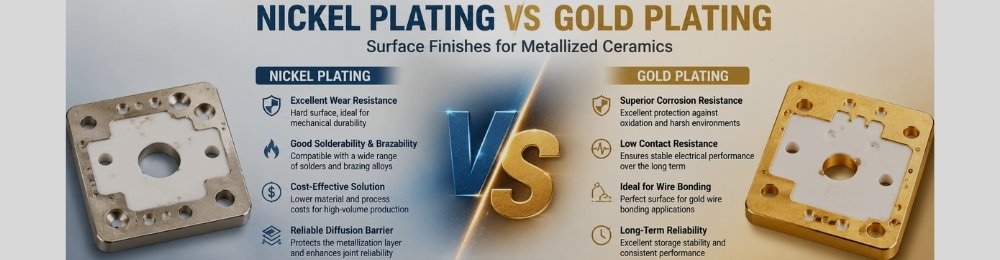
This guide compares nickel plating and gold plating on metallized ceramics from an engineering perspective, helping designers and buyers select the most suitable surface finish for different applications.|
Why Do Metallized Ceramics Need Surface Plating?
A common misconception is that once a ceramic component has been metallized, it is ready for soldering or brazing. In reality, the initial metallization layer—such as molybdenum-manganese (Mo-Mn)—is mainly designed to bond securely with the ceramic during high-temperature firing. Although it adheres strongly to the ceramic substrate, its surface is not ideal for direct joining or long-term exposure.
To improve performance, one or more plating layers are typically added. Nickel acts as a diffusion barrier and enhances solderability, while gold protects the surface from oxidation and provides excellent electrical contact and wire bonding capability.
A typical metallized ceramic structure is shown below:
Ceramic Substrate → Mo-Mn Metallization → Nickel Plating → Gold Plating (Optional)
Not every component requires all layers. The plating structure should be selected according to joining method, operating environment, and reliability requirements.
What Is Nickel Plating?
Nickel plating is the most common surface treatment applied after ceramic metallization. Rather than serving as a decorative finish, the nickel layer performs several important engineering functions.
Its primary role is to act as a diffusion barrier between the metallization layer and subsequent joining materials. During brazing or soldering, nickel helps prevent excessive interdiffusion between different metals, maintaining joint integrity and reducing the risk of brittle intermetallic compounds.
Nickel plating also improves solderability, enhances corrosion resistance, and provides a harder, more wear-resistant surface than gold. For many industrial applications, nickel plating alone is sufficient without requiring an additional gold finish.
Typical nickel plating thickness ranges from 2–10 μm, depending on the application and joining process.
What Is Gold Plating?
Gold plating is typically applied over a nickel layer to create a highly conductive, oxidation-resistant, and bondable surface. Unlike nickel, gold does not readily form surface oxides under normal atmospheric conditions, allowing components to maintain excellent solderability and electrical performance even after long-term storage.
Gold plating is particularly valuable in applications requiring gold wire bonding, microwave signal transmission, high-frequency electronics, or ultra-high reliability. Because gold offers low contact resistance and outstanding chemical stability, it is widely used in hermetic packages, aerospace electronics, medical devices, optical communication modules, and semiconductor packaging.
However, gold plating is significantly more expensive than nickel plating. Increasing the gold thickness does not always improve performance; instead, the required thickness should be optimized according to bonding, soldering, wear resistance, and cost requirements.
Typical gold thickness ranges from 0.05–2 μm, depending on the application.
Gold vs Nickel Plating: Performance Comparison
Although both nickel plating and gold plating are commonly applied to metallized ceramics, they serve different engineering purposes. Nickel primarily acts as a functional barrier layer that improves brazing performance, mechanical durability, and corrosion resistance. Gold, on the other hand, is usually selected when superior electrical performance, oxidation resistance, or wire bonding reliability is required.
Instead of asking which plating is better, engineers should evaluate which surface finish best matches the application’s electrical, mechanical, environmental, and manufacturing requirements.
Performance Comparison
| Property | Nickel Plating | Gold Plating |
| Primary Function | Barrier Layer | Functional Surface |
| Electrical Conductivity | Good | Excellent |
| Contact Resistance | Moderate | Very Low |
| Oxidation Resistance | Good | Excellent |
| Corrosion Resistance | Good | Excellent |
| Solderability | Excellent | Excellent |
| Brazing Performance | Excellent | Excellent |
| Wire Bonding | Limited | Excellent |
| Wear Resistance | Excellent | Good |
| Surface Hardness | High | Low |
| Shelf Life | Medium | Long |
| Manufacturing Cost | Low | High |
| Typical Applications | Industrial Electronics | High Reliability Electronics |
Why Nickel Is Used as a Barrier Layer
One of the most misunderstood aspects of ceramic metallization is the role of nickel plating. Many assume that nickel is applied simply to improve appearance, but its primary function is to serve as a diffusion barrier.
During brazing or high-temperature soldering, atoms from different metals naturally diffuse into one another. Excessive diffusion may weaken the joint, create brittle intermetallic compounds, or reduce long-term reliability. The nickel layer slows this diffusion process, maintaining joint stability throughout thermal cycling and long-term service.
Nickel also improves wetting during brazing and provides a harder surface that better resists handling damage and mechanical wear.
Why Gold Is Applied Over Nickel
Gold plating is rarely deposited directly onto ceramic metallization. Instead, it is almost always plated over a nickel layer.
The nickel layer provides structural support and diffusion resistance, while the gold layer protects the surface from oxidation and maintains excellent electrical performance.
Because gold remains chemically stable in air, components can be stored for extended periods without significant degradation in solderability or electrical contact performance. This characteristic makes gold plating especially valuable for aerospace electronics, medical devices, military systems, and semiconductor packages.
Typical Metallization Structure
A typical metallized ceramic assembly consists of multiple functional layers, each serving a specific engineering purpose rather than simply increasing thickness.
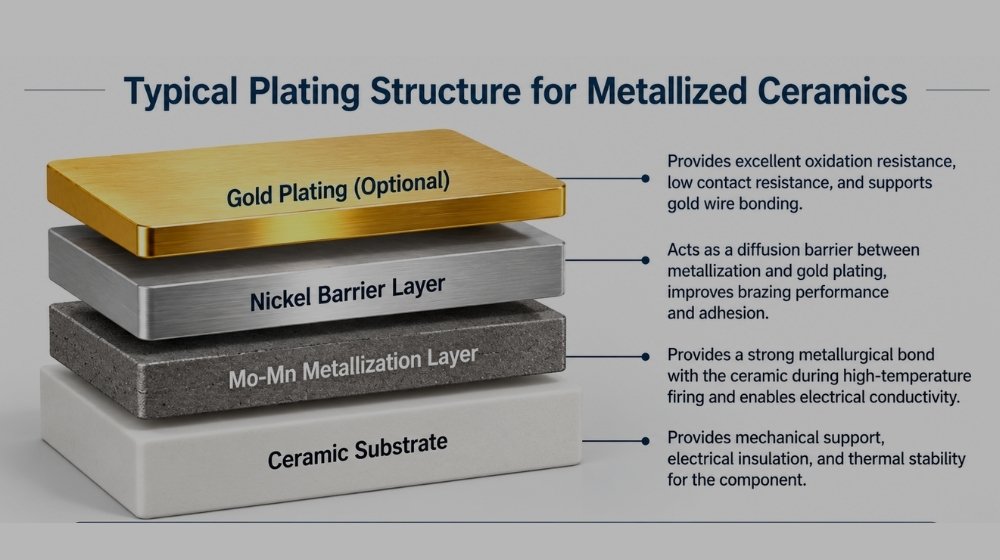
- Gold Layer: Prevents oxidation, improves electrical contact, supports wire bonding.
- Nickel Layer: Acts as a diffusion barrier and enhances brazing reliability.
- Mo-Mn Layer: Forms a strong metallurgical bond with the ceramic during high-temperature firing.
- Ceramic Substrate: Provides electrical insulation, mechanical support, and thermal stability.
Typical Manufacturing Process
Although the exact process varies depending on product requirements, a typical metallized ceramic manufacturing route includes the following steps:
- Ceramic substrate preparation
- Mo-Mn metallization printing or coating
- High-temperature hydrogen sintering
- Surface cleaning and activation
- Nickel plating
- Gold plating (if required)
- Thickness and adhesion inspection
- Brazing or soldering
- Final quality inspection
Each process influences adhesion, plating quality, and long-term reliability. Strict process control is therefore essential for high-reliability ceramic components.
When Should You Choose Nickel Plating?
Nickel plating is the preferred solution for many industrial ceramic components because it provides an excellent balance between performance, durability, and cost. It offers reliable brazing performance, good corrosion resistance, and high surface hardness while remaining significantly less expensive than gold plating.
For applications where gold wire bonding or ultra-low contact resistance is not required, nickel plating alone is often sufficient.
Nickel plating is commonly selected for:
- Industrial sensors
- Ceramic feedthroughs
- Vacuum components
- Power electronics
- General brazed ceramic assemblies
- Automotive electronic components
- Mechanical ceramic parts
- High-volume industrial production
For products operating in relatively clean environments with moderate humidity and limited storage requirements, nickel plating generally provides reliable long-term performance.
When Should You Choose Gold Plating?
Gold plating should be considered whenever long-term electrical stability, oxidation resistance, or wire bonding performance is critical.
Because gold does not readily oxidize under normal atmospheric conditions, it maintains excellent solderability and electrical contact even after prolonged storage. This makes gold plating particularly valuable for high-reliability electronic assemblies.
Typical applications include:
- Semiconductor packaging
- Hermetic ceramic packages
- Microwave and RF devices
- Medical electronics
- Aerospace electronics
- Military electronics
- Optical communication modules
- High-frequency sensors
Although gold plating increases manufacturing cost, it often reduces long-term reliability risks in demanding applications.
Engineering Selection Guide
The choice between nickel plating and gold plating should be based on engineering requirements rather than appearance.
Consider the following questions during product design:
- Will the component require wire bonding?
- Will it be exposed to humid or corrosive environments?
- Is long-term storage expected before assembly?
- Will the component operate at high frequencies?
- Is the product cost-sensitive?
- Is excellent electrical contact required throughout its service life?
If the answer to several of these questions is yes, gold plating is generally recommended. Otherwise, nickel plating is often the more economical solution.
Typical Engineering Applications
Power Module Ceramic Substrates
Aluminum nitride substrates used in power modules are frequently nickel plated before brazing to copper heat sinks. Nickel provides reliable wetting during brazing while acting as a diffusion barrier between the metallization layer and the filler metal.
Hermetic Electronic Packages
Hermetic ceramic packages commonly use a nickel-gold plating system. Nickel strengthens the metallization structure, while gold provides oxidation resistance and enables reliable gold wire bonding inside the package.
RF and Microwave Components
High-frequency ceramic packages require stable electrical performance and low contact resistance. Gold plating minimizes oxidation and helps maintain consistent signal transmission over long service periods.
Industrial Sensors
Many industrial ceramic sensors use nickel plating because they primarily require reliable brazing, moderate corrosion resistance, and cost-effective production rather than premium electrical performance.
Medical Devices
Medical electronic devices often employ gold plating because components may remain in storage for extended periods before assembly. Gold maintains excellent solderability and electrical performance throughout the storage cycle.
Engineering Recommendations
| Application | Recommended Finish |
| General Industrial Electronics | Nickel |
| Ceramic Feedthroughs | Nickel or Ni/Au |
| Power Electronics | Nickel |
| Hermetic Packages | Nickel + Gold |
| RF / Microwave | Gold |
| Medical Electronics | Gold |
| Aerospace & Defense | Gold |
| Wire Bonding Packages | Gold |
Recommended Plating Thickness
The thickness of nickel and gold plating has a direct influence on solderability, brazing reliability, electrical performance, corrosion resistance, and manufacturing cost. Contrary to common belief, thicker plating does not always produce better performance. Excessive plating may increase internal stress, reduce dimensional accuracy, raise production costs, or even affect bonding reliability.
The optimal plating thickness should therefore be determined according to the joining process, service environment, electrical requirements, and expected product lifetime.
Typical Plating Thickness
| Layer | Typical Thickness | Primary Function |
| Mo-Mn Metallization | 10–30 μm | Bonding layer between ceramic and metal |
| Nickel Plating | 2–8 μm | Diffusion barrier and brazing surface |
| Soft Gold | 0.05–0.5 μm | Oxidation protection and electrical contact |
| Hard Gold | 0.5–2 μm | Wear resistance and repeated electrical contact |
It should be noted that these values represent common industrial practice. The actual thickness should comply with customer specifications, applicable industry standards, and process capability.
Common Plating Defects and Solutions
Surface plating quality has a significant impact on the long-term reliability of metallized ceramics. Even when the ceramic substrate and metallization process are well controlled, defects introduced during plating may reduce solderability, adhesion strength, or corrosion resistance.
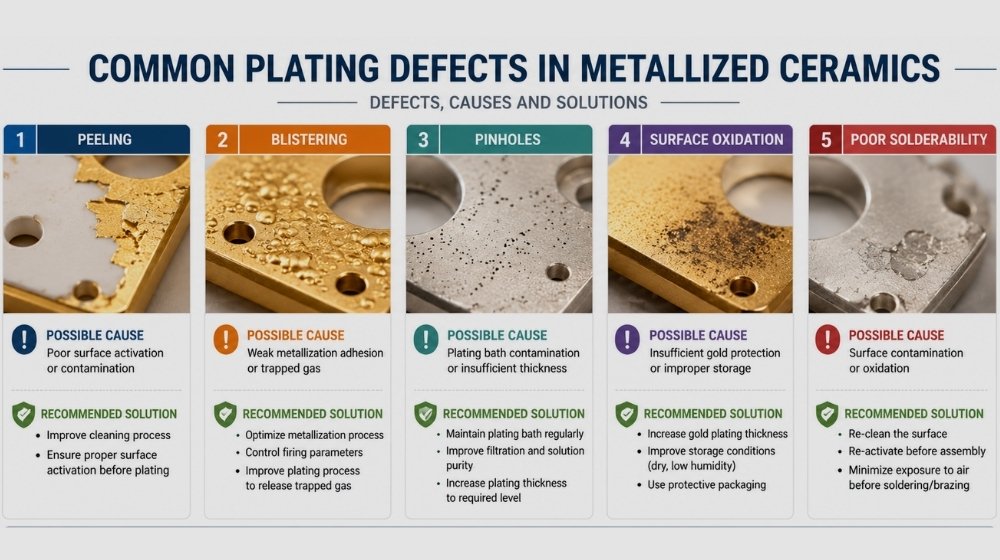
The following defects are frequently encountered in production.
| Defect | Possible Cause | Recommended Solution |
|---|---|---|
| Peeling | Poor surface activation or contamination | Improve cleaning and pretreatment |
| Blistering | Weak metallization adhesion or trapped gas | Optimize metallization and plating process |
| Pinholes | Contaminated plating bath or thin coating | Improve bath maintenance and plating thickness |
| Surface Oxidation | Insufficient gold protection or improper storage | Increase gold thickness or improve packaging |
| Poor Solderability | Oxidation or surface contamination | Re-clean or re-activate the plated surface |
Early detection through adhesion testing, thickness measurement, microscopic inspection, and solderability testing can effectively reduce field failures.
Reliability Comparison
Selecting a plating system is not only a matter of initial performance but also of long-term reliability. Environmental exposure, thermal cycling, storage conditions, and repeated electrical contact all influence the service life of plated ceramic components.
| Reliability Factor | Nickel Plating | Gold Plating |
|---|---|---|
| Thermal Cycling | Excellent | Excellent |
| High Humidity | Good | Excellent |
| Salt Spray Resistance | Good | Excellent |
| Long-Term Storage | Good | Excellent |
| Electrical Contact Stability | Good | Excellent |
| Wear Resistance | Excellent | Good |
Gold plating generally provides superior electrical stability and corrosion resistance, while nickel plating offers greater hardness and mechanical durability.
Common Failure Analysis
Even high-quality plating systems may fail if the plating design does not match the application environment.Typical failure mechanisms include:
- Gold Wear: Repeated mechanical contact gradually removes the gold layer, exposing the underlying nickel and increasing contact resistance.
- Porosity Corrosion: Thin gold plating may contain microscopic pores that allow moisture to reach the nickel layer, eventually leading to corrosion.
- Nickel Oxidation: Components stored for long periods without adequate gold protection may develop nickel oxide, reducing solderability.
- Excessive Gold Thickness: Overly thick soft gold layers may deform during assembly or wire bonding, increasing manufacturing cost without improving reliability.
Understanding these mechanisms allows engineers to optimize plating specifications before production begins.
Cost Considerations
Gold plating is significantly more expensive than nickel plating due to the cost of precious metals. However, material cost alone should not determine the final plating selection.
For high-reliability products such as aerospace electronics, medical devices, or hermetic packages, the additional cost of gold plating is often justified because it reduces maintenance, repair, and warranty costs over the product’s lifetime.
Engineers should therefore evaluate the total cost of ownership (TCO) rather than focusing solely on initial manufacturing cost.
Frequently Asked Questions (FAQ)
1. Is gold plating always better than nickel plating?
No. Gold plating is not universally better than nickel plating. Gold offers superior oxidation resistance, lower contact resistance, and excellent wire bonding performance, making it suitable for aerospace, medical, RF, and semiconductor applications. Nickel plating, however, provides higher hardness, excellent brazing performance, and significantly lower cost. The best choice depends on electrical requirements, environmental conditions, joining methods, and budget rather than simply selecting the more expensive finish.
2. Why is nickel plated before gold plating?
Nickel serves as an effective diffusion barrier between the metallization layer and the gold plating. During soldering or brazing, it prevents excessive interdiffusion of metal atoms that could weaken the joint or create brittle intermetallic compounds. Nickel also improves adhesion and provides mechanical support for the gold layer, resulting in better long-term reliability.
3. Can nickel-plated ceramics be soldered directly?
Yes. In many industrial applications, nickel-plated metallized ceramics can be soldered or brazed directly without additional gold plating. Nickel provides good wettability with many common solder alloys and brazing fillers. However, if the component will be stored for a long period or exposed to humid environments, a gold finish may provide better oxidation protection.
4. Does thicker gold plating always improve reliability?
Not necessarily. Increasing gold thickness beyond the application requirement may significantly increase manufacturing cost without delivering proportional improvements in reliability. In some cases, excessively thick soft gold may even deform during handling or wire bonding. Engineers should determine gold thickness according to bonding methods, wear requirements, and applicable industry standards.
5. Can gold plating wear off during service?
Yes. Gold is softer than nickel and can gradually wear away under repeated mechanical contact or sliding motion. Once the gold layer is worn through, the underlying nickel becomes exposed, increasing contact resistance and reducing corrosion resistance. Components subjected to frequent mating cycles may require hard gold plating or periodic inspection.
6. Why does nickel plating oxidize while gold plating does not?
Nickel naturally reacts with oxygen in the atmosphere, forming a thin oxide film over time. Although this oxide layer offers some corrosion protection, it may reduce solderability and increase electrical contact resistance. Gold is a noble metal with excellent chemical stability and does not readily oxidize under normal atmospheric conditions, making it ideal for long-term electrical applications.
7. What is the typical plating structure for metallized ceramics?
The most common structure is Ceramic → Mo-Mn Metallization → Nickel Plating → Gold Plating (optional). The Mo-Mn layer bonds firmly to the ceramic substrate, nickel acts as the diffusion barrier and brazing surface, while gold provides oxidation resistance, excellent electrical contact, and compatibility with gold wire bonding. The exact structure depends on the application and reliability requirements.
8. Which applications require gold plating?
Gold plating is commonly specified for semiconductor packages, hermetic electronic packages, aerospace electronics, medical devices, RF and microwave components, optical communication modules, and products requiring gold wire bonding. These applications demand long-term electrical stability, excellent corrosion resistance, and high reliability throughout the product lifecycle.
9. How should engineers choose between nickel plating and gold plating?
The decision should be based on engineering requirements rather than appearance or material cost. Designers should evaluate joining methods, storage time, service environment, contact resistance, wear conditions, and manufacturing budget. Nickel plating is often suitable for general industrial products, while gold plating is preferred for high-reliability electronic applications where oxidation resistance and stable electrical performance are essential.
10. What standards are commonly referenced for plated metallized ceramics?
There is no single universal standard covering all metallized ceramic plating systems. Manufacturers typically refer to customer drawings together with industry standards such as IPC specifications for electronic surface finishes, relevant MIL standards for high-reliability electronics, and company-specific process specifications. Final acceptance criteria should always be defined by the application and customer requirements.
Choosing the right plating system is critical to the long-term performance of metallized ceramic components. If you need support in selecting nickel plating, gold plating, or customized metallization solutions for your application, our engineering team can provide material recommendations, plating specifications, and prototype manufacturing services.