

Introduction
Material selection in medical devices is rarely just about strength or cost. In many cases, electrical insulation, sterilization resistance, dimensional stability, and long-term reliability are equally important.
This is one reason advanced ceramics have started appearing in more medical applications over the past decade. While metals and polymers still dominate many device structures, they also show limitations in certain environments — especially where repeated sterilization, electrical isolation, wear resistance, or chemical stability are required.
As a result, medical ceramics are being used more and more widely, from dental restorations and artificial joints to implantable electronics and imaging equipment.
In this article, we’ll look at why ceramics are increasingly used in medical devices, where they are commonly applied, and what should be considered when selecting ceramic materials for different medical scenarios.

Why Are Ceramics Used in Medical Devices
There isn’t a single property that makes ceramics suitable for medical devices. In practice, engineers usually choose ceramics when several demanding requirements need to be satisfied at the same time.
Extremely Wear-Resistant with Low Debris Generation
Alumina and zirconia ceramics are known for their excellent wear resistance. Compared with many metal materials, they generate far less wear debris during long-term friction.
This is especially important in artificial joint systems, where excessive wear particles may increase the risk of inflammation or osteolysis over time. For this reason, ceramic-on-ceramic or ceramic-based bearing systems are widely used in some orthopedic implants.
Excellent Biocompatibility and Chemical Stability
Many advanced ceramics are chemically stable in physiological environments and release very few ions in the human body.
Materials such as alumina and zirconia are often selected because of their bioinert characteristics. In long-term implantation environments, this helps reduce unwanted biological reactions and improves material stability.
Of course, actual biocompatibility requirements still depend on the specific medical application and validation standards involved.
Reliable Electrical Insulation
Advanced ceramics typically have very high volume resistivity and stable insulating properties.
In implantable electronics, sensors, and hermetically sealed assemblies, ceramics are often used to provide electrical isolation while maintaining long-term sealing reliability. Compared with many polymer materials, ceramics also maintain more stable insulation performance under heat and humidity.
Corrosion Resistance and Sterilization Compatibility
Medical devices are frequently exposed to sterilization environments involving steam, chemicals, or radiation.
Alumina and zirconia ceramics generally tolerate repeated sterilization cycles well and remain chemically stable in many acidic or alkaline environments. This makes them suitable for reusable surgical instruments and certain medical electronic assemblies.
By comparison, some metals may face corrosion risks under long-term exposure, while certain polymers gradually lose mechanical stability after repeated sterilization.
Why Ceramics Are Preferred in These Medical Applications
Dental Restorations
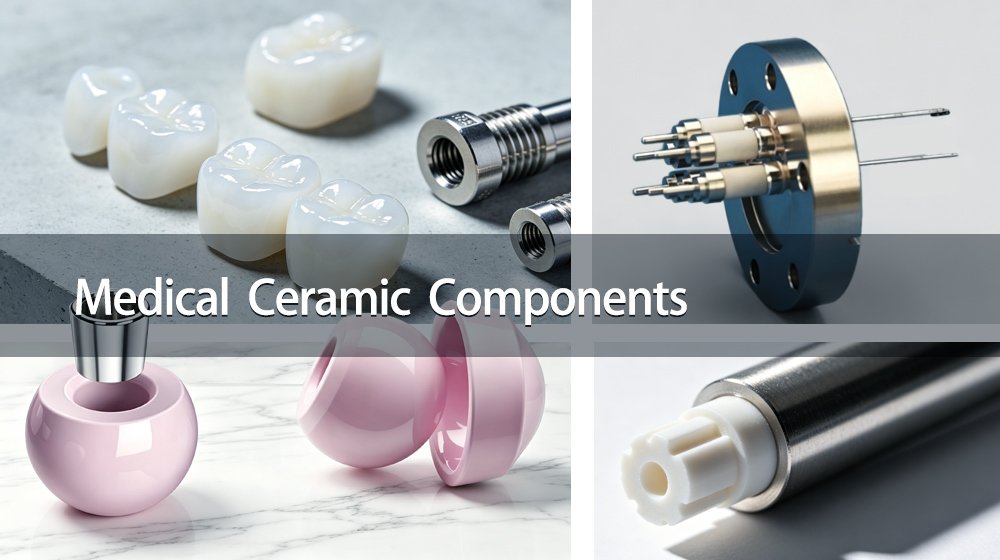
Zirconia ceramics are widely used in dental crowns and bridges because they combine high strength with a more natural appearance than metals.
For patients with metal sensitivities, all-ceramic restorations also help avoid some issues associated with metal-based structures, such as dark gum lines or aesthetic mismatch.
Artificial Joints
Zirconia-toughened alumina (ZTA) ceramics are commonly used in certain hip joint bearing components because of their wear resistance and mechanical stability.
One advantage of ceramic-based bearing systems is the reduced generation of wear particles during long-term movement, which may help improve implant lifespan in some cases.
Active Implantable Medical Devices
In devices such as pacemakers, cochlear implants, and neurostimulators, ceramic feedthroughs are often used in hermetically sealed electronic packages.
These ceramic components help provide electrical insulation while allowing signals and power to pass through sealed metal housings.
Surgical Instruments
Some high-frequency electrosurgical instruments have started exploring conductive ceramic composites such as Al₂O₃-TiN.
By introducing conductive phases into alumina ceramics, these materials can achieve controlled conductivity while maintaining good thermal and chemical stability. Compared with conventional stainless-steel electrodes, they may also help reduce tissue adhesion and localized thermal effects in certain applications.
This area is still evolving, but it reflects a broader trend toward more specialized ceramic materials in medical technology.
Diagnostic Equipment
In imaging systems such as CT, MRI, and X-ray equipment, ceramics are often used for insulating supports, vacuum components, and precision motion systems.
High-purity alumina provides stable insulation and sealing performance, while silicon nitride is sometimes selected for its high strength, wear resistance, and non-magnetic properties.
These characteristics help maintain equipment stability without interfering with imaging performance.
Key Comparisons for Material Selection
Different medical applications place very different demands on ceramic materials. In actual projects, material selection is usually a balance between mechanical performance, insulation, wear resistance, manufacturability, and cost.
| Material | Typical Advantages | Common Medical Uses |
| Alumina (Al2O3) | Electrical insulation, wear resistance, chemical stability | Feedthroughs, insulating parts, surgical components |
| Zirconia (ZrO2) | High strength, fracture toughness, aesthetics | Dental restorations, joint components |
| ZTA | Improved wear resistance and toughness | Orthopedic bearing systems |
| Silicon Nitride (Si3N4) | High strength, non-magnetic, thermal stability | Imaging equipment, precision motion parts |
It’s also important to recognize that ceramics are not ideal for every medical application. Although they perform well in wear resistance and insulation, their brittleness means they are generally less suitable for components exposed to large deformation or heavy impact loads.
In those situations, metals still remain the more practical choice.
Conclusion
The increasing use of ceramics in medical devices is largely driven by the growing performance demands placed on modern medical equipment.
As devices become smaller, more precise, and more dependent on long-term reliability, traditional materials sometimes struggle to meet all requirements simultaneously. Advanced ceramics help fill this gap by offering a combination of electrical insulation, wear resistance, chemical stability, and biocompatibility.
That said, there is no universal ceramic solution for every medical application. Material selection still depends heavily on the operating environment, structural design, manufacturing constraints, and regulatory requirements of the final device.
Final Thoughts
In real medical device projects, choosing the material is only one part of the process. For ceramic components, structural design and manufacturing feasibility also play an important role in long-term reliability.
For example, sharp corners, localized stress concentration, or unsuitable assembly methods can all increase the risk of ceramic cracking. In many cases, these issues are related more to design details than to the material itself.
This is why ceramic-related considerations are often introduced early in the product development stage, especially for precision or implantable applications.
Frequently Asked Questions
Which ceramic materials are most commonly used in medical devices?
A: In many medical-related projects, alumina and zirconia are still the most commonly specified ceramic materials. Depending on the application, zirconia-toughened alumina (ZTA) and silicon nitride may also be used for components requiring higher toughness or mechanical stability.
What are the main challenges in machining ceramic components for medical devices?
A: Because ceramics are both hard and relatively brittle, precision machining requires careful process control — especially for thin-walled or complex geometries.
That said, modern grinding and inspection technologies are already capable of achieving very stable dimensional accuracy and surface quality for most medical ceramic components.
Does your company hold certifications related to medical ceramic components?
A: We are currently certified under the ISO 9001 quality management system and have experience in precision ceramic manufacturing and quality control.
For medical-related projects, specific certification and validation requirements usually depend on the product’s intended use and target market. We can support customers with material testing, dimensional inspection, and related verification work according to project requirements.