

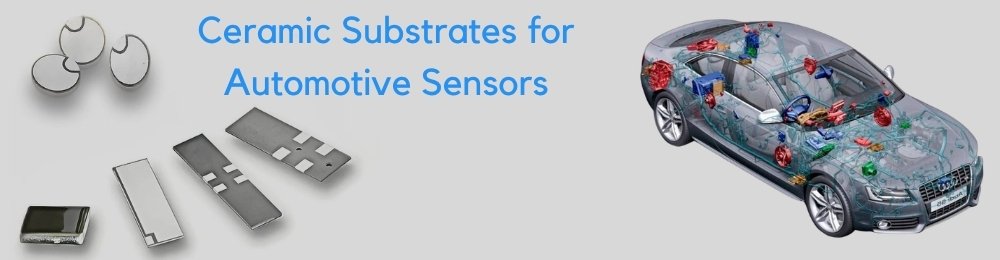
Modern vehicles rely on hundreds of sensors to monitor engine performance, battery systems, emissions, braking, steering, and driver assistance functions. As automotive electronics continue to evolve toward electrification, autonomous driving, and intelligent control, sensor reliability has become more critical than ever.
Unlike conventional printed circuit boards, ceramic substrates provide superior electrical insulation, dimensional stability, thermal conductivity, and resistance to harsh automotive environments. These characteristics make them an ideal foundation for high-performance automotive sensor packages.
This guide explains how ceramic substrates are used in automotive sensors, compares common ceramic materials, discusses design considerations, and highlights manufacturing technologies that improve long-term reliability.
Table of Contents
ToggleWhy Automotive Sensors Use Ceramic Substrates
Automotive sensors operate in demanding environments where temperatures can range from –40°C to over 150°C, while also enduring vibration, humidity, engine fluids, and repeated thermal cycling. Traditional PCB materials may suffer from warpage, moisture absorption, or reduced insulation under these conditions.
Ceramic substrates offer several advantages:
- Excellent electrical insulation for high-voltage systems.
- Stable dimensions during thermal cycling.
- Superior wear, corrosion, and chemical resistance.
- Compatibility with laser processing and hermetic packaging.
- Long service life in harsh automotive environments.
Common Automotive Sensors and Recommended Ceramic Materials
| Sensor | Recommended Material | Main Advantage |
| Pressure Sensor | 96% Alumina | Cost-effective & stable |
| Oxygen Sensor | Zirconia | Oxygen ion conductivity |
| NOx Sensor | Zirconia | High-temperature electrochemistry |
| Current Sensor | AlN | High thermal conductivity |
| Battery Temperature Sensor | Alumina | Reliable insulation |
| Position Sensor | Alumina | Dimensional stability |
Ceramic Material Selection
96% Alumina
96% alumina is the most widely used ceramic substrate in automotive electronics because it provides an excellent balance between insulation, mechanical strength, manufacturability, and cost. It is suitable for pressure, temperature, and position sensors.
Aluminum Nitride
Aluminum nitride offers thermal conductivity exceeding 170 W/m·K, making it ideal for high-power current sensors, battery management systems, and electric vehicle electronics where efficient heat dissipation is critical.
Zirconia
Zirconia is widely used in oxygen and NOx sensors because of its oxygen-ion conductivity at elevated temperatures. It plays a key role in engine emission control systems.
Key Manufacturing Technologies
Modern automotive sensor substrates typically involve several precision manufacturing processes:
- Precision grinding for flatness control
- Laser cutting and scribing
- Laser drilling
- Thick-film or thin-film circuit fabrication
- Mo/Mn metallization
- Nickel plating
- Ceramic-to-metal brazing
- Hermetic sealing
Design Considerations
Successful automotive sensor design depends on more than selecting the right ceramic material. Engineers should also consider:
- Matching thermal expansion coefficients
- Thermal management
- Vibration resistance
- Metallization quality
- Package sealing
- Laser processing tolerances
Proper design reduces thermal stress and improves long-term reliability.
Common Failure Modes
Typical failures include:
- Thermal cracking
- Metallization peeling
- Thermal fatigue
- Wire bond failure
- Seal leakage
- Mechanical fracture
Most failures are related to package design, thermal mismatch, or manufacturing quality rather than the ceramic material itself.
FAQ
1. Why is alumina widely used in automotive sensors?
Alumina combines excellent electrical insulation, mechanical strength, corrosion resistance, and cost-effectiveness. It also supports thick-film printing, laser machining, and metallization, making it suitable for a wide range of automotive sensors while providing reliable long-term performance.
2. When should aluminum nitride be selected?
Aluminum nitride is recommended when thermal management is critical, such as in EV current sensors, battery management systems, and power electronics. Its high thermal conductivity helps reduce operating temperatures and improves system reliability.
3. Why do oxygen sensors use zirconia?
Zirconia becomes an oxygen-ion conductor at elevated temperatures, allowing it to measure oxygen concentration accurately. This property makes it the standard material for automotive oxygen and NOx sensors used in emission control systems.
4. What manufacturing processes are commonly used?
Automotive ceramic substrates are typically manufactured using precision grinding, laser processing, metallization, brazing, and hermetic sealing. These processes ensure dimensional accuracy, electrical performance, and long-term durability under harsh operating conditions.
Conclusion
Ceramic substrates have become an indispensable part of modern automotive sensors. Alumina remains the preferred choice for most sensing applications due to its balanced performance and cost, while aluminum nitride provides superior thermal management for electric vehicles, and zirconia enables reliable oxygen sensing.
Choosing the appropriate ceramic material requires evaluating operating temperature, thermal conductivity, electrical insulation, package design, and manufacturing processes together. Close collaboration with experienced ceramic manufacturers can significantly improve sensor performance and long-term reliability.