

Introductbion
Mechanical seals are essential components in pumps, compressors, mixers, agitators, chemical processing equipment, and many rotating machines. Their primary function is to prevent fluid leakage between a rotating shaft and a stationary housing while maintaining long-term reliability under demanding operating conditions.
Among all sealing materials, ceramic seal rings have become one of the most widely used solutions because they combine excellent wear resistance, corrosion resistance, dimensional stability, and high-temperature capability. Compared with conventional metallic sealing materials, engineering ceramics maintain their surface integrity for much longer periods and significantly reduce friction-related wear.
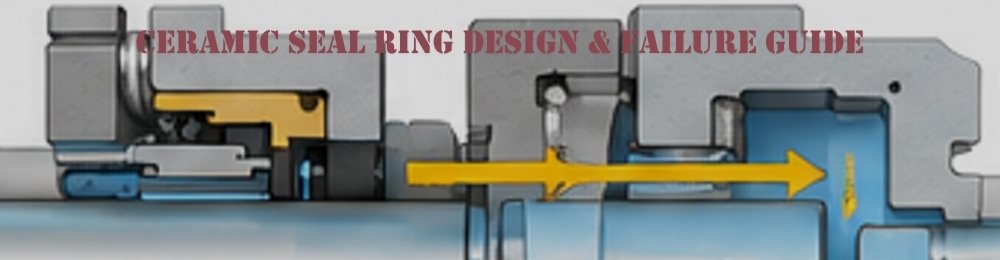
However, selecting the right ceramic material is only the first step. Many premature seal failures are not caused by poor material quality but by inappropriate material selection, improper structural design, incorrect installation, thermal stress, dry running, or unsuitable operating conditions.
This guide explains how ceramic seal rings work, compares common ceramic materials, discusses key design principles, analyzes typical failure modes, and provides practical recommendations for improving seal life and system reliability.
What Is a Ceramic Seal Ring?
A ceramic seal ring is a precision-engineered component used in mechanical sealing systems. It forms one of the two primary sealing faces inside a mechanical seal assembly.
A complete mechanical seal typically consists of:
- Rotating seal ring
- Stationary seal ring
- Secondary sealing elements (O-rings or bellows)
- Springs
- Metal housing
The ceramic seal ring serves as the wear-resistant sealing surface. During operation, two highly polished sealing faces remain in close contact while a microscopic lubricating fluid film separates them. This thin fluid film minimizes friction, reduces wear, dissipates heat, and maintains effective sealing.
Depending on application requirements, ceramic seal rings may be manufactured from alumina, silicon carbide, zirconia, silicon nitride, or other advanced ceramic materials.
How Does a Ceramic Mechanical Seal Work?
Mechanical seals operate by maintaining controlled contact between two extremely flat sealing faces. One ring rotates with the shaft, while the other remains stationary inside the housing.
Instead of completely eliminating the gap, the seal allows an extremely thin lubricating film—typically only a few micrometers thick—to remain between the two faces. This film performs several important functions:
- Reduces friction between sealing faces
- Removes frictional heat
- Prevents direct surface damage
- Maintains stable sealing pressure
- Extends seal service life
Spring force, hydraulic pressure, surface flatness, and shaft alignment all work together to keep the sealing faces properly loaded. If any of these factors deviate from the design conditions, leakage or premature failure may occur.
Why Choose Ceramic Seal Rings?
Engineering ceramics offer a unique combination of mechanical, thermal, and chemical properties that cannot be achieved by conventional metallic materials.
The major advantages include:
Exceptional Wear Resistance
Ceramic materials exhibit extremely high hardness, allowing seal faces to resist abrasive wear even in slurry, chemical, or high-speed applications.
Excellent Corrosion Resistance
Most engineering ceramics remain chemically stable in acidic, alkaline, and solvent environments where stainless steel may corrode.
High Temperature Stability
Ceramic seal rings maintain dimensional stability at elevated temperatures, making them suitable for demanding industrial processes.
Low Thermal Expansion
Compared with metals, ceramics expand much less during heating, helping maintain sealing face flatness.
Long Service Life
Under proper operating conditions, ceramic seal rings often provide significantly longer service life than conventional sealing materials, reducing maintenance costs and equipment downtime.
Common Ceramic Materials for Seal Rings
| Material | Key Advantages | Typical Applications |
|---|---|---|
| Silicon Carbide (SSiC) | Highest wear resistance, corrosion resistance, thermal conductivity | Chemical pumps, slurry pumps, semiconductor equipment |
| Reaction Bonded SiC | Cost-effective, suitable for large components | Industrial pumps, mining equipment |
| Alumina (Al₂O₃) | Economical, high hardness, excellent insulation | Water pumps, food machinery, textile equipment |
| Zirconia (ZrO₂) | High fracture toughness, impact resistance | Precision equipment, low-load pumps |
| Silicon Nitride (Si₃N₄) | Thermal shock resistance, lightweight | Aerospace, high-speed rotating equipment |
Ceramic Seal Ring Design Principles
The performance of a ceramic seal ring depends not only on the material itself but also on how the seal is designed, manufactured, and installed. Even the highest-grade silicon carbide or alumina seal ring can fail prematurely if critical design parameters are overlooked.
A successful ceramic seal ring design should balance mechanical strength, thermal stability, sealing efficiency, wear resistance, and manufacturing feasibility. Designers should evaluate the complete operating environment rather than focusing solely on material hardness.
The following design considerations have the greatest influence on seal performance and service life.
Surface Flatness
Surface flatness is one of the most critical parameters affecting sealing performance.
Mechanical seals rely on two precision-machined faces that contact each other under controlled pressure. If the sealing surfaces are not sufficiently flat, local high spots increase contact pressure while low areas create leakage paths.
For high-performance mechanical seals, flatness is often controlled within 0.3–0.6 μm. This extremely tight tolerance helps maintain a uniform lubricating film and minimizes leakage.
Higher flatness generally improves sealing performance, but excessively high polishing costs should also be considered during design.
Surface Roughness
Surface roughness directly affects friction, lubrication, and wear characteristics.
An excessively rough surface causes rapid wear during the running-in period, while an overly smooth surface may reduce lubricant retention under certain operating conditions.
Typical surface roughness values for ceramic seal faces are:
- Precision seals: Ra 0.02–0.05 μm
- General industrial seals: Ra 0.05–0.10 μm
Proper polishing produces a stable lubricating film that minimizes friction and extends seal life.
Seal Face Parallelism
Parallelism is equally important as flatness.
Even if both faces are individually flat, poor parallelism causes uneven contact pressure, resulting in localized overheating, accelerated wear, and unstable sealing performance.
Maintaining tight parallelism also reduces vibration and improves leakage control during high-speed operation.
Edge Chamfer Design
Ceramics are extremely hard but relatively brittle.
Sharp edges are vulnerable to chipping during machining, transportation, and assembly. Proper chamfer design significantly reduces edge damage and stress concentration.
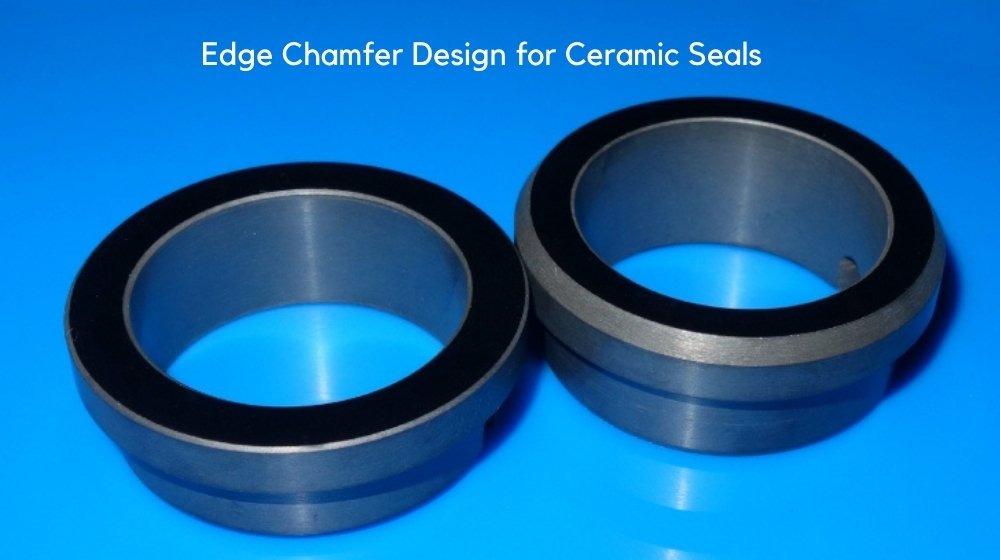
Typical chamfer sizes range from 0.2 mm to 0.5 mm, depending on ring dimensions.
Thermal Expansion Matching
Ceramic seal rings are commonly assembled with stainless steel housings.
Because ceramics and metals have significantly different coefficients of thermal expansion, improper fit design may generate excessive compressive or tensile stress during temperature changes.
Designers should calculate thermal expansion differences carefully and provide sufficient assembly clearance where appropriate.
Installation Stress Control
Improper installation is one of the most common causes of ceramic seal ring failure.
Unlike metals, ceramics cannot plastically deform to absorb assembly stress. Excessive interference fits, uneven tightening, or impact loading may create internal tensile stress that later develops into cracks during operation.
Recommended practices include:
- Uniform tightening torque
- Controlled interference fit
- Clean mounting surfaces
- Avoiding impact during installation
Material Selection Guide
Selecting the correct material is essential for maximizing seal life and minimizing maintenance costs.
| Operating Condition | Recommended Material | Reason |
| Clean water pumps | Alumina | Cost-effective and wear resistant |
| Chemical pumps | Sintered SiC | Excellent corrosion resistance |
| Slurry pumps | Sintered SiC | High hardness and abrasion resistance |
| Food equipment | Alumina | Chemically stable and economical |
| Pharmaceutical pumps | Zirconia | High toughness and precision |
| High-speed equipment | Silicon Nitride | Lightweight and thermal shock resistant |
| High-temperature service | Silicon Carbide | Excellent thermal stability |
Engineering Case Study 1
One of our clients, a chemical company, supplied 100 samples of ceramic seals. After three months of operation on their mechanical seal equipment, they reported frequent cracking of the ceramic sealing rings. The client believed there was a quality issue with the materials used in our product. Upon receiving the returned failed samples, we performed microscopic analysis, but no sintering defects were found. The raw materials were from a stable supply chain and had not caused similar problems in other products.
After analyzing multiple causes without finding a clear one, we asked the client to provide the assembly drawings of the ceramic seals. Further analysis revealed that the matching stainless steel sealing seat had an excessively large interference fit. Based on the factory engineers’ years of experience, we concluded that during the equipment’s thermal cycling, the metal expansion generated significant compressive stress, ultimately leading to radial cracks in the silicon carbide sealing rings.
The client later adjusted the dimensions on the assembly drawings, adjusted the assembly clearances, and optimized the installation process. After reusing the seals, the average lifespan of the ceramic sealing rings increased from three months to over two years.
Engineering Case Study 2
One of our clients, a food processing plant, ordered a custom sealing ring made of alumina for a syrup delivery pump, considering price. After several months of operation, significant wear appeared, failing to meet the expected lifespan. Following communication and understanding of the client’s usage, inspection revealed that fine sugar crystals in the syrup were persistently suspended, causing continuous abrasive wear on the sealing surface.
We recommended that the client replace the custom sealing ring with one made of pressureless sintered silicon carbide. A new sample was then made and installed, resulting in significantly improved wear resistance and a markedly extended equipment maintenance cycle.
Common Failure Modes of Ceramic Seal Rings
Even premium ceramic materials can fail if the operating environment exceeds their design limits. Understanding common failure mechanisms helps engineers identify root causes and improve both seal design and maintenance practices.
1. Thermal Cracking
Thermal cracking is one of the most common failure modes of ceramic seal rings. Ceramics possess excellent heat resistance but relatively low thermal shock resistance compared with metals.
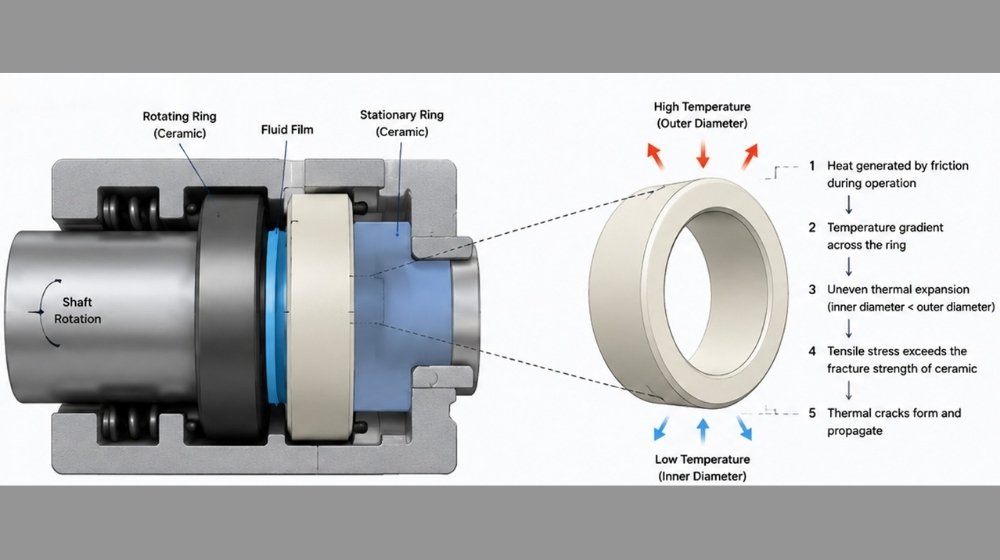
Rapid heating or cooling creates temperature gradients inside the seal ring. Different regions expand or contract unevenly, generating tensile stress that eventually exceeds the fracture strength of the ceramic.
Typical causes include:
- Dry running
- Sudden start-up
- Cold liquid entering a hot pump
- Rapid temperature cycling
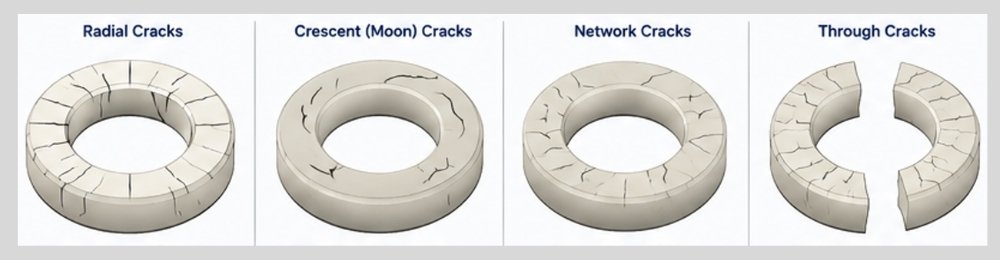
Typical appearance:
- Radial cracks
- Crescent-shaped fractures
- Multiple branching cracks
2. Edge Chipping
Edge chipping usually occurs during handling, assembly, or improper installation rather than during normal operation.
Although ceramics have extremely high hardness, sharp edges are susceptible to impact damage. Even small chips may become stress concentration points that later develop into major cracks.
Prevention measures include:
- Proper chamfer design
- Protective packaging
- Non-impact installation
- Clean assembly fixtures
3. Seal Face Wear
Seal face wear is an inevitable process, but abnormal wear indicates an underlying problem.
Common causes include:
- Abrasive particles
- Misalignment
- Insufficient lubrication
- Excessive contact pressure
Typical wear patterns include:
- Uniform polishing wear
- Circular grooves
- Localized scoring
- Uneven wear bands
Proper material selection and clean operating media significantly extend service life.
4. Dry Running Damage
Dry running is considered one of the most destructive conditions for mechanical seals.
Without a lubricating fluid film, friction increases dramatically. Temperatures at the sealing interface may rise within seconds, causing thermal cracking, severe wear, or complete seal failure.
Common reasons include:
- Pump running without liquid
- Air entering the system
- Blocked inlet
- Improper start-up procedures
5. Chemical Corrosion
Although engineering ceramics exhibit excellent corrosion resistance, no material is universally resistant to every chemical.
For example:
- Alumina may suffer in concentrated alkali.
- Silicon carbide can be attacked by hydrofluoric acid or strong oxidizing environments.
- Material compatibility should always be verified before design.
6. Leakage
Leakage is the most visible symptom of seal failure but not necessarily the root cause.
Leakage may result from:
- Surface distortion
- Seal face wear
- Improper installation
- Excessive vibration
- Thermal deformation
- Secondary seal failure
Root cause analysis should always precede component replacement.
How to Extend Ceramic Seal Ring Service Life
Engineers can significantly improve seal reliability by following several best practices:
- Select the appropriate ceramic material for the operating medium.
- Maintain proper shaft alignment.
- Avoid dry running.
- Ensure sufficient cooling and lubrication.
- Control installation stress and tightening torque.
- Prevent abrasive contamination.
- Inspect seal faces regularly.
- Replace damaged secondary seals before leakage develops.
Proper design and preventive maintenance often extend seal life by several times compared with reactive replacement strategies.
Failure Analysis Checklist
| Inspection Item | Possible Cause |
| Radial cracks | Thermal shock or installation stress |
| Edge chipping | Impact during assembly |
| Uniform wear | Normal service wear |
| Local grooves | Abrasive particles |
| Blue discoloration | Overheating |
| Leakage | Face distortion or seal damage |
| Broken ring | Excessive interference or overload |
Frequently Asked Questions (FAQ)
1. Why do ceramic seal rings crack?
Ceramic seal rings rarely crack because of material defects alone. In most industrial applications, cracking is caused by excessive thermal stress, improper installation, excessive interference fits, shaft misalignment, or sudden temperature changes. Dry running is another major contributor because the absence of a lubricating film allows frictional heat to build up rapidly. To prevent cracking, engineers should verify assembly tolerances, avoid impact during installation, maintain adequate lubrication, and select a ceramic material suitable for the operating temperature and chemical environment.
2. Which ceramic material is best for mechanical seals?
There is no single ceramic that is ideal for every application. Sintered silicon carbide (SSiC) is generally preferred for demanding chemical, slurry, and high-speed pumps because of its outstanding wear resistance, corrosion resistance, and thermal conductivity. Alumina offers excellent value for clean water and general industrial service, while zirconia provides higher fracture toughness for applications involving vibration or impact. Material selection should always be based on the operating medium, temperature, pressure, and expected service life rather than cost alone.
3. How flat should a ceramic seal face be?
Seal face flatness directly influences leakage performance and friction. Precision mechanical seals are commonly lapped to one or two helium light bands, approximately 0.3–0.6 μm. Maintaining this level of flatness allows a stable lubricating film to form between the rotating and stationary faces. Excessive deviation may increase leakage, accelerate wear, and shorten service life.
4. Can ceramic seal rings operate without lubrication?
Most ceramic seal rings are not designed for continuous dry running. Although engineering ceramics have excellent wear resistance, they still rely on a thin lubricating film to remove heat and reduce friction. Continuous dry operation can rapidly increase interface temperature, resulting in thermal cracking, accelerated wear, and seal failure. If intermittent dry running cannot be avoided, specialized seal materials and system designs should be evaluated.
5. What causes ceramic seal ring leakage?
Leakage is usually a symptom rather than the root cause of failure. It may result from worn sealing faces, poor flatness, thermal distortion, shaft vibration, damaged secondary seals, or improper installation. Before replacing the seal ring, engineers should inspect the complete sealing system to identify the actual failure mechanism and avoid repeated failures.
6. Silicon carbide or alumina—which lasts longer?
Under identical operating conditions, sintered silicon carbide generally provides a longer service life because of its superior hardness, abrasion resistance, corrosion resistance, and thermal conductivity. However, alumina remains an excellent choice for many clean and moderately loaded applications due to its lower cost and stable performance. The best material depends on the operating environment rather than on one property alone.
7. How often should ceramic seal rings be inspected?
Inspection frequency depends on operating conditions. Pumps handling abrasive slurries or corrosive chemicals require more frequent inspections than clean-water systems. In general, seal faces should be checked during scheduled maintenance for wear, chipping, discoloration, or leakage. Monitoring vibration, temperature, and leakage trends can also help identify problems before catastrophic failure occurs.
8. What surface finish is recommended for ceramic seal rings?
Most precision ceramic seal rings are finished to a surface roughness of Ra 0.02–0.05 μm. This range provides a good balance between lubrication retention and friction reduction. Excessively rough surfaces accelerate wear, while surfaces polished beyond practical requirements may increase manufacturing costs without significantly improving sealing performance.
Conclusion
Ceramic seal rings play a vital role in the reliability of modern mechanical sealing systems. Their exceptional wear resistance, corrosion resistance, dimensional stability, and thermal performance make them indispensable in industries such as chemical processing, semiconductor manufacturing, food processing, pharmaceuticals, energy, and mining.
However, material selection alone cannot guarantee long service life. Successful seal performance depends on a combination of appropriate ceramic material, precision manufacturing, optimized structural design, proper installation, effective lubrication, and preventive maintenance.
By understanding common failure mechanisms—including thermal cracking, dry running, abrasive wear, chemical attack, and installation stress—engineers can significantly improve seal reliability, reduce downtime, and lower total maintenance costs.
As industrial equipment continues to operate under higher speeds, higher temperatures, and more aggressive media, ceramic seal ring technology will remain a key solution for achieving long-term sealing performance.