

Introduction
When developing a grinder, product designers often need to decide whether to use ceramic burrs or stainless steel burrs. Both materials have their own advantages and limitations, and the right choice depends on the specific application and performance requirements.
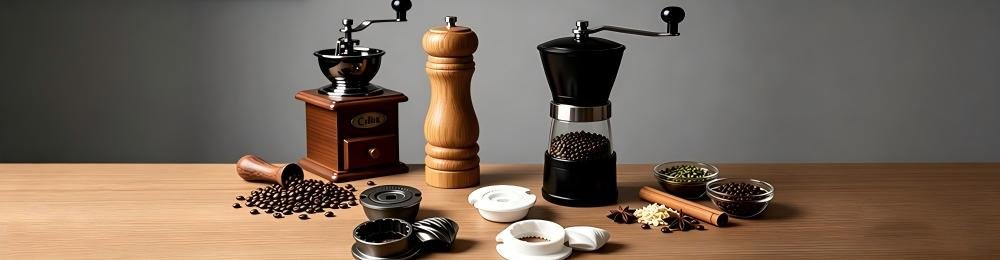
Choosing the right grinder burr material is essential for achieving consistent grinding performance and long service life. Ceramic burrs are widely used in coffee, salt, pepper, and spice grinders due to their excellent wear resistance and corrosion resistance. Stainless steel burrs are another commonly used option, especially for applications where toughness and initial cost are priorities.
This article compares ceramic and stainless steel burrs in terms of performance, durability, applications, and cost to help you select the right burr material for your grinder. For a more comprehensive understanding of ceramic burr materials, structural design, and OEM solutions, you can also refer to our ceramic grinding core guide.
For clarity and consistency, this article focuses on ceramic burrs compared with 304 stainless steel, one of the most commonly used materials for household spice grinders.
Ceramic Burr vs Stainless Steel Burr: Key Differences
Ceramic and stainless steel are two of the most commonly used materials for grinder burrs. Each material has its own advantages and limitations, and the better choice depends on the application, grinding frequency, and performance requirements.
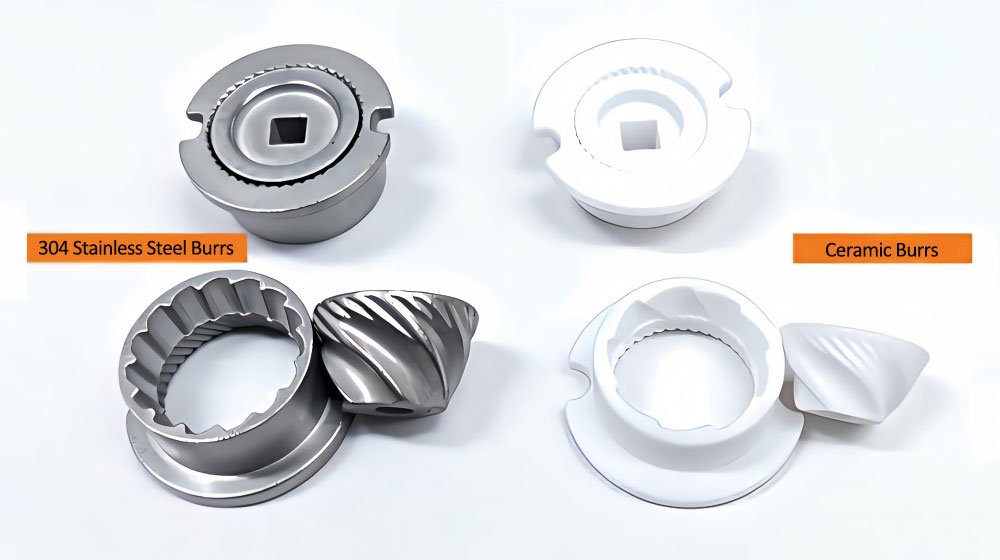
The key differences between ceramic burrs and stainless steel burrs are summarized below:
| Feature | Ceramic Burr | Stainless Steel Burr (304) |
| Hardness & Wear Resistance | Higher hardness with excellent wear resistance and longer service life | Good durability but wears faster under high-frequency use |
| Corrosion Resistance | Excellent resistance to salt, moisture, and acidic environments | Good corrosion resistance for normal household use |
| Impact Resistance | More brittle and may chip under strong impact | Higher toughness and better impact resistance |
| Grinding Consistency | Maintains consistent grinding performance over long-term use | Provides sharp cutting performance, especially when new |
| Initial Cost | Higher initial cost | Lower initial cost |
| Recommended Applications | High-frequency grinding, salt/spice grinders, and long service life applications | Low-frequency household grinders and cost-sensitive products |
In general, ceramic burrs are preferred when wear resistance, corrosion resistance, and long-term consistency are the main priorities. Stainless steel burrs are often a practical choice when impact resistance and lower initial cost are more important.
However, material alone does not determine grinding performance. Burr geometry, manufacturing precision, surface finish, and operating conditions also play important roles in the final grinding result.
Choosing the Right Burr Material for Your Application
Pros and Cons of Ceramic Burrs
Pros: The ceramic burr generates minimal heat during grinding. This helps preserve the original flavor. Corrosion-resistant and less prone to rust. Low overall cost.
Cons: Ceramic burrs are relatively brittle and may chip or crack under strong impact or when exposed to hard foreign particles. Learn more about the common causes and prevention methods in our article why do ceramic grinder burrs crack?
Pros and Cons of Stainless Steel (304) Burrs
This article focuses on 304 stainless steel because it is one of the most commonly used materials for household salt, pepper, and spice grinder burrs. While hardened stainless steels such as 420 or 440C can offer higher wear resistance, they are typically used in different applications and are beyond the scope of this comparison.
Pros: 304 stainless steel burrs can be manufactured with high-precision cutting edges, providing excellent initial grinding performance.
Cons: 304 stainless steel offers good general corrosion resistance but is susceptible to pitting corrosion in chloride-rich environments, such as salt grinding. Long-term grinding generates heat. This may slightly affect the flavor of the ingredients.
In conclusion, ceramic burrs and stainless steel burrs each have their advantages and disadvantages. There is no absolute better choice. It’s just a matter of which is more suitable under certain conditions.
Next, we will further break down and compare them from an engineering perspective.
Ceramic Burr vs Stainless Steel Burr: Performance Comparison
When comparing properties, we focus not only on hardness, but also on other properties such as toughness and chemical stability.
| Property | 95% Alumina Ceramic | Zirconia Ceramic | 304 Stainless Steel |
| Vickers Hardness (HV) | ≥1380 | ≥1200 | 300-400 |
| Fracture Toughness (MPa·m¹/²) | 4-5 | 6.5-8 | 50-200 |
| Flexural Strength (MPa) | ≥280 | >800 | 500-700 |
| Resistant to Salt/Acid Corrosion | Excellent corrosion resistance | Excellent corrosion resistance | Limited corrosion resistance |
| Release of Metal Ions | No metallic wear particles under normal grinding | No metallic wear particles under normal grinding | Trace amounts (Fe, Cr, Ni) |
| Coefficient of Thermal Expansion (1×10⁻⁶/℃) | 6.5-8 | 9-11 | 16-18 |
Material is only one factor affecting grinding performance. Tooth geometry, surface finish, and manufacturing precision also play important roles. For a deeper analysis, see our guide what determines ceramic burr grinding performance.
Wear Resistance and Service Life: Ceramic vs Stainless Steel Burrs
The wear of stainless steel burrs does not occur at a constant rate. New burrs have a work-hardened layer on their surface, which wears our slowly.
As wear progresses, the hardened surface layer gradually diminishes, leading to faster wear and reduced grinding efficiency.
More importantly, pitting corrosion can occur in salt or acid environments, and these corrosion pits accelerate wear. In commercial high-frequency applications, we typically need to replace stainless steel burrs every 3 to 6 months.
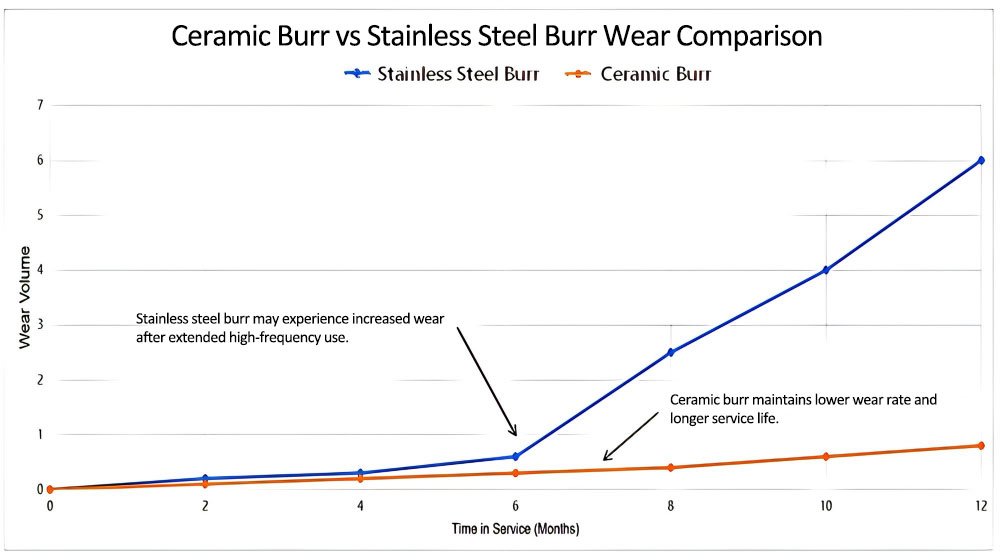
In contrast, ceramic burrs typically exhibit a much slower and more stable wear rate than stainless steel under similar operating conditions.
The tooth profile maintains its grinding profile for a much longer period. Based on our engineering experience, the service life of ceramic burrs is typically 3-10 times that of stainless steel burrs.
Common Applications of Ceramic and Stainless Steel Burrs
Below is a table we’ve compiled based on our experience. You’ll see which type of burr we recommend most for different applications. Hopefully, this will be helpful to you.
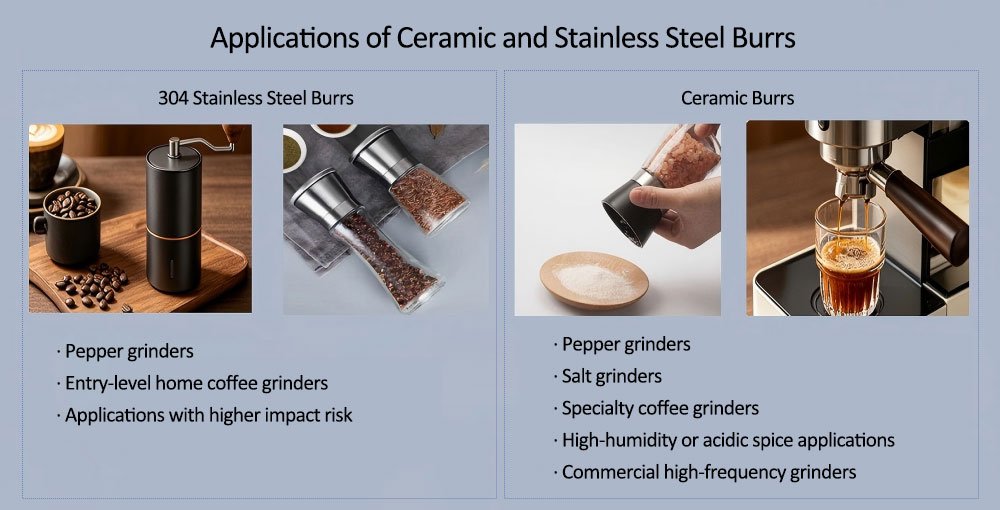
| Application | Burr Material We Recommend | Core Logic |
| Salt grinder | Alumina ceramic | ・Chloride ions (Cl-) can cause pitting corrosion in 304 stainless steel.
・Ceramics are completely immune to this. |
| Specialty coffee grinder | Zirconia ceramic | ・Non-thermal conductive, preserving flavor.
・Does not introduce metallic wear particles. ・Low thermal expansion and stable particle size. |
| High-humidity/acidic spices (e.g., pickled peppers) | Ceramic | 304 stainless steel is prone to corrosion, and the resulting corrosion byproducts can contaminate food. |
| Commercial high-frequency grinder (restaurants, production lines) | Alumina/Zirconia ceramic | Long service life reduces downtime for replacement, resulting in the lowest overall cost |
| Entry-level home coffee grinder | 304 stainless steel | ・Low cost.
・Acceptable wear with infrequent use. |
| Impact risk (ingredients contain hard shells) | 304 stainless steel | ・304 stainless steel has excellent toughness and is not easily broken.
・Ceramics may crack under impact conditions.. |
| Food-grade product for export to Europe and America | Ceramic | Ceramic burrs can comply with FDA and EU food-contact regulations and do not generate metallic wear particles during normal grinding. |
| Economy salt grinder | Steatite ceramic | Corrosion-resistant and cost-effective, yet with a service life comparable to that of stainless steel. |
Here are a few tips to help you make a quick decision:
1. If it contains salt or acid, is sensitive to flavor, is used frequently, or requires compliance with export regulations → Choose ceramic.
2. Dry and neutral, low-frequency household use, cost-sensitive → Choose 304 stainless steel.
3. If you’re looking for low cost and corrosion resistance, and don’t mind a medium service life → Steatite is the entry-level choice.
When Stainless Steel Burrs Are the Better Choice
Although ceramic burrs offer excellent wear resistance and corrosion resistance, stainless steel burrs remain the better choice for certain applications.
Choose stainless steel burrs when:
- Impact resistance is critical.
Stainless steel is less likely to chip or crack if hard foreign objects are encountered.
- The grinder is used infrequently.
For low-frequency household use, the wear resistance of 304 stainless steel is generally sufficient.
- Keeping the initial cost low is the priority.
Stainless steel burrs typically have a lower initial cost than ceramic burrs, making them suitable for budget-sensitive products.
- High machining precision is required.
Stainless steel burrs can be manufactured to tight tolerances and are less susceptible to handling damage during assembly.
In short, ceramic burrs are often the better choice for long service life, corrosion resistance, and frequent use, while stainless steel burrs are well suited to impact-prone, low-frequency, and cost-sensitive applications.
Real Case Study: Upgrading Burr Material for Commercial Salt Grinders
The following case is based on a real material selection project completed by our engineering team. Product details have been simplified for confidentiality.
Background: Steatite Ceramic Was Selected for Cost Reasons
A client initially produced disposable salt grinders using steatite ceramic burrs. Since household users typically use grinders infrequently, steatite ceramic burrs performed well thanks to their low cost, corrosion resistance, and stable performance.
Problem: High-Frequency Use Caused Rapid Wear
Later, the client launched a commercial, high-capacity salt grinder designed for use more than 200 times per day, with a target lifespan of over three years. The R&D team retained the original steatite ceramic design to maintain its cost advantage.
After six months in the market, several restaurants reported that the ground salt was becoming increasingly coarse. Disassembly and inspection revealed significant wear on the grinding teeth, increasing the grinding gap.
Under conditions of high-frequency, continuous use, the wear resistance of steatite ceramic was no longer sufficient to meet commercial demands, with an actual service life of only about 8–12 months.
Solution: Upgrading to Alumina Ceramic Burrs
Subsequently, we recommended that the client upgrade the burr material to 95% alumina ceramic. Thanks to its higher hardness and superior wear resistance, the new solution significantly extended the service life of the burr, enabling stable operation for over three years under the same operating conditions.
As of two years after the product redesign, the client has not received any further complaints regarding similar wear issues.
Lesson Learned
This case shows that burr material selection should be based on actual operating conditions rather than initial material cost alone.
Steatite ceramics are suitable for disposable or low-frequency household salt grinders, offering a cost-effective solution. However, for high-frequency commercial applications, 95% alumina ceramics are generally a more reliable and economical long-term choice.
Although the unit cost increased slightly, the upgrade significantly reduced replacement frequency and maintenance costs, lowering the overall life-cycle cost.
If you need help selecting the right burr material, our engineers can provide application-specific recommendations.
Initial Cost vs Overall Cost: The Long-Term Value of Ceramic Burrs
We will use an example to illustrate this.
Consider a commercial pepper grinder that operates 100 times a day. The service life of a 304 stainless steel burr is 6 months (unit price: US$8-12). The service life of a alumina ceramic burr is 5 years (unit price: US$25-40). The labor cost for each replacement is US$15.
Cost Analysis
| Item | 304 Stainless Steel Burr | Alumina Ceramic Burr |
| Number of replacements over five years | 10 | 0 |
| Initial cost of burr | US$8–12 | US$25–40 |
| Labor cost for each replacement | US$15 | US$0 |
| Overall cost over 5 years | US$230-270 | US$25–40 |
Note: 1. Actual service life depends on factors such as burr geometry, grinding frequency, material hardness, and operating conditions. 2. The prices listed above are for a commercial-grade pepper grinder. Your actual cost will depend on the size and material of your burr.
Engineering Summary
1. The overall cost of ceramic burrs is about 10%-20% of that of stainless steel burrs.
2. With higher usage frequency, the advantages of ceramic burrs become increasingly apparent.
If you expect your grinder to last more than a year and use it dozens of times a day or more, the overall cost of ceramic burrs is significantly lower than that of stainless steel burrs.
Although ceramic burrs typically have a higher initial cost, several factors influence their final price, including material grade, burr design, manufacturing process, and production volume. Learn more about these factors in our guide what determines the price of a ceramic burr.
Conclusion
There is no universally better burr material. The right choice depends on your application, operating conditions, performance requirements, and budget.
Ceramic burrs are ideal for applications that require excellent wear resistance, corrosion resistance, long service life, and consistent grinding performance. They are particularly well suited for salt, spices, and other high-frequency grinding applications.
Stainless steel burrs offer higher impact resistance, excellent machining precision, and a lower initial cost, making them a practical choice for low-frequency household use and budget-sensitive products.
By understanding the strengths and limitations of each material, you can select the burr that best matches your product requirements and long-term performance goals.
Whether you’re developing a coffee grinder, salt grinder, or pepper grinder, selecting the right burr material is essential for long-term performance. If you’d like expert advice or custom ceramic burr solutions, our engineering team is ready to help.
Frequently Asked Questions
Q1: What is the best material for grinder burrs?
A1: There is no single best material for all grinder burrs. Ceramic burrs are ideal for applications requiring high wear resistance, corrosion resistance, and long service life, while stainless steel burrs are better suited for applications requiring higher impact resistance and lower initial cost. The best choice depends on the grinding application, frequency of use, and performance requirements.
Q2: Are ceramic burrs better than stainless steel burrs?
A2: Ceramic burrs are not always better than stainless steel burrs. They offer excellent wear resistance, corrosion resistance, and long service life, while stainless steel burrs provide higher toughness and lower initial cost. The better choice depends on the application and performance requirements.
Q3: Do ceramic burrs wear out faster than stainless steel burrs?
A3: No. Ceramic burrs generally have higher hardness and better wear resistance than stainless steel burrs, allowing them to maintain grinding performance for a longer time in high-frequency applications. However, they are more brittle and may crack under strong impact.
Q4: Are ceramic burrs suitable for salt and spice grinders?
A4: Yes. Ceramic burrs are widely used for salt and spice grinders because they offer excellent corrosion resistance and wear resistance. They are especially suitable for applications involving frequent grinding or exposure to moisture and salt.