

Introduction
Under conditions of high temperature, abrasion, and corrosion, traditional materials often quickly reveal their limitations: metals soften easily, and plastics can deform. Once critical components fail, equipment downtime is almost inevitable, leading to increased maintenance costs and production losses.
For this reason, more and more applications are turning to advanced ceramic solutions. This is not simply “changing materials,” but rather a more targeted optimization and improvement of existing performance bottlenecks.
Next, we will start from practical applications, outlining five common pain points of traditional materials, and further explaining how advanced ceramics utilize their material properties to address these problems one by one.
How Advanced Ceramics Overcome Material Limits
In engineering design, metals and plastics have always been the most common and mature material choices. However, under more demanding conditions, such as high temperatures, strong abrasion, or corrosive environments, the limitations of these materials gradually become apparent, even becoming key factors affecting system reliability.
Identifying the problem is only the first step. More importantly, we need to find a solution. So, is there a material that can truly address these challenges at their source, rather than simply “patching” existing problems?
From a practical application perspective, advanced ceramics fill this gap. It’s not a minor optimization of traditional materials, but rather, based on entirely different material properties, it provides a more direct and effective solution path for many key performance aspects.
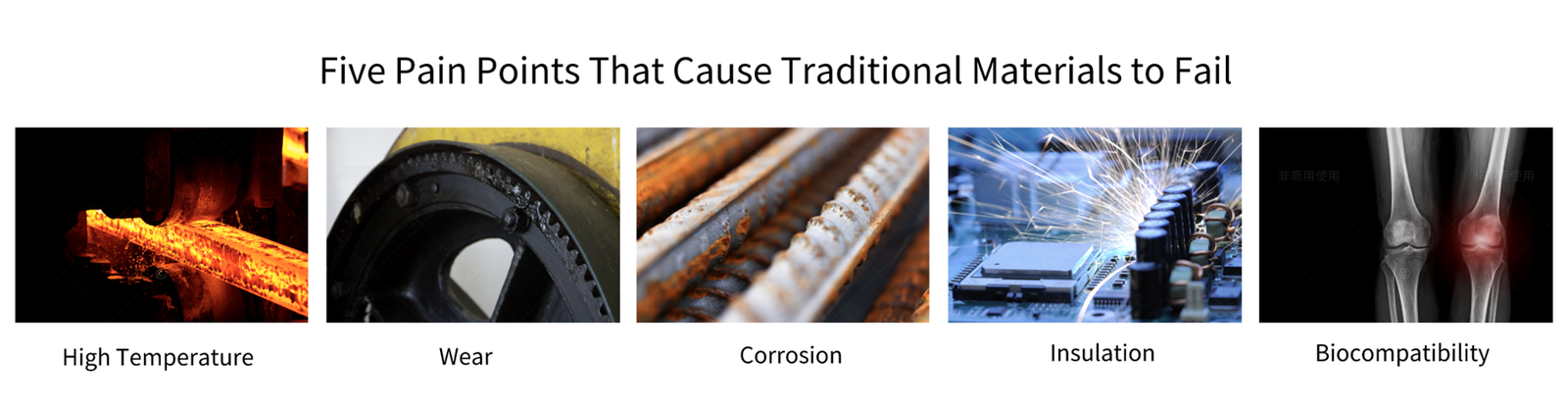
Temperature Limits
In typical high-temperature applications, such as engine combustion chambers, high-temperature heat treatment equipment, or semiconductor diffusion processes, the temperature a material can withstand often directly determines the maximum power output and service life of the equipment.
In practice, the problem is quite real: the strength of ordinary steel begins to decline significantly above 500℃, while most engineering plastics soften or even decompose around 150℃, making long-term stable operation difficult.
In contrast, some advanced ceramic materials exhibit much greater stability. Materials like alumina and silicon carbide are less prone to softening or creep at high temperatures. They can maintain their original structural strength and chemical stability even when temperatures exceed the limits of metal usage.
Wear limits
In many continuously operating devices, such as mining conveying systems, guide components of automated production lines, or mud pumps in the chemical industry, wear and tear is an almost unavoidable problem. Once wear intensifies, precision decreases, and downtime for maintenance becomes increasingly frequent.
In reality, even with hardened steel, wear accumulates rapidly under prolonged friction or abrasive conditions. Before long, critical dimensions begin to deviate, shortening the equipment’s lifespan.
In this scenario, the wear resistance of the material itself becomes crucial. Advanced ceramics typically have a hardness far exceeding that of steel, even approaching that of diamond. When dealing with sliding friction, abrasive wear, or fretting wear, ceramic components often maintain a lower wear rate and a significantly longer service life.
Chemical Corrosion Limits
In many industrial environments, corrosion is almost ubiquitous. Whether it’s rollers on an electroplating line, stirring components in a reactor, or equipment on an offshore platform, prolonged exposure to chemical media makes complete corrosion almost inevitable.
Commonly, metal surfaces gradually corrode in acidic, alkaline, or salt spray environments. At first, it may only be a change in appearance, but over time, it may cause leaks, pollution, or even safety risks.
If we hope to reduce these kinds of problems at the material level, advanced ceramics is a direction worth considering. These materials possess high chemical stability and exhibit excellent resistance to most strong acids, strong alkalis, and various organic media. Under appropriate application conditions, they can significantly reduce the risks of corrosion-related failures and contamination.
Electrical Performance Limits
In some applications with high electrical performance requirements, such as substrates for high-frequency communication chips, insulating components in high-voltage systems, or high-power IGBT modules, materials often need to simultaneously achieve insulation, thermal conductivity, and mechanical strength, which is not easy to do.
In reality, while metals offer good thermal conductivity, their inherent electrical conductivity becomes a limiting factor in high-voltage insulation or high-frequency signal environments. Plastics, while providing insulation, often fall short in heat dissipation and structural strength, making long-term stable use difficult.
From a material properties perspective, advanced ceramics offer advantages in these applications. They possess excellent electrical insulation properties, and materials like aluminum nitride also exhibit high thermal conductivity.
Therefore, ceramics can achieve a more reasonable balance between insulation and heat dissipation, better meeting the requirements of high-voltage and high-frequency operating conditions.
Biocompatibility Limits
In medical applications, such as dental implants or artificial joints, materials must not only possess sufficient strength, but more importantly, ensure safety and stability during long-term contact with the human body.
In practical applications, some metallic materials may pose potential risks. For example, alloys containing nickel and chromium may release ions during long-term use, potentially triggering allergic reactions or rejection.
In contrast, ceramic materials like zirconia offer advantages in terms of biocompatibility. They are chemically stable, do not release metal ions, and cause less irritation to human tissues. Under appropriate design and manufacturing conditions, they can also form good bonds with bone tissue. Therefore, they are increasingly being used in implant applications.
As the above typical scenarios demonstrate, when traditional materials approach their performance limits, advanced ceramics often offer an alternative solution. It’s not a simple replacement, but rather a more stable performance in key areas.
Below, we can use comparisons to more intuitively see the differences between ceramics and metals/plastics.
| Performance | Advanced Ceramics | Metals | Engineering Plastics |
| Max. Operating Temperature | Very high | Medium | Low |
| Hardness | Extremely high | High | Low |
| Wear Resistance | Excellent | Good | Poor |
| Chemical Corrosion Resistance | Excellent | Poor to Good | Good to Excellent |
| Density | Medium | High | Low |
| Electrical Insulation | Excellent insulator | Conductor | Excellent insulator |
Now that you have some understanding of advanced ceramic solutions, are you curious about whether they can be applied to your industry? Below, we will provide some application examples.
Advanced Ceramic Solutions: Five Industrial Case Studies
We selected five industrial case studies. Let’s explore how advanced ceramic solutions address these challenges.
Industrial Automation
On automated production lines, components such as conveyor rollers, robot grippers, and certain bearings often operate under conditions of combined friction and vibration, demanding high wear resistance from materials.
In actual use, it can be seen that wear on metal parts will gradually accumulate under these working conditions. Once wear occurs in critical areas, not only does positioning accuracy decrease, but scratches may also appear on the product surface. To maintain stable operation, many production lines have to schedule downtime for parts replacement every few months, significantly impacting overall efficiency.
In this context, some companies have begun to experiment with replacing critical wear-resistant components with ceramic materials, such as high-purity alumina (99% or higher) or yttria-stabilized zirconia. Application results show that, under appropriate design and operating conditions, these materials exhibit more stable wear resistance, extending the service life of components from a few months to a year or even longer.
The direct result is reduced replacement frequency, less downtime, and more controllable maintenance, contributing to lower overall operating costs in the long run.
Semiconductor Manufacturing
During wafer transfer and processing, extremely high cleanliness requirements are imposed. Even micron-sized abrasive particles or trace amounts of metal ion contamination can affect chip yield and even cause performance fluctuations in the entire batch of products.
In such an environment, material selection becomes crucial. High-purity alumina (99.5% and above) is widely used in cost-sensitive components, such as insulating fixtures and cavity liners, due to its excellent insulation, corrosion resistance, and high hardness, as well as good stability in plasma environments.
On the other hand, aluminum nitride is more often used in scenarios with higher thermal management requirements. It not only has excellent thermal conductivity but also exhibits stability in plasma environments, and its coefficient of thermal expansion is close to that of silicon. Therefore, it is commonly used in RF components, etching chambers, and substrate structures related to chip heat dissipation.
Medical Industry
In long-term implantable medical applications, such as joint or dental restoration materials, the interaction between the material and the human body is often more important than short-term strength. Co-Cr and other metal implants may release trace amounts of metal ions due to wear during long-term use. These ions may trigger inflammatory reactions or allergic reactions in some patients.
Furthermore, there is a significant difference in elastic modulus between metal materials and bone tissue. This can lead to a “stress shielding” phenomenon, causing gradual bone degeneration under long-term stress.
In these applications, medical-grade zirconia ceramics are a common choice. They possess high wear resistance and good biocompatibility. In the human body environment, these materials are relatively stable and less likely to cause adverse reactions. With proper structural design, they can also help reduce the long-term effects of stress mismatch. Therefore, they have been widely used in dental restorations and some joint implants.
Electric Vehicle
As the power density and operating voltage of electric vehicles continue to increase, the requirements for system heat dissipation, structural stability, and integration are also becoming increasingly stringent. Under this trend, the contradictions faced by materials are becoming more apparent. Many traditional materials struggle to simultaneously achieve insulation performance, thermal conductivity, and mechanical reliability.
In power module applications, silicon nitride substrates are a common solution. They possess high thermal conductivity, electrical insulation, and mechanical strength, and also exhibit good thermal stability. Under high power density, high voltage, and long-term thermal cycling conditions, these materials typically maintain relatively stable performance.
Therefore, they can provide effective heat dissipation while also serving a structural support function. In electric vehicle power modules, this advanced ceramic solution is gradually becoming one of the important choices.
Petrochemical and Extreme Environments
In deep well drilling and highly corrosive media transportation, metal valve seats and sealing rings are typically subjected to high pressure, high wear, and chemical corrosion. These factors accelerate component failure.
Once failure occurs, internal valve leakage or media leakage may occur. Such problems often pose significant safety risks and cause substantial economic losses.
In this application environment, we can consider yttria-stabilized zirconia ceramics. They possess good overall performance, especially high toughness.
Under high pressure and impact conditions, they typically maintain relatively stable operation. Therefore, they are frequently used to address these complex failure scenarios.
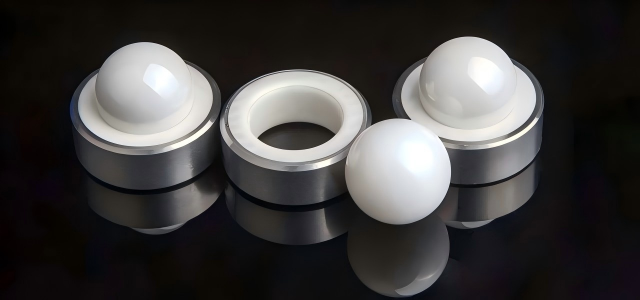
How to Customize Your Advanced Ceramic Solutions
As can be seen from the previous application examples, the key to designing advanced ceramic solutions lies in clearly stating the actual needs, such as mechanical load, wear type, operating temperature, chemical environment, and precision requirements.
Only after these conditions are clarified can we make appropriate choices among different materials such as alumina, zirconia, and silicon carbide, finding a more reasonable balance between performance and cost.
This typically requires considering multiple aspects, including structural design, manufacturing processes, and quality control, rather than being determined by a single material.
Conclusion
When metals soften at high temperatures, plastics deform under load, and corrosion gradually spreads, these problems often indicate that traditional materials are approaching their limits of use. However, this is not necessarily the end. More often, it’s just the starting point for rethinking material solutions.
Advanced ceramics have been developed in response to these needs, designed to handle more demanding operating conditions. If your equipment also encounters limitations in material performance, consider conducting a targeted technical evaluation.
FAQs
Q1: What are advanced ceramics?
A1: Advanced ceramics are produced through artificially designed raw material compositions and precision manufacturing processes. They overcome the performance limitations of traditional ceramics, thus possessing superior properties.
Common advanced ceramic materials include: alumina ceramics (Al₂O₃), aluminum nitride ceramics (AlN), zirconium oxide ceramics (ZrO₂), silicon nitride ceramics (Si₃N₄), silicon carbide ceramics (SiC), beryllium oxide ceramics (BeO), and machinable glass ceramics.
These materials typically possess excellent mechanical strength, high-temperature resistance, corrosion resistance, and electrical insulation or thermal conductivity.
They are widely used in the electronics, automotive, energy, and semiconductor industries.
Q2: When should I consider replacing metal with advanced ceramics?
A2: The best time to consider an advanced ceramic solution is when your application exhibits one or more of the following warning signs:
1. High Temperature Warning: Operating temperatures exceeding 500°C cause metal softening, creep, or severe oxidation.
2. Wear Warning: Excessive wear of metal components leads to frequent replacements, downtime, or decreased product accuracy.
3. Corrosion Warning: Rapid corrosion of metals in acidic, alkaline, or salt spray environments leads to contamination or leakage.
4. Insulation Warning: The material must simultaneously possess high insulation, high thermal conductivity, or specific dielectric properties.
5. Biocompatibility Warning: Materials intended for implantation in the human body must eliminate the risk of metal ion release.
Q3: What are the advantages of ceramic bearings compared to steel bearings?
A3: Ceramic bearings are specialized solutions developed to overcome challenges like high speed, poor lubrication, corrosion, and electrical insulation. However, in cost-sensitive, heavy-load, and high-impact general-purpose applications, steel bearings remain a more economical and reliable choice.
Below are the advantages of the two types of ceramic bearings.
1. Hybrid Ceramic Bearing (Most Common)
Structure: Steel inner and outer rings + silicon nitride ceramic balls.
Core Advantages: High speed and low temperature rise, long service life (3-5 times that of high-grade steel bearings under poor lubrication), and protection against electrolytic corrosion (ceramic balls provide insulation).
Application: High-speed spindles, electric vehicle drive motors, vacuum pumps.
2. All-Ceramic Bearings
Structure: The bearing rings and rolling elements are all made of ceramic (e.g. silicon nitride or zirconia).
Core Advantages: Unrivaled corrosion resistance, high temperature resistance (can operate in high-temperature environments without grease), and complete insulation (completely eliminates any possibility of electro-corrosion).
Application: Highly corrosive and ultra-clean applications such as chemical pumps, medical devices, and semiconductor wet processing equipment.
Q4: What are the applications of the high thermal conductivity of aluminum nitride ceramics?
A4: Aluminum nitride ceramics possess two seemingly contradictory properties: high thermal conductivity and high electrical insulation. This makes them an indispensable heat dissipation material in the electronics industry.
1. As a chip packaging substrate: Used in high-power LEDs, 5G communication RF modules, lasers (LDs), and insulated-gate bipolar transistors (IGBTs). They can rapidly dissipate the heat generated by the chip, ensuring that the device operates efficiently and stably within a safe temperature range.
2. As a thermal management material: Its coefficient of thermal expansion matches that of silicon chips, reducing thermal stress and improving packaging reliability.