

What Are Precision Ceramic Components
Precision ceramic components are engineered parts designed for wear resistance, corrosion resistance, high temperatures, and high-precision applications.
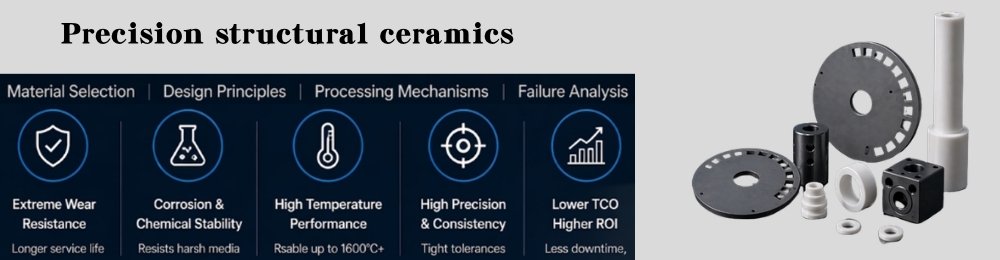
Precision structural ceramics, often called advanced ceramics or engineering ceramics, are mainly used in applications that require load-bearing capacity, excellent wear resistance, and high stability under demanding industrial conditions. They are manufactured from high-purity feedstock through controlled processes including powder preparation, forming, sintering, and precision machining.
Not your typical ceramics. Built for superior performance and long-term reliability, these ceramic components serve as critical core parts in high-performance equipment. They find wide use across industries including chemical, energy, medical, semiconductor, and aerospace—especially in wear-resistant parts, corrosion-resistant components, high-temperature environments, and precision mechanical systems.
Performance is not just about the material.
It also comes down to structure and how well the part is processed. Grain uniformity and density matter a lot.A smooth, crack-free surface helps parts last longer.
If any step is not well controlled, problems can show up early.
That means higher risk and extra cost. That is why quality control matters at every step. From raw material to final part.
So the components can run stable in harsh conditions.
Understanding what they are is only the first step. The next question is why they are increasingly replacing metals.
Why Are Ceramics Replacing Metals
Precision ceramics are engineered for demanding conditions. They are used in wear, corrosion, and high-temperature environments. Most failures are not due to low strength. They are caused by wear, corrosion, or thermal effects.
Metals such as stainless steel perform well in standard conditions. However, performance drops in harsh environments. Frequent wear and corrosion reduce service life.This increases operating cost.
Ceramics offer different material behavior. High hardness improves wear resistance.Service life can be several times longer than metals. They also maintain stability above 1000°C. Ceramics should be treated as engineered solutions. Not simple material replacements.
If you are new to this field, start with our basics guide: Advanced Ceramics vs Traditional Ceramics: Differences in Materials, Properties, Manufacturing, and Applications
Ceramic vs Stainless Steel: Performance and Cost Comparison
When comparing ceramic vs metal components, the difference is most evident in wear, corrosion, and lifespan. Stainless steel is easy to source. But it comes with hidden costs in harsh conditions. Frequent wear and corrosion lead to replacement. Downtime and maintenance increase total cost.
Ceramics offer a more stable solution. Ceramic wear resistance is one of the main reasons for extended service life in harsh environments. Ceramics solve key pain points. Wear, corrosion, and contamination control. Smart decisions focus on total cost of ownership. Not just unit price. Ceramics deliver better value over time.
| Property | Ceramics | Stainless Steel |
| Service life | 3–10× longer | Shorter |
| Corrosion resistance | High | Moderate |
| Heat resistance | Up to 1600°C | Limited |
| Clean operation | No ion release | Risk present |
| Maintenance cost | Low | High |
This is why ceramics are not just an alternative, but a more stable long-term solution in demanding environments. In many cases, ceramics outperform metals—see full comparison: Ceramic vs Stainless Steel
Material Selection for Better Long-Term Results
Choosing the right ceramic material depends on the application conditions, load requirements, and failure risks. Common structural ceramics materials include alumina, zirconia, silicon carbide, and silicon nitride.
Choosing the wrong material increases cost. Start from the actual working condition.
Alumina (Al₂O₃)
Low cost and widely available;
Good for wear and insulation;
Best for general applications.
Zirconia (ZrO₂)
Higher cost but better toughness;
Reduces failure in impact conditions.
Silicon Carbide (SiC)
Higher upfront cost,But performs well in heat and corrosion.
Reduces replacement frequency.
Silicon Nitride (Si₃N₄)
Best for high-speed systems;
Improves reliability under thermal stress.
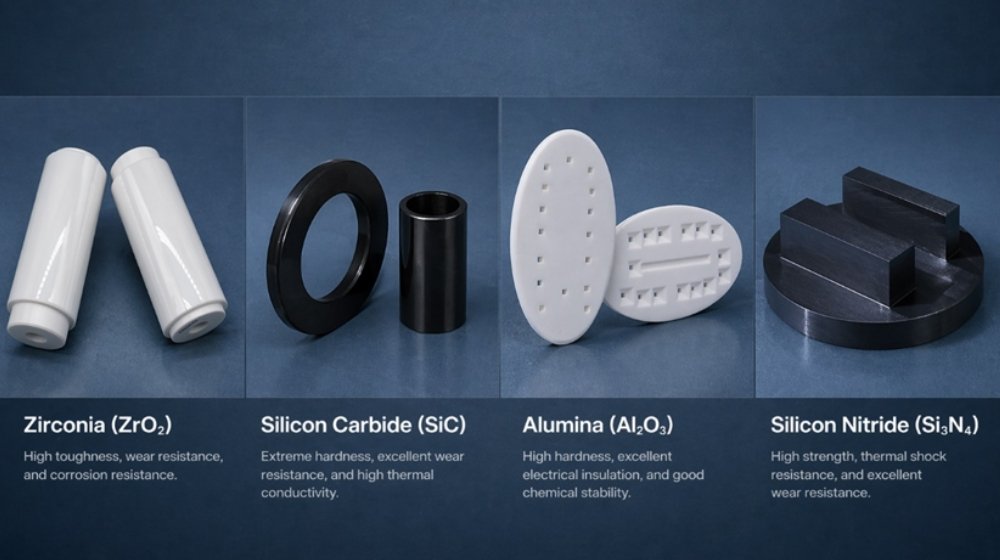 zirconia silicon carbide alumina silicon nitride ceramic components
Selection rule is:Match material to failure type. Not just initial price. For full comparison, see our material guide: How to Choose Ceramic Materials: Alumina, Zirconia, SiC & Si₃N₄
However, material selection alone is not enough. Design plays an equally critical role in performance and reliability.
Design Principles for Precision Ceramics
Ceramics are brittle. They do not deform to absorb stress. Design must control stress and avoid crack initiation. Proper ceramic component design is essential to minimize stress concentration and prevent cracking.
1. Wall Thickness
Classify by part size:
Small ≤ 30 mm; Medium 30–100 mm; Large > 100 mm.
Minimum wall thickness for mass production:
Small ≥ 0.8 mm; Medium ≥ 1.5 mm; Large ≥ 3.0 mm.
Avoid uneven thickness.
It causes uneven shrinkage during sintering. This leads to residual stress and cracking.
2. Fillet Design
Inner radius ≥ 0.5 mm, outer edge radius ≥ 0.2 mm.
Sharp corners create stress concentration. They are the main source of cracks.
3. Hole Design
Difficulty depends more on thickness than hole size.
Load-bearing holes:
Use standard grinding, Diameter ≥ 0.5 mm. Depth-to-diameter ratio ≤ 5mm
Micro holes in thin parts:
Laser drilling can achieve 0.2 mm. Not recommended for thick sections.
Deep holes increase machining difficulty. They also raise the risk of microcracks or fracture.
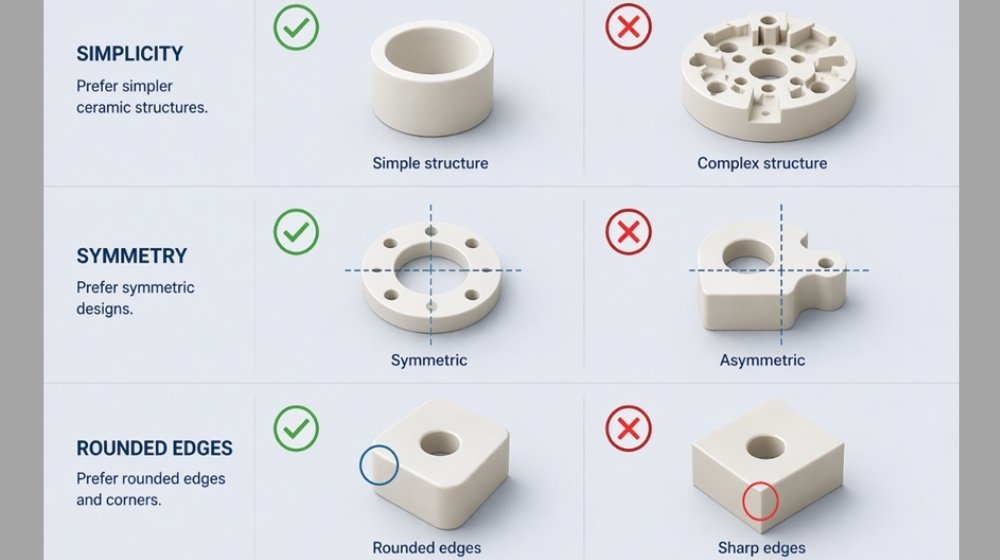 Design principles for precision ceramics
Design Rule:
Keep geometry simple and symmetric. Use smooth transitions and rounded edges. Avoid sharp corners, thin walls, cantilevers, deep holes, and sudden section changes. These reduce fracture risk. Once the design is finalized, manufacturing quality becomes the next critical factor.
In short, simple and symmetric designs significantly reduce fracture risk in ceramic components.
For detailed design rules, refer to: Ceramic Design Guidelines (Wall Thickness, Fillets and Hole Design)
How Ceramic Parts Are Machined
Due to their ultra-high hardness and brittleness, ceramics cannot be effectively processed by conventional cutting. Ceramic machining therefore relies on diamond-based grinding, where material is removed at a micro scale using diamond abrasives, demanding specialized manufacturing processes.
Precision ceramic machining requires specialized grinding, lapping, and finishing processes to achieve tight tolerances.
Processes
Surface, OD, and ID grinding.
Followed by lapping or polishing.
Process Parameters
Wheel speed: 20–35 m/s.
Feed rate: 0.005–0.02 mm/rev.
Depth of cut: 2–20 μm.
Cooling is critical. Thermal stress can cause surface cracks.
Surface Quality
Ra 0.2–0.4 μm after grinding;
Ra 0.05–0.2 μm after lapping;
Below 0.03 μm after polishing.
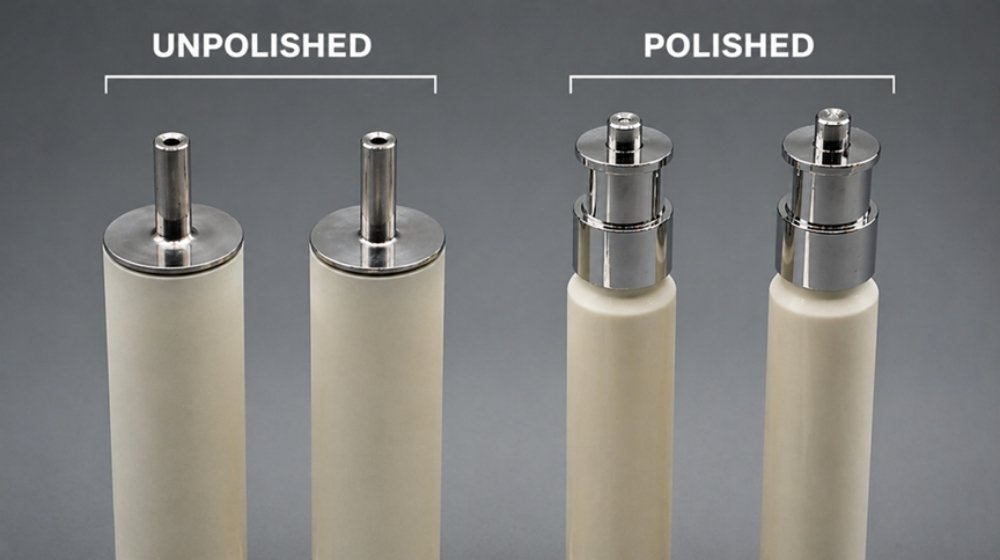 Surface finish comparison
Surface integrity controls performance.
Microcracks and residual stress reduce strength.
Crack growth leads to failure in service.
Learn more about processes and tolerances in: Ceramic Machining Tolerance: Cost and Surface Roughness Guide
Failure Analysis
Based on our production experience and field cases,over 80% of ceramic failures are not material-related. Most issues come from poor selection, design, or machining.These problems can often be prevented early.
Common Failure Modes
Thermal Shock
Rapid temperature changes create high internal stress. This leads to cracking or chipping.
Stress Concentration
Sharp corners or uneven wall thickness increase local stress.This can cause sudden fracture.
Machining Microcracks
Improper grinding or poor cooling leaves tiny surface cracks. These grow over time and lead to failure.
Wrong Material Selection
Mismatch between material and working conditions.For example, using alumina in impact conditions. Or using zirconia in high-temperature environments.
Engineering Conclusion:
Ceramic failure is rarely due to brittleness alone. It is usually a system issue. Good design, correct material choice, and proper machining matter most. With early planning, ceramic parts can run safely and reliably for a long time.
In short, most failures are preventable with proper design, material selection, and process control. Ceramic failure analysis is critical to identify root causes and improve long-term reliability.
Common issues are explained in: Ceramic Machining Risk Management: Failure Analysis
Application Case: Ceramic Plunger Pumps in Food Processing
Our customer used 316L stainless steel plungers on their tomato sauce filling line, which only lasted 3–6 months. In acidic tomato sauce, these metal parts suffered severe corrosion and wear. This caused size deviation and unstable filling accuracy, and also brought risks of metal ion contamination to products.
To fix these issues, we recommended the customer replace the original stainless steel parts with 99% alumina ceramic plungers. After the material switch, the equipment performance improved greatly:
- The smoother surface reduces sauce sticking effectively.
- Great corrosion resistance ensures stable operation in acidic conditions.
- Filling accuracy is steadily kept within ±0.1%.
- Plunger service life is extended to over 5 years.
- Equipment maintenance is needed far less often.
- The customer’s annual operating costs have dropped by around 80%.
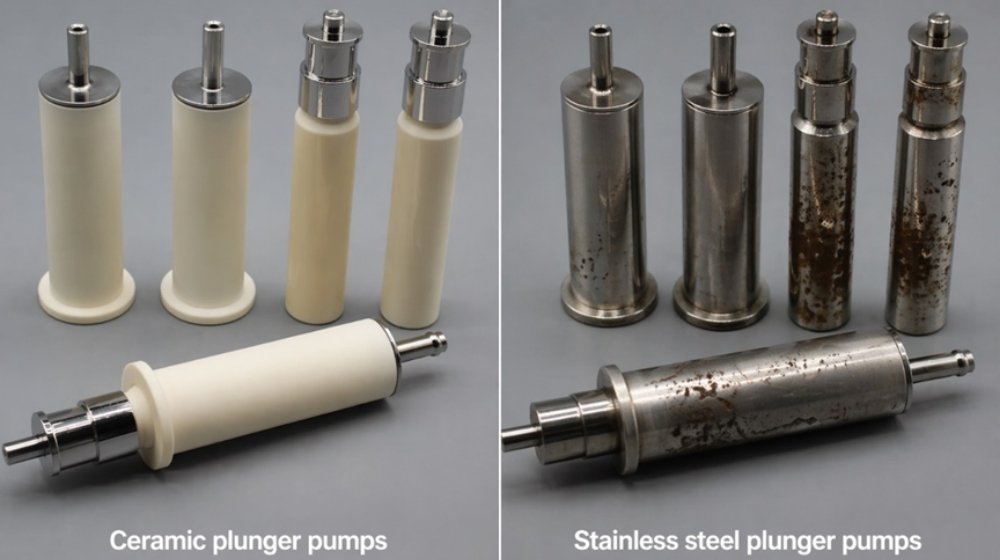 Product failure comparison after long-term use
Engineering Insight
Ceramics are effective in corrosive and wear conditions. They improve both performance and system stability. Beyond performance improvements, cost is often the key factor in decision-making.
How to Evaluate Ceramic Cost
Do not judge by unit price alone. Look at operating cost over time.
Cost Drivers
Complex design increases cost;
High precision adds more processing;
Machining time is a major factor.
Ways to Control Cost
Avoid unnecessary precision;
Simplify structure;
Use standard designs when possible.
TCO Matters
Total cost includes downtime and downtime loss. Not just purchase price. Ceramics last 3 to 10 times longer than metal. They reduce maintenance and replacement. In demanding applications, payback can be achieved within 6 to 18 months. After that, cost savings are clear.
In many cases, ceramic components provide a lower total cost of ownership compared to traditional materials. For a full cost breakdown, see: Ceramic Cost and ROI Analysis
FAQ
Q1: Are ceramic parts more expensive than metal?
Yes, the unit price is higher.
But service life is 3–10 times longer.
Total cost of ownership is lower in harsh conditions.
Q2: What accuracy can ceramics achieve?
With proper design, tolerance can reach ±0.001 mm.
Flatness and roundness can reach sub-micron levels.
Surface finish can reach nano level.
Surface quality plays a key role—see: Ceramic Surface Finish and Tolerance
Q3: When should ceramics replace stainless steel?
In wear, corrosion, high heat, or clean environments.
Also for insulation or stable long-term precision.
Q4: Why do ceramic parts crack?
Ceramics are sensitive to stress concentration.
Cracks come from sharp corners, thermal shock, or microcracks.
Not from the material itself.
Q5: Which ceramic is best for wear?
Alumina for general wear.
Silicon carbide for heavy wear.
Silicon nitride for impact with wear.
Zirconia for vibration wear.
Q6: How to choose a reliable supplier?
Choose suppliers with material and machining capability.
They should also support design and testing.
Early involvement reduces cost and risk.
Key Takeaways
Precision structural ceramics play a critical role in modern engineering applications requiring durability, stability, and high performance.
1 Ceramic parts need less maintenance and reduce downtime. Total cost is much lower than metal over time.
2 Precision ceramics reach micron-level accuracy. Surfaces are extremely smooth. They work well in high-end and precision equipment.
3 Most ceramic failures are not quality issues. They come from poor design, wrong material choice, or bad processing. Good planning greatly reduces failure risk.
Conclusion
Precision ceramics are not simple metal replacements. They are engineered solutions for wear, corrosion, heat, contamination, and instability. They are widely used across industries. Including food, chemical, mining, textile, machinery, and energy.
From real-world applications, the key to reliability is clear: Design for the problem、Choose the right material、Control the machining process. Get these three steps right. More than 80% of failures can be avoided.
Final Thoughts
Choosing ceramics is a strategic decision. It reduces cost and improves reliability over time. It is not about replacing metal. It is about improving the whole process. In demanding environments, ceramics deliver better long-term value.
If you are facing wear, high maintenance, or downtime loss, we can support your project. Share your requirements with us. We will provide a tailored solution and cost analysis.
Helping you achieve better performance with lower total cost. If you are sourcing parts, refer to: Custom Ceramic Parts Guide