

Introduction: Why Hermeticity Matters More Than You Think
In high-reliability industries, failure rarely comes from visible damage. More often, it starts with something invisible—microscopic leakage.
For advanced ceramic components used in electronic packaging, vacuum systems, or harsh environments, even a tiny leak path can lead to moisture ingress, oxidation, and eventual system failure.
This is why helium leak testing has become a standard quality control step—not as an option, but as a requirement.
What Is Helium Leak Testing
Helium leak testing is a high-precision method used to detect and quantify leaks in sealed components. By using helium as a tracer gas and a mass spectrometer detector, even extremely small leakage paths can be identified.
Helium offers numerous advantages. It is present in ambient air only at very low concentrations, making it easily detectable. Helium is non-toxic and does not react with other materials. Furthermore, due to its small atomic radius, helium allows for rapid testing and enables the detection of even the tiniest leaks.
Two Core Testing Methods: Not Just a Technical Choice
Helium leak testing is typically performed using two main methods, and the choice between them depends on the application scenario rather than preference.
1.Vacuum Method: When Precision Is Critical
In the vacuum method, the component is filled with helium and placed in a vacuum chamber. Any escaping helium is detected externally.
This method offers extremely high sensitivity, often reaching leak rates as low as 10⁻⁹ mbar·L/s or even better.
It is widely used in hermetic electronic packages, aerospace components, and vacuum-grade ceramic assemblies.
2.Sniffer Method: When Flexibility Matters
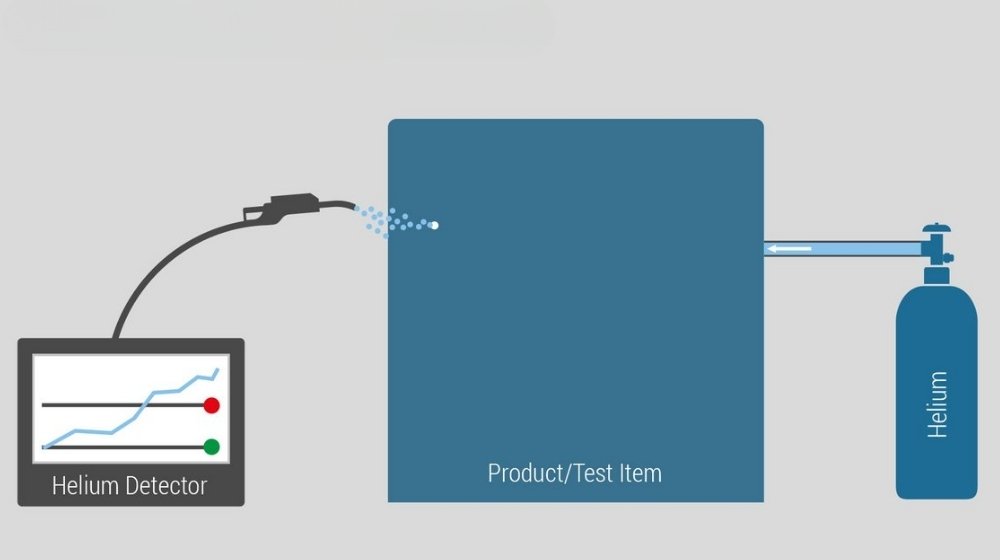
The sniffer method works in the opposite way. Helium is applied externally, and a probe is used to detect leak points.
Although less sensitive (typically 10⁻⁵ to 10⁻⁷ mbar·L/s), it is more flexible and suitable for large components or field inspections.
Understanding Leak Rate: The Core of Hermetic Standards
When discussing hermeticity, the most critical parameter is the leak rate. Leak rate is typically expressed in mbar·L/s, representing the amount of gas escaping per unit time under defined conditions.
For high-reliability applications, a commonly accepted criterion is:
≤ 1×10⁻⁹ mbar·L/s
However, what qualifies as “acceptable” is not universal. It depends on the application environment, product lifetime expectations, and failure risk tolerance.
Key Hermetic Testing Standards You Should Know
To ensure consistency and reliability, helium leak testing is governed by several international standards.
Among the most widely referenced are:
- MIL-STD-883
- MIL-STD-750
- ASTM E493
- ISO 20485
These standards define test methods, sensitivity levels, and acceptance criteria, particularly for electronic and aerospace applications.
Understanding which standard applies to your product is often more important than the test itself.
Why Ceramic Components Are Especially Sensitive to Leakage
Unlike metals, ceramics are often used in applications where insulation, vacuum integrity, or hermetic sealing is critical. For example, metallized ceramics used in electronic packages rely on perfect sealing between ceramic and metal interfaces.
Any micro-leak at the interface can compromise the entire system. Similarly, ceramic-to-metal brazed assemblies are highly sensitive to leakage due to thermal expansion mismatch and joint integrity challenges.
From Testing to Reliability: What Really Matters
Helium leak testing is not just about detecting leaks—it is about ensuring long-term reliability. A low leak rate today does not guarantee performance tomorrow unless the design, materials, and manufacturing processes are all aligned.
This is why testing should be viewed as part of a broader reliability strategy, not an isolated step.
Conclusion: Choosing the Right Testing Approach
Helium leak testing remains one of the most reliable methods for evaluating hermeticity, especially for advanced ceramic components. However, the key is not just performing the test, but selecting the right method, defining the correct leak rate criteria, and aligning with applicable standards. Only then can hermetic performance truly support long-term product reliability.
If you are working with advanced ceramic components and need to evaluate hermetic performance, understanding helium leak testing is the first step. The next step is ensuring your testing approach matches your application requirements.
Talk to an engineer to define the right leak rate and testing method for your application.