

Introduction
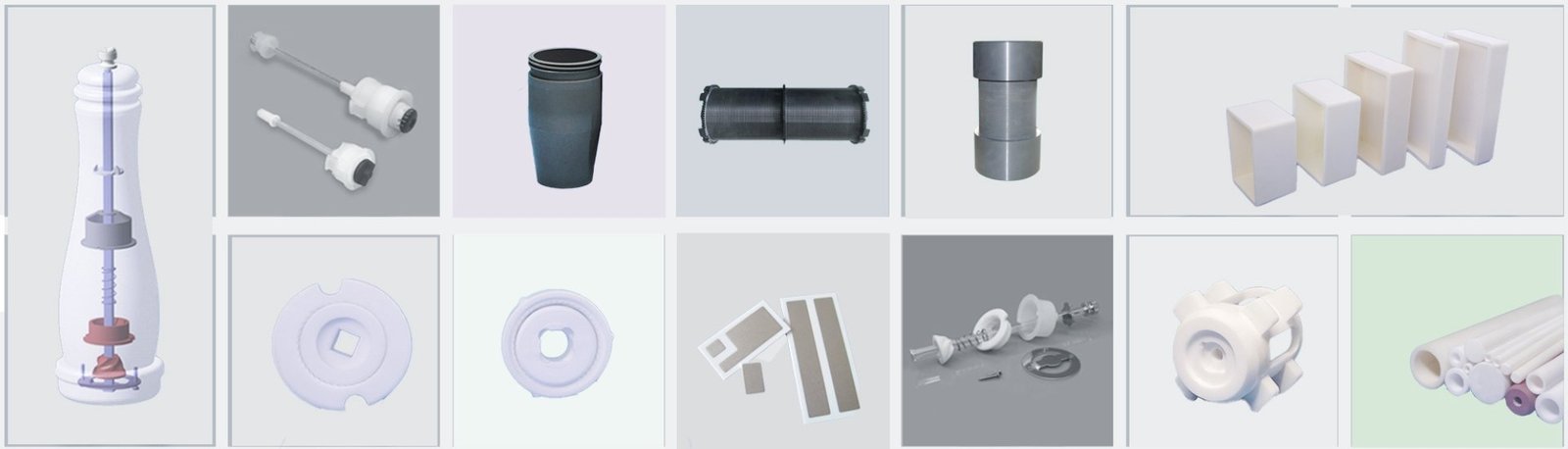
The grinding core, also known as the grinding burr, is the heart of the grinding system in food processing equipment, directly determining product quality, production stability, and equipment lifespan. Whether it’s a small seasoning grinder or an industrial-grade pulverizing system, the design and material of the grinding core affect particle uniformity, food safety, and total costs, making it an important criterion for procurement and engineering solutions.
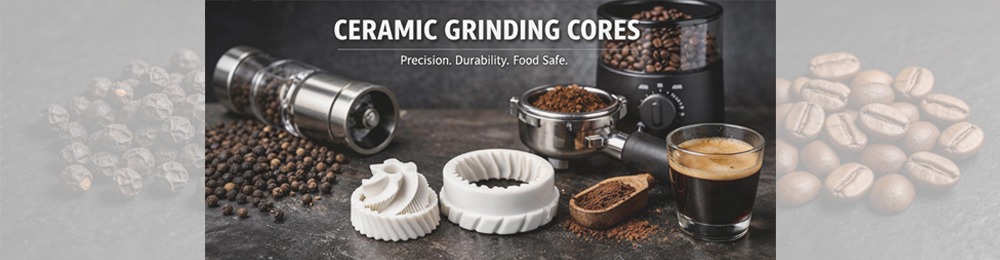
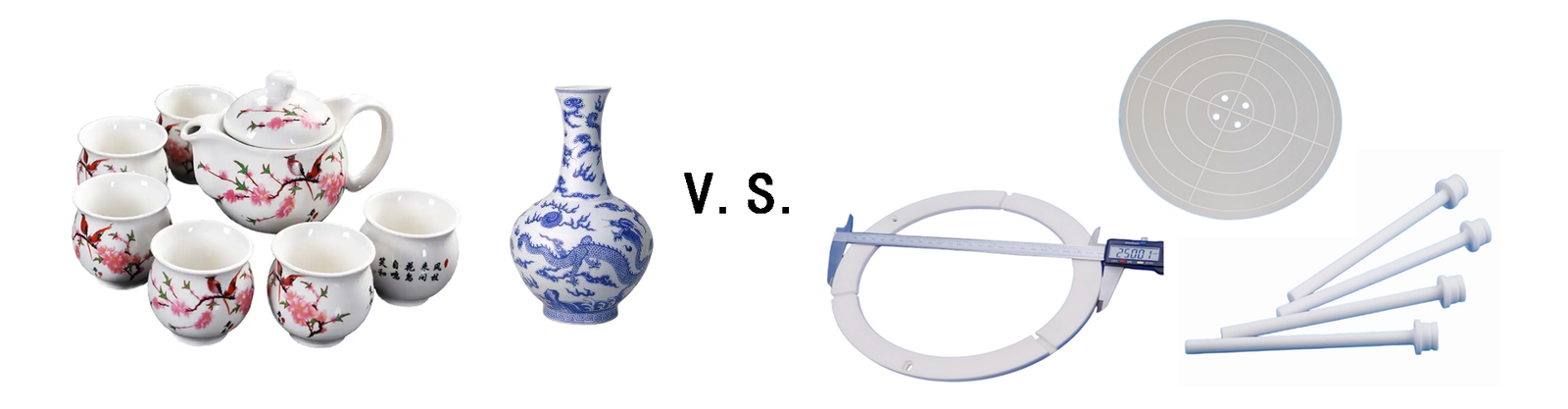
In long-term use, traditional metal grinding cores such as stainless steel and carbon steel are prone to wear and corrosion, and may also pose a risk of metal contamination. In contrast, ceramic grinding cores effectively avoid these problems and have been adopted in large quantities by an increasing number of food grinding equipment manufacturers.
In our collaborations with clients, we are most frequently asked: Are ceramic grinding cores a good fit for their applications? How can we choose a core that balances performance and cost? This article will use our practical experience to systematically introduce the materials, design, and applicable scenarios of ceramic grinding cores, and also explain why your grinding cores break down after only a few months. Why are abrasive particles becoming increasingly uneven? Why are ceramics being used more and more in abrasive products?
Key Takeaways
1. Compared to metal grinding cores, ceramic ones offer 3–10 times longer wear resistance.
2. In food applications, a ceramic grinding burr can achieve zero metal leaching and contamination.
3. Alumina (Al2O3) is recommended for general conditions of ceramic core, while zirconium oxide (ZrO2) is more suitable for high-impact or high-end applications.
4. It is worth emphasizing that design parameters such as the tooth profile of the grinding core have a greater impact on performance than the material itself.
5. The right selection of grinding cores requires simultaneous consideration of application scenarios, service life, material selection, structural design, and assembly precision.
What is A Ceramic Grinding Core?
A ceramic grinding core is a precision grinding component made of high-performance engineered ceramics. It can efficiently perform shearing and crushing operations on particulate materials. Unlike traditional metal grinding cores, ceramic types offer significant improvements in hardness, wear resistance, chemical corrosion resistance, and food contact safety.
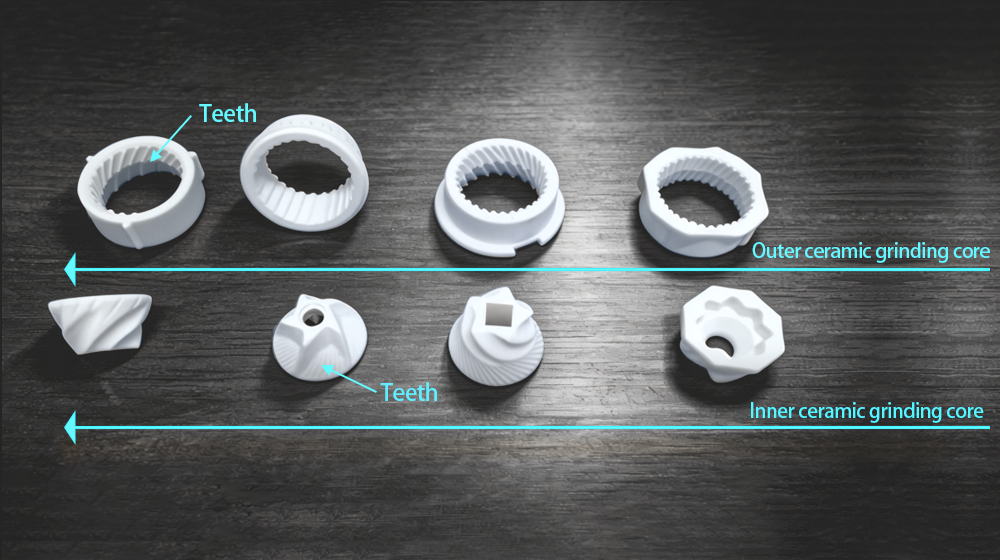
Due to their excellent material properties, ceramic grinding cores have been widely used in coffee grinding systems, pepper and spice mills, salt grinders, and various food powder processing equipment.
To learn more about its working principles, materials, types, and more, please click: What is a Ceramic Grinding Core?
Ceramic vs Stainless Steel vs Plastic for Grinding Cores?
From an engineering and procurement perspective, the key to material selection lies in balancing performance, cost, and potential risks. Based on this principle, ceramic grinding cores have significant advantages in food grinding applications, specifically as follows:
A significant improvement in wear resistance
Advanced ceramic materials, especially high-purity alumina, possess high hardness and a wear rate far lower than stainless steel. In practical use, metal grinding cores typically show significant wear within a few months to six months, while the service life of ceramic grinding cores can be increased by 3–10 times. For equipment operating at high frequencies for extended periods, this directly translates to fewer grinding burr replacements and lower maintenance costs.
Food safety and zero pollution
For the food industry, food safety and zero contamination are vital, even more so than equipment performance. Metal grinding cores, under prolonged grinding and friction, may produce trace metal particles that can seep into the ground product, posing a contamination risk. In contrast, technical ceramic materials are chemically stable, do not undergo chemical reactions, and do not release metal ions that could affect food flavor, making them the preferred solution for high-end food equipment and export products.
Excellent corrosion resistance
Ceramic grinding cores have outstanding corrosion resistance. In salty and humid environments, stainless steel grinding cores may still experience corrosion or pitting, while ceramic ones are chemically inert and insensitive to salt and acidic substances, maintaining stable performance during long-term use.
More stable grinding effect
Ceramic grinding cores offer more stable grinding performance than stainless steel ones. Once metal cores wear down, their particle control capability gradually declines; ceramic grinding cores, due to their excellent wear resistance, maintain uniform particle size and stable powder output throughout their entire service life.
Comparison table of ceramic vs. stainless steel vs. plastic grinding cores:
| Comparison Dimensions | Ceramic | Stainless Steel | Plastic |
| Service life | 3–10 times or longer than stainless steel | Medium wear and tear | Short lifespan, prone to aging |
| Wear resistance | Extremely high hardness (close to corundum). | Moderate wear and tear, noticeable over long-term use. | Low, easily deformed |
| Anti-corrosion | Completely corrosion resistant (stable in acid/salt environments) | Easy to corrode and rust (especially in saline environments). | Not corroded, but is prone to aging. |
| Food safety | No metal contamination, strong chemical inertness | Risk of metal particles | Risk of microplastic release |
| Flavor affect | Not affect the flavor (no off-odor). | May have a metallic taste. | May absorb odors |
| Grinding stability | Stable particle size and high uniformity | Stability decreased after use | Big fluctuation of particle size |
| Maintenance frequency | Low | Medium | High |
| Costs (Initial) | Higher | Medium | Low |
| Total cost (long term) | Optimal (long lifespan) | Medium | High (Frequent replacement) |
| Typical use | Coffee, pepper, and salt grinders (high-end applications) | Coffee equipment (partial), disposable products | Disposable grinders |
For a detailed comparison of ceramic and stainless steel grinding cores, please click Ceramic vs Stainless Steel Burr.
Alumina vs Zirconia in Grinding Cores
In the material system of ceramic grinding cores, different materials correspond to different application requirements, with alumina (Al2O3) being the most representative. This material possesses high hardness and excellent wear resistance, while also being relatively inexpensive and having a mature manufacturing process. It meets the needs of pepper grinding, coffee grinding, and most general food grinding equipment, making it the mainstream choice with the highest cost-performance ratio.
Zirconia (ZrO2) is another commonly used high-performance ceramic material for grinding cores. It is characterized by higher fracture toughness and excellent impact resistance, but its overall cost is higher than that of alumina. Therefore, it is often used in high-end coffee equipment, high-impact products, and high-end brand solutions, making it more suitable for applications requiring higher impact resistance.
What Really Determines Grinding Performance: Material or Design?
In practical applications, a common misconception is that only the grinding core material is considered, while the structural design is neglected. Engineering experience shows that the actual grinding performance of a grinding core is primarily determined by its geometry, with the material playing a secondary role.
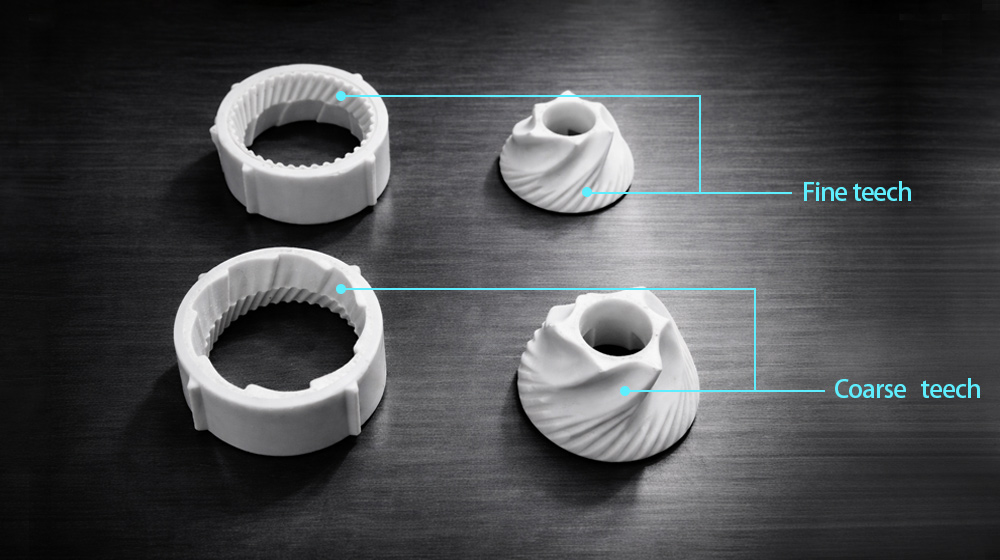
Tooth geometry
Tooth geometry is a core factor influencing the grinding performance of the grinding core, directly determining shearing efficiency, particle distribution range, and final powder uniformity. In practical applications, different materials such as coffee and spices have significantly different requirements for tooth profile structure, necessitating differentiated design.
Surface finish
Surface finish directly affects the actual performance of the grinding core. The surface quality of the grinding core influences its frictional resistance, the heat generated during grinding, and whether powder tends to adhere and accumulate on the surface of the grinding core.
Dimensional accuracy and tolerance
The dimensional accuracy and tolerance of ceramic grinding cores directly affect the reliability of assembly. Since grinding cores are used in conjunction with plastic or metal components, an overly tight fit can lead to cracking, while an overly loose fit will result in decreased powder uniformity and stability.
Fitting design matching
In grinding core applications, many failures are unrelated to material properties, but rather caused by factors such as unreasonable structural design or incorrect installation methods. Whether the assembly structure matches is precisely the aspect most easily overlooked during the procurement process.
Typical Application Analysis
Coffee bean grinders/mills
The quality of a coffee grinder depends mainly on three aspects:
1. The uniformity of the grind size;
2. To preserve the original flavor of the coffee, the grinder should not generate too much heat during the grinding process.
3. The grinding mechanism itself should not affect the taste of the coffee.
Spice & pepper grinders/mills
For applications such as spice and pepper grinding, the key requirements for grinding cores are high wear resistance, no risk of flavor transfer, and stable and reliable structural performance.
Salt grinders/mills
In a salty, humid grinding environment, the key design parameters for grinding cores are good corrosion resistance, long service life, and low maintenance costs in use.
For information on which grinding core shapes are used in which applications, please see “ Burr Types Explained: Flat vs Conical Burr.”
Core Issues to Consider Before Procurement
To avoid compatibility issues after mass production, the following key issues need to be thoroughly checked before bulk purchasing of ceramic grinding cores.
1. What material is being ground?
A: First, the specific application scenario needs to be clearly defined. The difference in grinding materials (such as coffee, spices, salt, etc.) will directly determine the overall design direction and performance focus of the grinding core.
2. What is the life expectancy?
A: Clear indicators should be proposed for the expected lifespan of the product, and the design standard of long-term maintenance-free operation should be determined in combination with the usage scenario.
3. Are there any food safety requirements?
It is essential to clearly define the food safety requirements for the application scenarios of the grinding core, and to determine whether the product is intended for overseas markets and whether it requires compliance certifications such as the FDA and EU.
4. Is customization required?
During the selection phase, it is necessary to confirm with the customer whether there are any customization requirements and clarify whether to use existing standard parts or carry out a dedicated OEM structural design, which directly affects the cost and delivery time.
5. Are the supplier’s capabilities a good match?
Before purchasing, it is essential to verify whether the supplier’s capabilities meet the requirements, primarily covering structural design capabilities, consistency in batch supply, and a comprehensive quality control system. A more comprehensive selection strategy can be found on the dedicated selection guide page.
How to assess the lifespan of grinding cores before bulk purchasing? Please refer to the following article: How to Evaluate Burr Lifespan Before Bulk Purchase.
Common Problems with Grinding Cores and How to Avoid Them
In practical use, these three types of problems occur frequently:
1. Grinding core cracking, often related to assembly structure or structural design;
2. Uneven powder output, frequently caused by tooth profile design or abnormal wear;
3. Lifespan not meeting expectations, mostly due to material or processing issues.
These problems are often not caused by a single reason, but rather are the result of the combined effects of design, materials, and usage conditions.
To learn about the root causes of ceramic grinding core cracking, “ Why Does Ceramic Burr Crack? Root Causes Explained”, please click here.
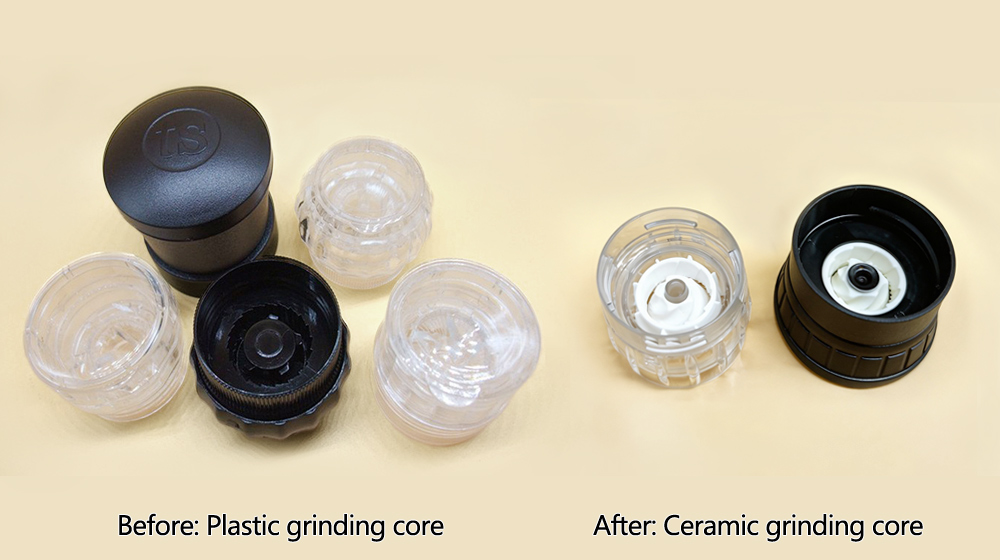
Case Study: Replacing Plastic Grinder Cores with Ceramic (EU Compliance)
Case background
A European customer needed to replace the plastic grinding core of their pepper grinder with a food-grade ceramic grinding core due to the EU’s Single-Use Plastics Directive.
Client requirements
1. Keep the assembly dimensions completely unchanged, minimizing modifications to the production line assembly line;
2. Particle size distribution of the powder: 10% > 0.6 mm, 80% between 0.3 and 0.6 mm, 10% < 0.3 mm
3. Meet food contact safety standards.
The challenges in this case are maintaining the same grinding core assembly dimensions, optimizing the grinding core structure, changing product materials, and ensuring the precision of the ground pepper particles.
Our solution
We redesigned the burr structure, tooth shape, and tooth angle of the ceramic grinding core based on the customer’s existing plastic grinding one and assembly components. This made the structure compatible with the existing assembly components, and the tooth shape and angle were adjusted to control the grinding particle size. We also finely adjusted the mating clearance of the inner and outer grinding teeth to improve the stability of powder output. As a result, the ceramic grinding core can directly replace the plastic grinding core without changing the original assembly structure.
Results and validation
1. The product meets US and EU food contact safety standards such as FDA and EEC;
2. The powder particle size distribution fully meets customer requirements.
3. The ceramic grinding core and plastic parts are 100% compatible in assembly dimensions;
4. The lifespan is 50-100 times longer than that of plastic grinding cores.
Benefit to the customer
● Reduced production line modification costs;
● More stable powder particle size and more consistent quality;
● Ceramic grinding cores replace plastic grinding cores, meeting EU compliance;
● Longer service life of ceramic grinding cores, reducing usage costs for end consumers.
Engineering Insight
By retaining the original plastic assembly structure, the plastic or metal grinding core can be upgraded to a ceramic grinding core, while simultaneously meeting the requirements for particle size control of the powder output and food compliance.
How to Choose a Ceramic Grinding Core, please click here.
Conclusion: How to Make The Right Choice?
From an engineering design perspective, ceramic grinding cores are not simply a replacement for metal/plastic materials. Their selection requires a systematic decision that comprehensively considers materials, structure, application matching, and the overall capabilities of the supply chain.
Frequently Asked Questions(FAQ)
Q1: Which is better, ceramic grinding cores or stainless steel grinding cores?
A1: When choosing between ceramic and stainless steel grinding cores, ceramics offer superior wear resistance, corrosion resistance, and food contact safety, with no risk of metal contamination. Mid- to low-end stainless steels such as 420, 410, and 201/430 are less expensive, but have lower durability.
Engineering Insight:
For scenarios involving long-term operation and food safety requirements, ceramic grinding cores should be the preferred choice.
Q2: How long can a ceramic grinding core typically be used?
A2: Under normal use, the lifespan of ceramic grinding cores is typically 3–10 times that of stainless steel grinding cores, with the final lifespan determined by the material grade, application conditions, and structural design.
Engineering Insight:
The core factors that determine lifespan are not only materials, but also structural design and usage conditions.
Q3: Are ceramic grinding cores prone to cracking?
A3: Ceramic grinding cores, due to their low toughness, are prone to cracking under impact, compression, or improper assembly. However, they exhibit good stability and reliability under proper installation and normal grinding operations.
Engineering Insight:
In actual failure cases, cracking is often caused by structural design flaws or improper installation.
Q4: What is the best material for ceramic grinding cores?
A4: When selecting ceramic grinding core materials, alumina is suitable for most applications and offers high cost-effectiveness, while zirconia has stronger toughness and is often used in high-end products and high-impact environments.
Engineering Insight:
Material selection should be based on the actual application, rather than just referring to a single performance indicator.
Q5: Are ceramic grinding cores suitable for food processing?
A5: Ceramic grinding cores are suitable for food processing applications. High-purity ceramics are chemically inert, do not produce metal contamination, and meet food contact safety requirements. They are widely used in food-grade grinders and related equipment.
Engineering Insight:
Export-oriented food grinding appliances mostly prioritize the use of ceramic grinding core structures.
Q6: Why do the grinding particles become uneven?
A6: Uneven particle size after grinding is commonly caused by wear of the grinding core, improper tooth design, or assembly tolerance issues, rather than a problem with the material itself.
Engineering Insight:
The long-term stability of grinding performance depends primarily on the stability of the overall structure.
If you are currently evaluating or purchasing ceramic grinding cores in bulk, we recommend providing your application scenario, existing structural drawings, and any issues encountered during actual use, such as wear and uneven powder output. We can then provide material recommendations, structural optimization, and customized design support based on your needs. Upon receiving your drawings or requirements, we will provide engineering advice and a quotation within 24 hours.