

Introduction: Why “Ceramic Heater Efficiency” Gets So Much Attention
Every winter, search interest in “ceramic heater efficiency” increases sharply. Rising electricity prices push homeowners, renters, and small office users to compare heating options carefully.
Many buyers hesitate between ceramic heaters, fan heaters, and oil-filled radiators. The main concern is simple: which heater delivers warmth faster while using less electricity?
This article explains how PTC ceramic heaters work, compares real-world efficiency, and shows why the internal ceramic material plays a critical role.
How Does a PTC Ceramic Heater Work?
PTC stands for Positive Temperature Coefficient. It describes a special ceramic material whose electrical resistance increases as temperature rises. When electricity flows through the ceramic element, it heats up rapidly. As the temperature approaches its design limit, resistance rises automatically. Current flow decreases, and the heater stabilizes without overheating.
A small fan pushes air across the heated ceramic surface. Warm air circulates into the room almost immediately. This self-regulating behavior improves safety and reduces unnecessary power consumption compared with traditional exposed metal coils.
How Efficient Are Ceramic Heaters in Real Use?
Most small ceramic heaters convert 85–90% of electrical energy into usable heat. However, real efficiency depends on more than conversion rate. It also includes:
• Warm-up time
• Temperature stability
• Heat distribution
• Energy waste during shutdown
Because ceramic heaters reach operating temperature within 30–60 seconds, they reduce idle heating loss. Oil heaters may require 10–15 minutes before noticeable warmth appears.
Comparison of Different Heaters
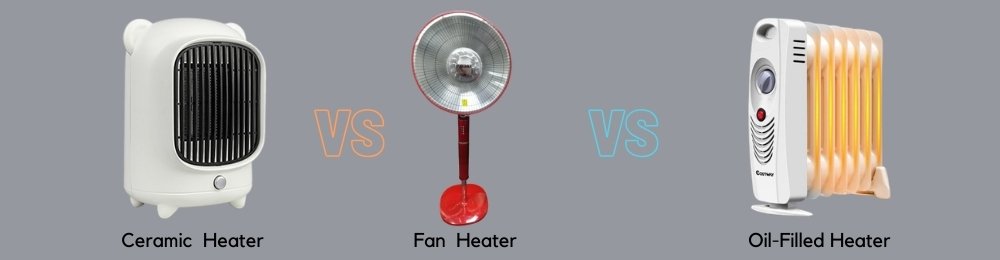
Ceramic VS Fan Heater
Fan heaters rely on metal coils. These coils must heat fully before air circulation becomes effective. They also remain extremely hot after shutdown. Ceramic heaters react faster and cool down faster. They respond quickly to thermostat changes.
Performance comparison:
| Feature | Ceramic Heater | Fan Heater |
|---|---|---|
| Warm-up Time | 30–60 seconds | 3–5 minutes |
| Surface Temperature | Moderate | Very high |
| Post-Shutdown Heat | Low | High |
| Short-Term Efficiency | High | Medium |
Ceramic VS Oil-Filled Heater
Oil-filled heaters heat sealed oil inside metal fins. The oil stores heat and releases it slowly into the room. They are heavy and slow to start but provide long residual warmth.
Ceramic heaters provide immediate warmth but do not store heat after power is off.
Comparison overview:
| Aspect | Ceramic Heater | Oil-Filled Heater |
|---|---|---|
| Start-Up Speed | Very Fast | Slow |
| Heat Retention | Low | High |
| Best For | Short Sessions | Long Sessions |
| Portability | Light | Heavy |
For short heating periods of 1–3 hours, ceramic heaters usually consume less total energy.
How Much Electricity Does a 1500W Ceramic Heater Use?
A 1500W heater consumes 1.5 kilowatt-hours per hour at full power. If the electricity rate is $0.15 per kWh, four hours of operation costs about $0.90.
Many models include 750W low-power settings. Using lower settings significantly reduces energy use. Digital thermostats further improve efficiency by cycling the heater only when necessary.
What Room Size Is Ideal for a Ceramic Heater?
Ceramic heaters work best in rooms under 150 square feet (about 14 m²). Using a small heater in a large open area reduces efficiency and increases running time.
Matching heater wattage to room size is essential for optimal performance.
Common Limitations of Ceramic Heaters
Ceramic heaters are not designed for whole-house heating. They produce mild fan noise and do not store heat after shutdown.
For very large spaces or continuous 10-hour heating cycles, oil systems may be more stable.
Why Ceramic Material Quality Matters
Two heaters with identical wattage may perform differently because of the ceramic element inside. High-grade engineering ceramics provide uniform heating, stable resistance behavior, and long cycle life.
Poor-quality ceramics may crack under repeated heating cycles or show unstable temperature control. For manufacturers of heating appliances and industrial thermal systems, ceramic material engineering directly impacts efficiency, safety, and durability.
Conclusion
PTC ceramic heaters are energy efficient for small spaces and short heating cycles. Their fast response and automatic temperature regulation reduce wasted electricity. Real efficiency depends not only on wattage but also on ceramic material quality, thermostat control, and proper room matching. Choosing advanced ceramic heating elements ensures better long-term performance and cost savings.